Nebraska: Sharing the road — Part 3 Practice Test
Questions in this part include: “Why should you not make sudden stops in front of large vehicles?” · “What is a No-Zone around a truck or bus?”
Independent educational site · not affiliated with any government agency or DMV
Ready? Test yourself
- Instant feedback with an explanation
- Every answer cites its source in the manual
- Your best score is saved on this device
- Keyboard: press 1 to 4 to answer and Enter for the next question
Questions are original and based on the official manual "Nebraska Driver's Manual" (January 2025), Nebraska Department of Motor Vehicles.
All 20 questions in this practice test
Take the test above first, then use this list to study. Tap “Show answer” to see the correct answer and explanation.
Show the questions and answersHide the questions
-
When you are meeting or overtaking a school bus whose amber warning lights are on, what should you do?
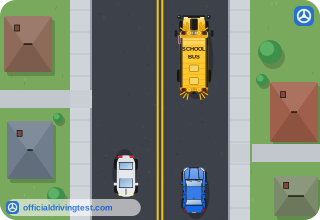
- Slow to 15 MPH and prepare to stop
- Slow to 35 MPH and prepare to stop
- Keep your speed until the red lights come on
- Slow to 25 MPH and prepare to stop
Show answer
Correct answer: Slow to 25 MPH and prepare to stop
When meeting or overtaking a bus, slow to 25 MPH and prepare to stop.
Source: Nebraska Driver's Manual (January 2025), page 70 · Open this page in the manual (Manual page 70)
-
How long do a school bus's amber warning lights stay on?
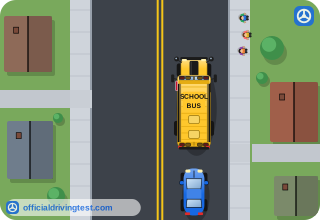
- Until the last child has boarded
- Until the bus door opens
- Until the bus has driven away
- Until the driver retracts the STOP arm
Show answer
Correct answer: Until the bus door opens
The amber warning lights will stay on until the bus door opens.
Source: Nebraska Driver's Manual (January 2025), page 70 · Open this page in the manual (Manual page 70)
-
When do the red stop lights and STOP arm of a school bus activate?
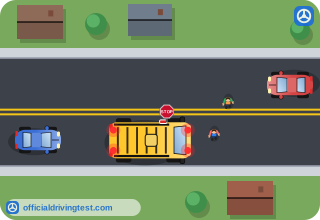
- When the amber warning lights first come on
- When the bus begins to slow for a stop
- When the bus driver opens the bus door
- When the driver sets the parking brake
Show answer
Correct answer: When the bus driver opens the bus door
The red stop lights and STOP arm activate when the bus driver opens the bus door.
Source: Nebraska Driver's Manual (January 2025), page 70 · Open this page in the manual (Manual page 70)
-
How long must you remain stopped for a school bus whose red stop lights and STOP arm are activated?
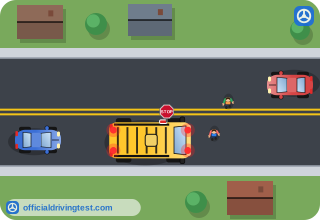
- Until the stop arm is retracted and the red lights are off
- Until the children are on the sidewalk and the door has closed
- Until the amber lights come back on and the bus moves
- Until no child is crossing in front of your vehicle
Show answer
Correct answer: Until the stop arm is retracted and the red lights are off
Stop and remain stopped until the bus driver retracts the stop arm and deactivates the red warning lights.
Source: Nebraska Driver's Manual (January 2025), page 70 · Open this page in the manual (Manual page 70)
-
How far from a school bus with its red lights on should you stop?
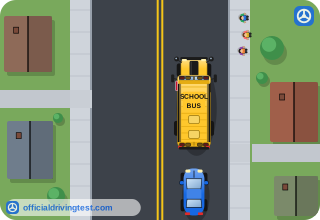
- As close to the bus as you can get
- A reasonable distance from the bus
- Beside the open bus door
- Right up to the STOP arm
Show answer
Correct answer: A reasonable distance from the bus
Stop a reasonable distance from the bus.
Source: Nebraska Driver's Manual (January 2025), page 70 · Open this page in the manual (Manual page 70)
-
What is the only exception to the rule that you must stop for a school bus with its stop lights on and the stop arm extended?
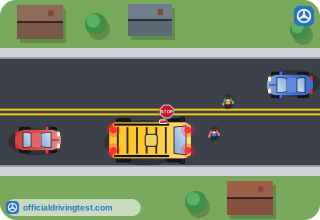
- Approaching from the opposite direction on an undivided road with four lanes
- Approaching from the opposite direction on a two-lane road with no center line
- Overtaking the bus on a road where children are not in sight
- Approaching from the opposite direction on a roadway divided by a median
Show answer
Correct answer: Approaching from the opposite direction on a roadway divided by a median
Not stopping for a school bus with stop lights on and the stop arm extended is unlawful, except when approaching it in the opposite direction on a roadway divided by a median.
Source: Nebraska Driver's Manual (January 2025), page 70 · Open this page in the manual (Manual page 70)
-
A loaded truck with good tires and properly adjusted brakes is traveling at 55 MPH on a clear, dry roadway. What is the minimum distance it needs to come to a complete stop?
- 340 feet
- 190 feet
- 250 feet
- 500 feet
Show answer
Correct answer: 340 feet
A loaded truck with good tires and properly adjusted brakes, traveling at 55 MPH on a clear, dry roadway, requires a minimum of 340 feet to stop.
Source: Nebraska Driver's Manual (January 2025), page 71 · Open this page in the manual (Manual page 71)
-
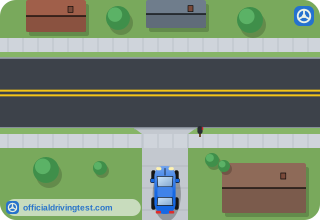
What should you avoid doing in front of a large vehicle when entering the roadway?
- Signaling before you enter the roadway
- Checking mirrors and blind spots first
- Abruptly entering the roadway in front of it
- Waiting for a gap behind the large vehicle
Show answer
Correct answer: Abruptly entering the roadway in front of it
Do not abruptly enter the roadway in front of a large vehicle.
Source: Nebraska Driver's Manual (January 2025), page 71 · Open this page in the manual (Manual page 71)
-
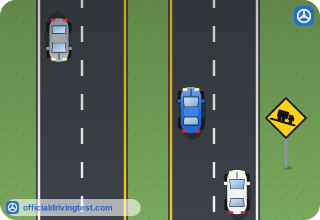
Why should you avoid driving in the right lane when traveling up or down steep grades?
- The right lane is reserved for emergency vehicles on hills
- Trucks are required to use the left lane on steep grades
- Larger vehicles often drive slower and use the right lane there
- The right lane is always narrower on a grade
Show answer
Correct answer: Larger vehicles often drive slower and use the right lane there
On steep grades larger vehicles often drive slower and use the right lane, so avoiding it reduces the chance of rear-ending or being rear-ended by a large vehicle.
Source: Nebraska Driver's Manual (January 2025), page 71 · Open this page in the manual (Manual page 71)
-
In which area should you avoid the right lane because slow-moving trucks will be trying to re-enter faster-moving traffic?
- In the vicinity of truck weigh stations
- On a quiet residential street
- In the vicinity of railroad crossings
- Near the exit sign of every freeway interchange
Show answer
Correct answer: In the vicinity of truck weigh stations
Avoid driving in the right lane in the vicinity of truck weigh stations, where slow-moving trucks will be attempting to re-enter faster-moving traffic.
Source: Nebraska Driver's Manual (January 2025), page 71 · Open this page in the manual (Manual page 71)
-
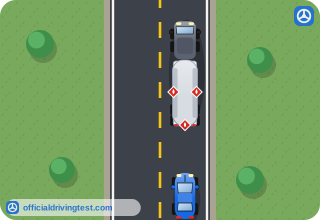
What should you do about vehicles that are clearly marked as carrying hazardous materials, such as "Explosives", "Poison" or "Flammable"?
- Follow closely behind them
- Travel beside them for long periods
- Pass them quickly on the right
- Avoid driving near them
Show answer
Correct answer: Avoid driving near them
Vehicles carrying hazardous materials are clearly marked with the type of material, and you should avoid driving near them.
Source: Nebraska Driver's Manual (January 2025), page 71 · Open this page in the manual (Manual page 71)
-
Why should you not make sudden stops in front of large vehicles?
- Their hydraulic brakes need time to cool between stops
- Their air brakes do not operate instantly like hydraulic brakes
- Their brake lights do not work when a vehicle stops suddenly
- Their air brakes lock the wheels at speeds above 40 MPH
Show answer
Correct answer: Their air brakes do not operate instantly like hydraulic brakes
Trucks and buses have air brakes, which do not operate instantly as hydraulic brakes on automobiles do.
Source: Nebraska Driver's Manual (January 2025), page 71 · Open this page in the manual (Manual page 71)
-
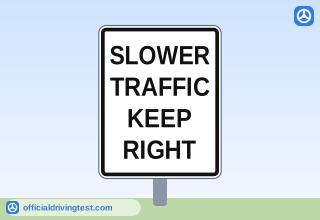
What does an additional right lane with a "Slow Traffic Keep Right" sign let slower vehicles such as trucks, farm equipment and recreational vehicles do?
- Move to the right lane so other traffic can pass on the grade
- Stop in the lane to cool their brakes
- Make left turns across the highway without stopping
- Travel faster than the posted limit on the grade
Show answer
Correct answer: Move to the right lane so other traffic can pass on the grade
On some highways approaching long steep hills, the additional right lane lets slower vehicles move right so other traffic can pass on the grade.
Source: Nebraska Driver's Manual (January 2025), page 71 · Open this page in the manual (Manual page 71)
-
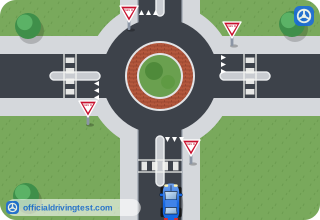
How may the raised paved truck apron along the edges of a roundabout's circular roadway be used?
- By bicyclists crossing the roundabout
- By cars as a passing lane when traffic is slow
- By the rear wheels of large vehicles
- By pedestrians waiting to cross the roadway
Show answer
Correct answer: By the rear wheels of large vehicles
When navigating a roundabout, the raised paved truck apron along the edges of the circular roadway may be used for the rear wheels of large vehicles.
Source: Nebraska Driver's Manual (January 2025), page 71 · Open this page in the manual (Manual page 71)
-
What is a No-Zone around a truck or bus?
- A section of highway where trucks and buses may not pass other vehicles or change lanes
- An area where cars disappear into blind spots or are so close the driver cannot stop or maneuver safely
- A lane on the roadway reserved for trucks and buses at all times and closed to cars
- An area near a weigh station where all vehicles must stop and wait
Show answer
Correct answer: An area where cars disappear into blind spots or are so close the driver cannot stop or maneuver safely
No-Zones are areas around trucks or buses where cars disappear into blind spots or are so close that they restrict the driver's ability to stop or maneuver safely.
Source: Nebraska Driver's Manual (January 2025), page 71 · Open this page in the manual (Manual page 71)
-
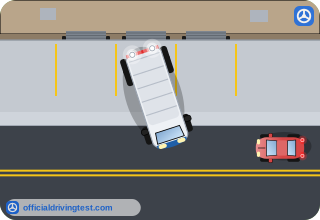
What should you never do near a truck or bus that is preparing to back up or is backing up?
- Stay a long way back
- Wait to one side of its path
- Give it room to block the street
- Pass close behind it
Show answer
Correct answer: Pass close behind it
A backing truck or bus sometimes must temporarily block the street, so never pass close behind one that is preparing to back up or is backing up.
Source: Nebraska Driver's Manual (January 2025), page 71 · Open this page in the manual (Manual page 71)
-
When passing a truck or bus, when may you pull in front of it?
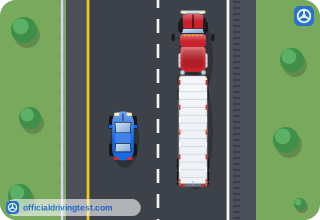
- As soon as you have passed the rear wheels of the truck or bus
- As soon as your rear bumper is even with its front bumper
- Once you are one car length ahead of its front bumper
- Only when you can see the entire front of it in your rear view mirror
Show answer
Correct answer: Only when you can see the entire front of it in your rear view mirror
One of the biggest mistakes is to cut in too soon when passing, so do not pull in front of a truck or bus unless the entire front of it can be seen in the rear view mirror.
Source: Nebraska Driver's Manual (January 2025), page 72 · Open this page in the manual (Manual page 72)
-
How can you tell whether the driver of a truck or bus can see you behind or beside it?
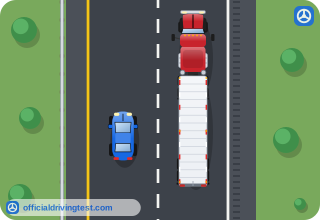
- If you can see its brake lights lit as it slows down
- If you can see the rearview mirrors of the truck or bus
- If its turn signal is flashing in your direction
- If you are close enough to read its license plate
Show answer
Correct answer: If you can see the rearview mirrors of the truck or bus
Being able to see the rearview mirrors of the truck or bus allows the driver of the larger vehicle to see vehicles behind or beside them.
Source: Nebraska Driver's Manual (January 2025), page 72 · Open this page in the manual (Manual page 72)
-
How do the blindspots on the sides of trucks and buses compare with those of cars?
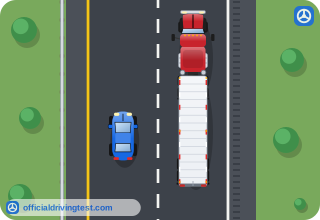
- Larger only on the left side
- About the same as a car's
- Much larger on both sides
- Smaller on the right side
Show answer
Correct answer: Much larger on both sides
Trucks and buses have much larger blindspots on both sides than cars do, so do not travel beside them for great lengths of time.
Source: Nebraska Driver's Manual (January 2025), page 72 · Open this page in the manual (Manual page 72)
-
What should you give a truck or bus that needs to swing wide to make a turn?
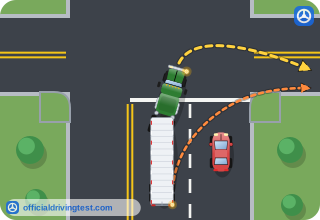
- Plenty of room, and never try to squeeze around it
- A short horn blast and then pass on the right
- A head start by speeding up beside its front
- A narrow gap so it can see you in its mirrors
Show answer
Correct answer: Plenty of room, and never try to squeeze around it
Truck and bus drivers sometimes need to swing wide and cannot see cars directly behind or beside them, so give them plenty of room and never try to squeeze around them.
Source: Nebraska Driver's Manual (January 2025), page 72 · Open this page in the manual (Manual page 72)