Nebraska: Sharing the road — Part 1 Practice Test
Questions in this part include: “What is a bike lane?” · “When does the manual say you should avoid driving?”
Independent educational site · not affiliated with any government agency or DMV
Ready? Test yourself
- Instant feedback with an explanation
- Every answer cites its source in the manual
- Your best score is saved on this device
- Keyboard: press 1 to 4 to answer and Enter for the next question
Questions are original and based on the official manual "Nebraska Driver's Manual" (January 2025), Nebraska Department of Motor Vehicles.
All 21 questions in this practice test
Take the test above first, then use this list to study. Tap “Show answer” to see the correct answer and explanation.
Show the questions and answersHide the questions
-
A yellow diamond sign shows a bicycle. What should you be alert for?
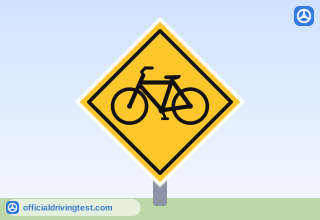
- Bicyclists riding on the shoulder
- A bike lane that ends ahead
- Bicyclists passing on the right
- Bicyclists crossing the street
Show answer
Correct answer: Bicyclists crossing the street
The Bicycle sign tells you to be alert for bicyclists crossing the street.
Source: Nebraska Driver's Manual (January 2025), page 40 · Open this page in the manual (Manual page 40)
-
What is a bike lane?
- A lane shared equally by bicyclists and motor vehicles
- A lane for slow-moving motor vehicles
- A part of the roadway for the exclusive use of bicyclists
- A parking lane next to the curb
Show answer
Correct answer: A part of the roadway for the exclusive use of bicyclists
Bike lanes are a portion of a roadway that has been designated for the exclusive use by bicyclists.
Source: Nebraska Driver's Manual (January 2025), page 46 · Open this page in the manual (Manual page 46)
-
What are bike lanes designed to do?
- Give bicyclists priority over pedestrians on sidewalks
- Separate bicycle traffic from motorized vehicle traffic
- Provide extra space for passing
- Mark where bicyclists must turn
Show answer
Correct answer: Separate bicycle traffic from motorized vehicle traffic
Bike lanes are designed to separate bicycle traffic from motorized vehicle traffic.
Source: Nebraska Driver's Manual (January 2025), page 46 · Open this page in the manual (Manual page 46)
-
Which is a reason a motorist may cross over a bike lane?
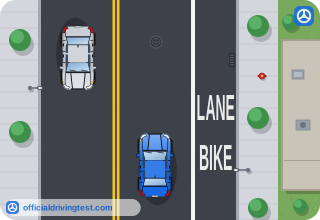
- To pass slow traffic on the right
- To avoid stopping at a red light
- To drive to the next intersection faster
- To enter or exit on-street parking spaces
Show answer
Correct answer: To enter or exit on-street parking spaces
Drivers may not drive in bike lanes, but they may cross over one to move into another travel lane, to enter or exit on-street parking spaces or to enter or exit private property.
Source: Nebraska Driver's Manual (January 2025), page 46 · Open this page in the manual (Manual page 46)
-
Before crossing a bike lane, what must you do?
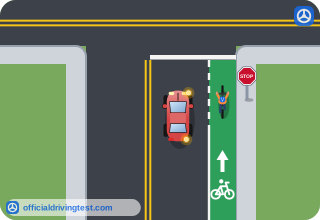
- Make sure it is safe and yield to approaching bicyclists
- Stop completely and wait at least ten seconds first
- Sound your horn to warn bicyclists
- Speed up so you cross quickly
Show answer
Correct answer: Make sure it is safe and yield to approaching bicyclists
Before crossing a bike lane, make sure it is safe to do so and yield the right-of-way to approaching bicyclists.
Source: Nebraska Driver's Manual (January 2025), page 46 · Open this page in the manual (Manual page 46)
-
When the bike lane is clear and you want to turn right, what does the manual say to do?
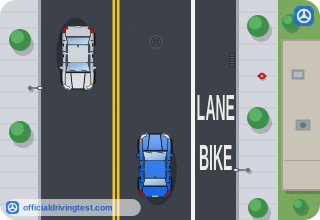
- Turn from the lane next to the bike lane, then signal
- Stop in the bike lane before turning
- Signal, then move into the bike lane before the turn
- Wait until the bike lane ends
Show answer
Correct answer: Signal, then move into the bike lane before the turn
When the bike lane is clear, signal your intention to turn and then move into the bike lane before making the turn.
Source: Nebraska Driver's Manual (January 2025), page 46 · Open this page in the manual (Manual page 46)
-
What do shared lane markings indicate?
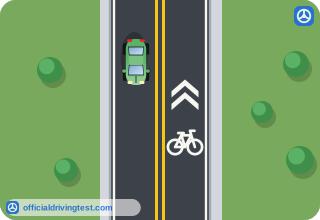
- The lane is for bicyclists only
- The lane is shared by both motor vehicles and bicyclists
- The lane is for parking
- The lane is closed to motor vehicles at all times
Show answer
Correct answer: The lane is shared by both motor vehicles and bicyclists
Shared lane markings are used to indicate the lane is shared by both motor vehicles and bicyclists.
Source: Nebraska Driver's Manual (January 2025), page 47 · Open this page in the manual (Manual page 47)
-
Motorists should avoid passing bicyclists in a shared lane until what exists?
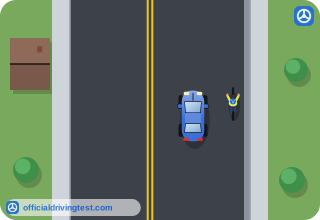
- Enough room to cross the center line
- Two feet of clearance
- A speed of 25 MPH
- No less than three feet clearance
Show answer
Correct answer: No less than three feet clearance
Motorists should avoid passing bicyclists until a safe distance of no less than three feet clearance exists.
Source: Nebraska Driver's Manual (January 2025), page 47 · Open this page in the manual (Manual page 47)
-
When is it unlawful to pass a school bus?
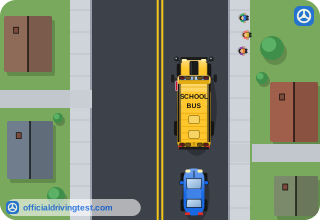
- When it is stopped with its overhead lights off
- When it has flashing red lights and its stop arm extended
- When it is stopped with its door closed and no lights flashing
- When it is parked at a school with no students on board
Show answer
Correct answer: When it has flashing red lights and its stop arm extended
It is unlawful to pass a school bus with flashing red lights and its stop arm extended.
Source: Nebraska Driver's Manual (January 2025), page 53 · Open this page in the manual (Manual page 53)
-
Unless there is an emergency, what should you do when another vehicle is passing you?
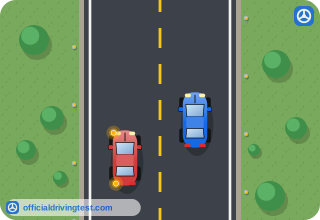
- Stay in your lane and maintain your speed
- Move to the right edge and slow down
- Speed up until the other vehicle has passed
- Brake and leave the road
Show answer
Correct answer: Stay in your lane and maintain your speed
When another vehicle is passing, you stay in your lane and keep your speed unless there is an emergency.
Source: Nebraska Driver's Manual (January 2025), page 54 · Open this page in the manual (Manual page 54)
-
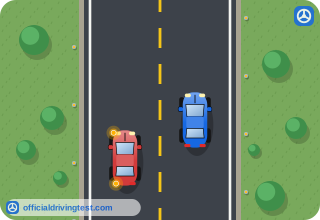
If there is an emergency while another vehicle is passing you, what may you do to prevent a crash?
- Only brake hard and stop in your lane
- Only sound the horn and hold your speed
- Speed up, slow down, or leave the road
- Only move to the center of the road
Show answer
Correct answer: Speed up, slow down, or leave the road
In an emergency you may speed up, slow down, or leave the road to prevent a crash.
Source: Nebraska Driver's Manual (January 2025), page 54 · Open this page in the manual (Manual page 54)
-
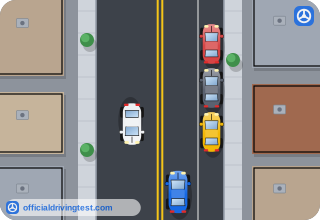
When driving past parked vehicles, which of these is a clue that a vehicle may pull out?
- Doors locked and windows rolled up
- Exhaust coming from the tail pipe
- Front wheels turned toward the curb
- A driver’s seat that is empty
Show answer
Correct answer: Exhaust coming from the tail pipe
Exhaust from the tail pipe is one of the clues the manual lists that a parked vehicle may pull out.
Source: Nebraska Driver's Manual (January 2025), page 54 · Open this page in the manual (Manual page 54)
-
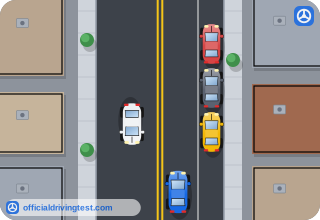
When driving past parked vehicles, what besides other vehicles should you watch for emerging from between them?
- Only emergency vehicles
- Road workers and flaggers
- Only other parked vehicles
- People or animals
Show answer
Correct answer: People or animals
Drivers passing parked vehicles must watch for people or animals emerging from between them.
Source: Nebraska Driver's Manual (January 2025), page 54 · Open this page in the manual (Manual page 54)
-
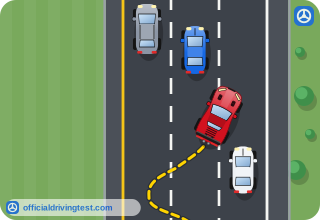
How does the manual define aggressive driving?
- Driving more than 10 MPH over the posted speed limit on any road
- Driving behavior that is frightening or rude to other drivers
- Driving that causes a crash
- Driving behavior that is slow and unpredictable
Show answer
Correct answer: Driving behavior that is frightening or rude to other drivers
Aggressive driving is driving behavior that is frightening or rude to other drivers.
Source: Nebraska Driver's Manual (January 2025), page 65 · Open this page in the manual (Manual page 65)
-
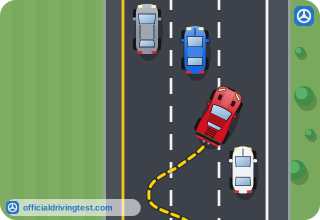
Which of these is an example of aggressive driving?
- Signaling well before a turn
- Staying in the right lane on the interstate
- Keeping a three-second following distance
- Tailgating
Show answer
Correct answer: Tailgating
Tailgating, cutting off other drivers, running red lights and failing to yield are examples of aggressive driving.
Source: Nebraska Driver's Manual (January 2025), page 65 · Open this page in the manual (Manual page 65)
-
When does the manual say you should avoid driving?
- When other drivers are honking
- After sunset on rural roads
- When you are angry or upset
- When you are driving with passengers
Show answer
Correct answer: When you are angry or upset
You should avoid driving when angry or upset and treat other motorists as you expect to be treated.
Source: Nebraska Driver's Manual (January 2025), page 65 · Open this page in the manual (Manual page 65)
-
How does the manual say you should treat other motorists?
- As you expect to be treated
- As they treat you
- According to how fast they drive
- By keeping as far from them as you can
Show answer
Correct answer: As you expect to be treated
The manual says to treat other motorists as you expect to be treated.
Source: Nebraska Driver's Manual (January 2025), page 65 · Open this page in the manual (Manual page 65)
-
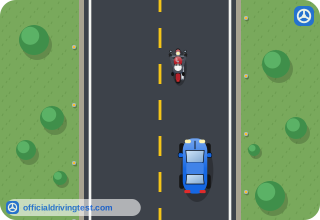
Compared with other vehicles on the roadway, what rights and privileges do motorcycles have?
- The same rights and privileges as any vehicle
- Fewer rights, because they are smaller
- Extra rights, because they are harder to see
- Rights only on roads below a set speed
Show answer
Correct answer: The same rights and privileges as any vehicle
Motorcycles are vehicles with the same rights and privileges as any vehicle on the roadway.
Source: Nebraska Driver's Manual (January 2025), page 68 · Open this page in the manual (Manual page 68)
-
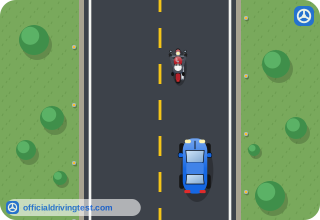
How much of the traffic lane should you allow a motorcyclist?
- Half of the lane width
- One-third of the lane width
- The full lane width
- Whatever is left beside your vehicle
Show answer
Correct answer: The full lane width
A motorcycle needs the room to maneuver safely, so a driver must allow the motorcyclist a full lane width and not share the lane.
Source: Nebraska Driver's Manual (January 2025), page 68 · Open this page in the manual (Manual page 68)
-
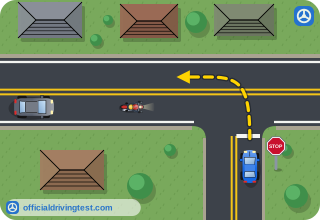
Why can it be difficult to judge the speed and distance of an approaching motorcycle?
- A motorcycle's engine noise hides how fast it is going
- A motorcycle has a much smaller profile than other vehicles
- Motorcycles always travel faster than the traffic around them
- A motorcycle's lights cannot be seen in daylight
Show answer
Correct answer: A motorcycle has a much smaller profile than other vehicles
Motorcycles are smaller and have a much smaller profile than other vehicles, which makes their speed and distance harder to judge.
Source: Nebraska Driver's Manual (January 2025), page 68 · Open this page in the manual (Manual page 68)
-
Why should you always signal your intentions before changing lanes or merging when a motorcycle is nearby?
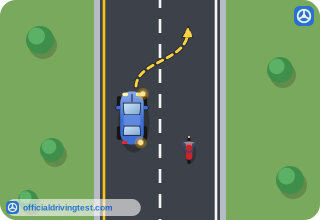
- It gives the motorcyclist permission to pass you on either side of the lane
- It tells the motorcyclist to stop and wait for you
- It makes the motorcycle's headlight turn on automatically
- It lets the motorcyclist anticipate traffic flow and find a safe lane position
Show answer
Correct answer: It lets the motorcyclist anticipate traffic flow and find a safe lane position
Signaling allows the motorcyclist to anticipate traffic flow and find a safe lane position.
Source: Nebraska Driver's Manual (January 2025), page 68 · Open this page in the manual (Manual page 68)