Nebraska: Sharing the road — Part 2 Practice Test
Questions in this part include: “Where must bicyclists ride in a lane?” · “What is a common crash type for young cyclists?”
Independent educational site · not affiliated with any government agency or DMV
Ready? Test yourself
- Instant feedback with an explanation
- Every answer cites its source in the manual
- Your best score is saved on this device
- Keyboard: press 1 to 4 to answer and Enter for the next question
Questions are original and based on the official manual "Nebraska Driver's Manual" (January 2025), Nebraska Department of Motor Vehicles.
All 21 questions in this practice test
Take the test above first, then use this list to study. Tap “Show answer” to see the correct answer and explanation.
Show the questions and answersHide the questions
-
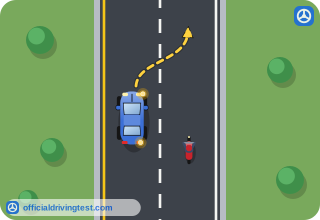
How should you check for motorcycles before entering or leaving a lane of traffic and at intersections?
- Listen for engine noise with the windows down
- Rely on one quick look in the rearview mirror
- Wait for the motorcyclist to sound a horn
- Make a visual check of your mirrors and blind spots
Show answer
Correct answer: Make a visual check of your mirrors and blind spots
Motorcyclists are often hidden in a blind spot or missed in a quick look, so make a visual check of mirrors and blind spots.
Source: Nebraska Driver's Manual (January 2025), page 68 · Open this page in the manual (Manual page 68)
-
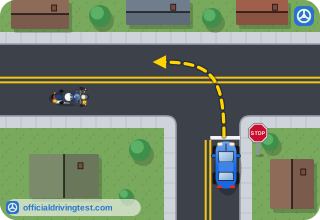
What should you do when a motorcycle near you has a flashing turn signal?
- Proceed at once, because the rider is certain to turn
- Wait until you are sure the motorcycle will turn
- Sound your horn so the rider turns off the signal
- Pass quickly on the side opposite the signal
Show answer
Correct answer: Wait until you are sure the motorcycle will turn
Motorcycle signals usually are not self-cancelling and riders sometimes forget to turn them off, so wait to be sure the motorcycle is going to turn.
Source: Nebraska Driver's Manual (January 2025), page 68 · Open this page in the manual (Manual page 68)
-
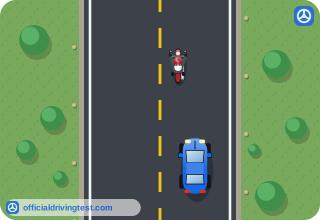
Which of these road conditions may cause a motorcyclist to change speed or position within a lane suddenly?
- Dry, smooth pavement
- A straight, empty road
- Grooved pavement
- A wide, clear lane
Show answer
Correct answer: Grooved pavement
Potholes, gravel, wet or slippery surfaces, pavement seams, railroad crossings and grooved pavement are major hazards to motorcyclists.
Source: Nebraska Driver's Manual (January 2025), page 68 · Open this page in the manual (Manual page 68)
-
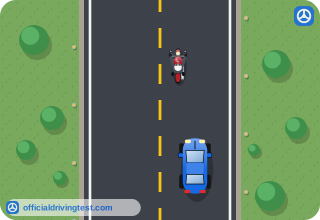
How much following distance should you allow when following a motorcycle?
- Three or four seconds
- One or two seconds
- Five or six seconds
- Seven or eight seconds
Show answer
Correct answer: Three or four seconds
Allow more following distance, three or four seconds, so the motorcyclist has enough time to maneuver or stop in an emergency.
Source: Nebraska Driver's Manual (January 2025), page 68 · Open this page in the manual (Manual page 68)
-
In dry conditions, how does a motorcycle's stopping ability compare with a car's?
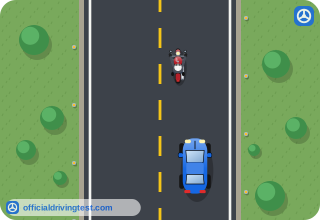
- A motorcycle always needs a longer distance to stop
- A motorcycle can stop more quickly than a car
- A motorcycle stops in exactly the same distance as a car
- A motorcycle cannot stop as quickly as a car
Show answer
Correct answer: A motorcycle can stop more quickly than a car
In dry conditions motorcycles can stop more quickly than a car.
Source: Nebraska Driver's Manual (January 2025), page 68 · Open this page in the manual (Manual page 68)
-
What duties and rights does a person riding a bicycle have?
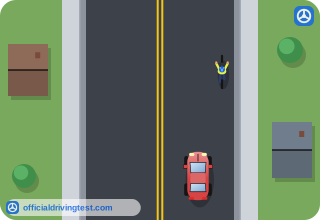
- Only the duties of a pedestrian
- The rights of a driver but none of the duties
- No duties, because bicycles are not motor vehicles
- The same duties and rights as a driver of a motor vehicle
Show answer
Correct answer: The same duties and rights as a driver of a motor vehicle
A person riding a bicycle has the same duties and rights as a driver of a motor vehicle, so bicyclists must obey traffic laws.
Source: Nebraska Driver's Manual (January 2025), page 68 · Open this page in the manual (Manual page 68)
-
Where must bicyclists ride in a lane?
- As far right as is practical, or on paved shoulders
- In the center of the lane at all times, never on shoulders
- As far left as is practical, on any street
- Wherever the bicyclist chooses, with no rule about position
Show answer
Correct answer: As far right as is practical, or on paved shoulders
Bicyclists must ride as far right in a lane as is practical or on paved shoulders.
Source: Nebraska Driver's Manual (January 2025), page 68 · Open this page in the manual (Manual page 68)
-
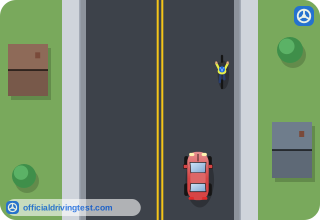
When may a bicyclist ride in the lane of travel instead of at the right edge?
- When the bicyclist is in a group of three or more riders
- When the bicyclist is traveling slower than the vehicles behind
- When the lane is too narrow for a bicycle and a vehicle to share it safely
- When the posted speed limit is above 35 MPH
Show answer
Correct answer: When the lane is too narrow for a bicycle and a vehicle to share it safely
Bicyclists may ride in the lane of travel where the lane is too narrow for a bicycle and a vehicle to travel safely side by side.
Source: Nebraska Driver's Manual (January 2025), page 68 · Open this page in the manual (Manual page 68)
-
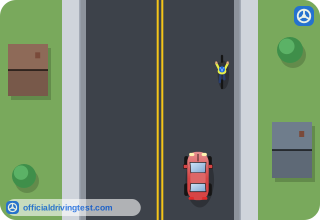
Why might a bicyclist move out of the right lane at an intersection?
- To avoid having to obey the signal at the intersection
- To ride against traffic on the left side of the road
- To make a left turn or continue through the intersection
- To keep the vehicles behind from passing at all
Show answer
Correct answer: To make a left turn or continue through the intersection
Bicyclists are not restricted to the right lane; they may need to change lanes to make left turns or continue through an intersection.
Source: Nebraska Driver's Manual (January 2025), page 69 · Open this page in the manual (Manual page 69)
-
Where may bicyclists ride on one-way streets in urban areas?
- In the far left lane
- Only in the far right lane
- Only in the center of the street
- Only on the sidewalk
Show answer
Correct answer: In the far left lane
On one-way streets in urban areas, bicyclists may ride in the far left lane.
Source: Nebraska Driver's Manual (January 2025), page 69 · Open this page in the manual (Manual page 69)
-
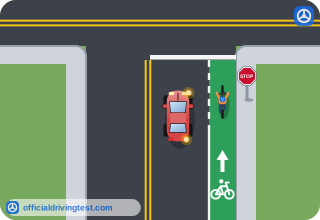
What should a motorist do when preparing for a right turn where bicycles are traveling in the same direction?
- Speed up and turn ahead of the bicyclists
- Turn directly across the path of the bicycles
- Stay well left and cut across the bike traffic
- Merge with the bicycle traffic before turning
Show answer
Correct answer: Merge with the bicycle traffic before turning
Motorists should merge with bicycle traffic when preparing for a right turn and avoid turning directly across a path of bicycles.
Source: Nebraska Driver's Manual (January 2025), page 69 · Open this page in the manual (Manual page 69)
-
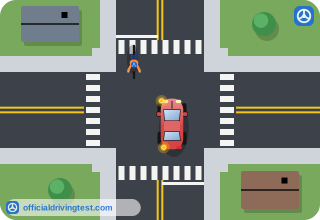
When turning left at an intersection, what should you do about oncoming bicyclists?
- Go first, because bicycles are slower than motor vehicles
- Yield to them just as you would to oncoming motorists
- Sound your horn so they stop for you
- Turn ahead of them only if they are in a bike lane
Show answer
Correct answer: Yield to them just as you would to oncoming motorists
When turning left at an intersection, yield to oncoming bicyclists just as you would to oncoming motorists.
Source: Nebraska Driver's Manual (January 2025), page 69 · Open this page in the manual (Manual page 69)
-
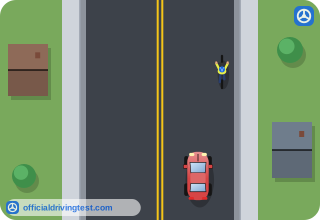
What should you not do when approaching a bicyclist?
- Blast the vehicle's horn
- Reduce your speed
- Check your mirrors
- Watch for the bicyclist's position
Show answer
Correct answer: Blast the vehicle's horn
Do not blast a vehicle's horn when approaching a bicyclist.
Source: Nebraska Driver's Manual (January 2025), page 69 · Open this page in the manual (Manual page 69)
-
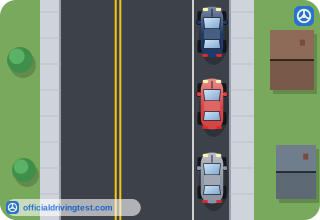
What should you look for before opening a car door?
- Hazard flashers
- Low-hanging branches
- Bicycles
- Parking meters
Show answer
Correct answer: Bicycles
Look for bicycles before opening car doors.
Source: Nebraska Driver's Manual (January 2025), page 69 · Open this page in the manual (Manual page 69)
-
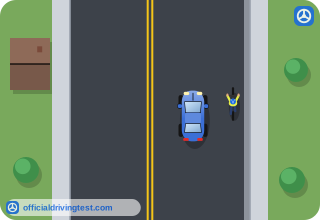
When overtaking a bicycle proceeding in the same direction, what is the least clearance the law requires a motorist to leave, when applicable?
- No less than one foot
- No less than three feet
- No less than five feet
- No less than six feet
Show answer
Correct answer: No less than three feet
The law requires motorists to leave a safe distance of no less than three feet clearance when passing a bicycle.
Source: Nebraska Driver's Manual (January 2025), page 69 · Open this page in the manual (Manual page 69)
-
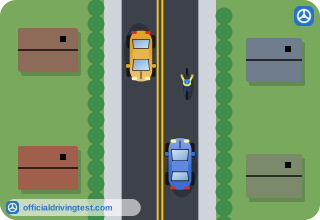
What should a driver do if it is not safe to leave three feet of clearance when passing a bicyclist?
- Pass as quickly as possible to limit the risk
- Sound the horn and pass closely
- Pass on the right-hand side of the bicyclist
- Reduce speed and wait until it is safe to pass
Show answer
Correct answer: Reduce speed and wait until it is safe to pass
If it is not safe to leave three feet of clearance, the driver should reduce speed and wait until it is safe to pass the bicyclist.
Source: Nebraska Driver's Manual (January 2025), page 69 · Open this page in the manual (Manual page 69)
-
What is a common crash type for young cyclists?
- Turning left at a signal without checking behind them
- Riding in a bike lane that ends at a right-turn lane
- Following too closely behind a parked or stopped vehicle
- Riding out into the road mid-block from a driveway, alley, or curb
Show answer
Correct answer: Riding out into the road mid-block from a driveway, alley, or curb
A common crash type for young cyclists is mid-block ride-outs entering a road from a driveway, alley, or curb without slowing, stopping or looking for traffic.
Source: Nebraska Driver's Manual (January 2025), page 69 · Open this page in the manual (Manual page 69)
-
Which behaviors are signs of an inexperienced bicyclist?
- Riding as far right as practical
- Riding against traffic or swerving
- Riding on a paved shoulder
- Stopping at each intersection
Show answer
Correct answer: Riding against traffic or swerving
Signs of an inexperienced bicyclist include riding against traffic or swerving, so take extra precautions around bicyclists displaying these behaviors.
Source: Nebraska Driver's Manual (January 2025), page 69 · Open this page in the manual (Manual page 69)
-
Why should you look both ways at intersections before turning, with bicyclists in mind?
- Bicyclists are never permitted to ride through an intersection
- Bicyclists always stop and wait at every intersection for cars
- Bicyclists may be riding on sidewalks or trails parallel to the road
- Bicyclists are required by law to ride on the left side of the street
Show answer
Correct answer: Bicyclists may be riding on sidewalks or trails parallel to the road
Bicyclists may be found riding on sidewalks or trails parallel to streets and roads, so look both ways before turning.
Source: Nebraska Driver's Manual (January 2025), page 69 · Open this page in the manual (Manual page 69)
-
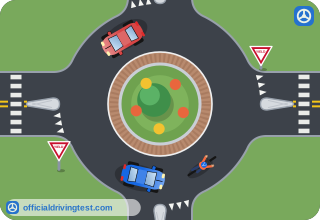
At intersections and roundabouts, how do right-of-way rules apply to bicyclists?
- They apply equally to bicyclists and motor vehicles
- Bicyclists always have the right-of-way over motor vehicles
- Motor vehicles always have the right-of-way over bicyclists
- Bicyclists must yield to every motor vehicle
Show answer
Correct answer: They apply equally to bicyclists and motor vehicles
At intersections and roundabouts, right-of-way rules apply equally to bicyclists and motor vehicles.
Source: Nebraska Driver's Manual (January 2025), page 69 · Open this page in the manual (Manual page 69)
-
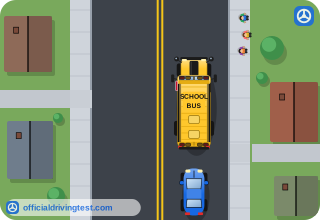
What does a school bus driver do when the bus is about to stop to load or unload children?
- Extends the STOP arm and turns on the red lights
- Turns on the headlights and sounds the horn
- Opens the door and then turns on the amber lights
- Activates the amber warning lights
Show answer
Correct answer: Activates the amber warning lights
When a school bus is about to stop and load or unload children, the bus driver activates amber warning lights.
Source: Nebraska Driver's Manual (January 2025), page 70 · Open this page in the manual (Manual page 70)