Nebraska: Speed and following distance — Part 1 Practice Test
Questions in this part include: “What does Nebraska's speed law require?” · “When may you drive slow enough to impede or block the normal and reasonable flow of traffic?”
Independent educational site · not affiliated with any government agency or DMV
Ready? Test yourself
- Instant feedback with an explanation
- Every answer cites its source in the manual
- Your best score is saved on this device
- Keyboard: press 1 to 4 to answer and Enter for the next question
Questions are original and based on the official manual "Nebraska Driver's Manual" (January 2025), Nebraska Department of Motor Vehicles.
All 24 questions in this practice test
Take the test above first, then use this list to study. Tap “Show answer” to see the correct answer and explanation.
Show the questions and answersHide the questions
-
A vehicle that is moving slower than the normal speed of traffic must be driven where, when it is available?
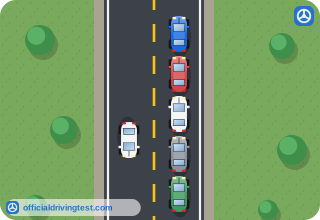
- In the right lane, or as close as practicable to the right edge
- In the left lane, close to the center line of the road
- In the center of the roadway between the two lanes of travel
- In whichever lane has the least traffic at that time
Show answer
Correct answer: In the right lane, or as close as practicable to the right edge
A vehicle going slower than the normal speed of traffic must be driven in the right lane when one is available, or as close as practicable to the right curb or edge of the roadway.
Source: Nebraska Driver's Manual (January 2025), page 48 · Open this page in the manual (Manual page 48)
-
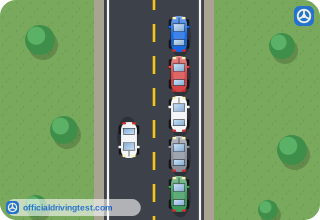
A driver going slower than the normal speed of traffic may leave the right lane when preparing for which maneuver?
- A right turn onto an entrance ramp of a freeway
- Parking along the left edge of a two-way road in a business area
- A left turn at an intersection or into a private road or driveway
- Slowing down for a yellow signal at a busy intersection
Show answer
Correct answer: A left turn at an intersection or into a private road or driveway
Besides overtaking and passing, slower vehicles may leave the right lane when preparing for a left turn at an intersection or into a private road or driveway.
Source: Nebraska Driver's Manual (January 2025), page 48 · Open this page in the manual (Manual page 48)
-
What does Nebraska's speed law require?
- Driving at the maximum speed limit allowed for the type of road
- Driving at a speed that is reasonable and safe under existing conditions
- Driving at the speed of the fastest traffic on the roadway
- Driving at the same speed in all weather and road conditions
Show answer
Correct answer: Driving at a speed that is reasonable and safe under existing conditions
Nebraska's speed law requires driving at a speed that is reasonable and safe under existing conditions.
Source: Nebraska Driver's Manual (January 2025), page 52 · Open this page in the manual (Manual page 52)
-
Unless otherwise posted, what is the maximum speed limit in business districts?
- 15 MPH
- 30 MPH
- 35 MPH
- 20 MPH
Show answer
Correct answer: 20 MPH
The maximum speed limit in business districts, unless otherwise posted, is 20 MPH.
Source: Nebraska Driver's Manual (January 2025), page 52 · Open this page in the manual (Manual page 52)
-
Unless otherwise posted, what is the maximum speed limit in residential districts?
- 25 MPH
- 20 MPH
- 30 MPH
- 35 MPH
Show answer
Correct answer: 25 MPH
The maximum speed limit in residential districts, unless otherwise posted, is 25 MPH.
Source: Nebraska Driver's Manual (January 2025), page 52 · Open this page in the manual (Manual page 52)
-
Unless otherwise posted, what is the maximum speed limit on any roadway that is gravel or not dustless?
- 40 MPH
- 45 MPH
- 50 MPH
- 55 MPH
Show answer
Correct answer: 50 MPH
On a gravel or not dustless roadway, the maximum speed limit unless otherwise posted is 50 MPH.
Source: Nebraska Driver's Manual (January 2025), page 52 · Open this page in the manual (Manual page 52)
-
Unless otherwise posted, what is the maximum speed limit on a dustless (paved) roadway that is not part of the state highway system?
- 45 MPH
- 55 MPH
- 60 MPH
- 65 MPH
Show answer
Correct answer: 55 MPH
On a dustless or paved roadway outside the state highway system, the maximum speed limit unless otherwise posted is 55 MPH.
Source: Nebraska Driver's Manual (January 2025), page 52 · Open this page in the manual (Manual page 52)
-
Unless otherwise posted, what is the maximum speed limit on a four-lane divided highway that is not part of the state highway system?
- 55 MPH
- 60 MPH
- 70 MPH
- 65 MPH
Show answer
Correct answer: 65 MPH
A four-lane divided highway that is not part of the state highway system has a maximum speed limit of 65 MPH unless otherwise posted.
Source: Nebraska Driver's Manual (January 2025), page 52 · Open this page in the manual (Manual page 52)
-
Unless otherwise posted, what is the maximum speed limit on the state highway system, other than an expressway, super-two highway or freeway?
- 65 MPH
- 55 MPH
- 60 MPH
- 70 MPH
Show answer
Correct answer: 65 MPH
On the state highway system other than an expressway, super-two highway or freeway, the maximum speed limit unless otherwise posted is 65 MPH.
Source: Nebraska Driver's Manual (January 2025), page 52 · Open this page in the manual (Manual page 52)
-
Unless otherwise posted, what is the maximum speed limit on expressways, super-two highways and freeways that are part of the state highway system?
- 60 MPH
- 65 MPH
- 70 MPH
- 75 MPH
Show answer
Correct answer: 70 MPH
Expressways, super-two highways and freeways on the state highway system have a maximum speed limit of 70 MPH unless otherwise posted.
Source: Nebraska Driver's Manual (January 2025), page 52 · Open this page in the manual (Manual page 52)
-
Unless otherwise posted, what is the maximum speed limit on rural interstate highways?
- 65 MPH
- 75 MPH
- 70 MPH
- 80 MPH
Show answer
Correct answer: 75 MPH
The maximum speed limit on rural interstate highways, unless otherwise posted, is 75 MPH.
Source: Nebraska Driver's Manual (January 2025), page 52 · Open this page in the manual (Manual page 52)
-
Why does the manual say to generally drive at the same speed as the main stream of traffic?
- To avoid having to use your turn signals when you change lanes
- To make it easier for emergency vehicles to pass you safely
- To keep a larger following distance from the vehicles ahead
- To avoid frequent passing and be able to adjust to slower moving vehicles
Show answer
Correct answer: To avoid frequent passing and be able to adjust to slower moving vehicles
Driving at the same speed as the main stream of traffic avoids frequent passing and lets you adjust to slower moving vehicles.
Source: Nebraska Driver's Manual (January 2025), page 52 · Open this page in the manual (Manual page 52)
-
When may you drive slow enough to impede or block the normal and reasonable flow of traffic?
- When safety, an emergency, or the law requires it
- When you are unsure of your route or the road
- When the road is dry and the weather is clear
- When you want more room in front of your vehicle
Show answer
Correct answer: When safety, an emergency, or the law requires it
You must not drive slow enough to impede or block the normal and reasonable flow of traffic unless safety, an emergency, or the law requires otherwise.
Source: Nebraska Driver's Manual (January 2025), page 53 · Open this page in the manual (Manual page 53)
-
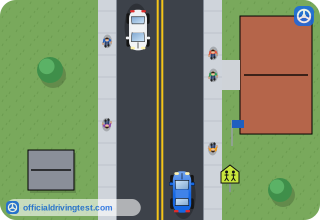
What should you do in a school zone?
- Keep your speed and watch for children only at crosswalks
- Reduce speed, obey all signs and be prepared to stop anytime
- Drive at the posted limit and stop only for a flagger
- Reduce speed only while children are on the roadway
Show answer
Correct answer: Reduce speed, obey all signs and be prepared to stop anytime
In a school zone you reduce speed, obey all signs and are prepared to stop anytime.
Source: Nebraska Driver's Manual (January 2025), page 53 · Open this page in the manual (Manual page 53)
-
What happens to speeding fines in school zones and when workers are present in work zones?
- They are reduced by half
- They are the same as normal
- They are tripled
- They are doubled
Show answer
Correct answer: They are doubled
Fines are doubled in school zones and in work zones when workers are present.
Source: Nebraska Driver's Manual (January 2025), page 53 · Open this page in the manual (Manual page 53)
-
Under the speeding fine schedule, what is the normal fine for driving 1-5 MPH over the limit?
- $10
- $5
- $20
- $25
Show answer
Correct answer: $10
The normal fine for 1-5 MPH over the limit is $10, plus court costs.
Source: Nebraska Driver's Manual (January 2025), page 53 · Open this page in the manual (Manual page 53)
-
Under the speeding fine schedule, what is the normal fine for driving 16-20 MPH over the limit?
- $75
- $175
- $250
- $125
Show answer
Correct answer: $125
The normal fine for 16-20 MPH over the limit is $125, plus court costs.
Source: Nebraska Driver's Manual (January 2025), page 53 · Open this page in the manual (Manual page 53)
-
Under the speeding fine schedule, what is the normal fine for driving more than 35 MPH over the limit?
- $200
- $400
- $300
- $600
Show answer
Correct answer: $300
The normal fine for driving more than 35 MPH over the limit is $300, plus court costs.
Source: Nebraska Driver's Manual (January 2025), page 53 · Open this page in the manual (Manual page 53)
-
Under the speeding fine schedule, what is the fine in a school zone or work zone for driving 11-15 MPH over the limit?
- $150
- $75
- $100
- $250
Show answer
Correct answer: $150
In school zones and work zones with workers present, the fine for 11-15 MPH over the limit is $150, plus court costs.
Source: Nebraska Driver's Manual (January 2025), page 53 · Open this page in the manual (Manual page 53)
-
What is added to the speeding fines in the manual's fine schedule?
- Court costs, in all cases
- Nothing, the fine is the total
- Court costs, only for fines over $200
- Court costs, only in work and school zones
Show answer
Correct answer: Court costs, in all cases
The fine schedule states that court costs are added in all cases.
Source: Nebraska Driver's Manual (January 2025), page 53 · Open this page in the manual (Manual page 53)
-
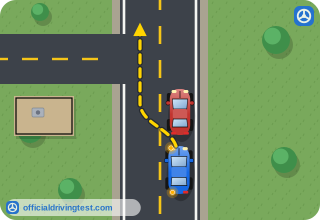
Within how close to an intersection is it unlawful to pass?
- Within 50 feet
- Within 150 feet
- Within 100 feet
- Within 300 feet
Show answer
Correct answer: Within 100 feet
It is unlawful to pass within 100 feet of any intersection.
Source: Nebraska Driver's Manual (January 2025), page 53 · Open this page in the manual (Manual page 53)
-
Within how close to a railroad crossing is it unlawful to pass?
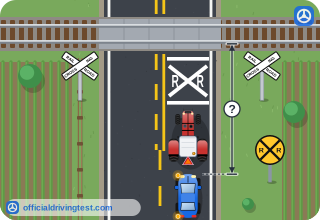
- Within 25 feet
- Within 100 feet
- Within 200 feet
- Within 300 feet
Show answer
Correct answer: Within 100 feet
It is unlawful to pass within 100 feet of any railroad crossing.
Source: Nebraska Driver's Manual (January 2025), page 53 · Open this page in the manual (Manual page 53)
-
Which of these is unlawful when passing another vehicle?
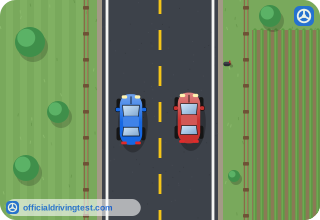
- Signaling before moving into the passing lane
- Increasing your speed to pull into the passing lane
- Checking all around your vehicle before passing
- Exceeding the posted speed limit
Show answer
Correct answer: Exceeding the posted speed limit
It is unlawful to exceed the posted speed limit when passing.
Source: Nebraska Driver's Manual (January 2025), page 53 · Open this page in the manual (Manual page 53)
-
Where is it unlawful to pass?
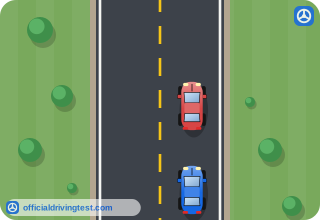
- On any hill, curve or bridge where vision is obstructed
- On any straight and level roadway in clear daylight
- On any roadway that has more than two lanes of traffic
- In any residential district at any time of day
Show answer
Correct answer: On any hill, curve or bridge where vision is obstructed
It is unlawful to pass on any hill, curve or bridge where vision is obstructed.
Source: Nebraska Driver's Manual (January 2025), page 53 · Open this page in the manual (Manual page 53)