Nebraska: Sharing the road
School buses, bicyclists, motorcycles, large trucks and buses, snowplows, deer and other users of Nebraska roads. Split into 3 shorter tests so you're not stuck in one long quiz.
Independent educational site · not affiliated with any government agency or DMV
Choose a part
Sharing the road — Part 1
Questions in this part include: “What is a bike lane?”
StartSharing the road — Part 2
Questions in this part include: “Where must bicyclists ride in a lane?”
StartSharing the road — Part 3
Questions in this part include: “Why should you not make sudden stops in front of large vehicles?”
StartAll 62 Sharing the road questions with answers
Choose a part above to take a practice test, or study every question and answer here.
Show the questions and answersHide the questions
-
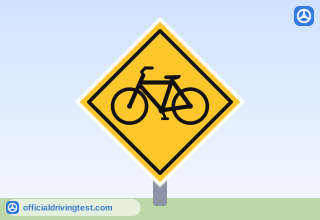
A yellow diamond sign shows a bicycle. What should you be alert for?
- Bicyclists riding on the shoulder
- A bike lane that ends ahead
- Bicyclists passing on the right
- Bicyclists crossing the street
Show answer
Correct answer: Bicyclists crossing the street
The Bicycle sign tells you to be alert for bicyclists crossing the street.
Source: Nebraska Driver's Manual (January 2025), page 40 · Open this page in the manual (Manual page 40)
-
What is a bike lane?
- A lane shared equally by bicyclists and motor vehicles
- A lane for slow-moving motor vehicles
- A part of the roadway for the exclusive use of bicyclists
- A parking lane next to the curb
Show answer
Correct answer: A part of the roadway for the exclusive use of bicyclists
Bike lanes are a portion of a roadway that has been designated for the exclusive use by bicyclists.
Source: Nebraska Driver's Manual (January 2025), page 46 · Open this page in the manual (Manual page 46)
-
What are bike lanes designed to do?
- Give bicyclists priority over pedestrians on sidewalks
- Separate bicycle traffic from motorized vehicle traffic
- Provide extra space for passing
- Mark where bicyclists must turn
Show answer
Correct answer: Separate bicycle traffic from motorized vehicle traffic
Bike lanes are designed to separate bicycle traffic from motorized vehicle traffic.
Source: Nebraska Driver's Manual (January 2025), page 46 · Open this page in the manual (Manual page 46)
-
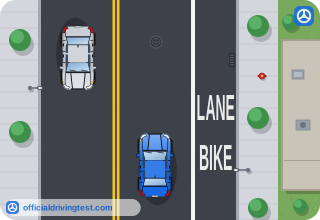
Which is a reason a motorist may cross over a bike lane?
- To pass slow traffic on the right
- To avoid stopping at a red light
- To drive to the next intersection faster
- To enter or exit on-street parking spaces
Show answer
Correct answer: To enter or exit on-street parking spaces
Drivers may not drive in bike lanes, but they may cross over one to move into another travel lane, to enter or exit on-street parking spaces or to enter or exit private property.
Source: Nebraska Driver's Manual (January 2025), page 46 · Open this page in the manual (Manual page 46)
-
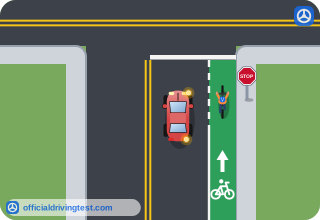
Before crossing a bike lane, what must you do?
- Make sure it is safe and yield to approaching bicyclists
- Stop completely and wait at least ten seconds first
- Sound your horn to warn bicyclists
- Speed up so you cross quickly
Show answer
Correct answer: Make sure it is safe and yield to approaching bicyclists
Before crossing a bike lane, make sure it is safe to do so and yield the right-of-way to approaching bicyclists.
Source: Nebraska Driver's Manual (January 2025), page 46 · Open this page in the manual (Manual page 46)
-
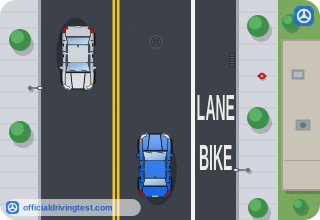
When the bike lane is clear and you want to turn right, what does the manual say to do?
- Turn from the lane next to the bike lane, then signal
- Stop in the bike lane before turning
- Signal, then move into the bike lane before the turn
- Wait until the bike lane ends
Show answer
Correct answer: Signal, then move into the bike lane before the turn
When the bike lane is clear, signal your intention to turn and then move into the bike lane before making the turn.
Source: Nebraska Driver's Manual (January 2025), page 46 · Open this page in the manual (Manual page 46)
-
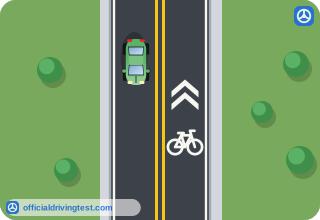
What do shared lane markings indicate?
- The lane is for bicyclists only
- The lane is shared by both motor vehicles and bicyclists
- The lane is for parking
- The lane is closed to motor vehicles at all times
Show answer
Correct answer: The lane is shared by both motor vehicles and bicyclists
Shared lane markings are used to indicate the lane is shared by both motor vehicles and bicyclists.
Source: Nebraska Driver's Manual (January 2025), page 47 · Open this page in the manual (Manual page 47)
-
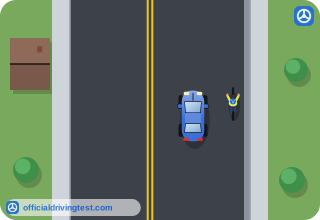
Motorists should avoid passing bicyclists in a shared lane until what exists?
- Enough room to cross the center line
- Two feet of clearance
- A speed of 25 MPH
- No less than three feet clearance
Show answer
Correct answer: No less than three feet clearance
Motorists should avoid passing bicyclists until a safe distance of no less than three feet clearance exists.
Source: Nebraska Driver's Manual (January 2025), page 47 · Open this page in the manual (Manual page 47)
-
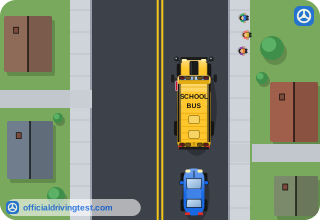
When is it unlawful to pass a school bus?
- When it is stopped with its overhead lights off
- When it has flashing red lights and its stop arm extended
- When it is stopped with its door closed and no lights flashing
- When it is parked at a school with no students on board
Show answer
Correct answer: When it has flashing red lights and its stop arm extended
It is unlawful to pass a school bus with flashing red lights and its stop arm extended.
Source: Nebraska Driver's Manual (January 2025), page 53 · Open this page in the manual (Manual page 53)
-
Unless there is an emergency, what should you do when another vehicle is passing you?
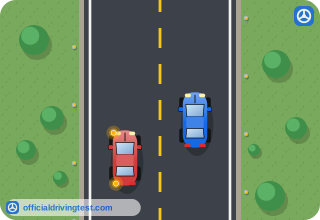
- Stay in your lane and maintain your speed
- Move to the right edge and slow down
- Speed up until the other vehicle has passed
- Brake and leave the road
Show answer
Correct answer: Stay in your lane and maintain your speed
When another vehicle is passing, you stay in your lane and keep your speed unless there is an emergency.
Source: Nebraska Driver's Manual (January 2025), page 54 · Open this page in the manual (Manual page 54)
-
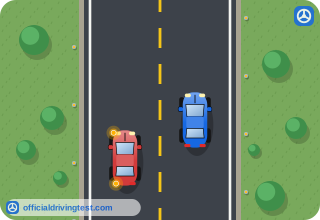
If there is an emergency while another vehicle is passing you, what may you do to prevent a crash?
- Only brake hard and stop in your lane
- Only sound the horn and hold your speed
- Speed up, slow down, or leave the road
- Only move to the center of the road
Show answer
Correct answer: Speed up, slow down, or leave the road
In an emergency you may speed up, slow down, or leave the road to prevent a crash.
Source: Nebraska Driver's Manual (January 2025), page 54 · Open this page in the manual (Manual page 54)
-
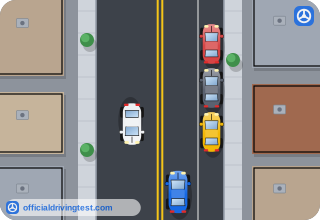
When driving past parked vehicles, which of these is a clue that a vehicle may pull out?
- Doors locked and windows rolled up
- Exhaust coming from the tail pipe
- Front wheels turned toward the curb
- A driver’s seat that is empty
Show answer
Correct answer: Exhaust coming from the tail pipe
Exhaust from the tail pipe is one of the clues the manual lists that a parked vehicle may pull out.
Source: Nebraska Driver's Manual (January 2025), page 54 · Open this page in the manual (Manual page 54)
-
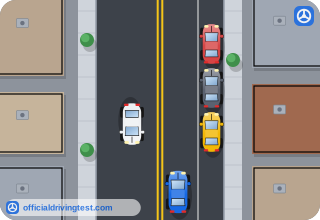
When driving past parked vehicles, what besides other vehicles should you watch for emerging from between them?
- Only emergency vehicles
- Road workers and flaggers
- Only other parked vehicles
- People or animals
Show answer
Correct answer: People or animals
Drivers passing parked vehicles must watch for people or animals emerging from between them.
Source: Nebraska Driver's Manual (January 2025), page 54 · Open this page in the manual (Manual page 54)
-
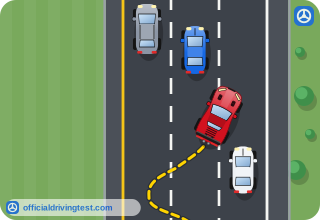
How does the manual define aggressive driving?
- Driving more than 10 MPH over the posted speed limit on any road
- Driving behavior that is frightening or rude to other drivers
- Driving that causes a crash
- Driving behavior that is slow and unpredictable
Show answer
Correct answer: Driving behavior that is frightening or rude to other drivers
Aggressive driving is driving behavior that is frightening or rude to other drivers.
Source: Nebraska Driver's Manual (January 2025), page 65 · Open this page in the manual (Manual page 65)
-
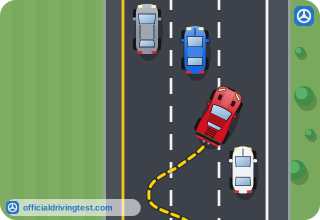
Which of these is an example of aggressive driving?
- Signaling well before a turn
- Staying in the right lane on the interstate
- Keeping a three-second following distance
- Tailgating
Show answer
Correct answer: Tailgating
Tailgating, cutting off other drivers, running red lights and failing to yield are examples of aggressive driving.
Source: Nebraska Driver's Manual (January 2025), page 65 · Open this page in the manual (Manual page 65)
-
When does the manual say you should avoid driving?
- When other drivers are honking
- After sunset on rural roads
- When you are angry or upset
- When you are driving with passengers
Show answer
Correct answer: When you are angry or upset
You should avoid driving when angry or upset and treat other motorists as you expect to be treated.
Source: Nebraska Driver's Manual (January 2025), page 65 · Open this page in the manual (Manual page 65)
-
How does the manual say you should treat other motorists?
- As you expect to be treated
- As they treat you
- According to how fast they drive
- By keeping as far from them as you can
Show answer
Correct answer: As you expect to be treated
The manual says to treat other motorists as you expect to be treated.
Source: Nebraska Driver's Manual (January 2025), page 65 · Open this page in the manual (Manual page 65)
-
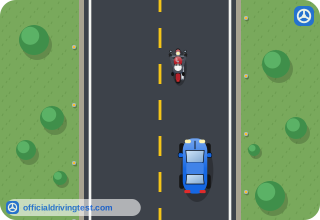
Compared with other vehicles on the roadway, what rights and privileges do motorcycles have?
- The same rights and privileges as any vehicle
- Fewer rights, because they are smaller
- Extra rights, because they are harder to see
- Rights only on roads below a set speed
Show answer
Correct answer: The same rights and privileges as any vehicle
Motorcycles are vehicles with the same rights and privileges as any vehicle on the roadway.
Source: Nebraska Driver's Manual (January 2025), page 68 · Open this page in the manual (Manual page 68)
-
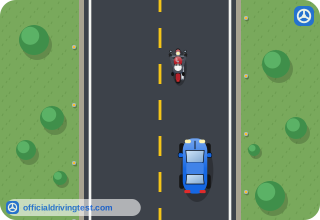
How much of the traffic lane should you allow a motorcyclist?
- Half of the lane width
- One-third of the lane width
- The full lane width
- Whatever is left beside your vehicle
Show answer
Correct answer: The full lane width
A motorcycle needs the room to maneuver safely, so a driver must allow the motorcyclist a full lane width and not share the lane.
Source: Nebraska Driver's Manual (January 2025), page 68 · Open this page in the manual (Manual page 68)
-
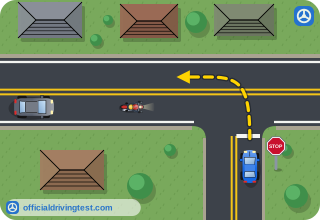
Why can it be difficult to judge the speed and distance of an approaching motorcycle?
- A motorcycle's engine noise hides how fast it is going
- A motorcycle has a much smaller profile than other vehicles
- Motorcycles always travel faster than the traffic around them
- A motorcycle's lights cannot be seen in daylight
Show answer
Correct answer: A motorcycle has a much smaller profile than other vehicles
Motorcycles are smaller and have a much smaller profile than other vehicles, which makes their speed and distance harder to judge.
Source: Nebraska Driver's Manual (January 2025), page 68 · Open this page in the manual (Manual page 68)
-
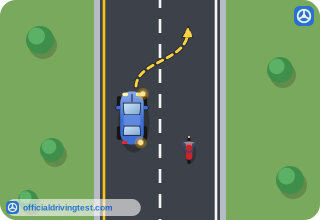
Why should you always signal your intentions before changing lanes or merging when a motorcycle is nearby?
- It gives the motorcyclist permission to pass you on either side of the lane
- It tells the motorcyclist to stop and wait for you
- It makes the motorcycle's headlight turn on automatically
- It lets the motorcyclist anticipate traffic flow and find a safe lane position
Show answer
Correct answer: It lets the motorcyclist anticipate traffic flow and find a safe lane position
Signaling allows the motorcyclist to anticipate traffic flow and find a safe lane position.
Source: Nebraska Driver's Manual (January 2025), page 68 · Open this page in the manual (Manual page 68)
-
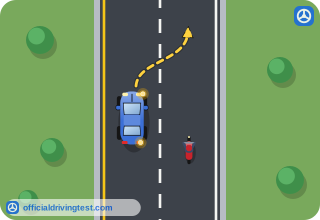
How should you check for motorcycles before entering or leaving a lane of traffic and at intersections?
- Listen for engine noise with the windows down
- Rely on one quick look in the rearview mirror
- Wait for the motorcyclist to sound a horn
- Make a visual check of your mirrors and blind spots
Show answer
Correct answer: Make a visual check of your mirrors and blind spots
Motorcyclists are often hidden in a blind spot or missed in a quick look, so make a visual check of mirrors and blind spots.
Source: Nebraska Driver's Manual (January 2025), page 68 · Open this page in the manual (Manual page 68)
-
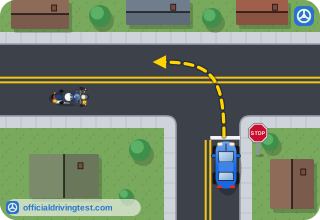
What should you do when a motorcycle near you has a flashing turn signal?
- Proceed at once, because the rider is certain to turn
- Wait until you are sure the motorcycle will turn
- Sound your horn so the rider turns off the signal
- Pass quickly on the side opposite the signal
Show answer
Correct answer: Wait until you are sure the motorcycle will turn
Motorcycle signals usually are not self-cancelling and riders sometimes forget to turn them off, so wait to be sure the motorcycle is going to turn.
Source: Nebraska Driver's Manual (January 2025), page 68 · Open this page in the manual (Manual page 68)
-
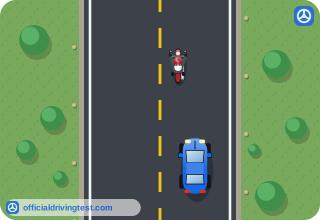
Which of these road conditions may cause a motorcyclist to change speed or position within a lane suddenly?
- Dry, smooth pavement
- A straight, empty road
- Grooved pavement
- A wide, clear lane
Show answer
Correct answer: Grooved pavement
Potholes, gravel, wet or slippery surfaces, pavement seams, railroad crossings and grooved pavement are major hazards to motorcyclists.
Source: Nebraska Driver's Manual (January 2025), page 68 · Open this page in the manual (Manual page 68)
-
How much following distance should you allow when following a motorcycle?
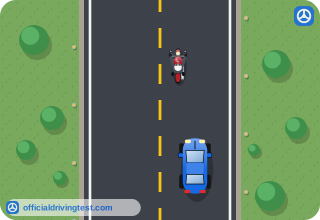
- Three or four seconds
- One or two seconds
- Five or six seconds
- Seven or eight seconds
Show answer
Correct answer: Three or four seconds
Allow more following distance, three or four seconds, so the motorcyclist has enough time to maneuver or stop in an emergency.
Source: Nebraska Driver's Manual (January 2025), page 68 · Open this page in the manual (Manual page 68)
-
In dry conditions, how does a motorcycle's stopping ability compare with a car's?
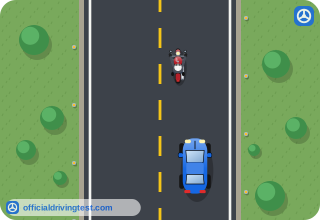
- A motorcycle always needs a longer distance to stop
- A motorcycle can stop more quickly than a car
- A motorcycle stops in exactly the same distance as a car
- A motorcycle cannot stop as quickly as a car
Show answer
Correct answer: A motorcycle can stop more quickly than a car
In dry conditions motorcycles can stop more quickly than a car.
Source: Nebraska Driver's Manual (January 2025), page 68 · Open this page in the manual (Manual page 68)
-
What duties and rights does a person riding a bicycle have?
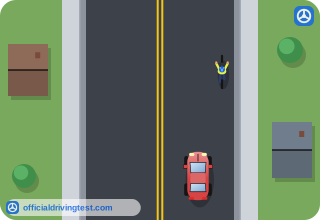
- Only the duties of a pedestrian
- The rights of a driver but none of the duties
- No duties, because bicycles are not motor vehicles
- The same duties and rights as a driver of a motor vehicle
Show answer
Correct answer: The same duties and rights as a driver of a motor vehicle
A person riding a bicycle has the same duties and rights as a driver of a motor vehicle, so bicyclists must obey traffic laws.
Source: Nebraska Driver's Manual (January 2025), page 68 · Open this page in the manual (Manual page 68)
-
Where must bicyclists ride in a lane?
- As far right as is practical, or on paved shoulders
- In the center of the lane at all times, never on shoulders
- As far left as is practical, on any street
- Wherever the bicyclist chooses, with no rule about position
Show answer
Correct answer: As far right as is practical, or on paved shoulders
Bicyclists must ride as far right in a lane as is practical or on paved shoulders.
Source: Nebraska Driver's Manual (January 2025), page 68 · Open this page in the manual (Manual page 68)
-
When may a bicyclist ride in the lane of travel instead of at the right edge?
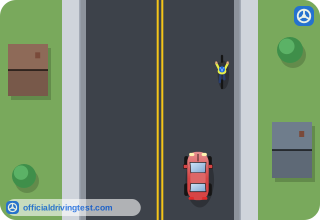
- When the bicyclist is in a group of three or more riders
- When the bicyclist is traveling slower than the vehicles behind
- When the lane is too narrow for a bicycle and a vehicle to share it safely
- When the posted speed limit is above 35 MPH
Show answer
Correct answer: When the lane is too narrow for a bicycle and a vehicle to share it safely
Bicyclists may ride in the lane of travel where the lane is too narrow for a bicycle and a vehicle to travel safely side by side.
Source: Nebraska Driver's Manual (January 2025), page 68 · Open this page in the manual (Manual page 68)
-
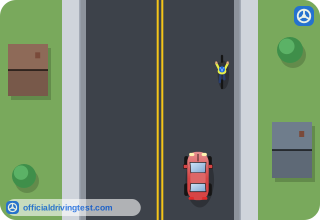
Why might a bicyclist move out of the right lane at an intersection?
- To avoid having to obey the signal at the intersection
- To ride against traffic on the left side of the road
- To make a left turn or continue through the intersection
- To keep the vehicles behind from passing at all
Show answer
Correct answer: To make a left turn or continue through the intersection
Bicyclists are not restricted to the right lane; they may need to change lanes to make left turns or continue through an intersection.
Source: Nebraska Driver's Manual (January 2025), page 69 · Open this page in the manual (Manual page 69)
-
Where may bicyclists ride on one-way streets in urban areas?
- In the far left lane
- Only in the far right lane
- Only in the center of the street
- Only on the sidewalk
Show answer
Correct answer: In the far left lane
On one-way streets in urban areas, bicyclists may ride in the far left lane.
Source: Nebraska Driver's Manual (January 2025), page 69 · Open this page in the manual (Manual page 69)
-
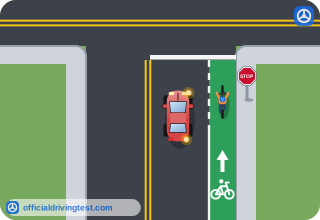
What should a motorist do when preparing for a right turn where bicycles are traveling in the same direction?
- Speed up and turn ahead of the bicyclists
- Turn directly across the path of the bicycles
- Stay well left and cut across the bike traffic
- Merge with the bicycle traffic before turning
Show answer
Correct answer: Merge with the bicycle traffic before turning
Motorists should merge with bicycle traffic when preparing for a right turn and avoid turning directly across a path of bicycles.
Source: Nebraska Driver's Manual (January 2025), page 69 · Open this page in the manual (Manual page 69)
-
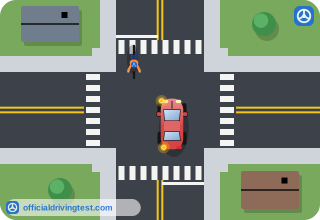
When turning left at an intersection, what should you do about oncoming bicyclists?
- Go first, because bicycles are slower than motor vehicles
- Yield to them just as you would to oncoming motorists
- Sound your horn so they stop for you
- Turn ahead of them only if they are in a bike lane
Show answer
Correct answer: Yield to them just as you would to oncoming motorists
When turning left at an intersection, yield to oncoming bicyclists just as you would to oncoming motorists.
Source: Nebraska Driver's Manual (January 2025), page 69 · Open this page in the manual (Manual page 69)
-
What should you not do when approaching a bicyclist?
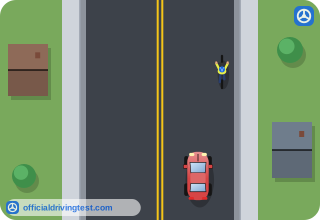
- Blast the vehicle's horn
- Reduce your speed
- Check your mirrors
- Watch for the bicyclist's position
Show answer
Correct answer: Blast the vehicle's horn
Do not blast a vehicle's horn when approaching a bicyclist.
Source: Nebraska Driver's Manual (January 2025), page 69 · Open this page in the manual (Manual page 69)
-
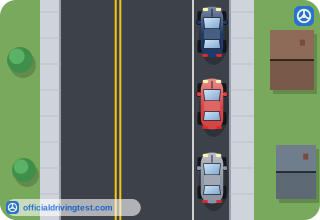
What should you look for before opening a car door?
- Hazard flashers
- Low-hanging branches
- Bicycles
- Parking meters
Show answer
Correct answer: Bicycles
Look for bicycles before opening car doors.
Source: Nebraska Driver's Manual (January 2025), page 69 · Open this page in the manual (Manual page 69)
-
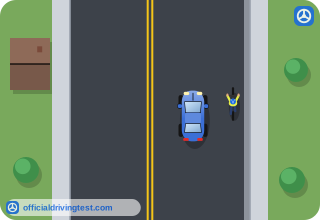
When overtaking a bicycle proceeding in the same direction, what is the least clearance the law requires a motorist to leave, when applicable?
- No less than one foot
- No less than three feet
- No less than five feet
- No less than six feet
Show answer
Correct answer: No less than three feet
The law requires motorists to leave a safe distance of no less than three feet clearance when passing a bicycle.
Source: Nebraska Driver's Manual (January 2025), page 69 · Open this page in the manual (Manual page 69)
-
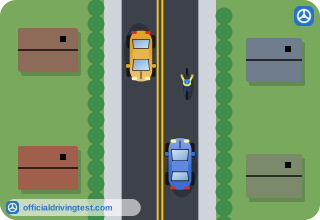
What should a driver do if it is not safe to leave three feet of clearance when passing a bicyclist?
- Pass as quickly as possible to limit the risk
- Sound the horn and pass closely
- Pass on the right-hand side of the bicyclist
- Reduce speed and wait until it is safe to pass
Show answer
Correct answer: Reduce speed and wait until it is safe to pass
If it is not safe to leave three feet of clearance, the driver should reduce speed and wait until it is safe to pass the bicyclist.
Source: Nebraska Driver's Manual (January 2025), page 69 · Open this page in the manual (Manual page 69)
-
What is a common crash type for young cyclists?
- Turning left at a signal without checking behind them
- Riding in a bike lane that ends at a right-turn lane
- Following too closely behind a parked or stopped vehicle
- Riding out into the road mid-block from a driveway, alley, or curb
Show answer
Correct answer: Riding out into the road mid-block from a driveway, alley, or curb
A common crash type for young cyclists is mid-block ride-outs entering a road from a driveway, alley, or curb without slowing, stopping or looking for traffic.
Source: Nebraska Driver's Manual (January 2025), page 69 · Open this page in the manual (Manual page 69)
-
Which behaviors are signs of an inexperienced bicyclist?
- Riding as far right as practical
- Riding against traffic or swerving
- Riding on a paved shoulder
- Stopping at each intersection
Show answer
Correct answer: Riding against traffic or swerving
Signs of an inexperienced bicyclist include riding against traffic or swerving, so take extra precautions around bicyclists displaying these behaviors.
Source: Nebraska Driver's Manual (January 2025), page 69 · Open this page in the manual (Manual page 69)
-
Why should you look both ways at intersections before turning, with bicyclists in mind?
- Bicyclists are never permitted to ride through an intersection
- Bicyclists always stop and wait at every intersection for cars
- Bicyclists may be riding on sidewalks or trails parallel to the road
- Bicyclists are required by law to ride on the left side of the street
Show answer
Correct answer: Bicyclists may be riding on sidewalks or trails parallel to the road
Bicyclists may be found riding on sidewalks or trails parallel to streets and roads, so look both ways before turning.
Source: Nebraska Driver's Manual (January 2025), page 69 · Open this page in the manual (Manual page 69)
-
At intersections and roundabouts, how do right-of-way rules apply to bicyclists?
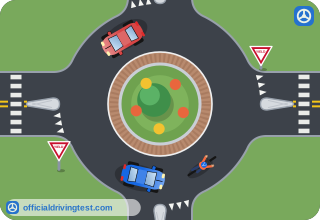
- They apply equally to bicyclists and motor vehicles
- Bicyclists always have the right-of-way over motor vehicles
- Motor vehicles always have the right-of-way over bicyclists
- Bicyclists must yield to every motor vehicle
Show answer
Correct answer: They apply equally to bicyclists and motor vehicles
At intersections and roundabouts, right-of-way rules apply equally to bicyclists and motor vehicles.
Source: Nebraska Driver's Manual (January 2025), page 69 · Open this page in the manual (Manual page 69)
-
What does a school bus driver do when the bus is about to stop to load or unload children?
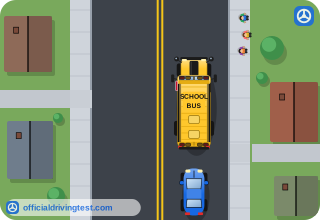
- Extends the STOP arm and turns on the red lights
- Turns on the headlights and sounds the horn
- Opens the door and then turns on the amber lights
- Activates the amber warning lights
Show answer
Correct answer: Activates the amber warning lights
When a school bus is about to stop and load or unload children, the bus driver activates amber warning lights.
Source: Nebraska Driver's Manual (January 2025), page 70 · Open this page in the manual (Manual page 70)
-
When you are meeting or overtaking a school bus whose amber warning lights are on, what should you do?
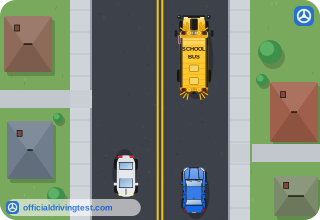
- Slow to 15 MPH and prepare to stop
- Slow to 35 MPH and prepare to stop
- Keep your speed until the red lights come on
- Slow to 25 MPH and prepare to stop
Show answer
Correct answer: Slow to 25 MPH and prepare to stop
When meeting or overtaking a bus, slow to 25 MPH and prepare to stop.
Source: Nebraska Driver's Manual (January 2025), page 70 · Open this page in the manual (Manual page 70)
-
How long do a school bus's amber warning lights stay on?
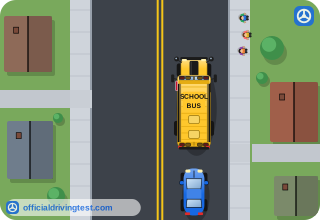
- Until the last child has boarded
- Until the bus door opens
- Until the bus has driven away
- Until the driver retracts the STOP arm
Show answer
Correct answer: Until the bus door opens
The amber warning lights will stay on until the bus door opens.
Source: Nebraska Driver's Manual (January 2025), page 70 · Open this page in the manual (Manual page 70)
-
When do the red stop lights and STOP arm of a school bus activate?
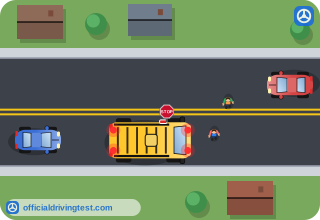
- When the amber warning lights first come on
- When the bus begins to slow for a stop
- When the bus driver opens the bus door
- When the driver sets the parking brake
Show answer
Correct answer: When the bus driver opens the bus door
The red stop lights and STOP arm activate when the bus driver opens the bus door.
Source: Nebraska Driver's Manual (January 2025), page 70 · Open this page in the manual (Manual page 70)
-
How long must you remain stopped for a school bus whose red stop lights and STOP arm are activated?
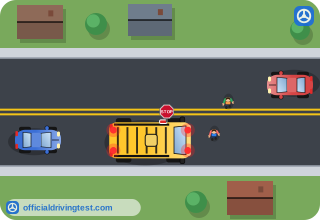
- Until the stop arm is retracted and the red lights are off
- Until the children are on the sidewalk and the door has closed
- Until the amber lights come back on and the bus moves
- Until no child is crossing in front of your vehicle
Show answer
Correct answer: Until the stop arm is retracted and the red lights are off
Stop and remain stopped until the bus driver retracts the stop arm and deactivates the red warning lights.
Source: Nebraska Driver's Manual (January 2025), page 70 · Open this page in the manual (Manual page 70)
-
How far from a school bus with its red lights on should you stop?
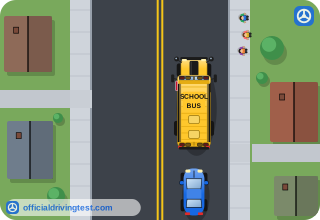
- As close to the bus as you can get
- A reasonable distance from the bus
- Beside the open bus door
- Right up to the STOP arm
Show answer
Correct answer: A reasonable distance from the bus
Stop a reasonable distance from the bus.
Source: Nebraska Driver's Manual (January 2025), page 70 · Open this page in the manual (Manual page 70)
-
What is the only exception to the rule that you must stop for a school bus with its stop lights on and the stop arm extended?
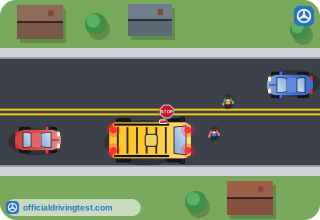
- Approaching from the opposite direction on an undivided road with four lanes
- Approaching from the opposite direction on a two-lane road with no center line
- Overtaking the bus on a road where children are not in sight
- Approaching from the opposite direction on a roadway divided by a median
Show answer
Correct answer: Approaching from the opposite direction on a roadway divided by a median
Not stopping for a school bus with stop lights on and the stop arm extended is unlawful, except when approaching it in the opposite direction on a roadway divided by a median.
Source: Nebraska Driver's Manual (January 2025), page 70 · Open this page in the manual (Manual page 70)
-
A loaded truck with good tires and properly adjusted brakes is traveling at 55 MPH on a clear, dry roadway. What is the minimum distance it needs to come to a complete stop?
- 340 feet
- 190 feet
- 250 feet
- 500 feet
Show answer
Correct answer: 340 feet
A loaded truck with good tires and properly adjusted brakes, traveling at 55 MPH on a clear, dry roadway, requires a minimum of 340 feet to stop.
Source: Nebraska Driver's Manual (January 2025), page 71 · Open this page in the manual (Manual page 71)
-
What should you avoid doing in front of a large vehicle when entering the roadway?
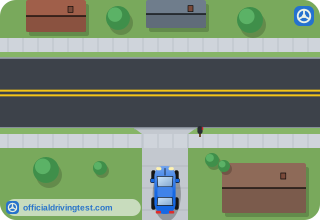
- Signaling before you enter the roadway
- Checking mirrors and blind spots first
- Abruptly entering the roadway in front of it
- Waiting for a gap behind the large vehicle
Show answer
Correct answer: Abruptly entering the roadway in front of it
Do not abruptly enter the roadway in front of a large vehicle.
Source: Nebraska Driver's Manual (January 2025), page 71 · Open this page in the manual (Manual page 71)
-
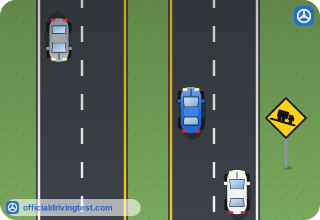
Why should you avoid driving in the right lane when traveling up or down steep grades?
- The right lane is reserved for emergency vehicles on hills
- Trucks are required to use the left lane on steep grades
- Larger vehicles often drive slower and use the right lane there
- The right lane is always narrower on a grade
Show answer
Correct answer: Larger vehicles often drive slower and use the right lane there
On steep grades larger vehicles often drive slower and use the right lane, so avoiding it reduces the chance of rear-ending or being rear-ended by a large vehicle.
Source: Nebraska Driver's Manual (January 2025), page 71 · Open this page in the manual (Manual page 71)
-
In which area should you avoid the right lane because slow-moving trucks will be trying to re-enter faster-moving traffic?
- In the vicinity of truck weigh stations
- On a quiet residential street
- In the vicinity of railroad crossings
- Near the exit sign of every freeway interchange
Show answer
Correct answer: In the vicinity of truck weigh stations
Avoid driving in the right lane in the vicinity of truck weigh stations, where slow-moving trucks will be attempting to re-enter faster-moving traffic.
Source: Nebraska Driver's Manual (January 2025), page 71 · Open this page in the manual (Manual page 71)
-
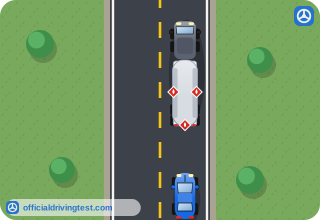
What should you do about vehicles that are clearly marked as carrying hazardous materials, such as "Explosives", "Poison" or "Flammable"?
- Follow closely behind them
- Travel beside them for long periods
- Pass them quickly on the right
- Avoid driving near them
Show answer
Correct answer: Avoid driving near them
Vehicles carrying hazardous materials are clearly marked with the type of material, and you should avoid driving near them.
Source: Nebraska Driver's Manual (January 2025), page 71 · Open this page in the manual (Manual page 71)
-
Why should you not make sudden stops in front of large vehicles?
- Their hydraulic brakes need time to cool between stops
- Their air brakes do not operate instantly like hydraulic brakes
- Their brake lights do not work when a vehicle stops suddenly
- Their air brakes lock the wheels at speeds above 40 MPH
Show answer
Correct answer: Their air brakes do not operate instantly like hydraulic brakes
Trucks and buses have air brakes, which do not operate instantly as hydraulic brakes on automobiles do.
Source: Nebraska Driver's Manual (January 2025), page 71 · Open this page in the manual (Manual page 71)
-
What does an additional right lane with a "Slow Traffic Keep Right" sign let slower vehicles such as trucks, farm equipment and recreational vehicles do?
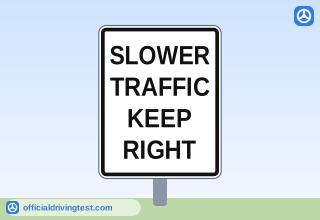
- Move to the right lane so other traffic can pass on the grade
- Stop in the lane to cool their brakes
- Make left turns across the highway without stopping
- Travel faster than the posted limit on the grade
Show answer
Correct answer: Move to the right lane so other traffic can pass on the grade
On some highways approaching long steep hills, the additional right lane lets slower vehicles move right so other traffic can pass on the grade.
Source: Nebraska Driver's Manual (January 2025), page 71 · Open this page in the manual (Manual page 71)
-
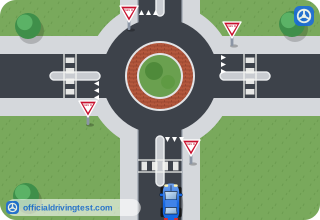
How may the raised paved truck apron along the edges of a roundabout's circular roadway be used?
- By bicyclists crossing the roundabout
- By cars as a passing lane when traffic is slow
- By the rear wheels of large vehicles
- By pedestrians waiting to cross the roadway
Show answer
Correct answer: By the rear wheels of large vehicles
When navigating a roundabout, the raised paved truck apron along the edges of the circular roadway may be used for the rear wheels of large vehicles.
Source: Nebraska Driver's Manual (January 2025), page 71 · Open this page in the manual (Manual page 71)
-
What is a No-Zone around a truck or bus?
- A section of highway where trucks and buses may not pass other vehicles or change lanes
- An area where cars disappear into blind spots or are so close the driver cannot stop or maneuver safely
- A lane on the roadway reserved for trucks and buses at all times and closed to cars
- An area near a weigh station where all vehicles must stop and wait
Show answer
Correct answer: An area where cars disappear into blind spots or are so close the driver cannot stop or maneuver safely
No-Zones are areas around trucks or buses where cars disappear into blind spots or are so close that they restrict the driver's ability to stop or maneuver safely.
Source: Nebraska Driver's Manual (January 2025), page 71 · Open this page in the manual (Manual page 71)
-
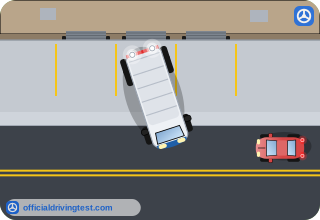
What should you never do near a truck or bus that is preparing to back up or is backing up?
- Stay a long way back
- Wait to one side of its path
- Give it room to block the street
- Pass close behind it
Show answer
Correct answer: Pass close behind it
A backing truck or bus sometimes must temporarily block the street, so never pass close behind one that is preparing to back up or is backing up.
Source: Nebraska Driver's Manual (January 2025), page 71 · Open this page in the manual (Manual page 71)
-
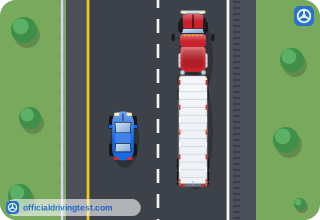
When passing a truck or bus, when may you pull in front of it?
- As soon as you have passed the rear wheels of the truck or bus
- As soon as your rear bumper is even with its front bumper
- Once you are one car length ahead of its front bumper
- Only when you can see the entire front of it in your rear view mirror
Show answer
Correct answer: Only when you can see the entire front of it in your rear view mirror
One of the biggest mistakes is to cut in too soon when passing, so do not pull in front of a truck or bus unless the entire front of it can be seen in the rear view mirror.
Source: Nebraska Driver's Manual (January 2025), page 72 · Open this page in the manual (Manual page 72)
-
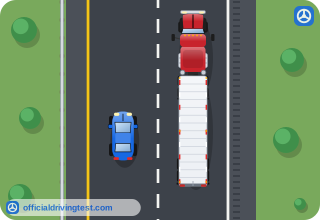
How can you tell whether the driver of a truck or bus can see you behind or beside it?
- If you can see its brake lights lit as it slows down
- If you can see the rearview mirrors of the truck or bus
- If its turn signal is flashing in your direction
- If you are close enough to read its license plate
Show answer
Correct answer: If you can see the rearview mirrors of the truck or bus
Being able to see the rearview mirrors of the truck or bus allows the driver of the larger vehicle to see vehicles behind or beside them.
Source: Nebraska Driver's Manual (January 2025), page 72 · Open this page in the manual (Manual page 72)
-
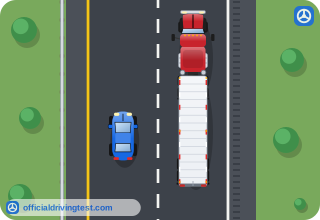
How do the blindspots on the sides of trucks and buses compare with those of cars?
- Larger only on the left side
- About the same as a car's
- Much larger on both sides
- Smaller on the right side
Show answer
Correct answer: Much larger on both sides
Trucks and buses have much larger blindspots on both sides than cars do, so do not travel beside them for great lengths of time.
Source: Nebraska Driver's Manual (January 2025), page 72 · Open this page in the manual (Manual page 72)
-
What should you give a truck or bus that needs to swing wide to make a turn?
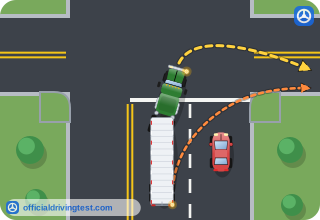
- Plenty of room, and never try to squeeze around it
- A short horn blast and then pass on the right
- A head start by speeding up beside its front
- A narrow gap so it can see you in its mirrors
Show answer
Correct answer: Plenty of room, and never try to squeeze around it
Truck and bus drivers sometimes need to swing wide and cannot see cars directly behind or beside them, so give them plenty of room and never try to squeeze around them.
Source: Nebraska Driver's Manual (January 2025), page 72 · Open this page in the manual (Manual page 72)