Montana: Speed and following distance — Part 3 Practice Test
Questions in this part include: “Through what part of your vehicle is its only contact with the road?” · “How much should you reduce your speed on packed snow?”
Independent educational site · not affiliated with any government agency or DMV
Ready? Test yourself
- Instant feedback with an explanation
- Every answer cites its source in the manual
- Your best score is saved on this device
- Keyboard: press 1 to 4 to answer and Enter for the next question
Questions are original and based on the official manual "Montana Driver Manual" (Revised April 2024), Montana Department of Justice, Motor Vehicle Division.
All 19 questions in this practice test
Take the test above first, then use this list to study. Tap “Show answer” to see the correct answer and explanation.
Show the questions and answersHide the questions
-
Through what part of your vehicle is its only contact with the road?
- The tires
- The brakes
- The suspension
- The axles
Show answer
Correct answer: The tires
The only contact your vehicle has with the road is through the tires.
Source: Montana Driver Manual (Revised April 2024), page 59
-
How do gravel and dirt roads differ from concrete and asphalt roads, according to the manual?

- Tires grip better, so you can turn at higher speeds
- Stopping takes much longer and skidding is easier when turning
- Stopping distances are shorter because of the loose material
- Traction is the same as on pavement when roads are dry
Show answer
Correct answer: Stopping takes much longer and skidding is easier when turning
There is less traction on gravel and dirt, so you must slow down, stopping takes much longer, and it is much easier to skid when turning.
Source: Montana Driver Manual (Revised April 2024), page 59
-
What is the “washboard” effect that can occur on gravel roads?
- A raised ridge of gravel that runs down the center of the road
- A band of loose stones that builds up along the road shoulder
- A layer of thick dust that makes it hard to see ahead
- A series of potholes that can affect steering and vehicle control
Show answer
Correct answer: A series of potholes that can affect steering and vehicle control
A washboard effect is a series of potholes that can affect steering and vehicle control.
Source: Montana Driver Manual (Revised April 2024), page 59
-
What does the manual recommend on extremely dusty gravel roads to make your vehicle more visible?

- Use high beam headlights
- Use only your parking lights
- Turn your headlights off to avoid glare
- Use low beam headlights
Show answer
Correct answer: Use low beam headlights
Dust can reduce vision, so the manual recommends using low beam headlights to make the vehicle more visible to others.
Source: Montana Driver Manual (Revised April 2024), page 59
-
On gravel or dirt roads, what should you do when you see a narrow bridge sign?
- Speed up so you can cross before traffic arrives
- Be prepared to stop for oncoming traffic
- Honk and keep your speed to warn oncoming vehicles
- Assume oncoming vehicles will stop for you
Show answer
Correct answer: Be prepared to stop for oncoming traffic
Drivers should look for narrow bridge signs and be prepared to stop for oncoming traffic.
Source: Montana Driver Manual (Revised April 2024), page 59
-
When should you slow down for a curve?
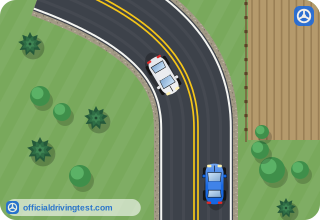
- Halfway through the curve
- Once the vehicle begins to skid
- Before you enter the curve
- As you leave the curve
Show answer
Correct answer: Before you enter the curve
Always slow down before you enter the curve so you do not have to brake in the curve, because braking in a curve can cause a skid.
Source: Montana Driver Manual (Revised April 2024), page 60
-
At what point should you slow down for rain, snow, or sleet?
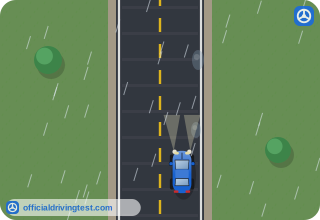
- At the first sign of it
- Once the road is covered with it
- When the vehicle starts to skid
- After it has fallen for an hour
Show answer
Correct answer: At the first sign of it
Rain, snow, and sleet all make the roadway slippery, so the manual says to slow down at the first sign of them.
Source: Montana Driver Manual (Revised April 2024), page 60
-
On a wet road, by about how much does the manual say to reduce your speed?
- About 5 mph
- About 10 mph
- About 20 mph
- About 30 mph
Show answer
Correct answer: About 10 mph
The manual says that on a wet road you should reduce your speed about 10 mph.
Source: Montana Driver Manual (Revised April 2024), page 60
-
How much should you reduce your speed on packed snow?
- By about 10 mph
- By about one quarter
- Slow to a crawl
- Cut it in half
Show answer
Correct answer: Cut it in half
The manual says that on packed snow you should cut your speed in half.
Source: Montana Driver Manual (Revised April 2024), page 60
-
What does the manual say to use when the road has snow on it?

- Snow tires or chains
- Tires with extra air pressure
- Low-profile summer tires
- Only a heavier load in the trunk
Show answer
Correct answer: Snow tires or chains
The manual says to use snow tires or chains when the road has snow on it.
Source: Montana Driver Manual (Revised April 2024), page 60
-
How much should you slow down when driving on ice?

- Cut your speed in half
- Reduce your speed by about 10 mph
- Slow to a crawl
- Slow to about 25 mph
Show answer
Correct answer: Slow to a crawl
On ice you must slow to a crawl, and driving on ice is very dangerous.
Source: Montana Driver Manual (Revised April 2024), page 60
-
During which dates are studded tires not allowed?
- June 1 through September 30
- May 1 through August 31
- April 1 through October 31
- July 1 through October 15
Show answer
Correct answer: June 1 through September 30
The manual states that studded tires are not allowed June 1 through September 30.
Source: Montana Driver Manual (Revised April 2024), page 60
-
Which of these spots does the manual say can be icy on cold, wet days?
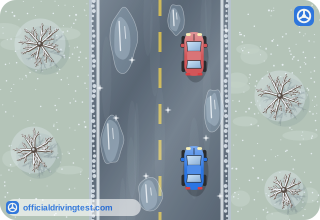
- Sunny spots
- Wide shoulders
- Dry gravel roads
- Shady spots
Show answer
Correct answer: Shady spots
On cold, wet days shady spots can be icy because they freeze first and dry out last.
Source: Montana Driver Manual (Revised April 2024), page 60
-
Why can the pavement on bridges be icy even when other areas of pavement are not?
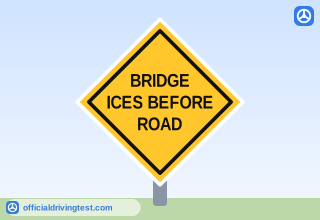
- Bridge surfaces are smoother and hold water longer than roads
- Bridges have no earth underneath to insulate them against the cold
- Bridges sit higher, so they get more rain than the road
- Bridges have too much earth underneath, which holds the cold
Show answer
Correct answer: Bridges have no earth underneath to insulate them against the cold
Bridges do not have earth underneath them to help insulate them against the cold.
Source: Montana Driver Manual (Revised April 2024), page 60
-
How does ice near the freezing point compare with ice at temperatures well below freezing?

- It is more slippery because it can become wet
- It is less slippery because it is softer
- It is equally slippery at any temperature
- It is easier to grip because tires sink into it
Show answer
Correct answer: It is more slippery because it can become wet
Ice can become wet near the freezing point, which makes it more slippery than at temperatures well below freezing.
Source: Montana Driver Manual (Revised April 2024), page 60
-
Why can the pavement be very slippery for the first few minutes when it starts to rain on a hot day?
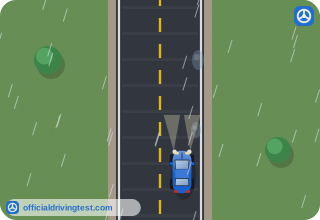
- Hot pavement turns the rain into ice for a short time
- Rain cannot soak into pavement that is hot
- Heat brings oil in the asphalt to the surface
- Tires lose air pressure quickly on hot pavement
Show answer
Correct answer: Heat brings oil in the asphalt to the surface
Heat causes oil in the asphalt to come to the surface, making the road more slippery until the oil is washed off.
Source: Montana Driver Manual (Revised April 2024), page 60
-
On a wet road, up to about what speed do most tires have good traction?
- About 25 mph
- About 35 mph
- About 45 mph
- About 60 mph
Show answer
Correct answer: About 35 mph
When the road is wet, most tires have good traction up to about 35 mph; above that they can start to float on water.
Source: Montana Driver Manual (Revised April 2024), page 60
-
In heavy rain, at about what speed can your tires lose all traction with the road?
- About 20 mph
- About 30 mph
- About 70 mph
- About 50 mph
Show answer
Correct answer: About 50 mph
In heavy rain, tires can lose all traction at about 50 mph, and badly worn tires lose traction at much lower speeds.
Source: Montana Driver Manual (Revised April 2024), page 60
-
What is the best way to keep from hydroplaning?
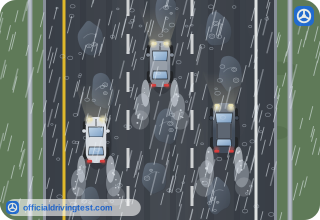
- Brake hard when the road first becomes wet
- Steer from side to side to clear water from the tires
- Drive faster to ride on top of the water
- Slow down in the rain or when the road is wet
Show answer
Correct answer: Slow down in the rain or when the road is wet
The manual says the best way to keep from hydroplaning is to slow down in the rain or when the road is otherwise wet.
Source: Montana Driver Manual (Revised April 2024), page 60