Montana: Speed and following distance — Part 5 Practice Test
Questions in this part include: “According to the manual, what are speed limits based on?” · “In some situations you need more space in front of your vehicle. What following distance may you need to be safe?”
Independent educational site · not affiliated with any government agency or DMV
Ready? Test yourself
- Instant feedback with an explanation
- Every answer cites its source in the manual
- Your best score is saved on this device
- Keyboard: press 1 to 4 to answer and Enter for the next question
Questions are original and based on the official manual "Montana Driver Manual" (Revised April 2024), Montana Department of Justice, Motor Vehicle Division.
All 18 questions in this practice test
Take the test above first, then use this list to study. Tap “Show answer” to see the correct answer and explanation.
Show the questions and answersHide the questions
-
According to the manual, what are speed limits based on?
- The age of the drivers, the weather, and the time of day on the road
- The number of crashes on the road in the last year and its repair cost
- How well the road is lit and how many drivers were ticketed there
- The road's design, the types of vehicles using it, and its location
Show answer
Correct answer: The road's design, the types of vehicles using it, and its location
Speed limits are based on the design of the road, the type of vehicles that use them, and where they are located.
Source: Montana Driver Manual (Revised April 2024), page 64
-
Posted speed limits are set for which conditions?
- Ideal conditions
- Wet-road conditions
- Average conditions
- Night-time conditions
Show answer
Correct answer: Ideal conditions
Speed limits are posted for ideal conditions, so you must slow down when the road is wet or icy, when you cannot see well, or when traffic is heavy.
Source: Montana Driver Manual (Revised April 2024), page 64
-
You drive under the posted speed limit on a wet or icy road, but too fast for the conditions. What can happen?
- Nothing, because you did not go over the posted speed limit
- You can be ticketed only if your driving causes a crash
- You can still get a ticket for traveling too fast for conditions
- You receive a warning but you cannot legally be ticketed
Show answer
Correct answer: You can still get a ticket for traveling too fast for conditions
Even if you are driving under the posted speed limit, you can get a ticket for traveling too fast for wet, icy, low-visibility or heavy-traffic conditions.
Source: Montana Driver Manual (Revised April 2024), page 64
-
What causes rear-end crashes, according to the manual?
- Drivers leaving too much space between their vehicle and the one ahead
- Drivers braking too early when the vehicle ahead is still far away
- Drivers who signal well ahead of time before slowing down for a stop
- Drivers following too closely to stop when the vehicle ahead suddenly stops
Show answer
Correct answer: Drivers following too closely to stop when the vehicle ahead suddenly stops
Rear-end crashes are caused by drivers following too closely to stop before hitting the vehicle ahead when that vehicle suddenly stops.
Source: Montana Driver Manual (Revised April 2024), page 64
-
The “Three-Second Rule” for checking whether you are following too closely works at which speeds?
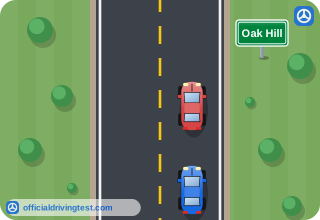
- At any speed
- Only at city speeds
- Only on dry roads
- Only below 30 mph
Show answer
Correct answer: At any speed
The manual says the “Three-Second Rule” works at any speed.
Source: Montana Driver Manual (Revised April 2024), page 64
-
When you use the Three-Second Rule, how do you know you are following too closely?
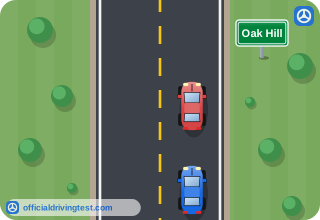
- You pass the mark after you finish counting
- The vehicle ahead is out of sight before you finish counting
- You pass the mark before you finish counting
- You can still see the vehicle’s license plate when you finish counting
Show answer
Correct answer: You pass the mark before you finish counting
You are following too closely if you pass the mark before you finish counting.
Source: Montana Driver Manual (Revised April 2024), page 64
-
If the Three-Second Rule shows you are following too closely, what should you do?
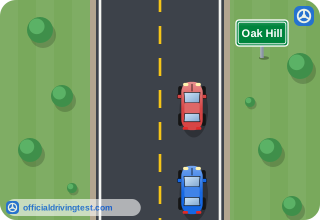
- Speed up and pass the vehicle ahead as soon as the way is clear
- Drop back, then count again at another spot to check the new distance
- Stay where you are and keep counting at the same spot until it passes
- Tap your brakes repeatedly to warn the vehicle ahead of you
Show answer
Correct answer: Drop back, then count again at another spot to check the new distance
You drop back and count again at another spot to check the new following distance, repeating until you are no closer than three seconds away.
Source: Montana Driver Manual (Revised April 2024), page 64
-
In some situations you need more space in front of your vehicle. What following distance may you need to be safe?
- One second
- Two seconds
- Six seconds
- Four seconds
Show answer
Correct answer: Four seconds
In situations that call for more space in front of your vehicle, you may need a four-second following distance.
Source: Montana Driver Manual (Revised April 2024), page 65
-
The driver behind you wants to pass. What should you do?
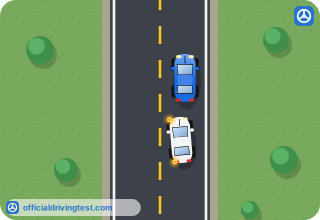
- Slow down to allow room in front of your vehicle
- Speed up so the pass can be completed sooner
- Hold your speed and stay close to the center line
- Move onto the shoulder and stop until it passes
Show answer
Correct answer: Slow down to allow room in front of your vehicle
You slow down to allow room in front of your vehicle, and slowing also lets the pass be completed sooner.
Source: Montana Driver Manual (Revised April 2024), page 65
-
Why do you need extra following distance behind a motorcycle?
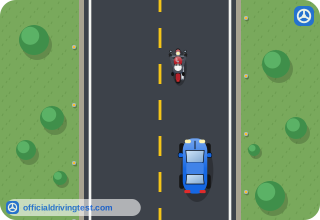
- Motorcycle riders are required to drive well below the speed limit
- So you can share the lane with the motorcycle when it slows down
- If the motorcycle should fall, you need room to avoid the rider
- Motorcycle signals cancel by themselves, so you must wait longer
Show answer
Correct answer: If the motorcycle should fall, you need room to avoid the rider
If the motorcycle should fall, you need extra distance to avoid the rider.
Source: Montana Driver Manual (Revised April 2024), page 65
-
Where are the chances of a motorcycle fall greatest?
- On dry, smooth asphalt roads with no curves in full daylight
- On wet or icy roads, gravel roads, or metal surfaces such as bridges
- On newly paved city streets with light traffic at midday
- On wide, straight highways with a smooth concrete surface
Show answer
Correct answer: On wet or icy roads, gravel roads, or metal surfaces such as bridges
The chances of a motorcycle falling are greatest on wet or icy roads, gravel roads, and metal surfaces such as bridges, gratings, or streetcar or railroad tracks.
Source: Montana Driver Manual (Revised April 2024), page 65
-
Why should you leave extra room when following a truck, bus, van, or vehicle pulling a camper or trailer?
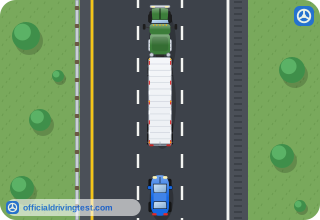
- Their brake lights are not required to work when they are loaded
- Their drivers must signal several seconds before every stop
- They are required to pull over when a vehicle follows too closely
- The driver may not see you directly behind and could stop suddenly
Show answer
Correct answer: The driver may not see you directly behind and could stop suddenly
These drivers may not be able to see you directly behind them and could stop suddenly without knowing you are there; falling back also gives you more room to see ahead.
Source: Montana Driver Manual (Revised April 2024), page 65
-
Why do you need more space ahead when you have a heavy load or are pulling a trailer?
- The extra weight increases your stopping distance
- The extra weight makes your brake lights harder to see
- The extra weight reduces the distance you need to stop
- The load can block the view of drivers ahead of you
Show answer
Correct answer: The extra weight increases your stopping distance
The extra weight of a heavy load or trailer increases your stopping distance.
Source: Montana Driver Manual (Revised April 2024), page 65
-
When darkness or bad weather makes it hard to see ahead, what should you do with your following distance?
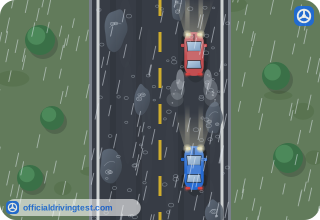
- Shorten it so you can see the vehicle ahead
- Keep it the same as in clear daylight
- Increase it
- Reduce it to under two seconds
Show answer
Correct answer: Increase it
When it is hard to see ahead because of darkness or bad weather, you need to increase your following distance.
Source: Montana Driver Manual (Revised April 2024), page 65
-
If you are being followed closely, you should slow down to encourage the vehicle behind you to pass, or you can:
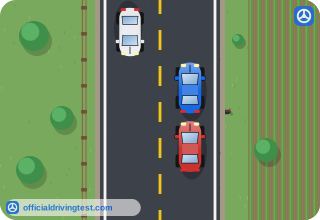
- Brake sharply to make the driver back off
- Pull off on a turnout and allow them to pass
- Speed up to keep a gap behind your vehicle
- Stop in your lane until the driver passes
Show answer
Correct answer: Pull off on a turnout and allow them to pass
When you are being followed closely, you should slow down to encourage the vehicle behind to pass, or pull off on a turnout and allow it to pass.
Source: Montana Driver Manual (Revised April 2024), page 65
-
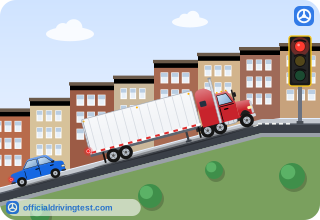
Why should you leave extra space when you are stopped on a hill?
- Your own brake lights are harder to see on a hill
- Vehicles on a hill may not be passed by other drivers
- The vehicle ahead may roll back when it starts up
- The vehicle ahead must stop for at least three seconds
Show answer
Correct answer: The vehicle ahead may roll back when it starts up
You leave extra space when stopped on a hill because the vehicle ahead may roll back when it starts up.
Source: Montana Driver Manual (Revised April 2024), page 65
-
How can you help keep the driver behind you at a safe distance?
- Drive a few miles below the speed limit at all times
- Keep a steady speed and signal in advance when you must slow down
- Move to the center line so the driver can see you better
- Slow down often so the driver learns to stay back
Show answer
Correct answer: Keep a steady speed and signal in advance when you must slow down
You can help keep the driver behind at a safe distance by keeping a steady speed and signaling in advance when you must slow down.
Source: Montana Driver Manual (Revised April 2024), page 65
-
Why should you never slow down quickly to discourage a tailgater?
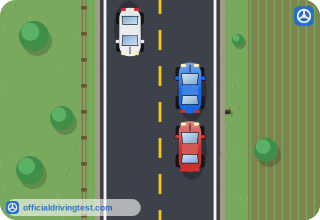
- It only increases your risk of being hit from behind
- It makes the tailgater follow even more closely
- It is illegal to slow down when someone is behind you
- It wastes fuel and wears out your brake pads
Show answer
Correct answer: It only increases your risk of being hit from behind
Slowing down quickly to discourage a tailgater does nothing but increase your risk of being hit from behind.
Source: Montana Driver Manual (Revised April 2024), page 65