Montana: Speed and following distance — Part 4 Practice Test
Questions in this part include: “What often causes crashes involving two or more vehicles?” · “If vehicles are piled up behind you, what should you do?”
Independent educational site · not affiliated with any government agency or DMV
Ready? Test yourself
- Instant feedback with an explanation
- Every answer cites its source in the manual
- Your best score is saved on this device
- Keyboard: press 1 to 4 to answer and Enter for the next question
Questions are original and based on the official manual "Montana Driver Manual" (Revised April 2024), Montana Department of Justice, Motor Vehicle Division.
All 19 questions in this practice test
Take the test above first, then use this list to study. Tap “Show answer” to see the correct answer and explanation.
Show the questions and answersHide the questions
-
In most cases, what causes skids?
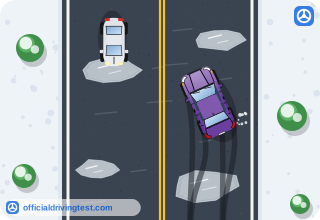
- Brakes that are worn or out of adjustment
- Drivers traveling too fast for conditions
- Roads with too many curves and bridges
- Tires that have too much air pressure in them
Show answer
Correct answer: Drivers traveling too fast for conditions
In most cases, skids are caused by drivers traveling too fast for conditions.
Source: Montana Driver Manual (Revised April 2024), page 60
-
What often causes crashes involving two or more vehicles?
- Drivers who travel at exactly the same speed as traffic
- Drivers going faster or slower than other vehicles on the road
- Drivers who keep a steady speed in the right lane
- Drivers who leave too much space around their vehicles
Show answer
Correct answer: Drivers going faster or slower than other vehicles on the road
Vehicles moving in the same direction at the same speed cannot hit one another; crashes often happen when drivers go faster or slower than other vehicles.
Source: Montana Driver Manual (Revised April 2024), page 61
-
What does the manual say about the time you save by speeding?
- It can save an hour on a long trip
- It saves a lot of time on highways
- It saves time only on two-lane roads
- It does not save more than a few minutes
Show answer
Correct answer: It does not save more than a few minutes
The manual says speeding does not save more than a few minutes, so you should drive with the flow of traffic.
Source: Montana Driver Manual (Revised April 2024), page 61
-
What can happen when you drive much slower than other vehicles?
- Traffic ahead of you speeds up to leave you more room
- Vehicles bunch up behind you and other traffic passes you
- Other drivers become more careful and keep more distance
- Your tires lose grip and the vehicle starts to skid
Show answer
Correct answer: Vehicles bunch up behind you and other traffic passes you
Going much slower than other vehicles can be as risky as speeding, because vehicles bunch up behind you and other traffic passes you.
Source: Montana Driver Manual (Revised April 2024), page 61
-
If vehicles are piled up behind you, what should you do?
- Slow down more so they pass you at once
- Stay in your lane and brake lightly to warn them
- Pull over and let them pass when it is safe
- Move to the left lane and stay beside them
Show answer
Correct answer: Pull over and let them pass when it is safe
The manual says to pull over and let them pass when it is safe to do so.
Source: Montana Driver Manual (Revised April 2024), page 61
-
What should you do when you turn from a high-speed, two-lane roadway with traffic following you?
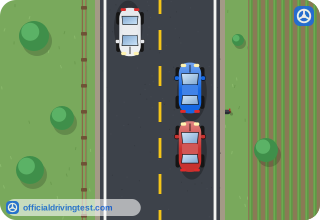
- Slow down gradually over a long distance before the turn
- Stop in the lane and wait until traffic has passed you
- Turn on your hazard lights and slow down early
- Tap your brakes and reduce your speed quickly but safely
Show answer
Correct answer: Tap your brakes and reduce your speed quickly but safely
Try not to slow down too early with traffic following; tap your brakes and reduce your speed quickly, but safely.
Source: Montana Driver Manual (Revised April 2024), page 62
-
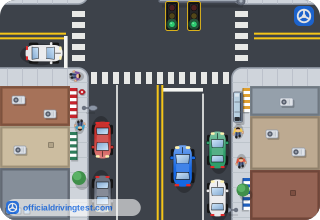
Why do you need to lower your speed wherever people or traffic gathers?
- Other drivers expect you to drive below the speed limit
- Your room to maneuver is limited, so you need time to react
- The road surface is usually slippery in crowded places
- Brakes work less well when many vehicles are nearby
Show answer
Correct answer: Your room to maneuver is limited, so you need time to react
Wherever people or traffic gathers, your room to maneuver is limited and you need to lower your speed to have time to react in a crowded space.
Source: Montana Driver Manual (Revised April 2024), page 62
-
What do rush hours often involve?
- Light traffic with many drivers going very slowly
- Long stretches of road with few other vehicles
- Heavy traffic and drivers that always seem to be in a hurry
- Few vehicles but many pedestrians crossing at random
Show answer
Correct answer: Heavy traffic and drivers that always seem to be in a hurry
The manual lists rush hours as a place to slow down because they often involve heavy traffic and drivers that always seem to be in a hurry.
Source: Montana Driver Manual (Revised April 2024), page 62
-
Why should you slow down at narrow bridges and tunnels?
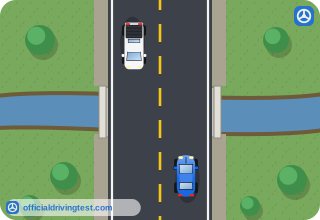
- Vehicles approaching each other are closer together
- Headlights are less visible to oncoming drivers there
- Vehicles in tunnels must stop for oncoming traffic
- Narrow bridges and tunnels have no speed limit
Show answer
Correct answer: Vehicles approaching each other are closer together
On narrow bridges and tunnels, vehicles approaching each other are closer together.
Source: Montana Driver Manual (Revised April 2024), page 62
-
What is happening at a toll plaza that is a reason to slow down?
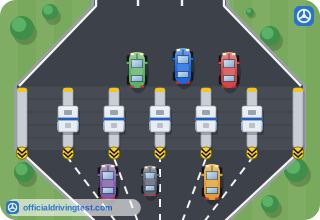
- Vehicles must come to a complete stop and stay in one lane
- Vehicles are changing lanes and preparing to stop, then speeding up again
- Most drivers there are going much faster than the speed limit
- The lanes always merge into one lane before the plaza
Show answer
Correct answer: Vehicles are changing lanes and preparing to stop, then speeding up again
At toll plazas vehicles change lanes, prepare to stop and then speed up as they leave, and the number of lanes could change before and after the plaza.
Source: Montana Driver Manual (Revised April 2024), page 62
-
Why should you be alert in school zones, playgrounds, and residential streets?
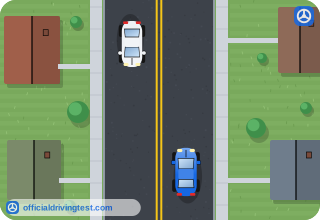
- Children there always stop at the curb before crossing
- Vehicles must stop completely at every driveway there
- Traffic signals there are timed to stop all vehicles together
- Children may cross the street, run, or ride into it without looking
Show answer
Correct answer: Children may cross the street, run, or ride into it without looking
These areas often have children present, so you should always be alert for children crossing the street, running, or riding into the street without looking.
Source: Montana Driver Manual (Revised April 2024), page 62
-
At night, within what distance must you be able to stop?
- The distance you can see ahead with your headlights
- The distance to the next intersection or sign ahead
- The distance shown on the posted speed limit sign
- Half of the distance you can see with high beams
Show answer
Correct answer: The distance you can see ahead with your headlights
You must be able to stop within the distance you can see ahead with your headlights, so you should drive at a speed that allows it.
Source: Montana Driver Manual (Revised April 2024), page 63
-
How does seeing an object at night compare with seeing it in the daytime?
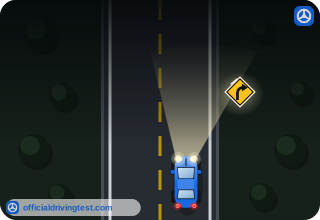
- You can see objects from farther away at night
- You can see objects at the same distance as in daylight
- You need to be closer to the object to see it at night
- You can see dark objects better than light objects
Show answer
Correct answer: You need to be closer to the object to see it at night
It is harder to see at night: you need to be closer to an object to see it than during the day.
Source: Montana Driver Manual (Revised April 2024), page 63
-
What should you do with your headlights when you drive in rain, fog, or snow?
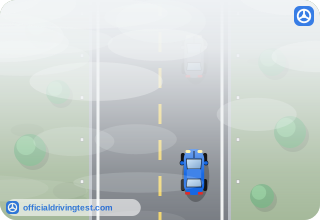
- Turn them off to avoid glare reflecting in the fog
- Use them only when you cannot see anything ahead
- Drive with them on so other vehicles can see you
- Use them only after the sun has gone down
Show answer
Correct answer: Drive with them on so other vehicles can see you
The manual says to drive with headlights on in rain, fog, or snow so other vehicles can see you.
Source: Montana Driver Manual (Revised April 2024), page 63
-
What should you do when you come to a hill or curve where you cannot see over or around it?
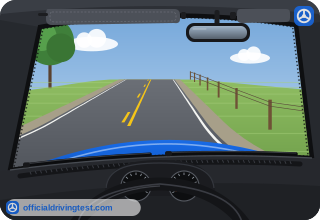
- Keep your speed because you know the road well
- Stay in the center of the road for the best view
- Sound your horn and keep your normal speed
- Adjust your speed so you can stop if necessary
Show answer
Correct answer: Adjust your speed so you can stop if necessary
A car could be stalled just over a hill or around a curve, so you must be able to stop and should adjust your speed accordingly.
Source: Montana Driver Manual (Revised April 2024), page 63
-
Vehicles parked along the side of the road can block your view. What should you give them?
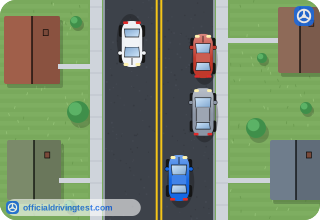
- Only enough room to pass
- As much room as you can
- No extra room if the shoulder is wide
- Room only when you are driving at night
Show answer
Correct answer: As much room as you can
People may be ready to get out of a car or walk out from between parked vehicles, so give parked vehicles as much room as you can.
Source: Montana Driver Manual (Revised April 2024), page 63
-
When you use the Four Second Sight Distance Rule, you reach the object you picked out before you finish saying “four-one-thousand.” What does that tell you?
- You are going too fast for your sight distance and need to slow down
- You are driving at a safe speed for your sight distance
- You are following the vehicle ahead too closely and must brake
- You should switch to your high beams to see farther
Show answer
Correct answer: You are going too fast for your sight distance and need to slow down
If you reach the object before you finish saying “four-one-thousand,” you are going too fast for your sight distance and need to slow down.
Source: Montana Driver Manual (Revised April 2024), page 64
-
In the Four Second Sight Distance Rule, which object do you pick out and count from?
- A moving vehicle as far ahead as you can clearly see
- The nearest sign or pole beside your vehicle
- A stationary object as far ahead as you can clearly see
- The center line at the front of your vehicle
Show answer
Correct answer: A stationary object as far ahead as you can clearly see
You pick out a stationary object, such as a sign or telephone pole, as far ahead as you can clearly see and start counting.
Source: Montana Driver Manual (Revised April 2024), page 64
-
What can you use the “Four Second Sight Distance Rule” for at night?
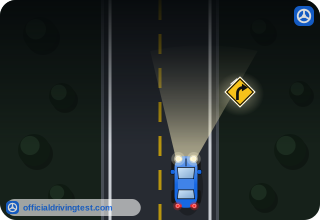
- To decide when to switch to your high beams
- To make sure you are not “over driving” your headlights
- To measure how far away oncoming headlights are
- To check that your headlights are aimed correctly
Show answer
Correct answer: To make sure you are not “over driving” your headlights
The rule can also be used at night to make sure you are not “over driving” your headlights.
Source: Montana Driver Manual (Revised April 2024), page 64