Montana: Speed and following distance — Part 2 Practice Test
Questions in this part include: “On a highway where the speed limit is 55 mph or more, what is the fastest a driver in a funeral procession may drive?” · “According to the manual, where must you look to know what is happening around your vehicle?”
Independent educational site · not affiliated with any government agency or DMV
Ready? Test yourself
- Instant feedback with an explanation
- Every answer cites its source in the manual
- Your best score is saved on this device
- Keyboard: press 1 to 4 to answer and Enter for the next question
Questions are original and based on the official manual "Montana Driver Manual" (Revised April 2024), Montana Department of Justice, Motor Vehicle Division.
All 19 questions in this practice test
Take the test above first, then use this list to study. Tap “Show answer” to see the correct answer and explanation.
Show the questions and answersHide the questions
-
On a highway where the speed limit is 55 mph or more, what is the fastest a driver in a funeral procession may drive?
- 55 mph
- 45 mph
- 60 mph
- 65 mph
Show answer
Correct answer: 55 mph
A driver in a funeral procession may not drive faster than 55 miles per hour on a highway where the speed limit is 55 miles per hour or more.
Source: Montana Driver Manual (Revised April 2024), page 42
-
On other streets or roads, how far below the posted speed limit may a driver in a funeral procession drive, at most?
- 10 mph
- 15 mph
- 5 mph
- 20 mph
Show answer
Correct answer: 5 mph
On streets or roads other than highways posted at 55 mph or more, a driver in a funeral procession may not drive more than 5 miles per hour below the posted speed limit.
Source: Montana Driver Manual (Revised April 2024), page 42
-
Where should you look when steering, according to the manual?
- Well down the road, not just at the road in front of your vehicle
- Only at the road directly in front of your vehicle, to see hazards
- At the hands you have placed on the steering wheel
- At the vehicle directly ahead of you and nowhere else
Show answer
Correct answer: Well down the road, not just at the road in front of your vehicle
Looking well down the road lets you see where you will need to steer so you have time to steer smoothly and safely.
Source: Montana Driver Manual (Revised April 2024), page 50
-
What does the manual say is the best way to control your speed?
- Know your speed by checking the speedometer often
- Follow the vehicle ahead at the same speed
- Judge your speed by the sound of the engine
- Keep the same speed on every kind of road
Show answer
Correct answer: Know your speed by checking the speedometer often
The best way to control your speed is to know how fast you are going, so you should check the speedometer often.
Source: Montana Driver Manual (Revised April 2024), page 51
-
When does the manual say you may be going much faster than you think?
- When you drive uphill on a mountain road with little traffic
- When you drive in heavy traffic on a busy city street
- When you leave high-speed roads and drive on much slower local roads
- When you follow another vehicle at night on a highway
Show answer
Correct answer: When you leave high-speed roads and drive on much slower local roads
People are not very good at judging speed, especially when leaving high-speed roads for much slower local roads.
Source: Montana Driver Manual (Revised April 2024), page 51
-
According to the manual, what does stopping suddenly usually point to?
- A driver whose brakes are worn
- A driver who is following the speed limit
- A driver who has good vision
- A driver who was not paying attention
Show answer
Correct answer: A driver who was not paying attention
Stopping suddenly is dangerous and usually points to a driver who was not paying attention.
Source: Montana Driver Manual (Revised April 2024), page 51
-
What can happen when you brake quickly?
- You could skid and lose control, and make it harder for drivers behind to stop
- Your tires will grip better and you will stop in a shorter distance
- Your brakes will cool down faster and last longer after heavy use
- Drivers behind you will have more time to react to your vehicle
Show answer
Correct answer: You could skid and lose control, and make it harder for drivers behind to stop
Braking quickly could make you skid and lose control, and it makes it harder for drivers behind you to stop without hitting you.
Source: Montana Driver Manual (Revised April 2024), page 51
-
How can you try to avoid panic stops?
- Follow the vehicle ahead more closely to react sooner
- Brake hard only when the vehicle ahead stops suddenly
- See events well in advance, then slow down or change lanes
- Stay in the left lane so that you can stop quickly
Show answer
Correct answer: See events well in advance, then slow down or change lanes
By seeing events well in advance and slowing down or changing lanes, you may not have to stop at all, or you can stop more gradually and safely.
Source: Montana Driver Manual (Revised April 2024), page 51
-
According to the manual, what is the single biggest contributor to crashes?
- Driving above the speed limit
- Failing to see what is happening
- Driving with worn tires
- Driving at night
Show answer
Correct answer: Failing to see what is happening
The manual says the single biggest contributor to crashes is failing to see what is happening.
Source: Montana Driver Manual (Revised April 2024), page 51
-
According to the manual, where must you look to know what is happening around your vehicle?
- Only straight ahead, at the road in front of your vehicle
- Only ahead and in the rearview mirror
- Only to the sides, at intersections
- Ahead, to the sides, and behind your vehicle
Show answer
Correct answer: Ahead, to the sides, and behind your vehicle
The manual says you must look ahead, to the sides, and behind your vehicle.
Source: Montana Driver Manual (Revised April 2024), page 52
-
How many seconds of road ahead of your vehicle does the manual say you should scan?
- At least 10 seconds ahead
- At least 5 seconds ahead
- At least 20 seconds ahead
- At least 30 seconds ahead
Show answer
Correct answer: At least 10 seconds ahead
You should look down the road at least 10 seconds ahead of your vehicle.
Source: Montana Driver Manual (Revised April 2024), page 52
-
In the city, how far ahead is 10 seconds, according to the manual?
- About two blocks
- About half a block
- About one block
- About three blocks
Show answer
Correct answer: About one block
In the city, 10 seconds is about one block, so in city traffic you should try to look at least one block ahead.
Source: Montana Driver Manual (Revised April 2024), page 52
-
According to the manual, how can you figure out whether you are looking 10 seconds ahead?
- Count the number of vehicles you can see on the road ahead of you
- Pick a non-moving object, like a sign, and count the seconds to reach it
- Check how long the vehicle in front of you takes to reach a sign
- Count the seconds it takes you to see the next intersection ahead
Show answer
Correct answer: Pick a non-moving object, like a sign, and count the seconds to reach it
You find a non-moving object such as a sign or telephone pole and count until you reach it; the count is the number of seconds ahead you were looking.
Source: Montana Driver Manual (Revised April 2024), page 52
-
Besides driving more safely, what does the manual say looking well ahead can save?
- Tire wear
- Engine oil
- Brake fluid
- Fuel
Show answer
Correct answer: Fuel
Looking well ahead lets you slow down gradually or change lanes and avoid the quick stops that take time and fuel to get back up to speed.
Source: Montana Driver Manual (Revised April 2024), page 52
-
How does looking well down the road affect your steering?
- It helps you steer straighter with less weaving
- It lets you steer with only one hand
- It means you need to check mirrors less often
- It keeps you from having to signal
Show answer
Correct answer: It helps you steer straighter with less weaving
Looking well down the road helps you steer straighter with less weaving.
Source: Montana Driver Manual (Revised April 2024), page 52
-
Why does the manual say traffic would flow more smoothly if everyone looked well ahead?
- Drivers would be able to use their horns less often in heavy traffic
- Everyone would be able to drive at a higher speed on every road
- Changes made before the last moment give drivers behind you more time to react
- Drivers would no longer need to use their turn signals to turn
Show answer
Correct answer: Changes made before the last moment give drivers behind you more time to react
Making driving changes before the last moment gives drivers behind you more time to react, which keeps traffic moving at a steady pace.
Source: Montana Driver Manual (Revised April 2024), page 52
-
Because vision is reduced at night, what does the manual say you should do?
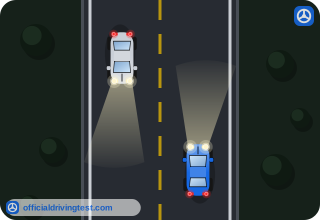
- Slow down
- Switch to parking lights
- Use only your high beams
- Follow other vehicles more closely
Show answer
Correct answer: Slow down
The manual says that because vision is reduced at night, drivers cannot see as well, so they should slow down.
Source: Montana Driver Manual (Revised April 2024), page 55
-
How does the distance needed to stop at 60 mph compare with the distance needed at 30 mph?
- Twice the distance
- About the same distance
- Exactly one and a half times
- Over three times the distance
Show answer
Correct answer: Over three times the distance
The manual says stopping at 60 mph does not take twice the distance it takes at 30 mph, but over three times the distance.
Source: Montana Driver Manual (Revised April 2024), page 59
-
Which of these is a road condition where the manual says you must slow down to be safe?
- A dry, straight concrete road
- Standing water on the road
- A road with a wide shoulder
- A freshly paved, dry road
Show answer
Correct answer: Standing water on the road
The manual says you must slow down before a curve, when the roadway is slippery, and when there is standing water on the road.
Source: Montana Driver Manual (Revised April 2024), page 59