Montana: Right-of-way, turning and passing — Part 5 Practice Test
Questions in this part include: “While waiting to complete a left turn, which way should your wheels point?” · “About how large a gap do you need anytime you want to merge with other traffic?”
Independent educational site · not affiliated with any government agency or DMV
Ready? Test yourself
- Instant feedback with an explanation
- Every answer cites its source in the manual
- Your best score is saved on this device
- Keyboard: press 1 to 4 to answer and Enter for the next question
Questions are original and based on the official manual "Montana Driver Manual" (Revised April 2024), Montana Department of Justice, Motor Vehicle Division.
All 17 questions in this practice test
Take the test above first, then use this list to study. Tap “Show answer” to see the correct answer and explanation.
Show the questions and answersHide the questions
-
While waiting to complete a left turn, which way should your wheels point?
- Toward the left
- Toward the right
- Toward the curb
- Straight ahead
Show answer
Correct answer: Straight ahead
With the wheels straight ahead, being struck from behind will not force you into oncoming traffic.
Source: Montana Driver Manual (Revised April 2024), page 58
-
When making a left turn, whom must you yield the right-of-way to?
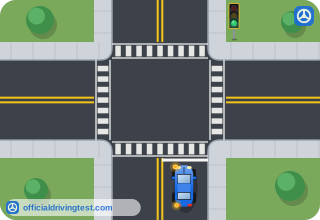
- Following vehicles
- Oncoming traffic
- Parked vehicles
- Vehicles waiting to turn right
Show answer
Correct answer: Oncoming traffic
The manual says to look and yield right-of-way to oncoming traffic when making a left turn.
Source: Montana Driver Manual (Revised April 2024), page 58
-
When completing a left turn, where should you enter the street?
- Just to the right of the center
- Just to the left of the center
- At the far right edge of the road
- Across the center, cutting the corner
Show answer
Correct answer: Just to the right of the center
You enter the street just to the right of the center and do not cut corners.
Source: Montana Driver Manual (Revised April 2024), page 58
-
After completing a left turn, what does the manual say to do?
- Stay near the centerline until the next intersection
- Move quickly to the right edge of the roadway
- Gradually move to the center of your lane
- Speed up and stay in the left part of the lane
Show answer
Correct answer: Gradually move to the center of your lane
After the turn you gradually move to the center of your lane and make sure the signal has canceled.
Source: Montana Driver Manual (Revised April 2024), page 58
-
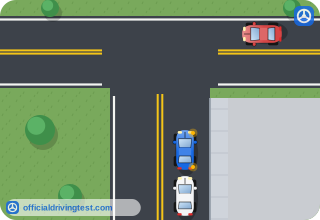
How close to the edge of the road should a right turn be made?
- With a wide swing into the left lane first
- As close to the right edge as practical
- From the middle of the roadway
- From the center of the lane
Show answer
Correct answer: As close to the right edge as practical
Right turns should be made as close as practical to the right edge of the curb or roadway.
Source: Montana Driver Manual (Revised April 2024), page 58
-
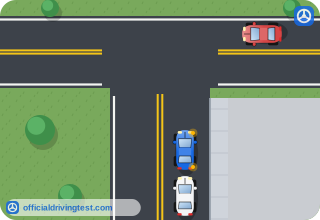
What should you NOT do when making a right turn?
- Get into the proper lane well in advance of the turn
- Signal well ahead of the turn and slow down
- Keep as close to the right side as possible
- Make a wide-sweeping turn or cross into the left lane
Show answer
Correct answer: Make a wide-sweeping turn or cross into the left lane
The manual says not to make a wide-sweeping turn or cross into the left lane.
Source: Montana Driver Manual (Revised April 2024), page 58
-
About how large a gap do you need anytime you want to merge with other traffic?
- About one second
- About two seconds
- About eight seconds
- About four seconds
Show answer
Correct answer: About four seconds
You need a gap of about four seconds anytime you want to merge with other traffic.
Source: Montana Driver Manual (Revised April 2024), page 66
-
If you move into the middle of a four-second gap, what following distance do you and the vehicle behind you each have?
- Two seconds
- One second
- Three seconds
- Four seconds
Show answer
Correct answer: Two seconds
Moving into the middle of a four-second gap gives both you and the vehicle now behind you a two-second following distance.
Source: Montana Driver Manual (Revised April 2024), page 66
-
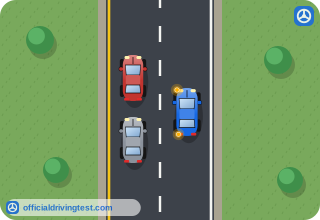
Why should you not merge into a gap that is too small?
- Your turn signal is harder to see in a small gap
- The vehicles around you may not be able to see your headlights
- A small gap can quickly become even smaller
- A small gap makes it harder for you to judge your own speed
Show answer
Correct answer: A small gap can quickly become even smaller
A small gap can quickly become even smaller, so you enter a gap that gives you a big enough space cushion to be safe.
Source: Montana Driver Manual (Revised April 2024), page 66
-
What is the safest way to cross several lanes?
- Wait until all lanes are clear, then cross all at once
- Take them one at a time
- Cross quickly in one move without checking each lane
- Stop on the lane lines and wait for gaps
Show answer
Correct answer: Take them one at a time
It is safest and easiest to merge one lane at a time, because it is very difficult to tell that all the lanes are free and safe to cross.
Source: Montana Driver Manual (Revised April 2024), page 66
-
When you cross traffic, what size gap do you need?
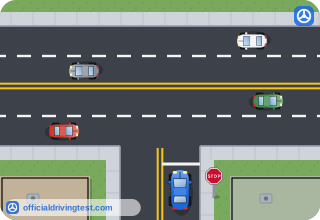
- A gap large enough to reach the middle of the road and stop there
- A gap of at least ten seconds in both directions
- A gap large enough to clear only the nearest lane
- A large enough gap to get all the way across the road without stopping
Show answer
Correct answer: A large enough gap to get all the way across the road without stopping
When you cross traffic, you need a large enough gap to get all the way across the road without stopping.
Source: Montana Driver Manual (Revised April 2024), page 66
-
When you enter traffic, what do you need?
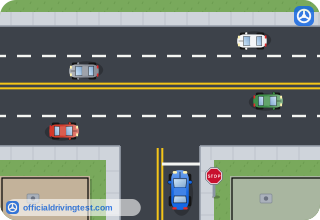
- Enough space to first turn and then get up to speed
- A gap just long enough to finish your turn
- A gap that lets you stop in the traffic lane if needed
- Enough space to turn and then match the speed of the slowest vehicle
Show answer
Correct answer: Enough space to first turn and then get up to speed
When you enter traffic, you need enough space to first turn and then get up to speed.
Source: Montana Driver Manual (Revised April 2024), page 66
-
When is it safe to stop halfway across a road you are crossing?
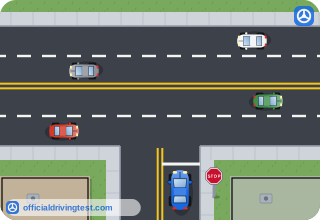
- Whenever there are no vehicles coming in the near lane
- Whenever you have your turn signal on and the road is clear
- Only when there is a median divider large enough to hold your car
- Whenever you can leave part of your vehicle sticking out safely
Show answer
Correct answer: Only when there is a median divider large enough to hold your car
Stopping halfway across is only safe when there is a median divider large enough to hold your car.
Source: Montana Driver Manual (Revised April 2024), page 66
-
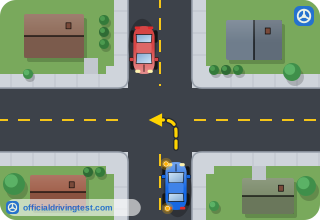
Before you turn left, what should you make sure of?
- That oncoming drivers have their turn signals on
- That no vehicles or pedestrians are blocking your path
- That you are already stopped across the oncoming lane
- That the vehicle behind you is slowing down too
Show answer
Correct answer: That no vehicles or pedestrians are blocking your path
When turning left, you make sure there are no vehicles or pedestrians blocking your path, so you are not stuck across a lane with an oncoming vehicle bearing down on you.
Source: Montana Driver Manual (Revised April 2024), page 66
-
You have a green light but cars are blocking your way across the intersection. What should you do?
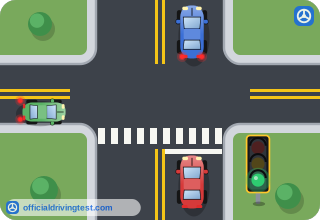
- Start across so you clear it before the light turns red
- Enter the intersection and stop in the middle until the cars move
- Sound your horn and drive around the blocking cars
- Wait; do not start across the intersection
Show answer
Correct answer: Wait; do not start across the intersection
Even with a green light, you do not start across if cars block your way, because you could be caught there when the light turns red, block other traffic, and be ticketed.
Source: Montana Driver Manual (Revised April 2024), page 66
-
An approaching vehicle has its turn signal on. What should you do instead of turning just because of the signal?
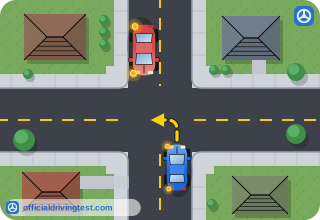
- Wait until the other driver actually starts to turn
- Turn at once, since the signal shows where it is going
- Sound your horn and turn before the vehicle slows
- Flash your headlights and turn when the driver waves
Show answer
Correct answer: Wait until the other driver actually starts to turn
The driver may plan to turn beyond you or may have forgotten to cancel a signal, so you wait until the other driver actually starts to turn and then go if it is safe.
Source: Montana Driver Manual (Revised April 2024), page 66
-
The turn signals of which kind of vehicle often do not cancel by themselves?
- Farm tractors
- School buses
- Motorcycles
- Delivery vans
Show answer
Correct answer: Motorcycles
Signals on motorcycles often do not cancel by themselves.
Source: Montana Driver Manual (Revised April 2024), page 66