Montana: Right-of-way, turning and passing
Who yields at intersections, right and left turns, turning on red, turning around, roundabouts, passing and funeral processions. Split into 5 shorter tests so you're not stuck in one long quiz.
Independent educational site · not affiliated with any government agency or DMV
Choose a part
Right-of-way, turning and passing — Part 1
Questions in this part include: “What is the speed at which you should drive in a roundabout?”
StartRight-of-way, turning and passing — Part 2
Questions in this part include: “Besides passing a vehicle that is turning left, when else is passing on the right legal?”
StartRight-of-way, turning and passing — Part 3
Questions in this part include: “When is it legal to drive on a sidewalk?”
StartRight-of-way, turning and passing — Part 4
Questions in this part include: “How closely must a driver in a funeral procession follow the vehicle ahead?”
StartRight-of-way, turning and passing — Part 5
Questions in this part include: “While waiting to complete a left turn, which way should your wheels point?”
StartAll 85 Right-of-way, turning and passing questions with answers
Choose a part above to take a practice test, or study every question and answer here.
Show the questions and answersHide the questions
-
After stopping for a steady red light when entering a two-way street, what may you do?
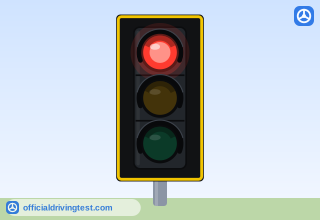
- Cautiously turn right, unless a sign or police officer tells you not to
- Turn left, as long as you yield to all oncoming traffic first
- Turn right only where a sign specifically says that you may do so
- Go straight ahead when no traffic is coming from either direction
Show answer
Correct answer: Cautiously turn right, unless a sign or police officer tells you not to
After stopping, you may cautiously turn right on red unless a sign or police officer tells you not to turn against the red light.
Source: Montana Driver Manual (Revised April 2024), page 30
-
When you turn right on a red light after stopping, whom must you yield to?
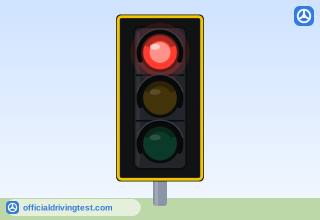
- Only the pedestrians who are in the crosswalk ahead
- Only the vehicles that are coming from your left
- Pedestrians, bicyclists, and traffic in the intersection
- No one, because you have already come to a stop
Show answer
Correct answer: Pedestrians, bicyclists, and traffic in the intersection
The manual says to yield to pedestrians, bicyclists, and traffic in the intersection, and to look for pedestrians to the left, right, and ahead.
Source: Montana Driver Manual (Revised April 2024), page 30
-
Under which condition may you turn left after stopping for a steady red light?
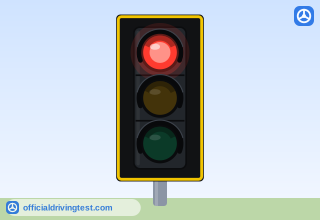
- When you are entering a one-way street from a two-way street
- When you are entering a one-way street from a one-way street
- When you are entering a two-way street from a one-way street
- When you are in the right-hand lane
Show answer
Correct answer: When you are entering a one-way street from a one-way street
The manual allows a left turn after stopping for the red light when entering a one-way street from a one-way street, yielding if needed.
Source: Montana Driver Manual (Revised April 2024), page 30
-
When there is no green arrow, what must left-turning and right-turning traffic do?
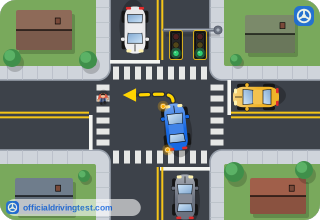
- Wait until the signal changes to red
- Turn first, since turning traffic has the right of way
- Use the turn lane to go ahead of oncoming traffic
- Yield right of way to oncoming traffic and pedestrians
Show answer
Correct answer: Yield right of way to oncoming traffic and pedestrians
Without a green arrow, turning traffic is unprotected and must yield right of way to oncoming traffic and pedestrians.
Source: Montana Driver Manual (Revised April 2024), page 31
-
What is the speed at which you should drive in a roundabout?
- 15 mph or less
- 25 mph or less
- 35 mph or less
- 10 mph or less
Show answer
Correct answer: 15 mph or less
The manual says driving speeds in roundabouts are 15 mph or less.
Source: Montana Driver Manual (Revised April 2024), page 32
-
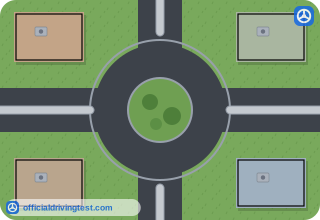
Who has the right-of-way at a roundabout?
- Vehicles that are entering the roundabout
- The vehicle on the largest street
- Vehicles that are already in the roundabout
- The vehicle that reaches the entrance first
Show answer
Correct answer: Vehicles that are already in the roundabout
Drivers entering a roundabout yield to vehicles already in it, because those vehicles have the right-of-way.
Source: Montana Driver Manual (Revised April 2024), page 32
-
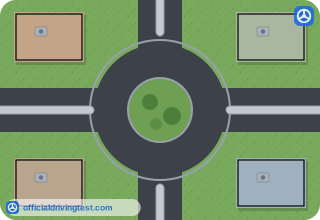
In which direction does traffic flow in a roundabout?
- Clockwise
- Counterclockwise
- Toward the center island
- Either way, depending on the exit
Show answer
Correct answer: Counterclockwise
The manual states that traffic in a roundabout flows in a counterclockwise direction.
Source: Montana Driver Manual (Revised April 2024), page 32
-
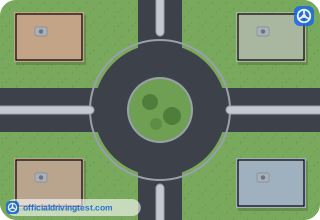
After you enter a roundabout, where should you stay?
- To the left of the center island
- On the truck apron
- In the middle of the circle
- To the right of the center island
Show answer
Correct answer: To the right of the center island
The manual says to enter the roundabout and stay to the right of the center island.
Source: Montana Driver Manual (Revised April 2024), page 32
-
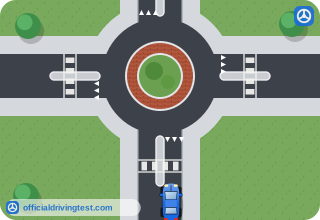
You reach a roundabout and the way is clear. What should you do?
- Enter without stopping
- Stop completely before entering
- Stop and count to three
- Wait for oncoming traffic to pass
Show answer
Correct answer: Enter without stopping
The manual says not to stop at a roundabout if the way is clear.
Source: Montana Driver Manual (Revised April 2024), page 32
-
What must you never do after entering a single-lane roundabout?
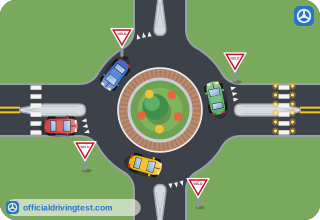
- Use your right-turn signal
- Slow down for a pedestrian
- Pass or overtake another vehicle
- Travel to your desired street
Show answer
Correct answer: Pass or overtake another vehicle
The manual says never to pass or overtake another vehicle after entering a single-lane roundabout.
Source: Montana Driver Manual (Revised April 2024), page 32
-
Which signal should you use to leave a roundabout when you reach your desired street?
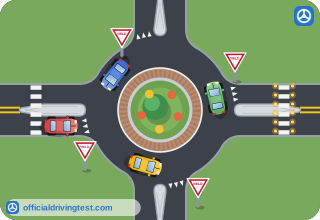
- Your left-turn signal
- Your right-turn signal
- Your hazard lights
- No signal is needed
Show answer
Correct answer: Your right-turn signal
The manual says to travel around the circle until you reach your desired street, use your right-turn signal, and exit.
Source: Montana Driver Manual (Revised April 2024), page 32
-
You are driving in a travel lane and become confused about where to go. What does the manual say to do?
- Stop in your lane and check your map or phone
- Keep moving until you can safely pull off
- Back up slowly to the last intersection you passed
- Slow to a crawl and stay in the lane
Show answer
Correct answer: Keep moving until you can safely pull off
Never back up or stop in any travel lane for any reason, including confusion. Keep moving until you can safely pull off the road.
Source: Montana Driver Manual (Revised April 2024), page 37
-
On a road with three or more lanes going in the same direction, which lane do the basic laws tell you to stay in, except to pass?
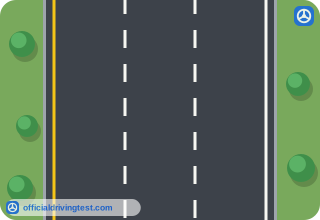
- The left lane
- Any lane with the least traffic
- The lane closest to the centerline
- The right lane
Show answer
Correct answer: The right lane
One of the basic laws is to stay in the right lane, except to pass, on a road with three or more lanes traveling in the same direction.
Source: Montana Driver Manual (Revised April 2024), page 37
-
On a road with three or more lanes going in the same direction, which lane does the manual say to use when a lot of traffic is entering?
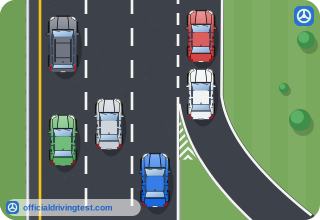
- The left-most lane
- The center travel lane
- The paved shoulder
- The shared center turn lane
Show answer
Correct answer: The center travel lane
When there is a lot of traffic entering, the manual says to use the center travel lane.
Source: Montana Driver Manual (Revised April 2024), page 37
-
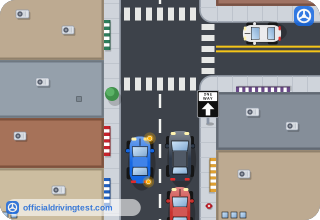
You are approaching a turn but find you are in the wrong lane, or you forgot to signal. What should you do?
- Turn anyway from the lane you are in now
- Turn at the next intersection from the proper lane
- Stop in your lane until you can merge over
- Back up and move into the proper lane
Show answer
Correct answer: Turn at the next intersection from the proper lane
You should proceed, get into the proper lane, go to the next intersection, signal, and then turn.
Source: Montana Driver Manual (Revised April 2024), page 37
-
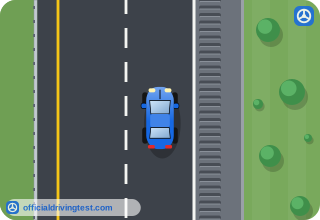
When may you drive on the shoulder of the road?
- Whenever traffic ahead is slow
- To pass a vehicle turning left
- Whenever the shoulder is paved
- Only when you are told to do so
Show answer
Correct answer: Only when you are told to do so
Unless told to do so, never drive on the shoulder of the road.
Source: Montana Driver Manual (Revised April 2024), page 37
-
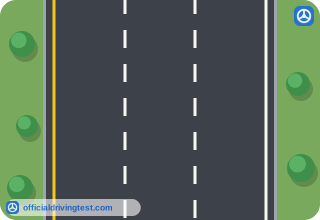
On multi-lane roads, what is the left-most lane intended to be used for?
- Trucks and buses
- Slow-moving vehicles
- Passing slower vehicles
- Vehicles entering the road
Show answer
Correct answer: Passing slower vehicles
On multi-lane roads, the left-most lane is intended to be used to pass slower vehicles.
Source: Montana Driver Manual (Revised April 2024), page 38
-
Passing on the right is legal when the vehicle you are passing is doing what?
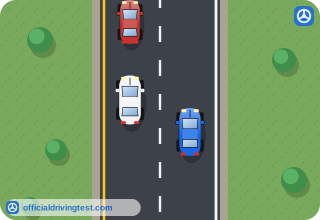
- Making or about to make a left turn
- Driving below the speed limit
- Pulling onto the shoulder to stop
- Stopped for a pedestrian in a crosswalk
Show answer
Correct answer: Making or about to make a left turn
Passing on the right is legal when the vehicle you are passing is making or about to make a left turn, and only on the pavement, never on the shoulder.
Source: Montana Driver Manual (Revised April 2024), page 38
-
Besides passing a vehicle that is turning left, when else is passing on the right legal?
- On a two-lane road when no oncoming traffic is in sight
- On a paved shoulder that is wide and free of any debris
- On any road when the driver ahead waves you past
- On pavement wide enough for two or more lanes in your direction
Show answer
Correct answer: On pavement wide enough for two or more lanes in your direction
Passing on the right is also legal on a road with unobstructed pavement wide enough for two or more lanes of vehicles legally going in the same direction.
Source: Montana Driver Manual (Revised April 2024), page 38
-
What does the manual say about passing on the shoulder of the road?
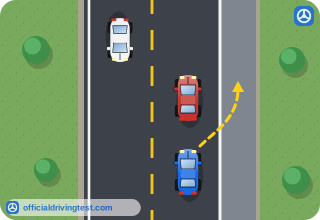
- Allowed only if the shoulder is paved
- Never pass on it, paved or not
- Allowed when traffic ahead is stopped
- Allowed to pass a vehicle turning left
Show answer
Correct answer: Never pass on it, paved or not
You cannot pass on the right by driving off the pavement, which means never passing on the shoulder, whether it is paved or not.
Source: Montana Driver Manual (Revised April 2024), page 38
-
Why does the manual warn that passing on the right can be risky?
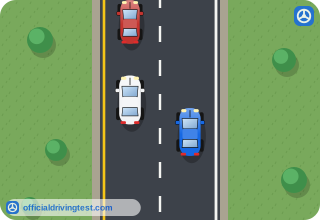
- Your own mirrors cannot show the right lane at all
- The driver may not see you and may move into your lane
- Oncoming traffic will be closer to your vehicle
- Vehicles turning right always have the right-of-way
Show answer
Correct answer: The driver may not see you and may move into your lane
If you pass on the right, the other driver may have difficulty seeing you and might suddenly change lanes in front of you.
Source: Montana Driver Manual (Revised April 2024), page 38
-
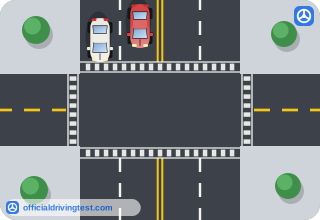
Where no signs or lane markings control turning, which lane should you turn from?
- Whichever lane has the least traffic in it
- Always the far left lane of the road
- The center lane, to allow a wider turn
- The lane nearest the direction you will go
Show answer
Correct answer: The lane nearest the direction you will go
Where no signs or lane markings control turning, turn from the lane closest to the direction you want to go and into the lane closest to the one you came from.
Source: Montana Driver Manual (Revised April 2024), page 38
-
What is gained by turning from the lane nearest your new direction and into the lane nearest the one you came from?
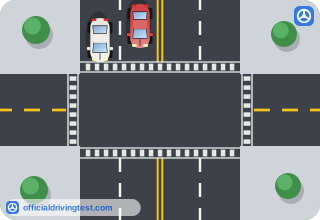
- You cross the fewest lanes of traffic
- You make the widest, smoothest turn
- You can turn at a higher speed
- Drivers behind you can pass on the right
Show answer
Correct answer: You cross the fewest lanes of traffic
Turning from and into the closest lanes means you will cross the fewest lanes of traffic.
Source: Montana Driver Manual (Revised April 2024), page 38
-
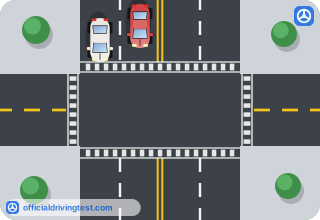
How should you go from one lane to the other while making a turn?
- In a wide arc to make the turn easier on you
- By first moving into the lane next to yours
- As directly as possible, without crossing lane lines
- Through the shared center lane when available
Show answer
Correct answer: As directly as possible, without crossing lane lines
When making turns, go from one lane to the other as directly as possible without crossing lane lines or interfering with traffic.
Source: Montana Driver Manual (Revised April 2024), page 38
-
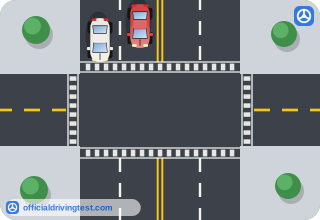
When may you change to another lane, if you need to, after making a turn?
- While still in the intersection
- Only after one full city block
- Only at the next intersection
- Once you have completed the turn
Show answer
Correct answer: Once you have completed the turn
Once you have completed your turn, you can change to another lane if you need to.
Source: Montana Driver Manual (Revised April 2024), page 38
-
What should you avoid doing when making a right turn?
- Slowing down before the turn
- Swinging wide to the left first
- Turning into the nearest lane
- Signaling 100 feet ahead in town
Show answer
Correct answer: Swinging wide to the left first
On right turns, avoid swinging wide to the left before turning to make the turn easier.
Source: Montana Driver Manual (Revised April 2024), page 38
-
If you swing wide before a right turn, what may the driver behind you try to do?
- Stop and wait for you to back up
- Turn right in front of you
- Pass you on the right
- Pull onto the left shoulder
Show answer
Correct answer: Pass you on the right
If you swing wide, the driver behind you may think you are changing lanes or turning left and may try to pass you on the right.
Source: Montana Driver Manual (Revised April 2024), page 38
-
When making a left turn, why should you avoid cutting the corner too sharply?
- You may run into someone approaching from the left
- You may scrape the curb on the right side of the road
- Oncoming drivers will think you are turning right
- You may block the lane for traffic behind you
Show answer
Correct answer: You may run into someone approaching from the left
When making a left turn, avoid cutting the corner so sharply that you run into someone approaching from the left.
Source: Montana Driver Manual (Revised April 2024), page 38
-
When making a left turn, the manual says you must leave room for whom?
- Oncoming vehicles turning left in front of you
- A vehicle behind you to pass on the right
- Pedestrians who are waiting at the corner
- Parked cars along the side of the road
Show answer
Correct answer: Oncoming vehicles turning left in front of you
When making a left turn, you must leave room for oncoming vehicles to turn left in front of you.
Source: Montana Driver Manual (Revised April 2024), page 38
-
To turn around on a roadway, how far of unobstructed view in both directions must the driver have, with no vehicles approaching?
- 100 feet
- 200 feet
- 500 feet
- 1,000 feet
Show answer
Correct answer: 500 feet
You may turn around on a roadway where the driver has 500 feet of unobstructed view in both directions and no vehicles are approaching.
Source: Montana Driver Manual (Revised April 2024), page 39
-
According to the manual, turning around on a busy street or near a curve or hill is what?
- Legal if you signal first
- Illegal and dangerous
- Legal if no officer is present
- Allowed only at night
Show answer
Correct answer: Illegal and dangerous
The manual says turning around on a busy street or near a curve or hill is both illegal and dangerous.
Source: Montana Driver Manual (Revised April 2024), page 39
-
What do most city ordinances say about U-turns in the middle of a block?
- Most allow them at night
- Most allow them with a signal
- Most allow them on quiet streets
- Most prohibit them
Show answer
Correct answer: Most prohibit them
Most city ordinances prohibit U-turns in the middle of a block, and some prohibit U-turns entirely.
Source: Montana Driver Manual (Revised April 2024), page 39
-
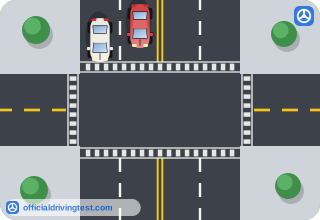
The manual says no vehicle shall be turned at any time unless which conditions are met?
- It has signaled for at least 500 feet
- Traffic behind it has come to a stop
- It is in the proper lane and it is safe
- An officer or flagger has waved it on
Show answer
Correct answer: It is in the proper lane and it is safe
No vehicle shall be turned at any time unless it is in the proper lane and it is safe to do so.
Source: Montana Driver Manual (Revised April 2024), page 39
-
According to the manual, when must you do everything you can to avoid striking a pedestrian or another vehicle?
- Regardless of the circumstances
- Only when you have the right-of-way
- Only when they are in a crosswalk
- Only inside school and park zones
Show answer
Correct answer: Regardless of the circumstances
You must do everything you can to prevent striking a pedestrian or another vehicle, regardless of the circumstances.
Source: Montana Driver Manual (Revised April 2024), page 39
-
When is it legal to drive on a sidewalk?
- Only to cross it
- To pass stopped traffic
- To reach a parking spot
- When the street is blocked
Show answer
Correct answer: Only to cross it
It is illegal to drive on a sidewalk, except to cross it.
Source: Montana Driver Manual (Revised April 2024), page 40
-
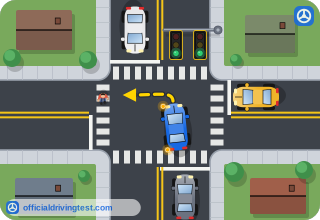
At an intersection, drivers turning left must yield to whom?
- Oncoming cars going straight ahead
- Vehicles waiting behind them
- Cross traffic facing a red light
- No one, if their light is green
Show answer
Correct answer: Oncoming cars going straight ahead
Drivers turning left must yield to oncoming cars going straight ahead.
Source: Montana Driver Manual (Revised April 2024), page 40
-
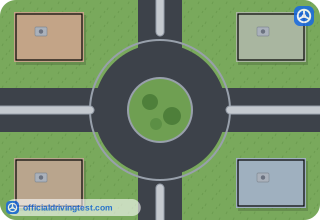
Drivers entering a traffic circle or rotary must yield to whom?
- Drivers entering from the right
- Larger vehicles only
- Drivers already in the circle
- No one, once they signal
Show answer
Correct answer: Drivers already in the circle
Drivers entering a traffic circle or rotary must yield to drivers already in the circle.
Source: Montana Driver Manual (Revised April 2024), page 40
-
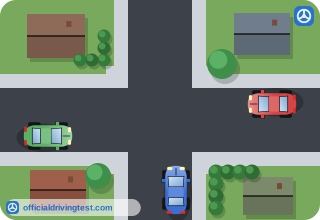
At an intersection with no stop sign or traffic signal, which vehicles should drivers yield to?
- Vehicles coming from the left
- Vehicles coming from the right
- The larger of the vehicles
- The vehicle going faster
Show answer
Correct answer: Vehicles coming from the right
At an intersection where there is no stop sign or traffic signal, drivers should yield to vehicles coming from the right, and always be prepared to yield to avoid a crash.
Source: Montana Driver Manual (Revised April 2024), page 40
-
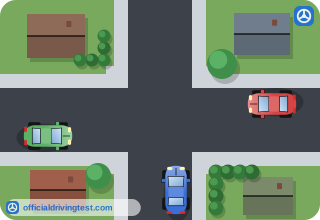
To be prepared to yield at an intersection, you take your foot off the accelerator and cover the brake. In which order should you then look?
- Right, left, and right again
- Straight ahead, then right
- Right only, then ahead
- Left, right, and left again
Show answer
Correct answer: Left, right, and left again
To be prepared to yield and avoid a crash, take your foot off the accelerator, cover the brake, and look left, right, and left again.
Source: Montana Driver Manual (Revised April 2024), page 40
-
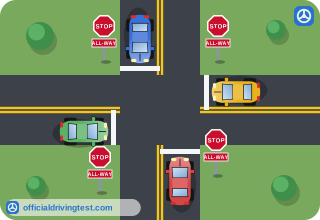
At a four-way stop, which driver gets to go first?
- The driver on the right, always
- The largest vehicle
- The driver who reached it first
- The driver going straight
Show answer
Correct answer: The driver who reached it first
At a four-way stop, the driver reaching the intersection first gets to go first, after coming to a complete stop.
Source: Montana Driver Manual (Revised April 2024), page 40
-
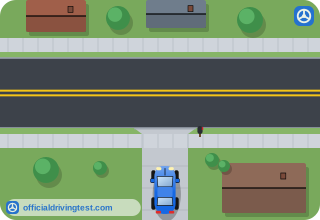
What must a driver entering a road from a driveway, alley, or roadside do?
- Stop and yield to vehicles on the main road
- Enter first, since others must yield
- Signal and then pull out right away
- Yield only to vehicles on your left
Show answer
Correct answer: Stop and yield to vehicles on the main road
Drivers entering a road from a driveway, alley, or roadside must stop and yield to vehicles already on the main roadway.
Source: Montana Driver Manual (Revised April 2024), page 40
-
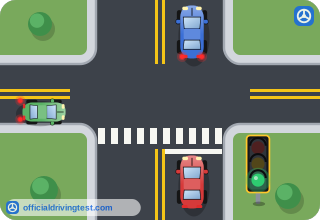
Traffic is backed up on the far side of an intersection. When may you enter the intersection?
- Whenever your signal light is green or flashing yellow
- As soon as there is room for your front bumper
- Whenever you have the right-of-way at the light
- Only when you can get through it without stopping
Show answer
Correct answer: Only when you can get through it without stopping
Drivers may not enter an intersection unless they can get through it without having to stop; wait until traffic ahead clears so you do not block the intersection.
Source: Montana Driver Manual (Revised April 2024), page 40
-
You are overtaking a vehicle going in your direction, and it starts slowing to a stop. What does the manual say?
- You must still yield to that vehicle
- It must yield to you, since you are passing
- You may pass it on the shoulder
- You may go around it on either side
Show answer
Correct answer: You must still yield to that vehicle
Drivers overtaking a vehicle traveling in the same direction must yield to that vehicle, even if it is slowing or coming to a stop.
Source: Montana Driver Manual (Revised April 2024), page 40
-
By state definition, a funeral procession is made up of how many motor vehicles?
- Three or more
- Four or more
- Five or more
- Two or more
Show answer
Correct answer: Two or more
By state definition, a funeral procession means two or more motor vehicles, including a funeral lead vehicle and a funeral escort vehicle.
Source: Montana Driver Manual (Revised April 2024), page 42
-
By state definition, during which hours does a funeral procession take place?
- At any hour of the day
- In the daylight hours
- Only after dark
- Only before noon
Show answer
Correct answer: In the daylight hours
By state definition, a funeral procession is two or more motor vehicles, one carrying the remains of a deceased person, in the daylight hours.
Source: Montana Driver Manual (Revised April 2024), page 42
-
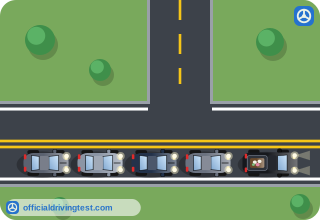
What must pedestrians and drivers who are not part of a funeral procession led by a lead or escort vehicle do?
- Join the end of the procession
- Yield the right-of-way to its vehicles
- Pass it on its right side
- Pull over only if it uses a siren
Show answer
Correct answer: Yield the right-of-way to its vehicles
State law requires pedestrians and drivers not part of a funeral procession to yield the right-of-way to a vehicle in a procession led by a funeral lead or escort vehicle.
Source: Montana Driver Manual (Revised April 2024), page 42
-
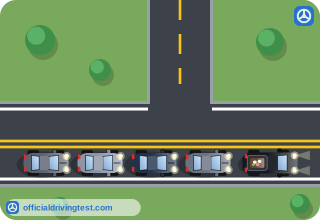
When may a driver who is not part of a moving funeral procession drive between its vehicles?
- When the gap is at least two car lengths
- When the driver signals first
- When the procession is under 55 mph
- When a police officer authorizes it
Show answer
Correct answer: When a police officer authorizes it
A driver not part of a funeral procession cannot drive between its vehicles while it is in motion unless authorized by a police officer, or driving an emergency vehicle.
Source: Montana Driver Manual (Revised April 2024), page 42
-
Regarding funeral processions, which of these does the manual say a driver may NOT do?
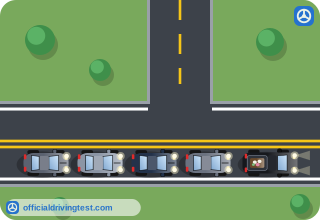
- Join a procession to get its right-of-way
- Yield to a procession at an intersection
- Enter an intersection without crossing its path
- Stop and let a procession go through first
Show answer
Correct answer: Join a procession to get its right-of-way
A driver may not join a funeral procession to secure the right-of-way that the procession enjoys.
Source: Montana Driver Manual (Revised April 2024), page 42
-
On a multiple-lane highway, when may you pass a funeral procession on its right side?
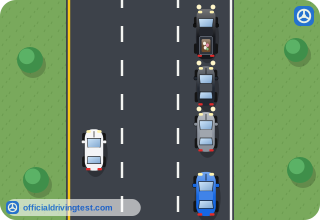
- When it is moving under 55 mph
- When a gap opens between its cars
- When it is in the farthest left lane
- When its turn signals are not flashing
Show answer
Correct answer: When it is in the farthest left lane
A driver may not pass a procession on a multiple-lane highway on its right side unless the procession is in the farthest left lane.
Source: Montana Driver Manual (Revised April 2024), page 42
-
A funeral procession is going through a red traffic-control device. When may a driver not in it enter the intersection?
- Once their own light has turned green
- After the lead vehicle has passed
- Whenever the procession has a gap
- Only if they will not cross its path
Show answer
Correct answer: Only if they will not cross its path
A driver not part of a procession may not enter the intersection unless that driver can do so without crossing the path of the funeral procession.
Source: Montana Driver Manual (Revised April 2024), page 42
-
When the funeral lead vehicle arrives at an intersection, what must it do?
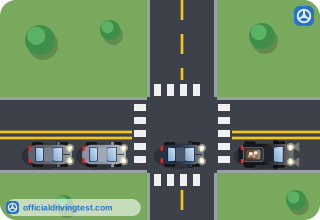
- Go through without stopping, with its lights on
- Obey the signals, signs, and right-of-way rules
- Stop and wait for an officer to wave it on
- Sound its horn and then proceed through
Show answer
Correct answer: Obey the signals, signs, and right-of-way rules
When the funeral lead vehicle arrives at an intersection, it must comply with any traffic-control device, right-of-way provision, or local ordinance.
Source: Montana Driver Manual (Revised April 2024), page 42
-
Once the funeral lead vehicle proceeds through an intersection, what may the vehicles following it in the procession do?
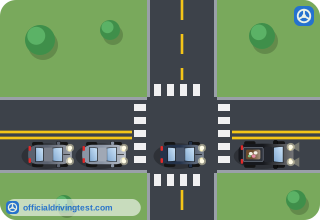
- Stop and wait for the next green light
- Go through only with a police escort
- Follow it through despite any traffic signal
- Go through one at a time after stopping
Show answer
Correct answer: Follow it through despite any traffic signal
Once the lead vehicle proceeds, others in the procession may follow through the intersection despite any traffic control device, using reasonable care toward other vehicles and pedestrians.
Source: Montana Driver Manual (Revised April 2024), page 42
-
How closely must a driver in a funeral procession follow the vehicle ahead?
- As closely as possible
- With room for a car to merge between
- Only as close as the escort directs
- In a separate lane from the car ahead
Show answer
Correct answer: As closely as possible
A driver in a funeral procession must follow the preceding vehicle as closely as possible; rules requiring space for another vehicle to enter do not apply to the procession.
Source: Montana Driver Manual (Revised April 2024), page 42
-
How does the manual define intersections?
- Only places where two public roads meet at a traffic signal
- Only places controlled by a stop sign or a signal
- Only places where two paved roads cross
- Any place where traffic merges or crosses
Show answer
Correct answer: Any place where traffic merges or crosses
Intersections are any place where traffic merges or crosses, including cross streets, side streets, driveways, and shopping center or parking lot entrances.
Source: Montana Driver Manual (Revised April 2024), page 53
-
If you are stopped at an intersection, when should you look both left and right?
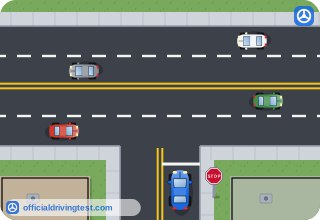
- Just before you start moving
- Only after you have started to move
- Only if another vehicle is stopped next to you
- Only when the light turns green
Show answer
Correct answer: Just before you start moving
The manual says that if you are stopped, you should look both left and right just before you start moving.
Source: Montana Driver Manual (Revised April 2024), page 53
-
Before you turn left across oncoming traffic, what should you look for?
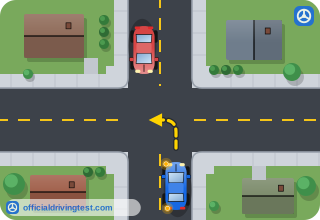
- A vehicle to follow through the turn
- An oncoming driver who will wave you through
- A safe gap in oncoming traffic
- A gap in traffic coming from behind you
Show answer
Correct answer: A safe gap in oncoming traffic
The manual says to look for a safe gap in oncoming traffic before turning left across it.
Source: Montana Driver Manual (Revised April 2024), page 53
-
Before you turn left across oncoming traffic, why should you look at the street you are turning into?
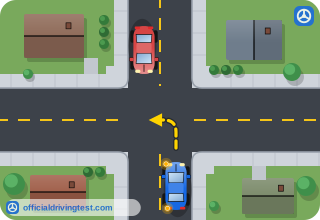
- To find out whether the street you are turning into has a posted speed limit
- To avoid being stranded in the path of oncoming traffic by vehicles or pedestrians
- To check whether the street you are turning into is a one-way street
- To see whether a traffic signal is on the next block of that street
Show answer
Correct answer: To avoid being stranded in the path of oncoming traffic by vehicles or pedestrians
You look to make sure no vehicles or pedestrians are in your path, which could leave you stranded in the path of oncoming traffic.
Source: Montana Driver Manual (Revised April 2024), page 53
-
At a red light, when may you turn left from a one-way street onto another one-way street after stopping?
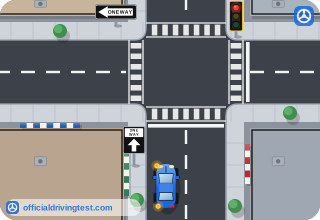
- Only when there is a green arrow
- Only when there is no other traffic
- Only during daylight hours
- Unless it is prohibited
Show answer
Correct answer: Unless it is prohibited
The manual says that, unless prohibited, you may turn left from a one-way street onto another one-way street.
Source: Montana Driver Manual (Revised April 2024), page 53
-
Before turning right, what must you make sure of?
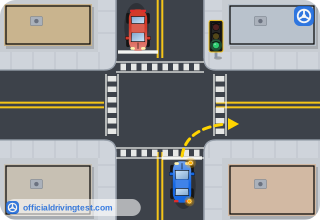
- No traffic is approaching from your left and no oncoming traffic is turning left
- No traffic is approaching from your right and no vehicle is parked ahead
- No oncoming traffic is approaching from straight ahead of you
- No vehicle is following you and no signal is flashing
Show answer
Correct answer: No traffic is approaching from your left and no oncoming traffic is turning left
Before turning right, make sure there is no traffic approaching from your left and no oncoming traffic turning left into your path.
Source: Montana Driver Manual (Revised April 2024), page 53
-
What must you check for before you begin a right turn?
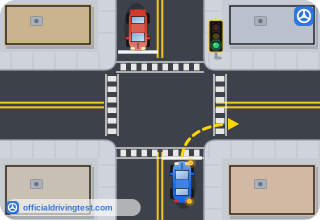
- Vehicles parked on the street you are leaving
- Whether the vehicle behind you is signaling
- Pedestrians crossing where you will be turning
- Bicycles passing in the left lane
Show answer
Correct answer: Pedestrians crossing where you will be turning
The manual says not to begin your turn without checking for pedestrians crossing where you will be turning.
Source: Montana Driver Manual (Revised April 2024), page 53
-
When may you turn right on red?
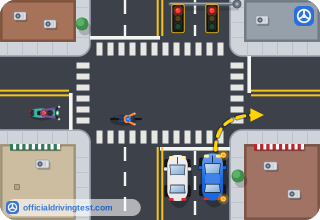
- Only after waiting one full minute
- Unless it is prohibited
- Only when no other vehicle is in sight
- Only on one-way streets
Show answer
Correct answer: Unless it is prohibited
The manual says you may turn right on red unless prohibited.
Source: Montana Driver Manual (Revised April 2024), page 53
-
Why does the manual say to look left and right at an intersection even if other traffic has a red light or stop sign?
- Signals often change without warning
- Stop signs are hard to see from a distance
- Cross traffic always has the right-of-way
- Some drivers do not obey traffic signals or signs
Show answer
Correct answer: Some drivers do not obey traffic signals or signs
Do not rely on signals or signs to stop cross traffic, because some drivers do not obey them.
Source: Montana Driver Manual (Revised April 2024), page 53
-
When are drivers on the cross street most likely to run a red light?
- Just after your light has turned green
- Just before your light turns yellow
- While your light is red
- During heavy rain or snow
Show answer
Correct answer: Just after your light has turned green
The manual says drivers on the cross street are most likely to run a red light just after your light has turned green.
Source: Montana Driver Manual (Revised April 2024), page 53
-
Besides red-light runners, which drivers does the manual say may not stop at an intersection?
- Drivers of large trucks and buses on the main road
- Drivers who are new to the area and unfamiliar with it
- Individuals who have been drinking and other reckless drivers
- Drivers who are carrying several passengers in a vehicle
Show answer
Correct answer: Individuals who have been drinking and other reckless drivers
The manual says individuals who have been drinking and other reckless drivers may not stop.
Source: Montana Driver Manual (Revised April 2024), page 53
-
If you were stopped and your view of a cross street is blocked, what should you do?
- Sound your horn and move across quickly
- Edge forward slowly until you can see
- Wait for the cross traffic to wave you through
- Move forward quickly to see past the obstruction
Show answer
Correct answer: Edge forward slowly until you can see
Edging forward slowly lets crossing drivers see the front of your vehicle before you can see them, so they can slow down and warn you if needed.
Source: Montana Driver Manual (Revised April 2024), page 53
-
When does the manual say there is a good chance that someone will cross or enter the road?
- Only when a traffic signal at the intersection is red
- Only when it is dark and the road has little lighting
- Only on roads that have a low posted speed limit
- Whenever there is a lot of activity along the side of the road
Show answer
Correct answer: Whenever there is a lot of activity along the side of the road
Whenever there is a lot of activity along the side of the road, someone is likely to cross or enter it, so look to the sides near shopping centers, parking lots, construction areas, busy sidewalks, playgrounds, and school yards.
Source: Montana Driver Manual (Revised April 2024), page 53
-
Well ahead of a left turn, after you look for following vehicles and give your signal, where should you move?
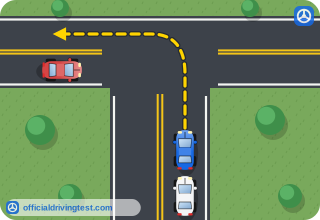
- To the right edge of the roadway
- Into the middle of the intersection
- Over close to the centerline
- Onto the shoulder to let traffic pass
Show answer
Correct answer: Over close to the centerline
For a left turn you look for following vehicles, give the signal, and move over close to the centerline.
Source: Montana Driver Manual (Revised April 2024), page 58
-
How far ahead should you signal a right turn when you are not in a rural area?
- 100 feet
- 50 feet
- 200 feet
- 500 feet
Show answer
Correct answer: 100 feet
The manual says to signal a right turn for 100 feet (1/3 city block), or 300 feet in rural areas, and slow down.
Source: Montana Driver Manual (Revised April 2024), page 58
-
While waiting to complete a left turn, which way should your wheels point?
- Toward the left
- Toward the right
- Toward the curb
- Straight ahead
Show answer
Correct answer: Straight ahead
With the wheels straight ahead, being struck from behind will not force you into oncoming traffic.
Source: Montana Driver Manual (Revised April 2024), page 58
-
When making a left turn, whom must you yield the right-of-way to?
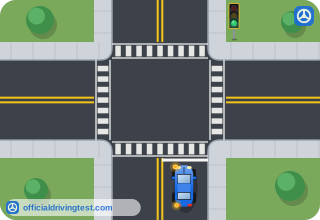
- Following vehicles
- Oncoming traffic
- Parked vehicles
- Vehicles waiting to turn right
Show answer
Correct answer: Oncoming traffic
The manual says to look and yield right-of-way to oncoming traffic when making a left turn.
Source: Montana Driver Manual (Revised April 2024), page 58
-
When completing a left turn, where should you enter the street?
- Just to the right of the center
- Just to the left of the center
- At the far right edge of the road
- Across the center, cutting the corner
Show answer
Correct answer: Just to the right of the center
You enter the street just to the right of the center and do not cut corners.
Source: Montana Driver Manual (Revised April 2024), page 58
-
After completing a left turn, what does the manual say to do?
- Stay near the centerline until the next intersection
- Move quickly to the right edge of the roadway
- Gradually move to the center of your lane
- Speed up and stay in the left part of the lane
Show answer
Correct answer: Gradually move to the center of your lane
After the turn you gradually move to the center of your lane and make sure the signal has canceled.
Source: Montana Driver Manual (Revised April 2024), page 58
-
How close to the edge of the road should a right turn be made?
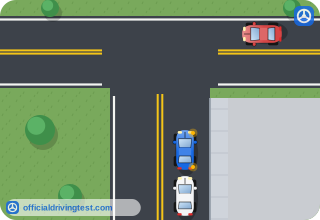
- With a wide swing into the left lane first
- As close to the right edge as practical
- From the middle of the roadway
- From the center of the lane
Show answer
Correct answer: As close to the right edge as practical
Right turns should be made as close as practical to the right edge of the curb or roadway.
Source: Montana Driver Manual (Revised April 2024), page 58
-
What should you NOT do when making a right turn?
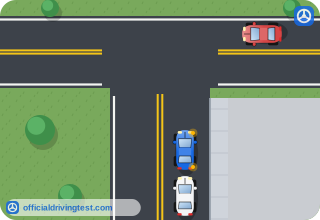
- Get into the proper lane well in advance of the turn
- Signal well ahead of the turn and slow down
- Keep as close to the right side as possible
- Make a wide-sweeping turn or cross into the left lane
Show answer
Correct answer: Make a wide-sweeping turn or cross into the left lane
The manual says not to make a wide-sweeping turn or cross into the left lane.
Source: Montana Driver Manual (Revised April 2024), page 58
-
About how large a gap do you need anytime you want to merge with other traffic?
- About one second
- About two seconds
- About eight seconds
- About four seconds
Show answer
Correct answer: About four seconds
You need a gap of about four seconds anytime you want to merge with other traffic.
Source: Montana Driver Manual (Revised April 2024), page 66
-
If you move into the middle of a four-second gap, what following distance do you and the vehicle behind you each have?
- Two seconds
- One second
- Three seconds
- Four seconds
Show answer
Correct answer: Two seconds
Moving into the middle of a four-second gap gives both you and the vehicle now behind you a two-second following distance.
Source: Montana Driver Manual (Revised April 2024), page 66
-
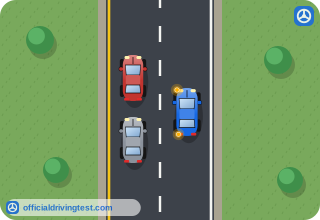
Why should you not merge into a gap that is too small?
- Your turn signal is harder to see in a small gap
- The vehicles around you may not be able to see your headlights
- A small gap can quickly become even smaller
- A small gap makes it harder for you to judge your own speed
Show answer
Correct answer: A small gap can quickly become even smaller
A small gap can quickly become even smaller, so you enter a gap that gives you a big enough space cushion to be safe.
Source: Montana Driver Manual (Revised April 2024), page 66
-
What is the safest way to cross several lanes?
- Wait until all lanes are clear, then cross all at once
- Take them one at a time
- Cross quickly in one move without checking each lane
- Stop on the lane lines and wait for gaps
Show answer
Correct answer: Take them one at a time
It is safest and easiest to merge one lane at a time, because it is very difficult to tell that all the lanes are free and safe to cross.
Source: Montana Driver Manual (Revised April 2024), page 66
-
When you cross traffic, what size gap do you need?
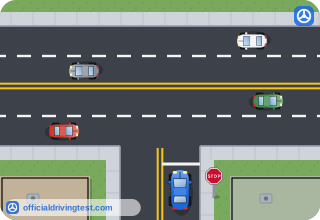
- A gap large enough to reach the middle of the road and stop there
- A gap of at least ten seconds in both directions
- A gap large enough to clear only the nearest lane
- A large enough gap to get all the way across the road without stopping
Show answer
Correct answer: A large enough gap to get all the way across the road without stopping
When you cross traffic, you need a large enough gap to get all the way across the road without stopping.
Source: Montana Driver Manual (Revised April 2024), page 66
-
When you enter traffic, what do you need?
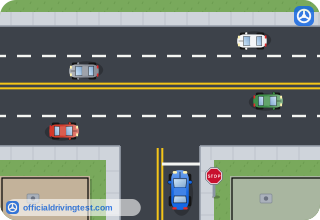
- Enough space to first turn and then get up to speed
- A gap just long enough to finish your turn
- A gap that lets you stop in the traffic lane if needed
- Enough space to turn and then match the speed of the slowest vehicle
Show answer
Correct answer: Enough space to first turn and then get up to speed
When you enter traffic, you need enough space to first turn and then get up to speed.
Source: Montana Driver Manual (Revised April 2024), page 66
-
When is it safe to stop halfway across a road you are crossing?
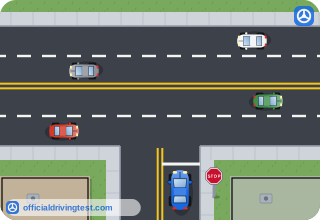
- Whenever there are no vehicles coming in the near lane
- Whenever you have your turn signal on and the road is clear
- Only when there is a median divider large enough to hold your car
- Whenever you can leave part of your vehicle sticking out safely
Show answer
Correct answer: Only when there is a median divider large enough to hold your car
Stopping halfway across is only safe when there is a median divider large enough to hold your car.
Source: Montana Driver Manual (Revised April 2024), page 66
-
Before you turn left, what should you make sure of?
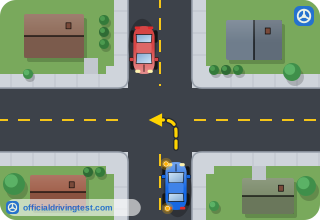
- That oncoming drivers have their turn signals on
- That no vehicles or pedestrians are blocking your path
- That you are already stopped across the oncoming lane
- That the vehicle behind you is slowing down too
Show answer
Correct answer: That no vehicles or pedestrians are blocking your path
When turning left, you make sure there are no vehicles or pedestrians blocking your path, so you are not stuck across a lane with an oncoming vehicle bearing down on you.
Source: Montana Driver Manual (Revised April 2024), page 66
-
You have a green light but cars are blocking your way across the intersection. What should you do?
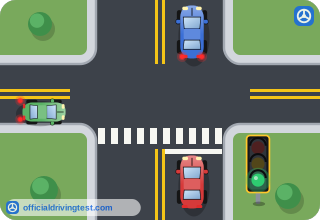
- Start across so you clear it before the light turns red
- Enter the intersection and stop in the middle until the cars move
- Sound your horn and drive around the blocking cars
- Wait; do not start across the intersection
Show answer
Correct answer: Wait; do not start across the intersection
Even with a green light, you do not start across if cars block your way, because you could be caught there when the light turns red, block other traffic, and be ticketed.
Source: Montana Driver Manual (Revised April 2024), page 66
-
An approaching vehicle has its turn signal on. What should you do instead of turning just because of the signal?
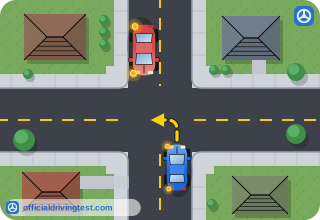
- Wait until the other driver actually starts to turn
- Turn at once, since the signal shows where it is going
- Sound your horn and turn before the vehicle slows
- Flash your headlights and turn when the driver waves
Show answer
Correct answer: Wait until the other driver actually starts to turn
The driver may plan to turn beyond you or may have forgotten to cancel a signal, so you wait until the other driver actually starts to turn and then go if it is safe.
Source: Montana Driver Manual (Revised April 2024), page 66
-
The turn signals of which kind of vehicle often do not cancel by themselves?
- Farm tractors
- School buses
- Motorcycles
- Delivery vans
Show answer
Correct answer: Motorcycles
Signals on motorcycles often do not cancel by themselves.
Source: Montana Driver Manual (Revised April 2024), page 66