Montana: Right-of-way, turning and passing — Part 3 Practice Test
Questions in this part include: “When is it legal to drive on a sidewalk?” · “By state definition, a funeral procession is made up of how many motor vehicles?”
Independent educational site · not affiliated with any government agency or DMV
Ready? Test yourself
- Instant feedback with an explanation
- Every answer cites its source in the manual
- Your best score is saved on this device
- Keyboard: press 1 to 4 to answer and Enter for the next question
Questions are original and based on the official manual "Montana Driver Manual" (Revised April 2024), Montana Department of Justice, Motor Vehicle Division.
All 17 questions in this practice test
Take the test above first, then use this list to study. Tap “Show answer” to see the correct answer and explanation.
Show the questions and answersHide the questions
-
When is it legal to drive on a sidewalk?
- Only to cross it
- To pass stopped traffic
- To reach a parking spot
- When the street is blocked
Show answer
Correct answer: Only to cross it
It is illegal to drive on a sidewalk, except to cross it.
Source: Montana Driver Manual (Revised April 2024), page 40
-
At an intersection, drivers turning left must yield to whom?
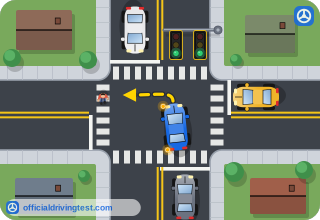
- Oncoming cars going straight ahead
- Vehicles waiting behind them
- Cross traffic facing a red light
- No one, if their light is green
Show answer
Correct answer: Oncoming cars going straight ahead
Drivers turning left must yield to oncoming cars going straight ahead.
Source: Montana Driver Manual (Revised April 2024), page 40
-
Drivers entering a traffic circle or rotary must yield to whom?

- Drivers entering from the right
- Larger vehicles only
- Drivers already in the circle
- No one, once they signal
Show answer
Correct answer: Drivers already in the circle
Drivers entering a traffic circle or rotary must yield to drivers already in the circle.
Source: Montana Driver Manual (Revised April 2024), page 40
-
At an intersection with no stop sign or traffic signal, which vehicles should drivers yield to?

- Vehicles coming from the left
- Vehicles coming from the right
- The larger of the vehicles
- The vehicle going faster
Show answer
Correct answer: Vehicles coming from the right
At an intersection where there is no stop sign or traffic signal, drivers should yield to vehicles coming from the right, and always be prepared to yield to avoid a crash.
Source: Montana Driver Manual (Revised April 2024), page 40
-
To be prepared to yield at an intersection, you take your foot off the accelerator and cover the brake. In which order should you then look?

- Right, left, and right again
- Straight ahead, then right
- Right only, then ahead
- Left, right, and left again
Show answer
Correct answer: Left, right, and left again
To be prepared to yield and avoid a crash, take your foot off the accelerator, cover the brake, and look left, right, and left again.
Source: Montana Driver Manual (Revised April 2024), page 40
-
At a four-way stop, which driver gets to go first?
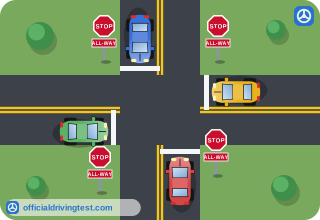
- The driver on the right, always
- The largest vehicle
- The driver who reached it first
- The driver going straight
Show answer
Correct answer: The driver who reached it first
At a four-way stop, the driver reaching the intersection first gets to go first, after coming to a complete stop.
Source: Montana Driver Manual (Revised April 2024), page 40
-
What must a driver entering a road from a driveway, alley, or roadside do?

- Stop and yield to vehicles on the main road
- Enter first, since others must yield
- Signal and then pull out right away
- Yield only to vehicles on your left
Show answer
Correct answer: Stop and yield to vehicles on the main road
Drivers entering a road from a driveway, alley, or roadside must stop and yield to vehicles already on the main roadway.
Source: Montana Driver Manual (Revised April 2024), page 40
-
Traffic is backed up on the far side of an intersection. When may you enter the intersection?
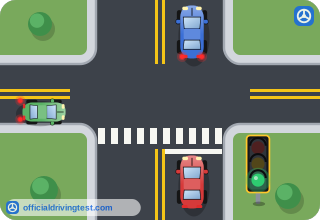
- Whenever your signal light is green or flashing yellow
- As soon as there is room for your front bumper
- Whenever you have the right-of-way at the light
- Only when you can get through it without stopping
Show answer
Correct answer: Only when you can get through it without stopping
Drivers may not enter an intersection unless they can get through it without having to stop; wait until traffic ahead clears so you do not block the intersection.
Source: Montana Driver Manual (Revised April 2024), page 40
-
You are overtaking a vehicle going in your direction, and it starts slowing to a stop. What does the manual say?
- You must still yield to that vehicle
- It must yield to you, since you are passing
- You may pass it on the shoulder
- You may go around it on either side
Show answer
Correct answer: You must still yield to that vehicle
Drivers overtaking a vehicle traveling in the same direction must yield to that vehicle, even if it is slowing or coming to a stop.
Source: Montana Driver Manual (Revised April 2024), page 40
-
By state definition, a funeral procession is made up of how many motor vehicles?
- Three or more
- Four or more
- Five or more
- Two or more
Show answer
Correct answer: Two or more
By state definition, a funeral procession means two or more motor vehicles, including a funeral lead vehicle and a funeral escort vehicle.
Source: Montana Driver Manual (Revised April 2024), page 42
-
By state definition, during which hours does a funeral procession take place?
- At any hour of the day
- In the daylight hours
- Only after dark
- Only before noon
Show answer
Correct answer: In the daylight hours
By state definition, a funeral procession is two or more motor vehicles, one carrying the remains of a deceased person, in the daylight hours.
Source: Montana Driver Manual (Revised April 2024), page 42
-
What must pedestrians and drivers who are not part of a funeral procession led by a lead or escort vehicle do?
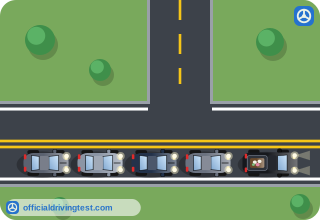
- Join the end of the procession
- Yield the right-of-way to its vehicles
- Pass it on its right side
- Pull over only if it uses a siren
Show answer
Correct answer: Yield the right-of-way to its vehicles
State law requires pedestrians and drivers not part of a funeral procession to yield the right-of-way to a vehicle in a procession led by a funeral lead or escort vehicle.
Source: Montana Driver Manual (Revised April 2024), page 42
-
When may a driver who is not part of a moving funeral procession drive between its vehicles?
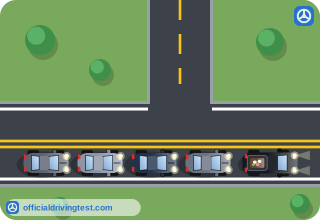
- When the gap is at least two car lengths
- When the driver signals first
- When the procession is under 55 mph
- When a police officer authorizes it
Show answer
Correct answer: When a police officer authorizes it
A driver not part of a funeral procession cannot drive between its vehicles while it is in motion unless authorized by a police officer, or driving an emergency vehicle.
Source: Montana Driver Manual (Revised April 2024), page 42
-
Regarding funeral processions, which of these does the manual say a driver may NOT do?
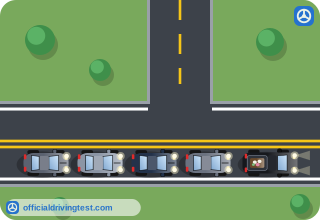
- Join a procession to get its right-of-way
- Yield to a procession at an intersection
- Enter an intersection without crossing its path
- Stop and let a procession go through first
Show answer
Correct answer: Join a procession to get its right-of-way
A driver may not join a funeral procession to secure the right-of-way that the procession enjoys.
Source: Montana Driver Manual (Revised April 2024), page 42
-
On a multiple-lane highway, when may you pass a funeral procession on its right side?
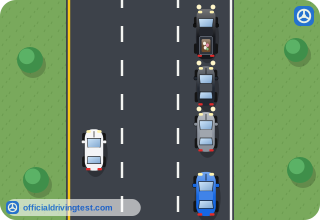
- When it is moving under 55 mph
- When a gap opens between its cars
- When it is in the farthest left lane
- When its turn signals are not flashing
Show answer
Correct answer: When it is in the farthest left lane
A driver may not pass a procession on a multiple-lane highway on its right side unless the procession is in the farthest left lane.
Source: Montana Driver Manual (Revised April 2024), page 42
-
A funeral procession is going through a red traffic-control device. When may a driver not in it enter the intersection?
- Once their own light has turned green
- After the lead vehicle has passed
- Whenever the procession has a gap
- Only if they will not cross its path
Show answer
Correct answer: Only if they will not cross its path
A driver not part of a procession may not enter the intersection unless that driver can do so without crossing the path of the funeral procession.
Source: Montana Driver Manual (Revised April 2024), page 42
-
When the funeral lead vehicle arrives at an intersection, what must it do?
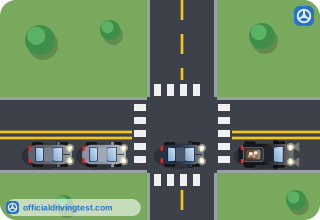
- Go through without stopping, with its lights on
- Obey the signals, signs, and right-of-way rules
- Stop and wait for an officer to wave it on
- Sound its horn and then proceed through
Show answer
Correct answer: Obey the signals, signs, and right-of-way rules
When the funeral lead vehicle arrives at an intersection, it must comply with any traffic-control device, right-of-way provision, or local ordinance.
Source: Montana Driver Manual (Revised April 2024), page 42