Montana: Right-of-way, turning and passing — Part 1 Practice Test
Questions in this part include: “What is the speed at which you should drive in a roundabout?” · “You are driving in a travel lane and become confused about where to go. What does the manual say to do?”
Independent educational site · not affiliated with any government agency or DMV
Ready? Test yourself
- Instant feedback with an explanation
- Every answer cites its source in the manual
- Your best score is saved on this device
- Keyboard: press 1 to 4 to answer and Enter for the next question
Questions are original and based on the official manual "Montana Driver Manual" (Revised April 2024), Montana Department of Justice, Motor Vehicle Division.
All 17 questions in this practice test
Take the test above first, then use this list to study. Tap “Show answer” to see the correct answer and explanation.
Show the questions and answersHide the questions
-
After stopping for a steady red light when entering a two-way street, what may you do?
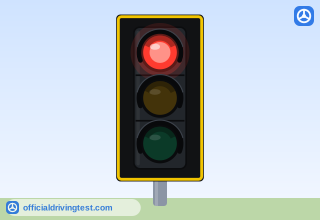
- Cautiously turn right, unless a sign or police officer tells you not to
- Turn left, as long as you yield to all oncoming traffic first
- Turn right only where a sign specifically says that you may do so
- Go straight ahead when no traffic is coming from either direction
Show answer
Correct answer: Cautiously turn right, unless a sign or police officer tells you not to
After stopping, you may cautiously turn right on red unless a sign or police officer tells you not to turn against the red light.
Source: Montana Driver Manual (Revised April 2024), page 30
-
When you turn right on a red light after stopping, whom must you yield to?
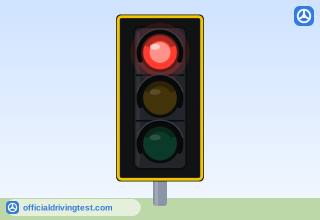
- Only the pedestrians who are in the crosswalk ahead
- Only the vehicles that are coming from your left
- Pedestrians, bicyclists, and traffic in the intersection
- No one, because you have already come to a stop
Show answer
Correct answer: Pedestrians, bicyclists, and traffic in the intersection
The manual says to yield to pedestrians, bicyclists, and traffic in the intersection, and to look for pedestrians to the left, right, and ahead.
Source: Montana Driver Manual (Revised April 2024), page 30
-
Under which condition may you turn left after stopping for a steady red light?
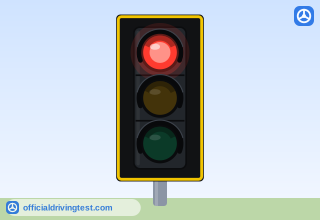
- When you are entering a one-way street from a two-way street
- When you are entering a one-way street from a one-way street
- When you are entering a two-way street from a one-way street
- When you are in the right-hand lane
Show answer
Correct answer: When you are entering a one-way street from a one-way street
The manual allows a left turn after stopping for the red light when entering a one-way street from a one-way street, yielding if needed.
Source: Montana Driver Manual (Revised April 2024), page 30
-
When there is no green arrow, what must left-turning and right-turning traffic do?
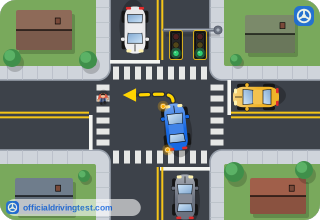
- Wait until the signal changes to red
- Turn first, since turning traffic has the right of way
- Use the turn lane to go ahead of oncoming traffic
- Yield right of way to oncoming traffic and pedestrians
Show answer
Correct answer: Yield right of way to oncoming traffic and pedestrians
Without a green arrow, turning traffic is unprotected and must yield right of way to oncoming traffic and pedestrians.
Source: Montana Driver Manual (Revised April 2024), page 31
-
What is the speed at which you should drive in a roundabout?
- 15 mph or less
- 25 mph or less
- 35 mph or less
- 10 mph or less
Show answer
Correct answer: 15 mph or less
The manual says driving speeds in roundabouts are 15 mph or less.
Source: Montana Driver Manual (Revised April 2024), page 32
-
Who has the right-of-way at a roundabout?
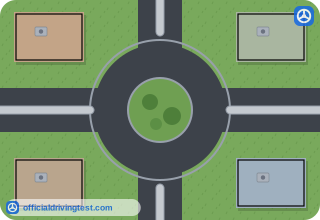
- Vehicles that are entering the roundabout
- The vehicle on the largest street
- Vehicles that are already in the roundabout
- The vehicle that reaches the entrance first
Show answer
Correct answer: Vehicles that are already in the roundabout
Drivers entering a roundabout yield to vehicles already in it, because those vehicles have the right-of-way.
Source: Montana Driver Manual (Revised April 2024), page 32
-
In which direction does traffic flow in a roundabout?
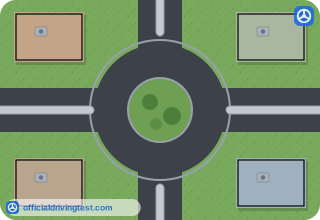
- Clockwise
- Counterclockwise
- Toward the center island
- Either way, depending on the exit
Show answer
Correct answer: Counterclockwise
The manual states that traffic in a roundabout flows in a counterclockwise direction.
Source: Montana Driver Manual (Revised April 2024), page 32
-
After you enter a roundabout, where should you stay?
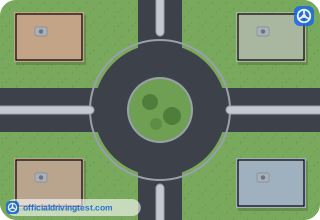
- To the left of the center island
- On the truck apron
- In the middle of the circle
- To the right of the center island
Show answer
Correct answer: To the right of the center island
The manual says to enter the roundabout and stay to the right of the center island.
Source: Montana Driver Manual (Revised April 2024), page 32
-
You reach a roundabout and the way is clear. What should you do?
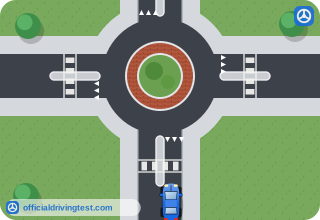
- Enter without stopping
- Stop completely before entering
- Stop and count to three
- Wait for oncoming traffic to pass
Show answer
Correct answer: Enter without stopping
The manual says not to stop at a roundabout if the way is clear.
Source: Montana Driver Manual (Revised April 2024), page 32
-
What must you never do after entering a single-lane roundabout?
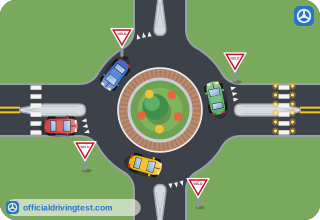
- Use your right-turn signal
- Slow down for a pedestrian
- Pass or overtake another vehicle
- Travel to your desired street
Show answer
Correct answer: Pass or overtake another vehicle
The manual says never to pass or overtake another vehicle after entering a single-lane roundabout.
Source: Montana Driver Manual (Revised April 2024), page 32
-
Which signal should you use to leave a roundabout when you reach your desired street?
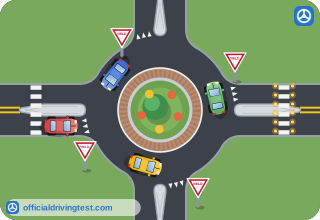
- Your left-turn signal
- Your right-turn signal
- Your hazard lights
- No signal is needed
Show answer
Correct answer: Your right-turn signal
The manual says to travel around the circle until you reach your desired street, use your right-turn signal, and exit.
Source: Montana Driver Manual (Revised April 2024), page 32
-
You are driving in a travel lane and become confused about where to go. What does the manual say to do?
- Stop in your lane and check your map or phone
- Keep moving until you can safely pull off
- Back up slowly to the last intersection you passed
- Slow to a crawl and stay in the lane
Show answer
Correct answer: Keep moving until you can safely pull off
Never back up or stop in any travel lane for any reason, including confusion. Keep moving until you can safely pull off the road.
Source: Montana Driver Manual (Revised April 2024), page 37
-
On a road with three or more lanes going in the same direction, which lane do the basic laws tell you to stay in, except to pass?
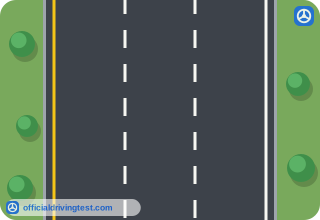
- The left lane
- Any lane with the least traffic
- The lane closest to the centerline
- The right lane
Show answer
Correct answer: The right lane
One of the basic laws is to stay in the right lane, except to pass, on a road with three or more lanes traveling in the same direction.
Source: Montana Driver Manual (Revised April 2024), page 37
-
On a road with three or more lanes going in the same direction, which lane does the manual say to use when a lot of traffic is entering?
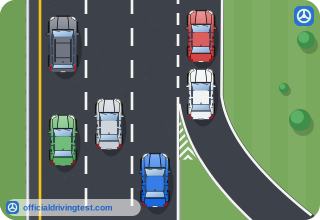
- The left-most lane
- The center travel lane
- The paved shoulder
- The shared center turn lane
Show answer
Correct answer: The center travel lane
When there is a lot of traffic entering, the manual says to use the center travel lane.
Source: Montana Driver Manual (Revised April 2024), page 37
-
You are approaching a turn but find you are in the wrong lane, or you forgot to signal. What should you do?
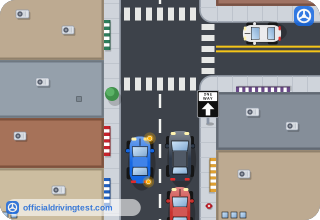
- Turn anyway from the lane you are in now
- Turn at the next intersection from the proper lane
- Stop in your lane until you can merge over
- Back up and move into the proper lane
Show answer
Correct answer: Turn at the next intersection from the proper lane
You should proceed, get into the proper lane, go to the next intersection, signal, and then turn.
Source: Montana Driver Manual (Revised April 2024), page 37
-
When may you drive on the shoulder of the road?
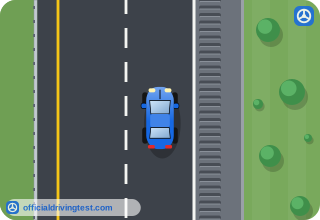
- Whenever traffic ahead is slow
- To pass a vehicle turning left
- Whenever the shoulder is paved
- Only when you are told to do so
Show answer
Correct answer: Only when you are told to do so
Unless told to do so, never drive on the shoulder of the road.
Source: Montana Driver Manual (Revised April 2024), page 37
-
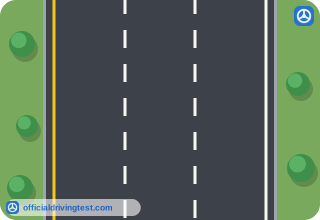
On multi-lane roads, what is the left-most lane intended to be used for?
- Trucks and buses
- Slow-moving vehicles
- Passing slower vehicles
- Vehicles entering the road
Show answer
Correct answer: Passing slower vehicles
On multi-lane roads, the left-most lane is intended to be used to pass slower vehicles.
Source: Montana Driver Manual (Revised April 2024), page 38