Montana: Right-of-way, turning and passing — Part 2 Practice Test
Questions in this part include: “Besides passing a vehicle that is turning left, when else is passing on the right legal?” · “When making a left turn, the manual says you must leave room for whom?”
Independent educational site · not affiliated with any government agency or DMV
Ready? Test yourself
- Instant feedback with an explanation
- Every answer cites its source in the manual
- Your best score is saved on this device
- Keyboard: press 1 to 4 to answer and Enter for the next question
Questions are original and based on the official manual "Montana Driver Manual" (Revised April 2024), Montana Department of Justice, Motor Vehicle Division.
All 17 questions in this practice test
Take the test above first, then use this list to study. Tap “Show answer” to see the correct answer and explanation.
Show the questions and answersHide the questions
-
Passing on the right is legal when the vehicle you are passing is doing what?
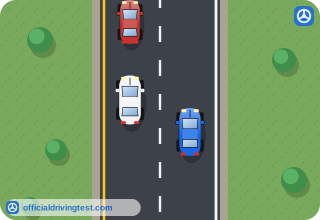
- Making or about to make a left turn
- Driving below the speed limit
- Pulling onto the shoulder to stop
- Stopped for a pedestrian in a crosswalk
Show answer
Correct answer: Making or about to make a left turn
Passing on the right is legal when the vehicle you are passing is making or about to make a left turn, and only on the pavement, never on the shoulder.
Source: Montana Driver Manual (Revised April 2024), page 38
-
Besides passing a vehicle that is turning left, when else is passing on the right legal?
- On a two-lane road when no oncoming traffic is in sight
- On a paved shoulder that is wide and free of any debris
- On any road when the driver ahead waves you past
- On pavement wide enough for two or more lanes in your direction
Show answer
Correct answer: On pavement wide enough for two or more lanes in your direction
Passing on the right is also legal on a road with unobstructed pavement wide enough for two or more lanes of vehicles legally going in the same direction.
Source: Montana Driver Manual (Revised April 2024), page 38
-
What does the manual say about passing on the shoulder of the road?
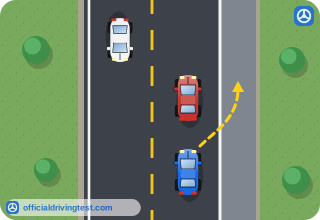
- Allowed only if the shoulder is paved
- Never pass on it, paved or not
- Allowed when traffic ahead is stopped
- Allowed to pass a vehicle turning left
Show answer
Correct answer: Never pass on it, paved or not
You cannot pass on the right by driving off the pavement, which means never passing on the shoulder, whether it is paved or not.
Source: Montana Driver Manual (Revised April 2024), page 38
-
Why does the manual warn that passing on the right can be risky?
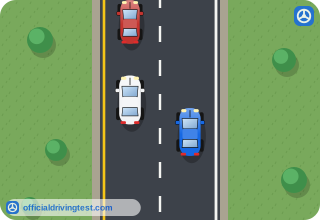
- Your own mirrors cannot show the right lane at all
- The driver may not see you and may move into your lane
- Oncoming traffic will be closer to your vehicle
- Vehicles turning right always have the right-of-way
Show answer
Correct answer: The driver may not see you and may move into your lane
If you pass on the right, the other driver may have difficulty seeing you and might suddenly change lanes in front of you.
Source: Montana Driver Manual (Revised April 2024), page 38
-
Where no signs or lane markings control turning, which lane should you turn from?
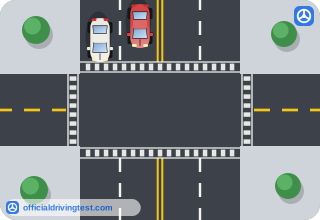
- Whichever lane has the least traffic in it
- Always the far left lane of the road
- The center lane, to allow a wider turn
- The lane nearest the direction you will go
Show answer
Correct answer: The lane nearest the direction you will go
Where no signs or lane markings control turning, turn from the lane closest to the direction you want to go and into the lane closest to the one you came from.
Source: Montana Driver Manual (Revised April 2024), page 38
-
What is gained by turning from the lane nearest your new direction and into the lane nearest the one you came from?
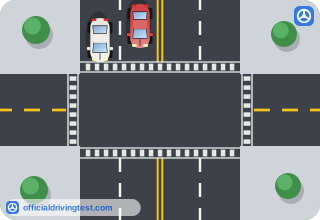
- You cross the fewest lanes of traffic
- You make the widest, smoothest turn
- You can turn at a higher speed
- Drivers behind you can pass on the right
Show answer
Correct answer: You cross the fewest lanes of traffic
Turning from and into the closest lanes means you will cross the fewest lanes of traffic.
Source: Montana Driver Manual (Revised April 2024), page 38
-
How should you go from one lane to the other while making a turn?
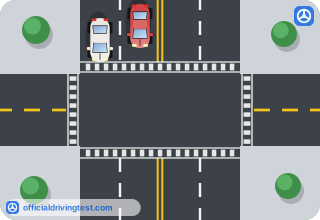
- In a wide arc to make the turn easier on you
- By first moving into the lane next to yours
- As directly as possible, without crossing lane lines
- Through the shared center lane when available
Show answer
Correct answer: As directly as possible, without crossing lane lines
When making turns, go from one lane to the other as directly as possible without crossing lane lines or interfering with traffic.
Source: Montana Driver Manual (Revised April 2024), page 38
-
When may you change to another lane, if you need to, after making a turn?
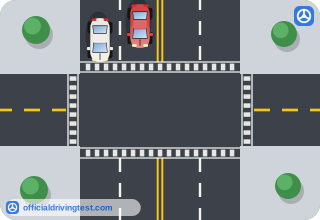
- While still in the intersection
- Only after one full city block
- Only at the next intersection
- Once you have completed the turn
Show answer
Correct answer: Once you have completed the turn
Once you have completed your turn, you can change to another lane if you need to.
Source: Montana Driver Manual (Revised April 2024), page 38
-
What should you avoid doing when making a right turn?
- Slowing down before the turn
- Swinging wide to the left first
- Turning into the nearest lane
- Signaling 100 feet ahead in town
Show answer
Correct answer: Swinging wide to the left first
On right turns, avoid swinging wide to the left before turning to make the turn easier.
Source: Montana Driver Manual (Revised April 2024), page 38
-
If you swing wide before a right turn, what may the driver behind you try to do?
- Stop and wait for you to back up
- Turn right in front of you
- Pass you on the right
- Pull onto the left shoulder
Show answer
Correct answer: Pass you on the right
If you swing wide, the driver behind you may think you are changing lanes or turning left and may try to pass you on the right.
Source: Montana Driver Manual (Revised April 2024), page 38
-
When making a left turn, why should you avoid cutting the corner too sharply?
- You may run into someone approaching from the left
- You may scrape the curb on the right side of the road
- Oncoming drivers will think you are turning right
- You may block the lane for traffic behind you
Show answer
Correct answer: You may run into someone approaching from the left
When making a left turn, avoid cutting the corner so sharply that you run into someone approaching from the left.
Source: Montana Driver Manual (Revised April 2024), page 38
-
When making a left turn, the manual says you must leave room for whom?
- Oncoming vehicles turning left in front of you
- A vehicle behind you to pass on the right
- Pedestrians who are waiting at the corner
- Parked cars along the side of the road
Show answer
Correct answer: Oncoming vehicles turning left in front of you
When making a left turn, you must leave room for oncoming vehicles to turn left in front of you.
Source: Montana Driver Manual (Revised April 2024), page 38
-
To turn around on a roadway, how far of unobstructed view in both directions must the driver have, with no vehicles approaching?
- 100 feet
- 200 feet
- 500 feet
- 1,000 feet
Show answer
Correct answer: 500 feet
You may turn around on a roadway where the driver has 500 feet of unobstructed view in both directions and no vehicles are approaching.
Source: Montana Driver Manual (Revised April 2024), page 39
-
According to the manual, turning around on a busy street or near a curve or hill is what?
- Legal if you signal first
- Illegal and dangerous
- Legal if no officer is present
- Allowed only at night
Show answer
Correct answer: Illegal and dangerous
The manual says turning around on a busy street or near a curve or hill is both illegal and dangerous.
Source: Montana Driver Manual (Revised April 2024), page 39
-
What do most city ordinances say about U-turns in the middle of a block?
- Most allow them at night
- Most allow them with a signal
- Most allow them on quiet streets
- Most prohibit them
Show answer
Correct answer: Most prohibit them
Most city ordinances prohibit U-turns in the middle of a block, and some prohibit U-turns entirely.
Source: Montana Driver Manual (Revised April 2024), page 39
-
The manual says no vehicle shall be turned at any time unless which conditions are met?
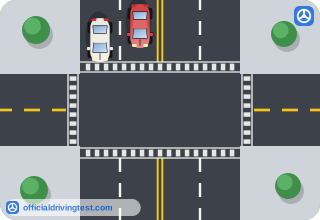
- It has signaled for at least 500 feet
- Traffic behind it has come to a stop
- It is in the proper lane and it is safe
- An officer or flagger has waved it on
Show answer
Correct answer: It is in the proper lane and it is safe
No vehicle shall be turned at any time unless it is in the proper lane and it is safe to do so.
Source: Montana Driver Manual (Revised April 2024), page 39
-
According to the manual, when must you do everything you can to avoid striking a pedestrian or another vehicle?
- Regardless of the circumstances
- Only when you have the right-of-way
- Only when they are in a crosswalk
- Only inside school and park zones
Show answer
Correct answer: Regardless of the circumstances
You must do everything you can to prevent striking a pedestrian or another vehicle, regardless of the circumstances.
Source: Montana Driver Manual (Revised April 2024), page 39