Montana: Right-of-way, turning and passing — Part 4 Practice Test
Questions in this part include: “How closely must a driver in a funeral procession follow the vehicle ahead?” · “Besides red-light runners, which drivers does the manual say may not stop at an intersection?”
Independent educational site · not affiliated with any government agency or DMV
Ready? Test yourself
- Instant feedback with an explanation
- Every answer cites its source in the manual
- Your best score is saved on this device
- Keyboard: press 1 to 4 to answer and Enter for the next question
Questions are original and based on the official manual "Montana Driver Manual" (Revised April 2024), Montana Department of Justice, Motor Vehicle Division.
All 17 questions in this practice test
Take the test above first, then use this list to study. Tap “Show answer” to see the correct answer and explanation.
Show the questions and answersHide the questions
-
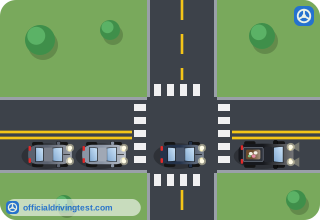
Once the funeral lead vehicle proceeds through an intersection, what may the vehicles following it in the procession do?
- Stop and wait for the next green light
- Go through only with a police escort
- Follow it through despite any traffic signal
- Go through one at a time after stopping
Show answer
Correct answer: Follow it through despite any traffic signal
Once the lead vehicle proceeds, others in the procession may follow through the intersection despite any traffic control device, using reasonable care toward other vehicles and pedestrians.
Source: Montana Driver Manual (Revised April 2024), page 42
-
How closely must a driver in a funeral procession follow the vehicle ahead?
- As closely as possible
- With room for a car to merge between
- Only as close as the escort directs
- In a separate lane from the car ahead
Show answer
Correct answer: As closely as possible
A driver in a funeral procession must follow the preceding vehicle as closely as possible; rules requiring space for another vehicle to enter do not apply to the procession.
Source: Montana Driver Manual (Revised April 2024), page 42
-
How does the manual define intersections?
- Only places where two public roads meet at a traffic signal
- Only places controlled by a stop sign or a signal
- Only places where two paved roads cross
- Any place where traffic merges or crosses
Show answer
Correct answer: Any place where traffic merges or crosses
Intersections are any place where traffic merges or crosses, including cross streets, side streets, driveways, and shopping center or parking lot entrances.
Source: Montana Driver Manual (Revised April 2024), page 53
-
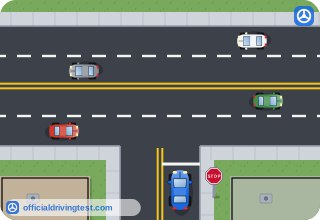
If you are stopped at an intersection, when should you look both left and right?
- Just before you start moving
- Only after you have started to move
- Only if another vehicle is stopped next to you
- Only when the light turns green
Show answer
Correct answer: Just before you start moving
The manual says that if you are stopped, you should look both left and right just before you start moving.
Source: Montana Driver Manual (Revised April 2024), page 53
-
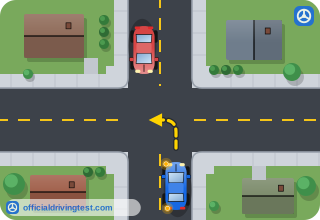
Before you turn left across oncoming traffic, what should you look for?
- A vehicle to follow through the turn
- An oncoming driver who will wave you through
- A safe gap in oncoming traffic
- A gap in traffic coming from behind you
Show answer
Correct answer: A safe gap in oncoming traffic
The manual says to look for a safe gap in oncoming traffic before turning left across it.
Source: Montana Driver Manual (Revised April 2024), page 53
-
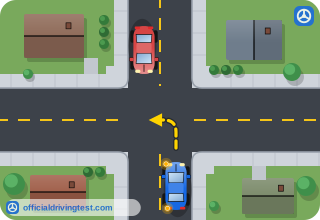
Before you turn left across oncoming traffic, why should you look at the street you are turning into?
- To find out whether the street you are turning into has a posted speed limit
- To avoid being stranded in the path of oncoming traffic by vehicles or pedestrians
- To check whether the street you are turning into is a one-way street
- To see whether a traffic signal is on the next block of that street
Show answer
Correct answer: To avoid being stranded in the path of oncoming traffic by vehicles or pedestrians
You look to make sure no vehicles or pedestrians are in your path, which could leave you stranded in the path of oncoming traffic.
Source: Montana Driver Manual (Revised April 2024), page 53
-
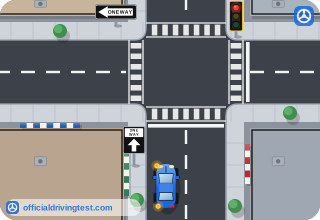
At a red light, when may you turn left from a one-way street onto another one-way street after stopping?
- Only when there is a green arrow
- Only when there is no other traffic
- Only during daylight hours
- Unless it is prohibited
Show answer
Correct answer: Unless it is prohibited
The manual says that, unless prohibited, you may turn left from a one-way street onto another one-way street.
Source: Montana Driver Manual (Revised April 2024), page 53
-
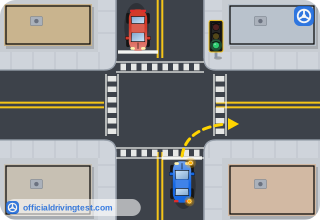
Before turning right, what must you make sure of?
- No traffic is approaching from your left and no oncoming traffic is turning left
- No traffic is approaching from your right and no vehicle is parked ahead
- No oncoming traffic is approaching from straight ahead of you
- No vehicle is following you and no signal is flashing
Show answer
Correct answer: No traffic is approaching from your left and no oncoming traffic is turning left
Before turning right, make sure there is no traffic approaching from your left and no oncoming traffic turning left into your path.
Source: Montana Driver Manual (Revised April 2024), page 53
-
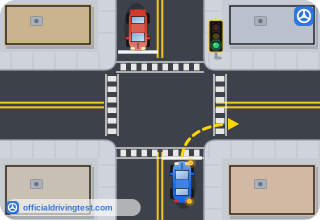
What must you check for before you begin a right turn?
- Vehicles parked on the street you are leaving
- Whether the vehicle behind you is signaling
- Pedestrians crossing where you will be turning
- Bicycles passing in the left lane
Show answer
Correct answer: Pedestrians crossing where you will be turning
The manual says not to begin your turn without checking for pedestrians crossing where you will be turning.
Source: Montana Driver Manual (Revised April 2024), page 53
-
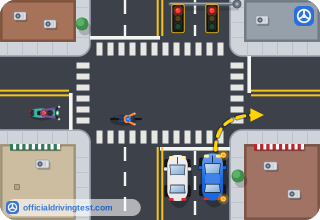
When may you turn right on red?
- Only after waiting one full minute
- Unless it is prohibited
- Only when no other vehicle is in sight
- Only on one-way streets
Show answer
Correct answer: Unless it is prohibited
The manual says you may turn right on red unless prohibited.
Source: Montana Driver Manual (Revised April 2024), page 53
-
Why does the manual say to look left and right at an intersection even if other traffic has a red light or stop sign?
- Signals often change without warning
- Stop signs are hard to see from a distance
- Cross traffic always has the right-of-way
- Some drivers do not obey traffic signals or signs
Show answer
Correct answer: Some drivers do not obey traffic signals or signs
Do not rely on signals or signs to stop cross traffic, because some drivers do not obey them.
Source: Montana Driver Manual (Revised April 2024), page 53
-
When are drivers on the cross street most likely to run a red light?
- Just after your light has turned green
- Just before your light turns yellow
- While your light is red
- During heavy rain or snow
Show answer
Correct answer: Just after your light has turned green
The manual says drivers on the cross street are most likely to run a red light just after your light has turned green.
Source: Montana Driver Manual (Revised April 2024), page 53
-
Besides red-light runners, which drivers does the manual say may not stop at an intersection?
- Drivers of large trucks and buses on the main road
- Drivers who are new to the area and unfamiliar with it
- Individuals who have been drinking and other reckless drivers
- Drivers who are carrying several passengers in a vehicle
Show answer
Correct answer: Individuals who have been drinking and other reckless drivers
The manual says individuals who have been drinking and other reckless drivers may not stop.
Source: Montana Driver Manual (Revised April 2024), page 53
-
If you were stopped and your view of a cross street is blocked, what should you do?
- Sound your horn and move across quickly
- Edge forward slowly until you can see
- Wait for the cross traffic to wave you through
- Move forward quickly to see past the obstruction
Show answer
Correct answer: Edge forward slowly until you can see
Edging forward slowly lets crossing drivers see the front of your vehicle before you can see them, so they can slow down and warn you if needed.
Source: Montana Driver Manual (Revised April 2024), page 53
-
When does the manual say there is a good chance that someone will cross or enter the road?
- Only when a traffic signal at the intersection is red
- Only when it is dark and the road has little lighting
- Only on roads that have a low posted speed limit
- Whenever there is a lot of activity along the side of the road
Show answer
Correct answer: Whenever there is a lot of activity along the side of the road
Whenever there is a lot of activity along the side of the road, someone is likely to cross or enter it, so look to the sides near shopping centers, parking lots, construction areas, busy sidewalks, playgrounds, and school yards.
Source: Montana Driver Manual (Revised April 2024), page 53
-
Well ahead of a left turn, after you look for following vehicles and give your signal, where should you move?
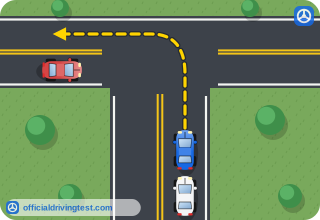
- To the right edge of the roadway
- Into the middle of the intersection
- Over close to the centerline
- Onto the shoulder to let traffic pass
Show answer
Correct answer: Over close to the centerline
For a left turn you look for following vehicles, give the signal, and move over close to the centerline.
Source: Montana Driver Manual (Revised April 2024), page 58
-
How far ahead should you signal a right turn when you are not in a rural area?
- 100 feet
- 50 feet
- 200 feet
- 500 feet
Show answer
Correct answer: 100 feet
The manual says to signal a right turn for 100 feet (1/3 city block), or 300 feet in rural areas, and slow down.
Source: Montana Driver Manual (Revised April 2024), page 58