Minnesota: Speed and following distance
Minnesota speed limits, slowing down for conditions, the three-second rule, stopping distance, and passing safely. Split into 4 shorter tests so you're not stuck in one long quiz.
Independent educational site · not affiliated with any government agency or DMV
Choose a part
Speed and following distance — Part 1
Questions in this part include: “What does Minnesota’s basic speed law say you must do?”
StartSpeed and following distance — Part 2
Questions in this part include: “When should you use your right turn signal while passing?”
StartSpeed and following distance — Part 3
Questions in this part include: “What do the letters SIPDE stand for in the defensive driving system described in the Minnesota Driver’s Manual?”
StartSpeed and following distance — Part 4
Questions in this part include: “What following distance must you maintain from other vehicles if you pull a camper or trailer?”
StartAll 72 Speed and following distance questions with answers
Choose a part above to take a practice test, or study every question and answer here.
Show the questions and answersHide the questions
-
What does Minnesota’s basic speed law say you must do?
- Drive at a speed that is reasonable for the current conditions
- Drive at the posted speed limit no matter what the conditions are
- Drive at the same speed as the vehicle ahead of you
- Drive no faster than the slowest vehicle on the road
Show answer
Correct answer: Drive at a speed that is reasonable for the current conditions
The basic speed law requires a speed that is reasonable for the weather, traffic and road conditions.
Source: Minnesota Driver’s Manual (June 2026), page 26
-
What is the posted speed limit on a road?
- The speed you should drive when the road is in poor condition
- The speed that most drivers on that road usually drive
- The minimum speed allowed on that road
- The maximum speed allowed on that road
Show answer
Correct answer: The maximum speed allowed on that road
The posted speed limit is the maximum speed allowed on the road, and driving faster than it is illegal.
Source: Minnesota Driver’s Manual (June 2026), page 26
-
On a two-lane highway with a speed limit of 55 mph or higher, by how much can you increase your speed when lawfully passing another vehicle?
- 5 mph
- 10 mph
- 15 mph
- 20 mph
Show answer
Correct answer: 10 mph
On two-lane highways with a speed limit of 55 mph or higher, you can increase your speed by 10 mph when lawfully passing another vehicle.
Source: Minnesota Driver’s Manual (June 2026), page 26
-
On a road with a posted minimum speed limit, what is illegal under normal conditions?
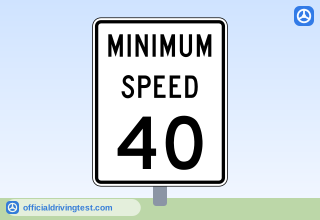
- Driving slower than the posted minimum speed
- Driving faster than the posted minimum speed
- Changing lanes while driving at the minimum speed
- Driving exactly at the posted minimum speed
Show answer
Correct answer: Driving slower than the posted minimum speed
Some roads have minimum speed limits, and driving slower than the posted minimum is illegal under normal conditions.
Source: Minnesota Driver’s Manual (June 2026), page 26
-
Under ideal conditions, unless signs say otherwise, what is the speed limit in alleys?
- 5 mph
- 10 mph
- 15 mph
- 20 mph
Show answer
Correct answer: 10 mph
Under ideal conditions the limit in alleys is 10 mph unless signs indicate otherwise.
Source: Minnesota Driver’s Manual (June 2026), page 26
-
Under ideal conditions, unless signs say otherwise, what is the speed limit on urban or town roads?
- 20 mph
- 40 mph
- 45 mph
- 30 mph
Show answer
Correct answer: 30 mph
Under ideal conditions the limit on urban or town roads is 30 mph unless signs indicate otherwise.
Source: Minnesota Driver’s Manual (June 2026), page 26
-
Under ideal conditions, unless signs say otherwise, what is the speed limit in locations that are not alleys or urban or town roads?
- 45 mph
- 50 mph
- 55 mph
- 60 mph
Show answer
Correct answer: 55 mph
Under ideal conditions the limit is 55 mph in all locations not otherwise specified, unless signs indicate otherwise.
Source: Minnesota Driver’s Manual (June 2026), page 26
-
What must you do in a school zone when children are present?
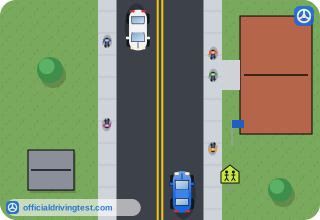
- Slow down
- Come to a complete stop
- Change lanes away from the children
- Sound your horn to warn them
Show answer
Correct answer: Slow down
In school zones you must slow down when children are present.
Source: Minnesota Driver’s Manual (June 2026), page 26
-
You drive how many miles per hour or more over the speed limit before additional fines apply?
- 5 mph
- 20 mph
- 10 mph
- 15 mph
Show answer
Correct answer: 20 mph
Additional fines apply if you drive 20 mph or more over the limit.
Source: Minnesota Driver’s Manual (June 2026), page 27
-
Which of these situations does the manual tell you to slow down for?
- Street signs and mailboxes on the side of the road
- A green traffic light at an intersection with no cross traffic
- Flag persons, barricades, flares or reflectors on the road
- A dry, straight road in daylight
Show answer
Correct answer: Flag persons, barricades, flares or reflectors on the road
You must slow down for flag persons, pedestrians, barricades, flares or reflectors on the road.
Source: Minnesota Driver’s Manual (June 2026), page 27
-
What does the manual say you must do in bad weather and poor road conditions?
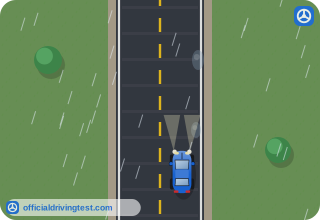
- Drive at the posted speed limit
- Slow down
- Follow the vehicle ahead more closely
- Turn on your hazard lights and keep moving
Show answer
Correct answer: Slow down
You must slow down in bad weather and poor road conditions.
Source: Minnesota Driver’s Manual (June 2026), page 27
-
When approaching which of these places should you drive slower?
- A wide, straight road with no hills
- A green traffic signal on a clear day
- A paved shoulder with no vehicles on it
- A curve, hilltop or railroad crossing
Show answer
Correct answer: A curve, hilltop or railroad crossing
Drive slower on narrow or winding roads and when approaching a curve, hilltop or railroad crossing.
Source: Minnesota Driver’s Manual (June 2026), page 27
-
Why do you need to slow down on gravel or dirt roads?
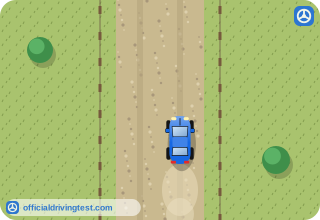
- It is harder to see traffic signs on gravel roads
- The speed limit on gravel roads is always lower by law
- It takes longer to stop and is easier to skid when turning
- Dust from the road makes your tires lose air
Show answer
Correct answer: It takes longer to stop and is easier to skid when turning
On gravel or dirt roads it takes longer to stop and it is easier to skid when turning, so you need to slow down.
Source: Minnesota Driver’s Manual (June 2026), page 27
-
How does increasing your speed affect your field of vision?
- It decreases your field of vision
- It increases your field of vision
- It does not change your field of vision
- It moves your field of vision to the side
Show answer
Correct answer: It decreases your field of vision
Increasing speed decreases your field of vision and increases the risk of a crash.
Source: Minnesota Driver’s Manual (June 2026), page 27
-
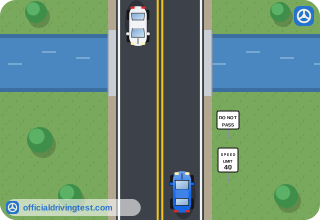
What does the manual tell you to do about special speed limits and “No Passing” signs on bridges?
- Ignore them if no other vehicles are on the bridge
- Obey them only when the bridge is wet or icy
- Follow them only if a flag person is present
- Watch for them and obey them
Show answer
Correct answer: Watch for them and obey them
You must watch for and obey special speed limits and “No Passing” signs posted on bridges.
Source: Minnesota Driver’s Manual (June 2026), page 27
-
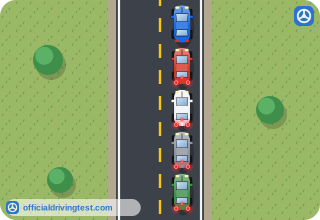
On a road with one lane in your direction, what must you do if you are going slow enough to create a traffic hazard?
- Drive in the center of the lane with your hazard lights on
- Move onto the left shoulder of the road
- Drive as close as possible to the right-hand curb or edge of the road
- Stop at the next intersection and wait
Show answer
Correct answer: Drive as close as possible to the right-hand curb or edge of the road
If you are going slow enough to create a traffic hazard, you must drive as close as possible to the right-hand curb or edge of the road.
Source: Minnesota Driver’s Manual (June 2026), page 33
-
On highways with more than one lane in the same direction, which lane should you drive in when it is available?
- The right-hand lane
- The left-most lane
- The center lane
- Whichever lane is moving fastest
Show answer
Correct answer: The right-hand lane
On highways with more than one lane in the same direction, you should drive in the right-hand lane when available.
Source: Minnesota Driver’s Manual (June 2026), page 33
-
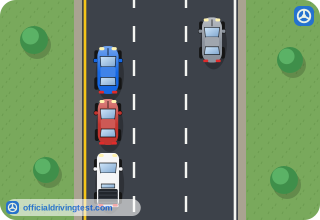
If you are in the left-most lane of a highway with more than one lane in your direction, what should you do when practical?
- Speed up to the limit and keep driving in the lane
- Stop and let the vehicle behind you pass
- Stay in the lane unless the road is slippery
- Move out of the lane to allow another vehicle to pass
Show answer
Correct answer: Move out of the lane to allow another vehicle to pass
The manual says to move out of the left-most lane when practical to allow another vehicle to pass.
Source: Minnesota Driver’s Manual (June 2026), page 33
-
Which is an exception to the rule to drive in the right-hand lane on a highway with more than one lane in your direction?
- When you are driving slower than the other traffic
- When preparing for a left turn at an intersection
- When the right-hand lane has merging traffic
- When you are driving a large truck
Show answer
Correct answer: When preparing for a left turn at an intersection
You may leave the right-hand lane when preparing for a left turn at an intersection or into a private road or driveway.
Source: Minnesota Driver’s Manual (June 2026), page 33
-
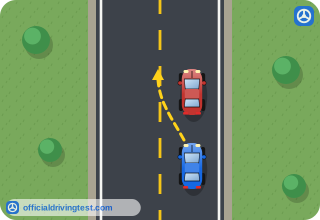
When preparing to pass, what should you check behind you?
- Whether the vehicle behind you is a commercial vehicle
- Whether the vehicle behind you has its headlights on
- Whether the road behind you has a hill
- Whether other drivers are preparing to pass you
Show answer
Correct answer: Whether other drivers are preparing to pass you
Before passing you should check behind to see if other drivers are preparing to pass you.
Source: Minnesota Driver’s Manual (June 2026), page 34
-
When should you use your right turn signal while passing?
- After passing and before returning to the right lane
- Before moving into the left lane to pass
- Only when you can no longer see the passed vehicle
- Only when the passed vehicle slows down
Show answer
Correct answer: After passing and before returning to the right lane
Use your left turn signal before moving into the left lane to pass, and your right turn signal after passing and before returning to the right lane.
Source: Minnesota Driver’s Manual (June 2026), page 34
-
When may you return to the right lane after passing a vehicle?
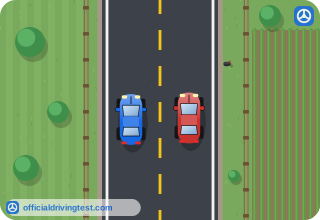
- As soon as your front bumper is clearly ahead of the other vehicle
- After you have driven 500 feet beyond the other vehicle
- When you can see the entire vehicle you passed in your rearview mirror
- As soon as the other driver signals that it is safe
Show answer
Correct answer: When you can see the entire vehicle you passed in your rearview mirror
Return to the right lane when you can see the entire vehicle you have just passed in your rearview mirror.
Source: Minnesota Driver’s Manual (June 2026), page 34
-
When passing, you must return to the right side of the road before coming within what distance of an oncoming vehicle?
- 50 feet
- 200 feet
- 500 feet
- 100 feet
Show answer
Correct answer: 100 feet
You must be back on the right side of the road before coming within 100 feet of an oncoming vehicle.
Source: Minnesota Driver’s Manual (June 2026), page 34
-
Do not pass on a curve or hill where you cannot clearly see the road ahead for at least how far?
- 700 feet
- 200 feet
- 300 feet
- 500 feet
Show answer
Correct answer: 700 feet
You must not pass on a curve or hill where you cannot clearly see the road ahead for at least 700 feet.
Source: Minnesota Driver’s Manual (June 2026), page 34
-
You should not pass within what distance of an intersection, underpass, tunnel or railroad crossing?
- 100 feet
- 50 feet
- 200 feet
- 500 feet
Show answer
Correct answer: 100 feet
You must not pass within 100 feet of an intersection, underpass, tunnel or railroad crossing.
Source: Minnesota Driver’s Manual (June 2026), page 34
-
What should you do when another driver is trying to pass you?
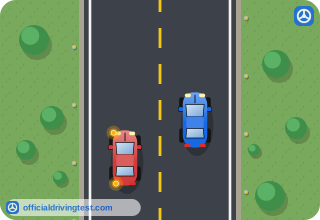
- Speed up to stay ahead of the vehicle
- Move onto the shoulder and brake
- Stay in your own lane and do not increase speed
- Move into the opposing lane to make room
Show answer
Correct answer: Stay in your own lane and do not increase speed
When another driver is trying to pass you, stay in your own lane and do not increase speed.
Source: Minnesota Driver’s Manual (June 2026), page 34
-
A driver may pass on the right of another vehicle when the vehicle being overtaken is doing what?
- Slowing down for a stop sign
- Making or about to make a left turn
- Making or about to make a right turn
- Driving slowly on a road with one lane each way
Show answer
Correct answer: Making or about to make a left turn
One condition for passing on the right is that the vehicle you are overtaking is making or about to make a left turn.
Source: Minnesota Driver’s Manual (June 2026), page 34
-
Which of these may you not use to pass another vehicle on the right?
- A lane on a one-way street wide enough for two or more lanes of vehicles
- A lane on a street with space for two lanes of moving vehicles in each direction
- The lane to the right of a vehicle that is about to turn left
- The shoulder of the road
Show answer
Correct answer: The shoulder of the road
When passing on the right you must not drive in a bicycle lane, on the shoulder, or off the pavement or main part of the road.
Source: Minnesota Driver’s Manual (June 2026), page 34
-
On a one-way street, under what conditions may you pass on the right?
- Only if the left lane is blocked and the driver ahead has signaled that it is safe to pass on the right
- Only if you do not exceed the speed limit by more than 10 mph while passing
- Only if there are no obstructions and the road is wide enough for two or more lanes of moving vehicles
- Only if the vehicle ahead is signaling to turn left at the next intersection
Show answer
Correct answer: Only if there are no obstructions and the road is wide enough for two or more lanes of moving vehicles
On a one-way street you may only pass on the right if there are no obstructions and the road is wide enough for two or more lanes of moving vehicles.
Source: Minnesota Driver’s Manual (June 2026), page 34
-
Which rule does the manual give to help you maintain a safe following distance?
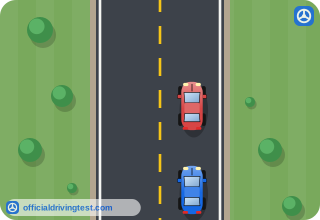
- The two-second rule
- The three-second rule
- The ten-car-length rule
- The one-car-length rule
Show answer
Correct answer: The three-second rule
The manual says to use the three-second rule to help maintain a safe following distance.
Source: Minnesota Driver’s Manual (June 2026), page 44
-
What must you be able to do when following the vehicle in front of you?
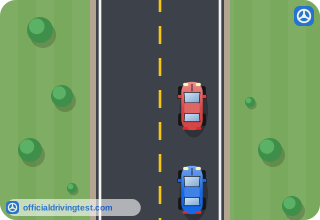
- Pass it within 5 seconds
- Keep it in view in your mirror
- Match its speed exactly
- Stop or turn to avoid a collision
Show answer
Correct answer: Stop or turn to avoid a collision
You must keep a safe distance so that you can stop or turn to avoid a collision.
Source: Minnesota Driver’s Manual (June 2026), page 44
-
Careless driving means driving or stopping a vehicle in a way that
- endangers the lives and safety of people or property
- causes a crash that injures another person in the vehicle
- exceeds the posted speed limit by a large amount
- ignores a red traffic signal at an intersection
Show answer
Correct answer: endangers the lives and safety of people or property
Careless driving is driving or stopping in a way that endangers the lives and safety of people or property.
Source: Minnesota Driver’s Manual (June 2026), page 44
-
Reckless driving means driving a vehicle while
- failing to signal a lane change before moving over on a busy road
- exceeding the posted speed limit by any amount on any road
- knowingly disregarding a substantial and unjustifiable risk to others
- stopping a vehicle in the roadway for a short time to talk
Show answer
Correct answer: knowingly disregarding a substantial and unjustifiable risk to others
Reckless driving is knowingly disregarding a substantial and unjustifiable risk, including racing or contest driving.
Source: Minnesota Driver’s Manual (June 2026), page 44
-
How does the manual define racing?
- Driving faster than the speed limit on a freeway or highway at night
- Intentionally comparing or contesting relative speeds by driving
- Passing another vehicle on a two-lane road at a high speed
- Driving much faster than the other traffic around you on a road
Show answer
Correct answer: Intentionally comparing or contesting relative speeds by driving
Racing is intentional comparing or contesting of relative speeds, whether or not the speed limit is exceeded.
Source: Minnesota Driver’s Manual (June 2026), page 44
-
If you are charged with careless or reckless driving, how will you be tried?
- By a driver's license examiner
- In court for a felony
- By mail with a fine only
- In court for a misdemeanor
Show answer
Correct answer: In court for a misdemeanor
A careless or reckless driving charge is tried in court for a misdemeanor.
Source: Minnesota Driver’s Manual (June 2026), page 44
-
Where might you see minimum speed limits posted?
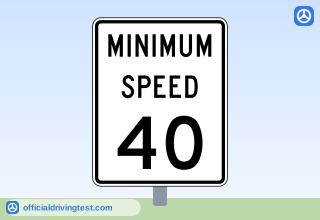
- On residential streets near schools
- On interstate freeways with controlled access
- On gravel and dirt roads outside of town
- In parking lots and driveways
Show answer
Correct answer: On interstate freeways with controlled access
The manual says you may also see minimum speed limits on interstate freeways with controlled access.
Source: Minnesota Driver’s Manual (June 2026), page 57
-
When may you drive slower than a posted minimum speed limit?
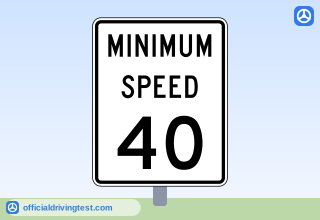
- When the vehicle ahead of you is driving slower
- When you are driving in the right-hand lane of the road
- When you are looking for your exit
- When bad weather or poor road conditions make it necessary
Show answer
Correct answer: When bad weather or poor road conditions make it necessary
You may drive slower than the minimum posted limit only when bad weather or poor road conditions make it necessary.
Source: Minnesota Driver’s Manual (June 2026), page 57
-
What do the letters SIPDE stand for in the defensive driving system described in the Minnesota Driver’s Manual?
- Scan, Identify, Predict, Decide and Execute
- Signal, Inspect, Prepare, Drive and Exit
- Stop, Inspect, Plan, Direct and Evaluate
- Search, Inform, Position, Decide and Exit
Show answer
Correct answer: Scan, Identify, Predict, Decide and Execute
The manual names the five steps of SIPDE as Scan, Identify, Predict, Decide and Execute.
Source: Minnesota Driver’s Manual (June 2026), page 72
-
In the Scan step of SIPDE, where should you search for hazards?
- Only straight ahead of your vehicle
- Only to the sides and behind
- Ahead, to the sides and behind
- Only at vehicles in your own lane
Show answer
Correct answer: Ahead, to the sides and behind
The Scan step tells drivers to search aggressively ahead, to the sides and behind to avoid hazards before they arise.
Source: Minnesota Driver’s Manual (June 2026), page 72
-
In the Scan step, where should you focus on finding potential escape routes?
- Long stretches of open rural road with no traffic nearby
- Intersections, shopping areas, schools and commercial zones
- Quiet residential streets and parking lots at night
- Highway shoulders and the medians of divided roads
Show answer
Correct answer: Intersections, shopping areas, schools and commercial zones
The Scan step says to focus on finding potential escape routes around intersections, shopping areas, schools and commercial zones.
Source: Minnesota Driver’s Manual (June 2026), page 72
-
Which of these does the manual say can make short, fast moves into your path?
- Potholes, guard rails and bridges
- Roadway signs, hedges and trees
- Parked vehicles with their engines off
- Unattended children and animals
Show answer
Correct answer: Unattended children and animals
In the Identify step, unattended children and animals are called unpredictable because they can make short, fast moves.
Source: Minnesota Driver’s Manual (June 2026), page 72
-
How does the manual describe stationary objects such as guard rails, bridges, hedges and trees?
- They will not move into your path but may influence your driving strategy
- They can be ignored because they never change how you drive
- They are the most critical hazards because they cannot be avoided
- They matter only when you are driving at night
Show answer
Correct answer: They will not move into your path but may influence your driving strategy
Stationary objects will not move into your path, but they may still influence your driving strategy.
Source: Minnesota Driver’s Manual (June 2026), page 72
-
In the Predict step, which hazards are described as more critical?
- Cars moving away from you
- Cars sitting still beside the road
- Cars moving into your path
- Cars far behind you
Show answer
Correct answer: Cars moving into your path
The manual says cars moving into your path are more critical than those moving away or sitting still.
Source: Minnesota Driver’s Manual (June 2026), page 72
-
In the Predict step, which three things do you consider about hazards to anticipate how they may affect you?
- Size, color and number of passengers
- Speed, distance and direction
- Weight, height and engine power
- Age, make and license plate
Show answer
Correct answer: Speed, distance and direction
To predict how hazards may affect you, the manual says to consider their speed, distance and direction.
Source: Minnesota Driver’s Manual (June 2026), page 72
-
In the Decide step of SIPDE, what do you decide?
- Which other driver would be at fault if a crash happened
- Which route would be shortest to your destination
- Whether to ignore hazards that are far away
- What you would need to do if the situation changed quickly
Show answer
Correct answer: What you would need to do if the situation changed quickly
In the Decide step you use your prediction to decide what you would need to do if the situation changed quickly.
Source: Minnesota Driver’s Manual (June 2026), page 72
-
In the Execute step, what does the manual say you can use to communicate your presence?
- Your lights, horn or both
- Hand signals only
- Your parking brake and mirrors
- Your voice through the window
Show answer
Correct answer: Your lights, horn or both
To create space and minimize harm, the Execute step says to communicate your presence with your lights, horn or both.
Source: Minnesota Driver’s Manual (June 2026), page 72
-
The Three-Second Rule is meant for which vehicles and conditions?
- Only vehicles that are longer than the standard length
- Any vehicle in any weather condition
- Standard-length vehicles driving in ideal conditions
- Only vehicles pulling a trailer
Show answer
Correct answer: Standard-length vehicles driving in ideal conditions
The manual says the rule is for standard-length vehicles driving in ideal conditions.
Source: Minnesota Driver’s Manual (June 2026), page 73
-
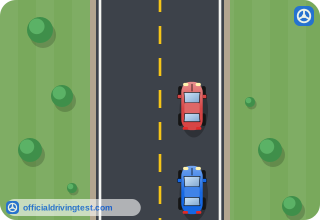
To use the Three-Second Rule, what do you choose first?
- A moving vehicle in the next lane that you can follow
- A fixed reference point at the side of the road ahead
- The speed you want to travel at
- A gap in traffic behind you
Show answer
Correct answer: A fixed reference point at the side of the road ahead
The first step is to choose a fixed reference point at the side of the road ahead, such as a telephone pole, signpost, tree or bridge.
Source: Minnesota Driver’s Manual (June 2026), page 73
-
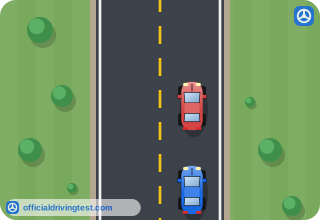
When do you begin counting in the Three-Second Rule?
- When your own front bumper reaches the reference point
- When the vehicle behind you passes the reference point
- When the vehicle ahead of you turns on its brake lights
- When the vehicle ahead of you passes the reference point
Show answer
Correct answer: When the vehicle ahead of you passes the reference point
You begin counting when the vehicle ahead of you passes the fixed reference point.
Source: Minnesota Driver’s Manual (June 2026), page 73
-
You pass the reference point before you finish counting “one-thousand-three.” What does that mean?
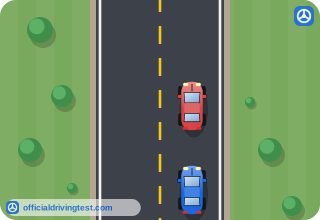
- You are following too closely
- You have a safe following distance
- You are driving too slowly
- You should speed up to pass
Show answer
Correct answer: You are following too closely
If you pass the reference point before you finish counting, you are following too closely and should gradually slow down.
Source: Minnesota Driver’s Manual (June 2026), page 73
-
When road conditions are poor, or you drive a vehicle longer than standard length, how many seconds should you count for your following distance?
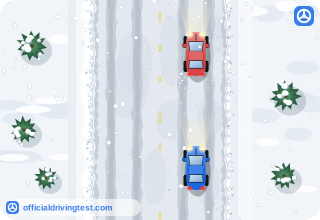
- Two seconds
- Three seconds
- Four or five seconds
- Ten seconds
Show answer
Correct answer: Four or five seconds
The manual says to increase the following distance to a four- or five-second count in poor conditions or with a longer vehicle.
Source: Minnesota Driver’s Manual (June 2026), page 73
-
What should you do if the vehicle behind you is following too closely?
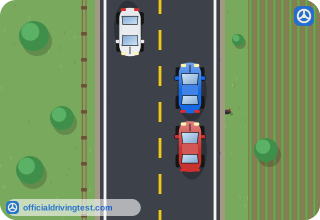
- Speed up to keep a gap ahead of it
- Slow down slightly and allow it to pass
- Brake hard to make it back off
- Stay in your lane and ignore it
Show answer
Correct answer: Slow down slightly and allow it to pass
The manual says to slow down slightly and allow a tailgating vehicle to pass.
Source: Minnesota Driver’s Manual (June 2026), page 73
-
How long does the manual say it takes from perceiving danger to using the brakes?
- About 1 1/2 seconds
- About 2 seconds
- About 5 seconds
- About 3/4 of a second
Show answer
Correct answer: About 3/4 of a second
The length of time from perceiving the danger to using the brakes is about 3/4 of a second.
Source: Minnesota Driver’s Manual (June 2026), page 73
-
Which of these does the manual list as a factor in your actual stopping distance?
- The condition of your tire treads
- The make of your vehicle’s stereo
- The number of seat belts installed
- The age of your driver’s license
Show answer
Correct answer: The condition of your tire treads
Stopping distance depends on factors including weather conditions, the condition of tire treads, and the type and condition of the brakes.
Source: Minnesota Driver’s Manual (June 2026), page 73
-
What following distance must you maintain from other vehicles if you pull a camper or trailer?
- At least 500 feet
- At least 100 feet
- At least 200 feet
- At least 350 feet
Show answer
Correct answer: At least 500 feet
If you pull a camper or trailer, you must maintain at least 500 feet of following distance from other vehicles.
Source: Minnesota Driver’s Manual (June 2026), page 79
-
Why should you travel at a slower speed when pulling a trailer?
- Small trailer wheels turn faster, and the heat buildup can cause wheel bearing failure
- The trailer’s extra weight makes the headlights dimmer at higher speeds
- Trailers are required by law to stay under the speed of main-line traffic
- Heavy loads make the hitch lock up when you drive at higher speeds
Show answer
Correct answer: Small trailer wheels turn faster, and the heat buildup can cause wheel bearing failure
Many trailers have smaller wheels that turn faster than car wheels, causing heat buildup that can lead to trailer wheel bearing failure.
Source: Minnesota Driver’s Manual (June 2026), page 79
-
What could a sudden stop at high speed do to a vehicle pulling a heavy trailer?
- Release the trailer from the hitch safely
- Damage only the trailer’s tires
- Flip both the trailer and the car
- Lock the trailer’s wheels harmlessly
Show answer
Correct answer: Flip both the trailer and the car
The brakes on your vehicle were probably not designed for heavy trailer loads, so a sudden stop at high speed could flip both the trailer and the car.
Source: Minnesota Driver’s Manual (June 2026), page 79
-
What should you do when towing a trailer or camper in wet or windy conditions?
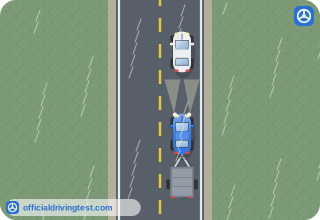
- Keep the same speed because the extra weight holds you steady
- Speed up to get through the rain or wind sooner
- Slow down more than you would normally do in such weather
- Switch to a higher gear and keep your usual speed
Show answer
Correct answer: Slow down more than you would normally do in such weather
Wind and rain affect your ability to control a vehicle pulling extra weight, so you should slow down more than usual.
Source: Minnesota Driver’s Manual (June 2026), page 80
-
Why should you allow plenty of room for turns when towing a long trailer?
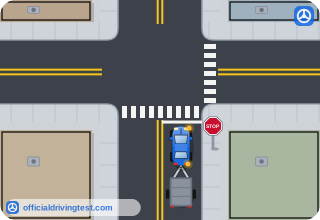
- Long trailers swing wider into the oncoming lane than your vehicle
- Long trailers turn more quickly than the vehicle that pulls them
- Long trailers need extra room because their brakes act first
- Long trailers swing closer to the edge of the road than your vehicle
Show answer
Correct answer: Long trailers swing closer to the edge of the road than your vehicle
Long trailers will swing closer to the edge of the road than your vehicle does.
Source: Minnesota Driver’s Manual (June 2026), page 80
-
What should you remember when passing other vehicles while pulling a trailer?
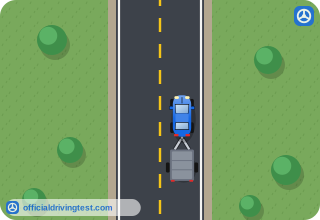
- The trailer brakes will stop you faster than your vehicle alone
- The trailer makes the vehicle accelerate faster once you are moving
- The additional length of your trailer and your reduced ability to accelerate
- The trailer keeps you in your lane even if you pass on a curve
Show answer
Correct answer: The additional length of your trailer and your reduced ability to accelerate
When passing with a trailer, remember its additional length and that your ability to accelerate is reduced.
Source: Minnesota Driver’s Manual (June 2026), page 80
-
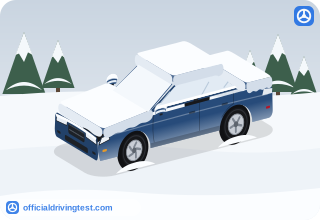
Which parts of your vehicle should you clear of snow and ice before driving?
- The windshield only
- Hood, windows and lights
- The windshield and the roof only
- The rear window and license plate only
Show answer
Correct answer: Hood, windows and lights
The manual says to remove snow and ice from your vehicle’s hood, windows and lights before driving.
Source: Minnesota Driver’s Manual (June 2026), page 81
-
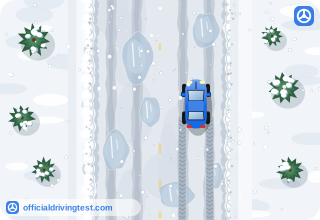
How can you test the road surface for slipperiness before you need to stop?
- Slam on the brakes at normal speed
- Drive over the shoulder and back
- Try your brakes while driving slowly
- Pump the accelerator several times
Show answer
Correct answer: Try your brakes while driving slowly
The manual says to get the feel of the road by trying your brakes while driving slowly to test the road surface.
Source: Minnesota Driver’s Manual (June 2026), page 81
-
How do you try to free a vehicle stuck on ice or snow by “rocking” it?

- Turn the front wheels sharply and spin the tires quickly to dig down to the road surface
- Keep the front wheels straight and slowly drive forward, then backward, without spinning the tires
- Shift into park and neutral repeatedly while accelerating hard each time
- Drive forward at high speed, then brake hard and put the vehicle in reverse
Show answer
Correct answer: Keep the front wheels straight and slowly drive forward, then backward, without spinning the tires
To rock a stuck vehicle, keep the front wheels straight and slowly drive forward, then backward, as far as possible, without spinning the tires.
Source: Minnesota Driver’s Manual (June 2026), page 81
-
While rocking a stuck vehicle, what should you do if it starts to slide or the tires start to spin?

- Press the accelerator harder until the tires grip the surface
- Turn the front wheels fully and keep driving in the same direction
- Shift into neutral and wait for the tires to stop spinning
- Apply the brake and repeat the operation in the opposite direction
Show answer
Correct answer: Apply the brake and repeat the operation in the opposite direction
If the vehicle slides or the tires spin, apply the brake and repeat the rocking operation in the opposite direction.
Source: Minnesota Driver’s Manual (June 2026), page 81
-
What does the manual say about using cruise control when the road surface is slippery?
- Use it at a low speed only
- Use it only on freeways
- Do not use cruise control
- Use it with your headlights on low beam
Show answer
Correct answer: Do not use cruise control
The manual says not to use cruise control when the road surface is slippery.
Source: Minnesota Driver’s Manual (June 2026), page 82
-
When must your headlights be used because of how far you can see ahead?
- When you cannot see more than 200 feet ahead
- When you cannot see more than 500 feet ahead
- When you cannot see more than 250 feet ahead
- When you cannot see more than 350 feet ahead
Show answer
Correct answer: When you cannot see more than 500 feet ahead
Headlights must be used when you cannot see more than 500 feet ahead and when it is raining, snowing, sleeting or hailing.
Source: Minnesota Driver’s Manual (June 2026), page 83
-
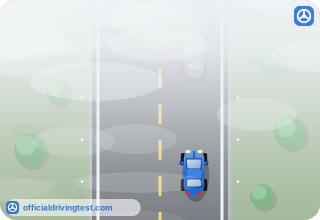
What should you do with your following distance when you encounter thunderstorms or fog?
- Decrease it
- Increase it
- Keep it the same as in dry weather
- Match it to the car ahead
Show answer
Correct answer: Increase it
In thunderstorms or fog you should reduce speed, use extra caution, be prepared to stop and increase your following distance.
Source: Minnesota Driver’s Manual (June 2026), page 83
-
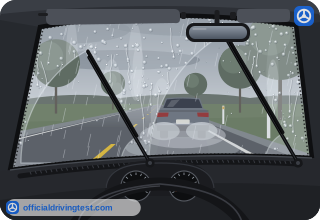
What should you do if you cannot see a safe distance ahead in heavy rain or fog?
- Follow the taillights of the vehicle ahead until the weather clears
- Turn on your high beams and continue slowly
- Speed up to leave the bad weather quickly
- Pull off the road and stop until visibility improves
Show answer
Correct answer: Pull off the road and stop until visibility improves
If you cannot see a safe distance ahead, pull off the road and stop until visibility improves.
Source: Minnesota Driver’s Manual (June 2026), page 83
-
At what speed or below do most tires “wipe” water off the road surface to stay in contact with the road?
- 35 mph or less
- 25 mph or less
- 45 mph or less
- 55 mph or less
Show answer
Correct answer: 35 mph or less
At speeds of 35 mph or less, most tires wipe water off the road surface to keep tires in contact with the road.
Source: Minnesota Driver’s Manual (June 2026), page 83
-
When can hydroplaning occur at any speed?
- When the water on the road is deeper than the depth of the tire treads
- When the road surface has been newly paved or sealed
- When the tires are inflated to the pressure the manufacturer lists
- When the vehicle is carrying a heavy load or pulling a trailer
Show answer
Correct answer: When the water on the road is deeper than the depth of the tire treads
Hydroplaning can occur at any speed if the depth of the water on the road is greater than the depth of the tire treads.
Source: Minnesota Driver’s Manual (June 2026), page 83
-
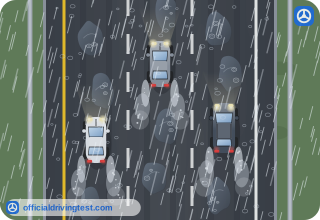
What helps prevent hydroplaning?
- Using cruise control so your speed stays steady on wet roads
- Braking firmly at the first sign of water on the road
- Keeping your tires in good condition and reducing speed on wet roads
- Driving with the tires slightly under-inflated
Show answer
Correct answer: Keeping your tires in good condition and reducing speed on wet roads
To prevent hydroplaning, keep your tires in good condition and reduce speed when driving on wet roads.
Source: Minnesota Driver’s Manual (June 2026), page 83
-
What does the manual say about coasting down steep hills?
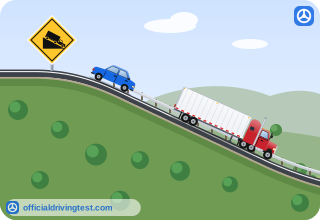
- Do not coast down with your transmission in neutral
- Coast in neutral to save fuel when the hill is long
- Coast in neutral only on a paved road with no curves
- Coast in neutral if you check your speedometer often
Show answer
Correct answer: Do not coast down with your transmission in neutral
The manual says not to coast down steep hills with your transmission in neutral, because vehicle speed will increase even when your foot is not on the accelerator.
Source: Minnesota Driver’s Manual (June 2026), page 83