Minnesota: Speed and following distance — Part 3 Practice Test
Questions in this part include: “What do the letters SIPDE stand for in the defensive driving system described in the Minnesota Driver’s Manual?” · “In the Predict step, which three things do you consider about hazards to anticipate how they may affect you?”
Independent educational site · not affiliated with any government agency or DMV
Ready? Test yourself
- Instant feedback with an explanation
- Every answer cites its source in the manual
- Your best score is saved on this device
Questions are original and based on the official manual "Minnesota Driver’s Manual" (June 2026), Minnesota Driver and Vehicle Services.
All 18 questions in this practice test
Take the test above first, then use this list to study. Tap “Show answer” to see the correct answer and explanation.
Show the questions and answersHide the questions
-
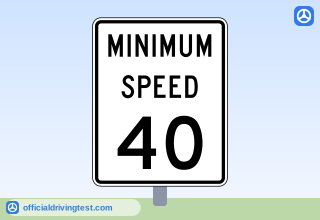
When may you drive slower than a posted minimum speed limit?
- When the vehicle ahead of you is driving slower
- When you are driving in the right-hand lane of the road
- When you are looking for your exit
- When bad weather or poor road conditions make it necessary
Show answer
Correct answer: When bad weather or poor road conditions make it necessary
You may drive slower than the minimum posted limit only when bad weather or poor road conditions make it necessary.
Source: Minnesota Driver’s Manual (June 2026), page 57
-
What do the letters SIPDE stand for in the defensive driving system described in the Minnesota Driver’s Manual?
- Scan, Identify, Predict, Decide and Execute
- Signal, Inspect, Prepare, Drive and Exit
- Stop, Inspect, Plan, Direct and Evaluate
- Search, Inform, Position, Decide and Exit
Show answer
Correct answer: Scan, Identify, Predict, Decide and Execute
The manual names the five steps of SIPDE as Scan, Identify, Predict, Decide and Execute.
Source: Minnesota Driver’s Manual (June 2026), page 72
-
In the Scan step of SIPDE, where should you search for hazards?
- Only straight ahead of your vehicle
- Only to the sides and behind
- Ahead, to the sides and behind
- Only at vehicles in your own lane
Show answer
Correct answer: Ahead, to the sides and behind
The Scan step tells drivers to search aggressively ahead, to the sides and behind to avoid hazards before they arise.
Source: Minnesota Driver’s Manual (June 2026), page 72
-
In the Scan step, where should you focus on finding potential escape routes?
- Long stretches of open rural road with no traffic nearby
- Intersections, shopping areas, schools and commercial zones
- Quiet residential streets and parking lots at night
- Highway shoulders and the medians of divided roads
Show answer
Correct answer: Intersections, shopping areas, schools and commercial zones
The Scan step says to focus on finding potential escape routes around intersections, shopping areas, schools and commercial zones.
Source: Minnesota Driver’s Manual (June 2026), page 72
-
Which of these does the manual say can make short, fast moves into your path?
- Potholes, guard rails and bridges
- Roadway signs, hedges and trees
- Parked vehicles with their engines off
- Unattended children and animals
Show answer
Correct answer: Unattended children and animals
In the Identify step, unattended children and animals are called unpredictable because they can make short, fast moves.
Source: Minnesota Driver’s Manual (June 2026), page 72
-
How does the manual describe stationary objects such as guard rails, bridges, hedges and trees?
- They will not move into your path but may influence your driving strategy
- They can be ignored because they never change how you drive
- They are the most critical hazards because they cannot be avoided
- They matter only when you are driving at night
Show answer
Correct answer: They will not move into your path but may influence your driving strategy
Stationary objects will not move into your path, but they may still influence your driving strategy.
Source: Minnesota Driver’s Manual (June 2026), page 72
-
In the Predict step, which hazards are described as more critical?
- Cars moving away from you
- Cars sitting still beside the road
- Cars moving into your path
- Cars far behind you
Show answer
Correct answer: Cars moving into your path
The manual says cars moving into your path are more critical than those moving away or sitting still.
Source: Minnesota Driver’s Manual (June 2026), page 72
-
In the Predict step, which three things do you consider about hazards to anticipate how they may affect you?
- Size, color and number of passengers
- Speed, distance and direction
- Weight, height and engine power
- Age, make and license plate
Show answer
Correct answer: Speed, distance and direction
To predict how hazards may affect you, the manual says to consider their speed, distance and direction.
Source: Minnesota Driver’s Manual (June 2026), page 72
-
In the Decide step of SIPDE, what do you decide?
- Which other driver would be at fault if a crash happened
- Which route would be shortest to your destination
- Whether to ignore hazards that are far away
- What you would need to do if the situation changed quickly
Show answer
Correct answer: What you would need to do if the situation changed quickly
In the Decide step you use your prediction to decide what you would need to do if the situation changed quickly.
Source: Minnesota Driver’s Manual (June 2026), page 72
-
In the Execute step, what does the manual say you can use to communicate your presence?
- Your lights, horn or both
- Hand signals only
- Your parking brake and mirrors
- Your voice through the window
Show answer
Correct answer: Your lights, horn or both
To create space and minimize harm, the Execute step says to communicate your presence with your lights, horn or both.
Source: Minnesota Driver’s Manual (June 2026), page 72
-
The Three-Second Rule is meant for which vehicles and conditions?
- Only vehicles that are longer than the standard length
- Any vehicle in any weather condition
- Standard-length vehicles driving in ideal conditions
- Only vehicles pulling a trailer
Show answer
Correct answer: Standard-length vehicles driving in ideal conditions
The manual says the rule is for standard-length vehicles driving in ideal conditions.
Source: Minnesota Driver’s Manual (June 2026), page 73
-
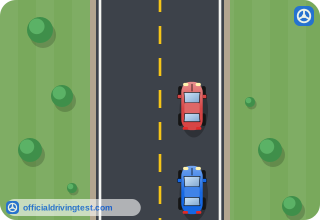
To use the Three-Second Rule, what do you choose first?
- A moving vehicle in the next lane that you can follow
- A fixed reference point at the side of the road ahead
- The speed you want to travel at
- A gap in traffic behind you
Show answer
Correct answer: A fixed reference point at the side of the road ahead
The first step is to choose a fixed reference point at the side of the road ahead, such as a telephone pole, signpost, tree or bridge.
Source: Minnesota Driver’s Manual (June 2026), page 73
-
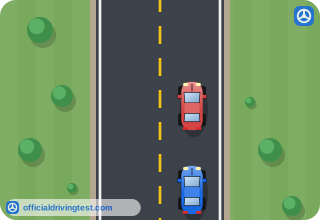
When do you begin counting in the Three-Second Rule?
- When your own front bumper reaches the reference point
- When the vehicle behind you passes the reference point
- When the vehicle ahead of you turns on its brake lights
- When the vehicle ahead of you passes the reference point
Show answer
Correct answer: When the vehicle ahead of you passes the reference point
You begin counting when the vehicle ahead of you passes the fixed reference point.
Source: Minnesota Driver’s Manual (June 2026), page 73
-
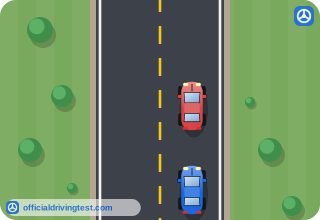
You pass the reference point before you finish counting “one-thousand-three.” What does that mean?
- You are following too closely
- You have a safe following distance
- You are driving too slowly
- You should speed up to pass
Show answer
Correct answer: You are following too closely
If you pass the reference point before you finish counting, you are following too closely and should gradually slow down.
Source: Minnesota Driver’s Manual (June 2026), page 73
-
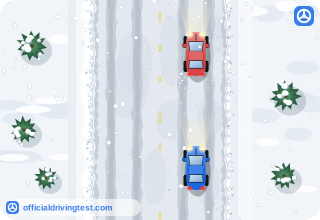
When road conditions are poor, or you drive a vehicle longer than standard length, how many seconds should you count for your following distance?
- Two seconds
- Three seconds
- Four or five seconds
- Ten seconds
Show answer
Correct answer: Four or five seconds
The manual says to increase the following distance to a four- or five-second count in poor conditions or with a longer vehicle.
Source: Minnesota Driver’s Manual (June 2026), page 73
-
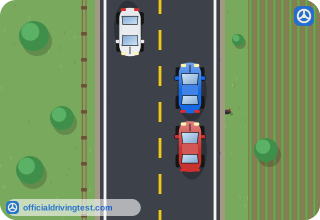
What should you do if the vehicle behind you is following too closely?
- Speed up to keep a gap ahead of it
- Slow down slightly and allow it to pass
- Brake hard to make it back off
- Stay in your lane and ignore it
Show answer
Correct answer: Slow down slightly and allow it to pass
The manual says to slow down slightly and allow a tailgating vehicle to pass.
Source: Minnesota Driver’s Manual (June 2026), page 73
-
How long does the manual say it takes from perceiving danger to using the brakes?
- About 1 1/2 seconds
- About 2 seconds
- About 5 seconds
- About 3/4 of a second
Show answer
Correct answer: About 3/4 of a second
The length of time from perceiving the danger to using the brakes is about 3/4 of a second.
Source: Minnesota Driver’s Manual (June 2026), page 73
-
Which of these does the manual list as a factor in your actual stopping distance?
- The condition of your tire treads
- The make of your vehicle’s stereo
- The number of seat belts installed
- The age of your driver’s license
Show answer
Correct answer: The condition of your tire treads
Stopping distance depends on factors including weather conditions, the condition of tire treads, and the type and condition of the brakes.
Source: Minnesota Driver’s Manual (June 2026), page 73