Minnesota: Speed and following distance — Part 2 Practice Test
Questions in this part include: “When should you use your right turn signal while passing?” · “A driver may pass on the right of another vehicle when the vehicle being overtaken is doing what?”
Independent educational site · not affiliated with any government agency or DMV
Ready? Test yourself
- Instant feedback with an explanation
- Every answer cites its source in the manual
- Your best score is saved on this device
Questions are original and based on the official manual "Minnesota Driver’s Manual" (June 2026), Minnesota Driver and Vehicle Services.
All 18 questions in this practice test
Take the test above first, then use this list to study. Tap “Show answer” to see the correct answer and explanation.
Show the questions and answersHide the questions
-
Which is an exception to the rule to drive in the right-hand lane on a highway with more than one lane in your direction?
- When you are driving slower than the other traffic
- When preparing for a left turn at an intersection
- When the right-hand lane has merging traffic
- When you are driving a large truck
Show answer
Correct answer: When preparing for a left turn at an intersection
You may leave the right-hand lane when preparing for a left turn at an intersection or into a private road or driveway.
Source: Minnesota Driver’s Manual (June 2026), page 33
-
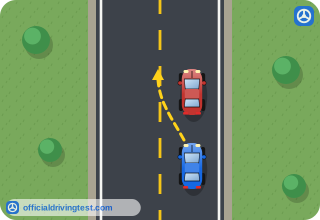
When preparing to pass, what should you check behind you?
- Whether the vehicle behind you is a commercial vehicle
- Whether the vehicle behind you has its headlights on
- Whether the road behind you has a hill
- Whether other drivers are preparing to pass you
Show answer
Correct answer: Whether other drivers are preparing to pass you
Before passing you should check behind to see if other drivers are preparing to pass you.
Source: Minnesota Driver’s Manual (June 2026), page 34
-
When should you use your right turn signal while passing?
- After passing and before returning to the right lane
- Before moving into the left lane to pass
- Only when you can no longer see the passed vehicle
- Only when the passed vehicle slows down
Show answer
Correct answer: After passing and before returning to the right lane
Use your left turn signal before moving into the left lane to pass, and your right turn signal after passing and before returning to the right lane.
Source: Minnesota Driver’s Manual (June 2026), page 34
-
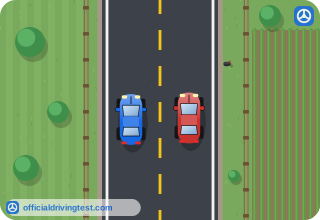
When may you return to the right lane after passing a vehicle?
- As soon as your front bumper is clearly ahead of the other vehicle
- After you have driven 500 feet beyond the other vehicle
- When you can see the entire vehicle you passed in your rearview mirror
- As soon as the other driver signals that it is safe
Show answer
Correct answer: When you can see the entire vehicle you passed in your rearview mirror
Return to the right lane when you can see the entire vehicle you have just passed in your rearview mirror.
Source: Minnesota Driver’s Manual (June 2026), page 34
-
When passing, you must return to the right side of the road before coming within what distance of an oncoming vehicle?
- 50 feet
- 200 feet
- 500 feet
- 100 feet
Show answer
Correct answer: 100 feet
You must be back on the right side of the road before coming within 100 feet of an oncoming vehicle.
Source: Minnesota Driver’s Manual (June 2026), page 34
-
Do not pass on a curve or hill where you cannot clearly see the road ahead for at least how far?
- 700 feet
- 200 feet
- 300 feet
- 500 feet
Show answer
Correct answer: 700 feet
You must not pass on a curve or hill where you cannot clearly see the road ahead for at least 700 feet.
Source: Minnesota Driver’s Manual (June 2026), page 34
-
You should not pass within what distance of an intersection, underpass, tunnel or railroad crossing?
- 100 feet
- 50 feet
- 200 feet
- 500 feet
Show answer
Correct answer: 100 feet
You must not pass within 100 feet of an intersection, underpass, tunnel or railroad crossing.
Source: Minnesota Driver’s Manual (June 2026), page 34
-
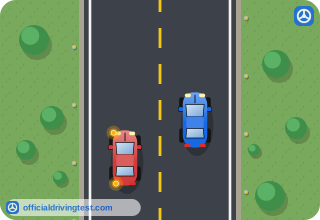
What should you do when another driver is trying to pass you?
- Speed up to stay ahead of the vehicle
- Move onto the shoulder and brake
- Stay in your own lane and do not increase speed
- Move into the opposing lane to make room
Show answer
Correct answer: Stay in your own lane and do not increase speed
When another driver is trying to pass you, stay in your own lane and do not increase speed.
Source: Minnesota Driver’s Manual (June 2026), page 34
-
A driver may pass on the right of another vehicle when the vehicle being overtaken is doing what?
- Slowing down for a stop sign
- Making or about to make a left turn
- Making or about to make a right turn
- Driving slowly on a road with one lane each way
Show answer
Correct answer: Making or about to make a left turn
One condition for passing on the right is that the vehicle you are overtaking is making or about to make a left turn.
Source: Minnesota Driver’s Manual (June 2026), page 34
-
Which of these may you not use to pass another vehicle on the right?
- A lane on a one-way street wide enough for two or more lanes of vehicles
- A lane on a street with space for two lanes of moving vehicles in each direction
- The lane to the right of a vehicle that is about to turn left
- The shoulder of the road
Show answer
Correct answer: The shoulder of the road
When passing on the right you must not drive in a bicycle lane, on the shoulder, or off the pavement or main part of the road.
Source: Minnesota Driver’s Manual (June 2026), page 34
-
On a one-way street, under what conditions may you pass on the right?
- Only if the left lane is blocked and the driver ahead has signaled that it is safe to pass on the right
- Only if you do not exceed the speed limit by more than 10 mph while passing
- Only if there are no obstructions and the road is wide enough for two or more lanes of moving vehicles
- Only if the vehicle ahead is signaling to turn left at the next intersection
Show answer
Correct answer: Only if there are no obstructions and the road is wide enough for two or more lanes of moving vehicles
On a one-way street you may only pass on the right if there are no obstructions and the road is wide enough for two or more lanes of moving vehicles.
Source: Minnesota Driver’s Manual (June 2026), page 34
-
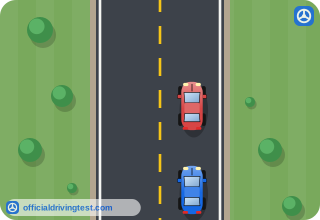
Which rule does the manual give to help you maintain a safe following distance?
- The two-second rule
- The three-second rule
- The ten-car-length rule
- The one-car-length rule
Show answer
Correct answer: The three-second rule
The manual says to use the three-second rule to help maintain a safe following distance.
Source: Minnesota Driver’s Manual (June 2026), page 44
-
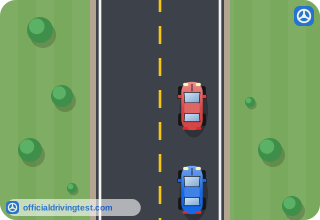
What must you be able to do when following the vehicle in front of you?
- Pass it within 5 seconds
- Keep it in view in your mirror
- Match its speed exactly
- Stop or turn to avoid a collision
Show answer
Correct answer: Stop or turn to avoid a collision
You must keep a safe distance so that you can stop or turn to avoid a collision.
Source: Minnesota Driver’s Manual (June 2026), page 44
-
Careless driving means driving or stopping a vehicle in a way that
- endangers the lives and safety of people or property
- causes a crash that injures another person in the vehicle
- exceeds the posted speed limit by a large amount
- ignores a red traffic signal at an intersection
Show answer
Correct answer: endangers the lives and safety of people or property
Careless driving is driving or stopping in a way that endangers the lives and safety of people or property.
Source: Minnesota Driver’s Manual (June 2026), page 44
-
Reckless driving means driving a vehicle while
- failing to signal a lane change before moving over on a busy road
- exceeding the posted speed limit by any amount on any road
- knowingly disregarding a substantial and unjustifiable risk to others
- stopping a vehicle in the roadway for a short time to talk
Show answer
Correct answer: knowingly disregarding a substantial and unjustifiable risk to others
Reckless driving is knowingly disregarding a substantial and unjustifiable risk, including racing or contest driving.
Source: Minnesota Driver’s Manual (June 2026), page 44
-
How does the manual define racing?
- Driving faster than the speed limit on a freeway or highway at night
- Intentionally comparing or contesting relative speeds by driving
- Passing another vehicle on a two-lane road at a high speed
- Driving much faster than the other traffic around you on a road
Show answer
Correct answer: Intentionally comparing or contesting relative speeds by driving
Racing is intentional comparing or contesting of relative speeds, whether or not the speed limit is exceeded.
Source: Minnesota Driver’s Manual (June 2026), page 44
-
If you are charged with careless or reckless driving, how will you be tried?
- By a driver's license examiner
- In court for a felony
- By mail with a fine only
- In court for a misdemeanor
Show answer
Correct answer: In court for a misdemeanor
A careless or reckless driving charge is tried in court for a misdemeanor.
Source: Minnesota Driver’s Manual (June 2026), page 44
-
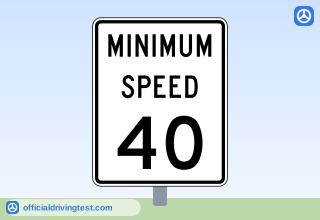
Where might you see minimum speed limits posted?
- On residential streets near schools
- On interstate freeways with controlled access
- On gravel and dirt roads outside of town
- In parking lots and driveways
Show answer
Correct answer: On interstate freeways with controlled access
The manual says you may also see minimum speed limits on interstate freeways with controlled access.
Source: Minnesota Driver’s Manual (June 2026), page 57