Minnesota: Speed and following distance — Part 1 Practice Test
Questions in this part include: “What does Minnesota’s basic speed law say you must do?” · “You drive how many miles per hour or more over the speed limit before additional fines apply?”
Independent educational site · not affiliated with any government agency or DMV
Ready? Test yourself
- Instant feedback with an explanation
- Every answer cites its source in the manual
- Your best score is saved on this device
Questions are original and based on the official manual "Minnesota Driver’s Manual" (June 2026), Minnesota Driver and Vehicle Services.
All 18 questions in this practice test
Take the test above first, then use this list to study. Tap “Show answer” to see the correct answer and explanation.
Show the questions and answersHide the questions
-
What does Minnesota’s basic speed law say you must do?
- Drive at a speed that is reasonable for the current conditions
- Drive at the posted speed limit no matter what the conditions are
- Drive at the same speed as the vehicle ahead of you
- Drive no faster than the slowest vehicle on the road
Show answer
Correct answer: Drive at a speed that is reasonable for the current conditions
The basic speed law requires a speed that is reasonable for the weather, traffic and road conditions.
Source: Minnesota Driver’s Manual (June 2026), page 26
-
What is the posted speed limit on a road?
- The speed you should drive when the road is in poor condition
- The speed that most drivers on that road usually drive
- The minimum speed allowed on that road
- The maximum speed allowed on that road
Show answer
Correct answer: The maximum speed allowed on that road
The posted speed limit is the maximum speed allowed on the road, and driving faster than it is illegal.
Source: Minnesota Driver’s Manual (June 2026), page 26
-
On a two-lane highway with a speed limit of 55 mph or higher, by how much can you increase your speed when lawfully passing another vehicle?
- 5 mph
- 10 mph
- 15 mph
- 20 mph
Show answer
Correct answer: 10 mph
On two-lane highways with a speed limit of 55 mph or higher, you can increase your speed by 10 mph when lawfully passing another vehicle.
Source: Minnesota Driver’s Manual (June 2026), page 26
-
On a road with a posted minimum speed limit, what is illegal under normal conditions?
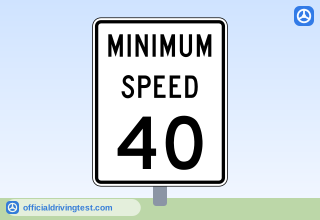
- Driving slower than the posted minimum speed
- Driving faster than the posted minimum speed
- Changing lanes while driving at the minimum speed
- Driving exactly at the posted minimum speed
Show answer
Correct answer: Driving slower than the posted minimum speed
Some roads have minimum speed limits, and driving slower than the posted minimum is illegal under normal conditions.
Source: Minnesota Driver’s Manual (June 2026), page 26
-
Under ideal conditions, unless signs say otherwise, what is the speed limit in alleys?
- 5 mph
- 10 mph
- 15 mph
- 20 mph
Show answer
Correct answer: 10 mph
Under ideal conditions the limit in alleys is 10 mph unless signs indicate otherwise.
Source: Minnesota Driver’s Manual (June 2026), page 26
-
Under ideal conditions, unless signs say otherwise, what is the speed limit on urban or town roads?
- 20 mph
- 40 mph
- 45 mph
- 30 mph
Show answer
Correct answer: 30 mph
Under ideal conditions the limit on urban or town roads is 30 mph unless signs indicate otherwise.
Source: Minnesota Driver’s Manual (June 2026), page 26
-
Under ideal conditions, unless signs say otherwise, what is the speed limit in locations that are not alleys or urban or town roads?
- 45 mph
- 50 mph
- 55 mph
- 60 mph
Show answer
Correct answer: 55 mph
Under ideal conditions the limit is 55 mph in all locations not otherwise specified, unless signs indicate otherwise.
Source: Minnesota Driver’s Manual (June 2026), page 26
-
What must you do in a school zone when children are present?
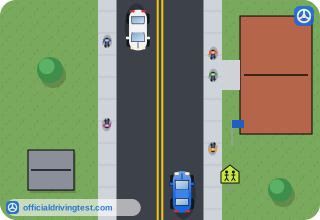
- Slow down
- Come to a complete stop
- Change lanes away from the children
- Sound your horn to warn them
Show answer
Correct answer: Slow down
In school zones you must slow down when children are present.
Source: Minnesota Driver’s Manual (June 2026), page 26
-
You drive how many miles per hour or more over the speed limit before additional fines apply?
- 5 mph
- 20 mph
- 10 mph
- 15 mph
Show answer
Correct answer: 20 mph
Additional fines apply if you drive 20 mph or more over the limit.
Source: Minnesota Driver’s Manual (June 2026), page 27
-
Which of these situations does the manual tell you to slow down for?
- Street signs and mailboxes on the side of the road
- A green traffic light at an intersection with no cross traffic
- Flag persons, barricades, flares or reflectors on the road
- A dry, straight road in daylight
Show answer
Correct answer: Flag persons, barricades, flares or reflectors on the road
You must slow down for flag persons, pedestrians, barricades, flares or reflectors on the road.
Source: Minnesota Driver’s Manual (June 2026), page 27
-
What does the manual say you must do in bad weather and poor road conditions?
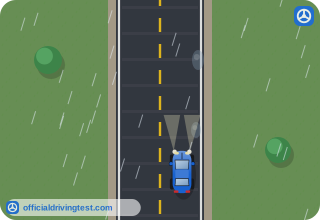
- Drive at the posted speed limit
- Slow down
- Follow the vehicle ahead more closely
- Turn on your hazard lights and keep moving
Show answer
Correct answer: Slow down
You must slow down in bad weather and poor road conditions.
Source: Minnesota Driver’s Manual (June 2026), page 27
-
When approaching which of these places should you drive slower?
- A wide, straight road with no hills
- A green traffic signal on a clear day
- A paved shoulder with no vehicles on it
- A curve, hilltop or railroad crossing
Show answer
Correct answer: A curve, hilltop or railroad crossing
Drive slower on narrow or winding roads and when approaching a curve, hilltop or railroad crossing.
Source: Minnesota Driver’s Manual (June 2026), page 27
-
Why do you need to slow down on gravel or dirt roads?

- It is harder to see traffic signs on gravel roads
- The speed limit on gravel roads is always lower by law
- It takes longer to stop and is easier to skid when turning
- Dust from the road makes your tires lose air
Show answer
Correct answer: It takes longer to stop and is easier to skid when turning
On gravel or dirt roads it takes longer to stop and it is easier to skid when turning, so you need to slow down.
Source: Minnesota Driver’s Manual (June 2026), page 27
-
How does increasing your speed affect your field of vision?
- It decreases your field of vision
- It increases your field of vision
- It does not change your field of vision
- It moves your field of vision to the side
Show answer
Correct answer: It decreases your field of vision
Increasing speed decreases your field of vision and increases the risk of a crash.
Source: Minnesota Driver’s Manual (June 2026), page 27
-
What does the manual tell you to do about special speed limits and “No Passing” signs on bridges?
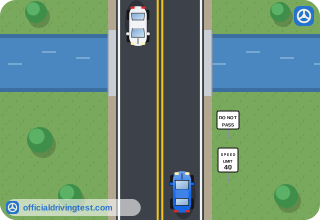
- Ignore them if no other vehicles are on the bridge
- Obey them only when the bridge is wet or icy
- Follow them only if a flag person is present
- Watch for them and obey them
Show answer
Correct answer: Watch for them and obey them
You must watch for and obey special speed limits and “No Passing” signs posted on bridges.
Source: Minnesota Driver’s Manual (June 2026), page 27
-
On a road with one lane in your direction, what must you do if you are going slow enough to create a traffic hazard?
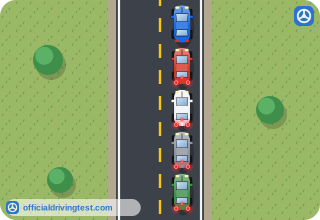
- Drive in the center of the lane with your hazard lights on
- Move onto the left shoulder of the road
- Drive as close as possible to the right-hand curb or edge of the road
- Stop at the next intersection and wait
Show answer
Correct answer: Drive as close as possible to the right-hand curb or edge of the road
If you are going slow enough to create a traffic hazard, you must drive as close as possible to the right-hand curb or edge of the road.
Source: Minnesota Driver’s Manual (June 2026), page 33
-
On highways with more than one lane in the same direction, which lane should you drive in when it is available?
- The right-hand lane
- The left-most lane
- The center lane
- Whichever lane is moving fastest
Show answer
Correct answer: The right-hand lane
On highways with more than one lane in the same direction, you should drive in the right-hand lane when available.
Source: Minnesota Driver’s Manual (June 2026), page 33
-
If you are in the left-most lane of a highway with more than one lane in your direction, what should you do when practical?
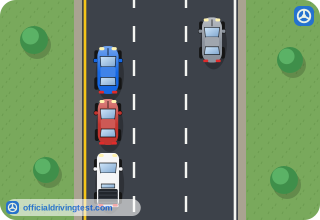
- Speed up to the limit and keep driving in the lane
- Stop and let the vehicle behind you pass
- Stay in the lane unless the road is slippery
- Move out of the lane to allow another vehicle to pass
Show answer
Correct answer: Move out of the lane to allow another vehicle to pass
The manual says to move out of the left-most lane when practical to allow another vehicle to pass.
Source: Minnesota Driver’s Manual (June 2026), page 33