Minnesota: Speed and following distance — Part 4 Practice Test
Questions in this part include: “What following distance must you maintain from other vehicles if you pull a camper or trailer?” · “What does the manual say about using cruise control when the road surface is slippery?”
Independent educational site · not affiliated with any government agency or DMV
Ready? Test yourself
- Instant feedback with an explanation
- Every answer cites its source in the manual
- Your best score is saved on this device
Questions are original and based on the official manual "Minnesota Driver’s Manual" (June 2026), Minnesota Driver and Vehicle Services.
All 18 questions in this practice test
Take the test above first, then use this list to study. Tap “Show answer” to see the correct answer and explanation.
Show the questions and answersHide the questions
-
What following distance must you maintain from other vehicles if you pull a camper or trailer?
- At least 500 feet
- At least 100 feet
- At least 200 feet
- At least 350 feet
Show answer
Correct answer: At least 500 feet
If you pull a camper or trailer, you must maintain at least 500 feet of following distance from other vehicles.
Source: Minnesota Driver’s Manual (June 2026), page 79
-
Why should you travel at a slower speed when pulling a trailer?
- Small trailer wheels turn faster, and the heat buildup can cause wheel bearing failure
- The trailer’s extra weight makes the headlights dimmer at higher speeds
- Trailers are required by law to stay under the speed of main-line traffic
- Heavy loads make the hitch lock up when you drive at higher speeds
Show answer
Correct answer: Small trailer wheels turn faster, and the heat buildup can cause wheel bearing failure
Many trailers have smaller wheels that turn faster than car wheels, causing heat buildup that can lead to trailer wheel bearing failure.
Source: Minnesota Driver’s Manual (June 2026), page 79
-
What could a sudden stop at high speed do to a vehicle pulling a heavy trailer?
- Release the trailer from the hitch safely
- Damage only the trailer’s tires
- Flip both the trailer and the car
- Lock the trailer’s wheels harmlessly
Show answer
Correct answer: Flip both the trailer and the car
The brakes on your vehicle were probably not designed for heavy trailer loads, so a sudden stop at high speed could flip both the trailer and the car.
Source: Minnesota Driver’s Manual (June 2026), page 79
-
What should you do when towing a trailer or camper in wet or windy conditions?
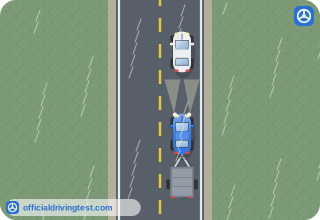
- Keep the same speed because the extra weight holds you steady
- Speed up to get through the rain or wind sooner
- Slow down more than you would normally do in such weather
- Switch to a higher gear and keep your usual speed
Show answer
Correct answer: Slow down more than you would normally do in such weather
Wind and rain affect your ability to control a vehicle pulling extra weight, so you should slow down more than usual.
Source: Minnesota Driver’s Manual (June 2026), page 80
-
Why should you allow plenty of room for turns when towing a long trailer?
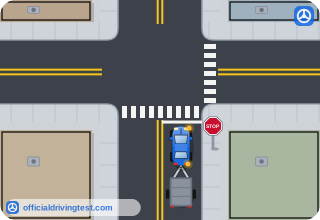
- Long trailers swing wider into the oncoming lane than your vehicle
- Long trailers turn more quickly than the vehicle that pulls them
- Long trailers need extra room because their brakes act first
- Long trailers swing closer to the edge of the road than your vehicle
Show answer
Correct answer: Long trailers swing closer to the edge of the road than your vehicle
Long trailers will swing closer to the edge of the road than your vehicle does.
Source: Minnesota Driver’s Manual (June 2026), page 80
-
What should you remember when passing other vehicles while pulling a trailer?
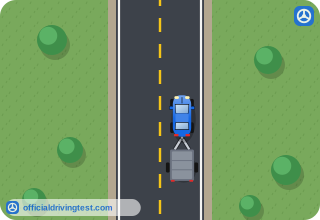
- The trailer brakes will stop you faster than your vehicle alone
- The trailer makes the vehicle accelerate faster once you are moving
- The additional length of your trailer and your reduced ability to accelerate
- The trailer keeps you in your lane even if you pass on a curve
Show answer
Correct answer: The additional length of your trailer and your reduced ability to accelerate
When passing with a trailer, remember its additional length and that your ability to accelerate is reduced.
Source: Minnesota Driver’s Manual (June 2026), page 80
-
Which parts of your vehicle should you clear of snow and ice before driving?
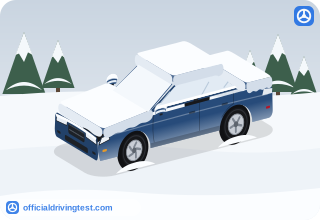
- The windshield only
- Hood, windows and lights
- The windshield and the roof only
- The rear window and license plate only
Show answer
Correct answer: Hood, windows and lights
The manual says to remove snow and ice from your vehicle’s hood, windows and lights before driving.
Source: Minnesota Driver’s Manual (June 2026), page 81
-
How can you test the road surface for slipperiness before you need to stop?

- Slam on the brakes at normal speed
- Drive over the shoulder and back
- Try your brakes while driving slowly
- Pump the accelerator several times
Show answer
Correct answer: Try your brakes while driving slowly
The manual says to get the feel of the road by trying your brakes while driving slowly to test the road surface.
Source: Minnesota Driver’s Manual (June 2026), page 81
-
How do you try to free a vehicle stuck on ice or snow by “rocking” it?

- Turn the front wheels sharply and spin the tires quickly to dig down to the road surface
- Keep the front wheels straight and slowly drive forward, then backward, without spinning the tires
- Shift into park and neutral repeatedly while accelerating hard each time
- Drive forward at high speed, then brake hard and put the vehicle in reverse
Show answer
Correct answer: Keep the front wheels straight and slowly drive forward, then backward, without spinning the tires
To rock a stuck vehicle, keep the front wheels straight and slowly drive forward, then backward, as far as possible, without spinning the tires.
Source: Minnesota Driver’s Manual (June 2026), page 81
-
While rocking a stuck vehicle, what should you do if it starts to slide or the tires start to spin?

- Press the accelerator harder until the tires grip the surface
- Turn the front wheels fully and keep driving in the same direction
- Shift into neutral and wait for the tires to stop spinning
- Apply the brake and repeat the operation in the opposite direction
Show answer
Correct answer: Apply the brake and repeat the operation in the opposite direction
If the vehicle slides or the tires spin, apply the brake and repeat the rocking operation in the opposite direction.
Source: Minnesota Driver’s Manual (June 2026), page 81
-
What does the manual say about using cruise control when the road surface is slippery?
- Use it at a low speed only
- Use it only on freeways
- Do not use cruise control
- Use it with your headlights on low beam
Show answer
Correct answer: Do not use cruise control
The manual says not to use cruise control when the road surface is slippery.
Source: Minnesota Driver’s Manual (June 2026), page 82
-
When must your headlights be used because of how far you can see ahead?
- When you cannot see more than 200 feet ahead
- When you cannot see more than 500 feet ahead
- When you cannot see more than 250 feet ahead
- When you cannot see more than 350 feet ahead
Show answer
Correct answer: When you cannot see more than 500 feet ahead
Headlights must be used when you cannot see more than 500 feet ahead and when it is raining, snowing, sleeting or hailing.
Source: Minnesota Driver’s Manual (June 2026), page 83
-
What should you do with your following distance when you encounter thunderstorms or fog?

- Decrease it
- Increase it
- Keep it the same as in dry weather
- Match it to the car ahead
Show answer
Correct answer: Increase it
In thunderstorms or fog you should reduce speed, use extra caution, be prepared to stop and increase your following distance.
Source: Minnesota Driver’s Manual (June 2026), page 83
-
What should you do if you cannot see a safe distance ahead in heavy rain or fog?
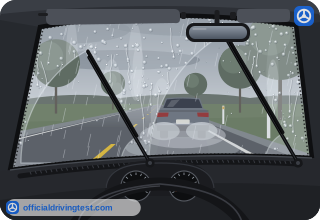
- Follow the taillights of the vehicle ahead until the weather clears
- Turn on your high beams and continue slowly
- Speed up to leave the bad weather quickly
- Pull off the road and stop until visibility improves
Show answer
Correct answer: Pull off the road and stop until visibility improves
If you cannot see a safe distance ahead, pull off the road and stop until visibility improves.
Source: Minnesota Driver’s Manual (June 2026), page 83
-
At what speed or below do most tires “wipe” water off the road surface to stay in contact with the road?
- 35 mph or less
- 25 mph or less
- 45 mph or less
- 55 mph or less
Show answer
Correct answer: 35 mph or less
At speeds of 35 mph or less, most tires wipe water off the road surface to keep tires in contact with the road.
Source: Minnesota Driver’s Manual (June 2026), page 83
-
When can hydroplaning occur at any speed?
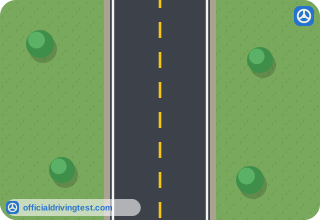
- When the water on the road is deeper than the depth of the tire treads
- When the road surface has been newly paved or sealed
- When the tires are inflated to the pressure the manufacturer lists
- When the vehicle is carrying a heavy load or pulling a trailer
Show answer
Correct answer: When the water on the road is deeper than the depth of the tire treads
Hydroplaning can occur at any speed if the depth of the water on the road is greater than the depth of the tire treads.
Source: Minnesota Driver’s Manual (June 2026), page 83
-
What helps prevent hydroplaning?
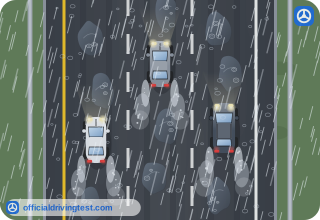
- Using cruise control so your speed stays steady on wet roads
- Braking firmly at the first sign of water on the road
- Keeping your tires in good condition and reducing speed on wet roads
- Driving with the tires slightly under-inflated
Show answer
Correct answer: Keeping your tires in good condition and reducing speed on wet roads
To prevent hydroplaning, keep your tires in good condition and reduce speed when driving on wet roads.
Source: Minnesota Driver’s Manual (June 2026), page 83
-
What does the manual say about coasting down steep hills?
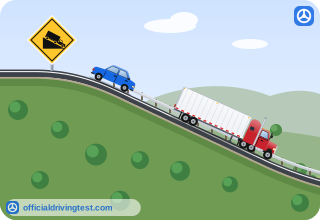
- Do not coast down with your transmission in neutral
- Coast in neutral to save fuel when the hill is long
- Coast in neutral only on a paved road with no curves
- Coast in neutral if you check your speedometer often
Show answer
Correct answer: Do not coast down with your transmission in neutral
The manual says not to coast down steep hills with your transmission in neutral, because vehicle speed will increase even when your foot is not on the accelerator.
Source: Minnesota Driver’s Manual (June 2026), page 83