Pavement markings in Massachusetts
The Massachusetts Driver's Manual shows or names everything on this page: 20 in all, on pages 89–92, 98, 116–117.
Independent educational site · not affiliated with any government agency or DMV
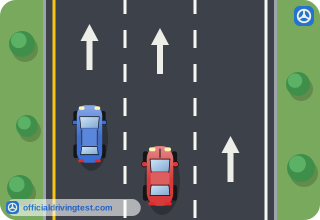
Broken White Line
Broken white lines separate lanes of traffic traveling in the same direction. Once you have signaled, and it is safe to do so, you may cross this line when changing lanes.
Manual page 89 · Open this page in the manual (Manual page 89)
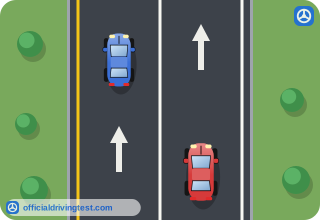
Solid White Line
A solid white line marks the right edge of the roadway or separates lanes of traffic traveling in the same direction, including bicycle lanes. You can go in the same direction on both sides of this line (except the shoulder), but you should not cross it unless you need to avoid danger.
Manual page 90 · Open this page in the manual (Manual page 90)
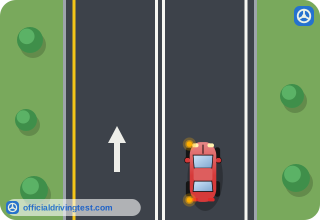
Double Solid White Line
A double solid white line separates two lanes of traffic going in the same direction. Crossing a double solid white line is not allowed.
Manual page 90 · Open this page in the manual (Manual page 90)
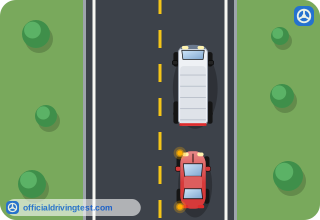
Broken Yellow Line
A broken yellow line separates lanes of traffic moving in opposite directions. Stay to the right of the line, unless you are passing a vehicle in front of you. When passing, you may cross this line temporarily when it is safe to do so.
Manual page 90 · Open this page in the manual (Manual page 90)
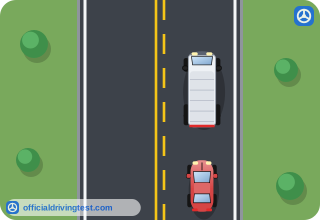
Double Yellow Lines: One Solid, One Broken
One solid yellow line and one broken yellow line separate opposite lanes of traffic. If the solid yellow line is closer to you, you cannot cross the lines. If the broken line is closer to you, you can only cross the line to pass another vehicle when it is safe to do so.
Manual page 90 · Open this page in the manual (Manual page 90)
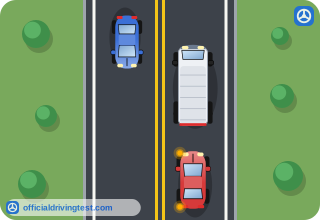
Double Yellow Lines: Both Solid
Two solid yellow lines prohibit vehicles from crossing them to pass another vehicle. You may not cross these lines unless turning left when it is safe to do so.
Manual page 90 · Open this page in the manual (Manual page 90)
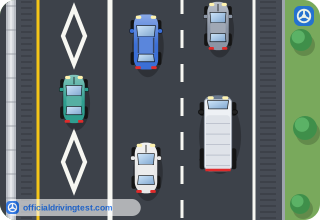
Diamond Lane Marking (High-Occupancy Lane)
A white diamond symbol means there is a special lane restriction, like “high occupancy vehicle (HOV) only” or “bus only.”
Manual page 90 · Open this page in the manual (Manual page 90)
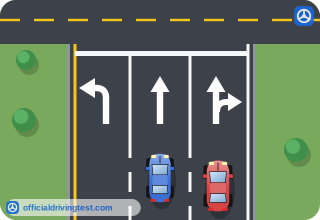
Pavement Arrows
White arrows show lane directions or restrictions.
Manual page 90 · Open this page in the manual (Manual page 90)
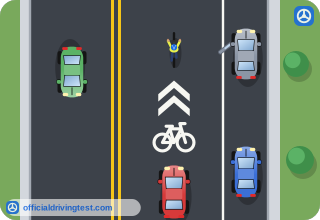
Shared Lane Markings (Sharrows)
Shared Lane Markings (also known as Sharrows) help bicyclists position themselves in the right location and in the right direction in a lane that is shared with motor vehicles. When you see a Shared Lane Marking, you must look out for the presence of bicyclists and make sure that you leave them enough space when passing.
Manual page 91 · Open this page in the manual (Manual page 91)
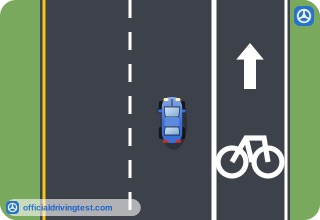
Bicycle Lane Marking
Bicycle lanes are portions of the roadway that are intended for use by bicyclists and are typically marked by solid white lines, along with pavement markings and signs. They are five feet wide. Motor vehicles may only drive in these lanes when turning on or off the road.
Manual page 91 · Open this page in the manual (Manual page 91)
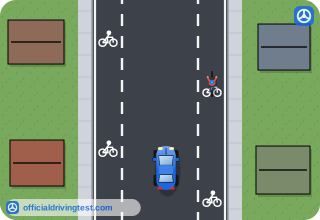
Advisory Bicycle Lanes
Advisory bicycle lanes are becoming common on streets that are too narrow for a full bicycle lane, but still have a lot of bicycle traffic. They are dashed on one or both sides to indicate that motor vehicles may use the lane space when necessary, but they must always yield to bicyclists first.
Manual page 91 · Open this page in the manual (Manual page 91)
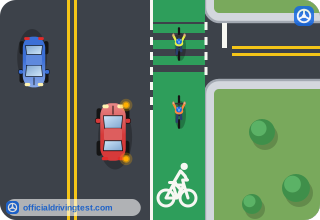
Green Pavement (Bicycle Lane)
Green pavement is used in areas where there could be road sharing conflicts between motor vehicles and bicycles. You should pay close attention and look for bicyclists before crossing green pavement. At a red light, you should not stop on green pavement.
Manual page 91 · Open this page in the manual (Manual page 91)
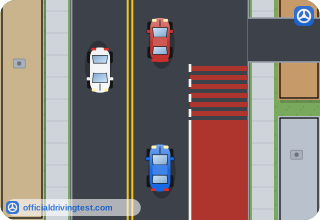
Bus Lane (Red Pavement)
Red pavement is used for travel lanes or station stops used by public transit systems. This includes buses, streetcars, trolleys, light-rail trains, and rapid transit fleets.
Manual page 91 · Open this page in the manual (Manual page 91)
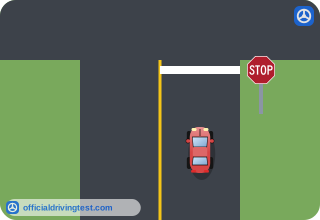
Stop Line
An intersection or pedestrian crossing with a stop sign or traffic signal may have a solid white STOP line painted across it. You must stop behind the stop lines, yield lines, and crosswalk lines if required by a stop/yield sign, traffic signal, or pedestrian in the crosswalk.
Manual page 92 · Open this page in the manual (Manual page 92)
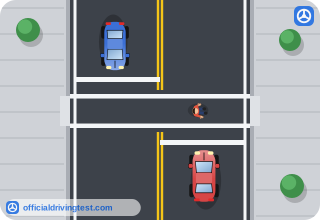
Crosswalk
A crosswalk is a pair of white lines, or other distinguished pavement markings or materials, painted across a lane to guide pedestrians from one side of the road to the other. A painted crosswalk also warns drivers that pedestrians may be crossing the road. Crosswalks may have diagonal or vertical lines painted between the two main lines.
Manual page 92 · Open this page in the manual (Manual page 92)
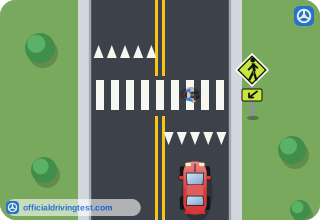
Yield Line
An intersection with a yield sign may have a YIELD line painted across it. A YIELD line looks like a series of triangles painted next to each other.
Manual page 92 · Open this page in the manual (Manual page 92)
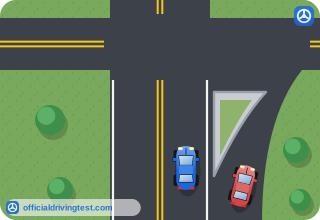
Channelizing Islands
A channelizing island is a traffic island or pavement marking that guides traffic along certain paths and prevents operation on areas of the roadway. You cannot drive over or park a motor vehicle upon any channelizing island, unless directed to do so by a police officer.
Manual page 92 · Open this page in the manual (Manual page 92)
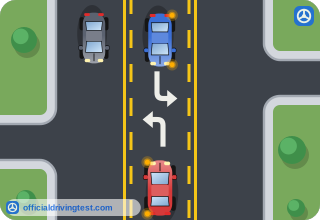
Center Lane LEFT TURN ONLY (Markings)
On some two-way roads, a center lane may be marked as a common left-turn lane to be used by vehicles in both directions. You may not travel in a center turning lane.
Manual page 98 · Open this page in the manual (Manual page 98)
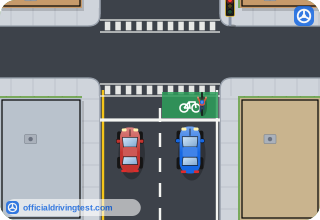
Bicycle Box
Bicycle boxes are pavement markings that are installed at intersections to allow bicyclists a safe way to turn when approaching a red light. Bicycle boxes are green and have an image of a bicyclist. At intersections, they are painted on the pavement before the crosswalk and they cover the entire travel lane. Drivers must stop behind the bicycle box (even when it's empty) and wait for a green light.
Manual page 116 · Open this page in the manual (Manual page 116)
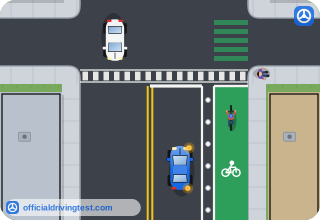
Separated Bicycle Lane
Separated bicycle lanes, also know as cycle tracks and protected bike lanes, physically separate bicycle traffic from vehicular traffic. Where bicycle lanes cross an intersection, they are often indicated by green pavement with an image of a bicyclist. Bicycle lanes are not intended for pedestrians, who must stay on the sidewalk.
Manual page 117 · Open this page in the manual (Manual page 117)