Massachusetts: Pavement markings Practice Test
White and yellow lane lines, passing and no-passing lines, stop and yield lines, crosswalks, colored pavement for bus and bicycle lanes, and channelizing islands.
Independent educational site · not affiliated with any government agency or DMV
Ready? Test yourself
- Instant feedback with an explanation
- Every answer cites its source in the manual
- Your best score is saved on this device
Questions are original and based on the official manual "Massachusetts Driver's Manual" (Revised April 2026), Massachusetts Registry of Motor Vehicles.
All 29 questions in this practice test
Take the test above first, then use this list to study. Tap “Show answer” to see the correct answer and explanation.
Show the questions and answersHide the questions
-
On the road, a solid white or solid yellow line turns into a dotted line made of short dashes. What does the dotted line mean?
- The line has ended and passing is allowed from that point on in either direction
- It marks a lane that is reserved for buses and carpools only at intersections
- It is a continuation of the line through an intersection or highway interchange
- It warns drivers that a pedestrian crossing is just ahead of the intersection
Show answer
Correct answer: It is a continuation of the line through an intersection or highway interchange
A solid white or yellow line that turns into a dotted line continues the line through an intersection or highway interchange.
Source: Massachusetts Driver's Manual (Revised April 2026), page 89 · Open this page in the manual (Manual page 89)
-
Unless you are turning, exiting a highway, or changing lanes, what should you always do with regard to lane lines?
- Drive with the left wheels on the line
- Stay between the lane lines
- Keep as close to the right edge as you can
- Follow the line markings of the vehicle ahead
Show answer
Correct answer: Stay between the lane lines
The manual says that unless you are turning, exiting a highway, or changing lanes, you should always stay between lane lines.
Source: Massachusetts Driver's Manual (Revised April 2026), page 89 · Open this page in the manual (Manual page 89)
-
What do white lane lines separate?
- Lanes of traffic moving in opposite directions
- Only lanes reserved for buses and carpools
- Only the lanes at an intersection or interchange
- Lanes of traffic moving in the same direction
Show answer
Correct answer: Lanes of traffic moving in the same direction
White lane lines separate lanes of traffic moving in the same direction.
Source: Massachusetts Driver's Manual (Revised April 2026), page 89 · Open this page in the manual (Manual page 89)
-
What may a single white line also mark?
- The right edge of the pavement
- The center of a two-way road
- The start of a no-passing zone
- The left edge of a divided highway
Show answer
Correct answer: The right edge of the pavement
Single white lines may also mark the right edge of the pavement.
Source: Massachusetts Driver's Manual (Revised April 2026), page 89 · Open this page in the manual (Manual page 89)
-
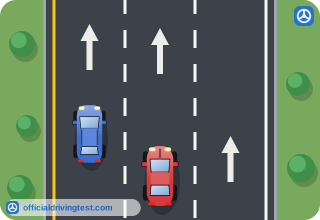
You see a broken white line between two lanes going the same direction. Once you have signaled and it is safe, what may you do?
- Cross the line only to pass a vehicle in front of you
- Cross the line only to make a left turn
- Cross the line when changing lanes
- Never cross the line under any circumstances
Show answer
Correct answer: Cross the line when changing lanes
Once you have signaled and it is safe, you may cross a broken white line when changing lanes.
Source: Massachusetts Driver's Manual (Revised April 2026), page 89 · Open this page in the manual (Manual page 89)
-
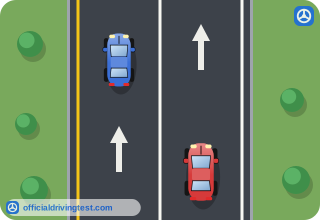
A solid white line separates two lanes going in the same direction. When should you cross it?
- Whenever you want to pass a slower vehicle
- Only if you need to avoid danger
- Whenever you have signaled and the other lane is clear
- Whenever the traffic in your lane slows down
Show answer
Correct answer: Only if you need to avoid danger
A solid white line may be crossed in the same direction, but you should not cross it unless you need to avoid danger.
Source: Massachusetts Driver's Manual (Revised April 2026), page 90 · Open this page in the manual (Manual page 90)
-
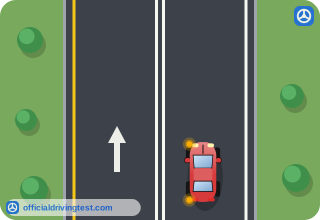
What does the manual say about crossing a double solid white line?
- It is allowed when you signal first
- It is allowed when you need to avoid danger
- It is allowed in order to pass a slower vehicle
- It is not allowed
Show answer
Correct answer: It is not allowed
A double solid white line separates two lanes going the same direction, and crossing it is not allowed.
Source: Massachusetts Driver's Manual (Revised April 2026), page 90 · Open this page in the manual (Manual page 90)
-
What do yellow lane lines separate?
- Lanes of traffic moving in opposite directions
- Lanes of traffic moving in the same direction
- Travel lanes from bicycle lanes
- Travel lanes from a highway breakdown lane
Show answer
Correct answer: Lanes of traffic moving in opposite directions
Yellow lane lines separate lanes of traffic moving in opposite directions.
Source: Massachusetts Driver's Manual (Revised April 2026), page 90 · Open this page in the manual (Manual page 90)
-
Where may a single yellow line mark the left edge of the pavement?
- On bicycle lanes and shared lanes
- On two-way streets with a center turning lane
- On divided highways and one-way streets
- On highway entrance and exit ramps only
Show answer
Correct answer: On divided highways and one-way streets
Single yellow lines may mark the left edge of the pavement on divided highways and one-way streets.
Source: Massachusetts Driver's Manual (Revised April 2026), page 90 · Open this page in the manual (Manual page 90)
-
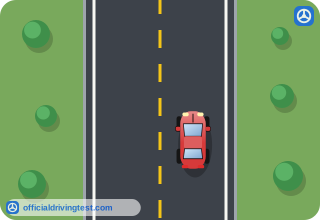
When may you cross a broken yellow line?
- Whenever the road ahead has no oncoming traffic in sight
- Temporarily, when passing a vehicle in front of you and it is safe
- Only when you are changing from one turning lane to another
- Only when you are turning right into a driveway
Show answer
Correct answer: Temporarily, when passing a vehicle in front of you and it is safe
A broken yellow line separates opposite lanes; you stay to the right unless you are passing, and then you may cross it temporarily when it is safe.
Source: Massachusetts Driver's Manual (Revised April 2026), page 90 · Open this page in the manual (Manual page 90)
-
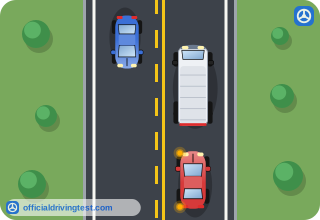
A double yellow line has one solid line and one broken line. The solid line is closer to you. May you cross the lines to pass?
- Yes, whenever it is safe to pass
- Yes, if no vehicle is behind you
- Yes, if you signal for 100 feet first
- No, you cannot cross them to pass
Show answer
Correct answer: No, you cannot cross them to pass
If the solid yellow line is closer to you, you cannot cross the lines.
Source: Massachusetts Driver's Manual (Revised April 2026), page 90 · Open this page in the manual (Manual page 90)
-
A double yellow line has one solid line and one broken line. The broken line is closer to you. When may you cross it?
- To pass another vehicle when it is safe to do so
- Never, because the other line is solid
- Only to turn right at the next intersection
- Whenever you have signaled for at least 100 feet
Show answer
Correct answer: To pass another vehicle when it is safe to do so
If the broken line is closer to you, you can only cross the line to pass another vehicle when it is safe to do so.
Source: Massachusetts Driver's Manual (Revised April 2026), page 90 · Open this page in the manual (Manual page 90)
-
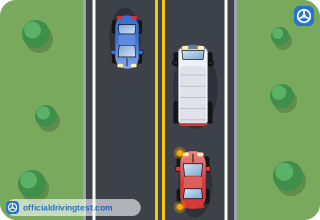
Two solid yellow lines run down the middle of a road. When may you cross them?
- When passing a slower vehicle, if it is safe
- When turning right, if it is safe
- Only when turning left, and it is safe to do so
- When changing lanes, once you have signaled
Show answer
Correct answer: Only when turning left, and it is safe to do so
Two solid yellow lines prohibit crossing to pass; you may not cross them unless turning left when it is safe to do so.
Source: Massachusetts Driver's Manual (Revised April 2026), page 90 · Open this page in the manual (Manual page 90)
-
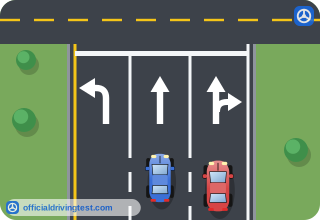
What do white arrows painted on the road show?
- The speed limit for that lane
- Lane directions or restrictions
- The lanes that are used for passing
- Where bicyclists must ride
Show answer
Correct answer: Lane directions or restrictions
White arrows painted on the roadway show lane directions or restrictions.
Source: Massachusetts Driver's Manual (Revised April 2026), page 90 · Open this page in the manual (Manual page 90)
-
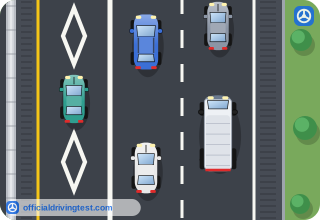
A white diamond symbol is painted in a lane. What does it mean?
- The lane ends and traffic must merge into the next lane
- The lane may be used for passing on a divided highway
- A pedestrian crossing is just ahead in this lane
- There is a special lane restriction, such as HOV only or bus only
Show answer
Correct answer: There is a special lane restriction, such as HOV only or bus only
A white diamond symbol means there is a special lane restriction, like high occupancy vehicle (HOV) only or bus only.
Source: Massachusetts Driver's Manual (Revised April 2026), page 91 · Open this page in the manual (Manual page 91)
-
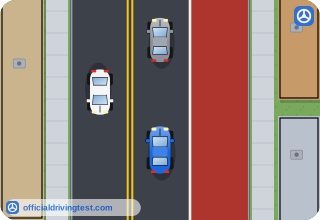
Red pavement is used for travel lanes or station stops of what?
- Bicycles and other human-powered vehicles that use the road
- Vehicles carrying two or more people in the same lane
- Public transit systems, such as buses, streetcars and trolleys
- Emergency vehicles that are responding to an emergency call
Show answer
Correct answer: Public transit systems, such as buses, streetcars and trolleys
Red pavement is used for travel lanes or station stops of public transit systems, including buses, streetcars, trolleys, light-rail trains and rapid transit fleets.
Source: Massachusetts Driver's Manual (Revised April 2026), page 91 · Open this page in the manual (Manual page 91)
-
What may be painted across an intersection or pedestrian crossing that has a stop sign or traffic signal?
- A solid yellow STOP line
- A solid white STOP line
- A line of white triangles
- A pair of broken white lines
Show answer
Correct answer: A solid white STOP line
An intersection or pedestrian crossing with a stop sign or traffic signal may have a solid white STOP line painted across it.
Source: Massachusetts Driver's Manual (Revised April 2026), page 91 · Open this page in the manual (Manual page 91)
-
What does a YIELD line look like?
- A solid white line painted across the lane ahead
- A pair of solid yellow lines painted across the lane
- A broken white line made up of long dashes
- A series of triangles painted next to each other
Show answer
Correct answer: A series of triangles painted next to each other
A YIELD line looks like a series of triangles painted next to each other.
Source: Massachusetts Driver's Manual (Revised April 2026), page 91 · Open this page in the manual (Manual page 91)
-
How does the manual define a crosswalk?
- A pair of white lines or other distinguished markings across a lane to guide pedestrians
- A single solid yellow line painted across a lane at an intersection to stop traffic
- A line of triangles painted across the lane before an intersection or crossing
- A broken white line that separates a bicycle lane from the rest of the traffic
Show answer
Correct answer: A pair of white lines or other distinguished markings across a lane to guide pedestrians
A crosswalk is a pair of white lines, or other distinguished pavement markings or materials, painted across a lane to guide pedestrians across the road.
Source: Massachusetts Driver's Manual (Revised April 2026), page 92 · Open this page in the manual (Manual page 92)
-
What may be painted between the two main lines of a crosswalk?
- Green or red pavement
- Diagonal or vertical lines
- Arrows showing traffic direction
- Triangles pointing at traffic
Show answer
Correct answer: Diagonal or vertical lines
Crosswalks may have diagonal or vertical lines painted between the two main lines.
Source: Massachusetts Driver's Manual (Revised April 2026), page 92 · Open this page in the manual (Manual page 92)
-
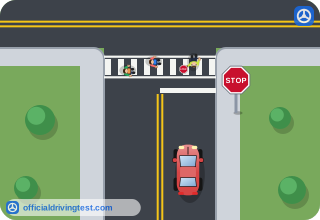
Where must you stop when a stop/yield sign, traffic signal, or pedestrian in the crosswalk requires it?
- Past the stop line, yield line, or crosswalk line
- In the middle of the crosswalk
- Just past the crosswalk
- Behind the stop line, yield line, or crosswalk line
Show answer
Correct answer: Behind the stop line, yield line, or crosswalk line
You must stop behind the stop lines, yield lines, and crosswalk lines if required by a stop/yield sign, traffic signal, or pedestrian in the crosswalk.
Source: Massachusetts Driver's Manual (Revised April 2026), page 92 · Open this page in the manual (Manual page 92)
-
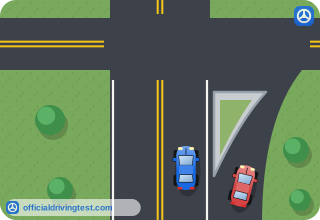
What is a channelizing island?
- A traffic island or pavement marking that guides traffic along certain paths
- A raised area where pedestrians wait for a safe time to cross the road
- A lane that buses use to reach a station stop on the street
- A part of the shoulder where disabled vehicles may stop for repairs
Show answer
Correct answer: A traffic island or pavement marking that guides traffic along certain paths
A channelizing island is a traffic island or pavement marking that guides traffic along certain paths and prevents operation on areas of the roadway.
Source: Massachusetts Driver's Manual (Revised April 2026), page 92 · Open this page in the manual (Manual page 92)
-
When may you drive over or park a motor vehicle on a channelizing island?
- When the road ahead is blocked by a stopped vehicle
- When you are turning right with no traffic nearby
- Only when directed to do so by a police officer
- When you stay on it for no more than a few minutes
Show answer
Correct answer: Only when directed to do so by a police officer
You cannot drive over or park a motor vehicle upon any channelizing island, unless directed to do so by a police officer.
Source: Massachusetts Driver's Manual (Revised April 2026), page 92 · Open this page in the manual (Manual page 92)
-
On a two-way road, what does a broken yellow line allow you to do?
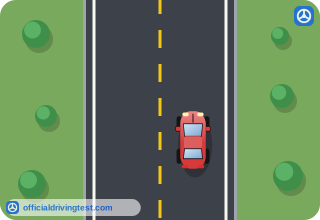
- Cross into the oncoming lane temporarily to pass, if it is safe
- Drive in the center turning lane for as long as you wish
- Make a U-turn anywhere along that stretch of road
- Drive on the shoulder to pass slower vehicles
Show answer
Correct answer: Cross into the oncoming lane temporarily to pass, if it is safe
The manual says a broken yellow line on a two-way road allows you to cross over into the oncoming lane temporarily to pass a vehicle, if it is safe to do so.
Source: Massachusetts Driver's Manual (Revised April 2026), page 103 · Open this page in the manual (Manual page 103)
-
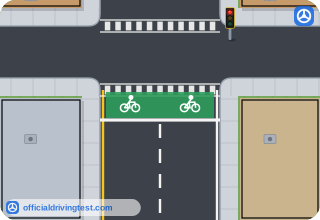
What does a bicycle box look like?
- A green pavement marking with an image of a bicyclist
- A yellow pavement box with a large diamond symbol inside
- A red pavement box with the words BIKE ONLY inside it
- A blue pavement square with a large wheelchair symbol on it
Show answer
Correct answer: A green pavement marking with an image of a bicyclist
The manual says bicycle boxes are green and have an image of a bicyclist.
Source: Massachusetts Driver's Manual (Revised April 2026), page 116 · Open this page in the manual (Manual page 116)
-
What are bicycle boxes at intersections meant to give bicyclists?
- A place to park their bicycles near the crosswalk
- A safe way to turn when approaching a red light
- A lane where they may ride through red lights
- A zone where pedestrians must wait for the light
Show answer
Correct answer: A safe way to turn when approaching a red light
The manual says bicycle boxes are installed at intersections to allow bicyclists a safe way to turn when approaching a red light.
Source: Massachusetts Driver's Manual (Revised April 2026), page 116 · Open this page in the manual (Manual page 116)
-
Where is a bicycle box painted at an intersection?
- On the pavement after the crosswalk, covering half of the lane
- In the bike lane only, beside the travel lane
- In the center of the intersection, covering all lanes
- On the pavement before the crosswalk, covering the entire travel lane
Show answer
Correct answer: On the pavement before the crosswalk, covering the entire travel lane
The manual says bicycle boxes are painted on the pavement before the crosswalk and cover the entire travel lane.
Source: Massachusetts Driver's Manual (Revised April 2026), page 116 · Open this page in the manual (Manual page 116)
-
What must drivers do at a bicycle box?
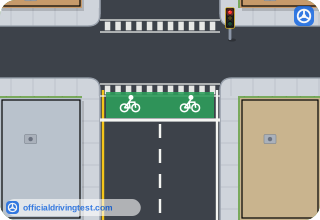
- Stop behind it, even when it is empty, and wait for a green light
- Stop in it when no bicyclists are present, and wait for a green light
- Drive through it when it is empty and no traffic is coming
- Stop on it only when they plan to turn right on red
Show answer
Correct answer: Stop behind it, even when it is empty, and wait for a green light
The manual says drivers must stop behind the bicycle box, even when it is empty, and wait for a green light.
Source: Massachusetts Driver's Manual (Revised April 2026), page 116 · Open this page in the manual (Manual page 116)
-
Where bicycle lanes cross an intersection, how are they often indicated?
- By a solid yellow line with a bicycle sign
- By green pavement with an image of a bicyclist
- By red pavement with the word BIKE
- By a white crosswalk with a bicycle symbol
Show answer
Correct answer: By green pavement with an image of a bicyclist
The manual says that where bicycle lanes cross an intersection they are often indicated by green pavement with an image of a bicyclist.
Source: Massachusetts Driver's Manual (Revised April 2026), page 117 · Open this page in the manual (Manual page 117)