Massachusetts: Right-of-way, turning and passing
Who yields at intersections, stop signs, four-way stops and rotaries, how to make left, right and U-turns, backing up, and the rules for passing and being passed. Split into 5 shorter tests so you're not stuck in one long quiz.
Independent educational site · not affiliated with any government agency or DMV
Choose a part
Right-of-way, turning and passing — Part 1
Questions in this part include: “What does the manual say about right-of-way?”
StartRight-of-way, turning and passing — Part 2
Questions in this part include: “How far before making a turn should you signal on a highway?”
StartRight-of-way, turning and passing — Part 3
Questions in this part include: “Where should you position your vehicle before you begin a three-point turn?”
StartRight-of-way, turning and passing — Part 4
Questions in this part include: “What is found at the entrance to a rotary?”
StartRight-of-way, turning and passing — Part 5
Questions in this part include: “If you are crossing a broken yellow line to pass, how far in front of you must you be able to see clearly?”
StartAll 95 Right-of-way, turning and passing questions with answers
Choose a part above to take a practice test, or study every question and answer here.
Show the questions and answersHide the questions
-
What does the manual say about right-of-way?
- It is something you give
- It always belongs to the larger vehicle
- It belongs to the faster driver
- It is something you take only at stop signs
Show answer
Correct answer: It is something you give
The manual says right-of-way is something you give, and giving it helps prevent unsafe traffic situations.
Source: Massachusetts Driver's Manual (Revised April 2026), page 41 · Open this page in the manual (Manual page 41)
-
What does the manual say is safer than creating an unsafe condition when others may not hear you?
- Honking, even if you are in a hurry
- Passing quickly, if you have the right of way
- Yielding, even if you have the right of way
- Stopping suddenly in the lane
Show answer
Correct answer: Yielding, even if you have the right of way
It is always safer for you to yield, even if you have the right of way, than to create an unsafe condition.
Source: Massachusetts Driver's Manual (Revised April 2026), page 50 · Open this page in the manual (Manual page 50)
-
When you turn left in front of an oncoming motorcycle, what should you do?
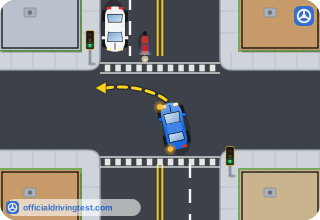
- Turn quickly before the motorcycle gets close to you in the intersection
- Flash your lights and turn
- Let the motorcycle safely pass through the intersection first
- Honk and turn at once
Show answer
Correct answer: Let the motorcycle safely pass through the intersection first
Even if you have enough time to turn, an oncoming motorcyclist may not have time to safely change speed, so let the motorcycle pass first.
Source: Massachusetts Driver's Manual (Revised April 2026), page 52 · Open this page in the manual (Manual page 52)
-
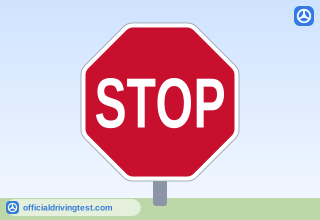
What does a STOP sign always mean?
- Slow down and be prepared to stop
- Stop only if other vehicles are present
- Come to a complete halt
- Stop only if pedestrians are crossing
Show answer
Correct answer: Come to a complete halt
A STOP sign always means come to a complete halt and applies to each vehicle that comes to the sign.
Source: Massachusetts Driver's Manual (Revised April 2026), page 86 · Open this page in the manual (Manual page 86)
-
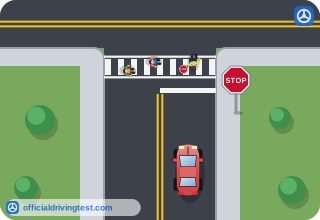
When approaching a stop sign, where must you stop?
- Within 15 feet past the crosswalk
- In the middle of the crosswalk
- Past the stop line, to see cross traffic
- Before any crosswalk or painted stop line
Show answer
Correct answer: Before any crosswalk or painted stop line
You must stop before any crosswalk or stop line painted on the pavement.
Source: Massachusetts Driver's Manual (Revised April 2026), page 86 · Open this page in the manual (Manual page 86)
-
At a STOP sign, is just slowing down enough?
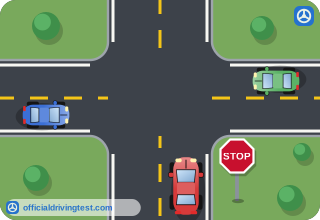
- No, you must come to a complete stop
- Yes, if no other vehicle is near
- Yes, if you are turning right
- Yes, if you are on a main road
Show answer
Correct answer: No, you must come to a complete stop
At a stop sign you must come to a complete stop; just slowing down is not enough.
Source: Massachusetts Driver's Manual (Revised April 2026), page 86 · Open this page in the manual (Manual page 86)
-
What must you do at a stop sign after coming to a complete stop?
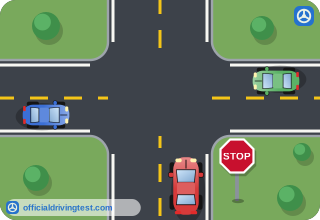
- Go at once without looking again
- Yield to pedestrians or vehicles, and go carefully
- Honk your horn and then go ahead
- Go if the road on your left is clear of cars
Show answer
Correct answer: Yield to pedestrians or vehicles, and go carefully
After a complete stop you must yield to pedestrians or other vehicles and go carefully.
Source: Massachusetts Driver's Manual (Revised April 2026), page 86 · Open this page in the manual (Manual page 86)
-
If a 4-WAY or ALL WAY sign is added to a STOP sign at an intersection, who must stop?
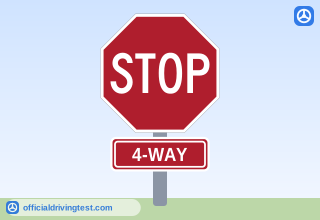
- All traffic coming to the intersection
- Only the vehicles on the main road
- Only vehicles turning left
- Only the first vehicle to arrive
Show answer
Correct answer: All traffic coming to the intersection
A 4-WAY or ALL WAY sign added to a STOP sign means all traffic coming to the intersection must stop.
Source: Massachusetts Driver's Manual (Revised April 2026), page 86 · Open this page in the manual (Manual page 86)
-
What should you do when you see a YIELD sign?
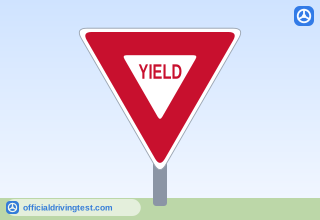
- Come to a complete stop every time
- Speed up to pass before traffic arrives
- Stop only if a pedestrian is present
- Slow down and be prepared to stop
Show answer
Correct answer: Slow down and be prepared to stop
At a YIELD sign you slow down and be prepared to stop.
Source: Massachusetts Driver's Manual (Revised April 2026), page 86 · Open this page in the manual (Manual page 86)
-
At a YIELD sign, whom must you let go before you proceed?
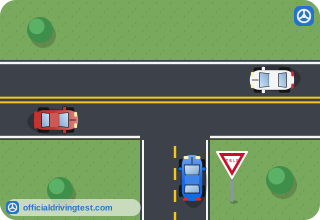
- Only vehicles on your left
- Vehicles, bicyclists, and pedestrians
- Only emergency vehicles
- Only pedestrians in the crosswalk
Show answer
Correct answer: Vehicles, bicyclists, and pedestrians
At a YIELD sign, let vehicles, bicyclists, and pedestrians go before you proceed.
Source: Massachusetts Driver's Manual (Revised April 2026), page 86 · Open this page in the manual (Manual page 86)
-
When must you come to a complete stop at a YIELD sign?
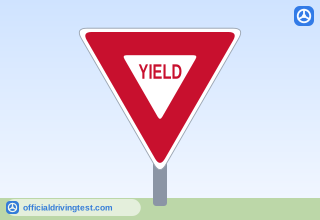
- If traffic conditions require it
- Never, because yield means slow down only
- Only at night
- Only when a police officer is present
Show answer
Correct answer: If traffic conditions require it
You must come to a complete stop at a YIELD sign if traffic conditions require it.
Source: Massachusetts Driver's Manual (Revised April 2026), page 86 · Open this page in the manual (Manual page 86)
-
How must you use traffic lanes?
- Following the vehicles that are ahead of you
- In whichever lane has the fewest vehicles
- As they are defined by pavement markings and road signs
- Based on the lane you used last time on that road
Show answer
Correct answer: As they are defined by pavement markings and road signs
The manual says to always use traffic lanes as defined by pavement markings and road signs.
Source: Massachusetts Driver's Manual (Revised April 2026), page 93 · Open this page in the manual (Manual page 93)
-
On a roadway with two or more lanes in your direction, which of these is a time you may leave the right lane?
- When you are driving below the speed limit
- When you see a vehicle merging from an on-ramp
- When the road ahead curves out of sight
- When you are making a left turn
Show answer
Correct answer: When you are making a left turn
You should use the right lane unless you are passing, making a left turn, or the right lane is blocked.
Source: Massachusetts Driver's Manual (Revised April 2026), page 94 · Open this page in the manual (Manual page 94)
-
What does the manual say about changing lanes in the middle of an intersection?
- It is illegal and dangerous
- It is allowed when no other vehicles are nearby
- It is allowed if you have signaled
- It is allowed on roads with three or more lanes
Show answer
Correct answer: It is illegal and dangerous
Never change lanes in the middle of an intersection; the manual says it is illegal and dangerous.
Source: Massachusetts Driver's Manual (Revised April 2026), page 94 · Open this page in the manual (Manual page 94)
-
You come to a curve in the road and cannot see ahead. What should you do?
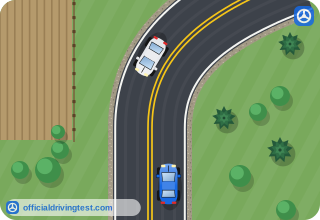
- Move to the center of the road and keep your speed
- Keep to the left and slow down
- Sound your horn and speed up
- Keep to the right and slow down
Show answer
Correct answer: Keep to the right and slow down
If you come to a curve and cannot see ahead, keep to the right and slow down.
Source: Massachusetts Driver's Manual (Revised April 2026), page 94 · Open this page in the manual (Manual page 94)
-
When may you drive in a lane that is posted as restricted?
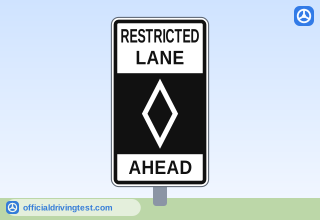
- Only when you are passing another vehicle
- Only when the other lanes are blocked
- Only during rush hour
- Only when preparing for a turn
Show answer
Correct answer: Only when preparing for a turn
You must not drive in lanes posted as restricted, except when preparing for a turn.
Source: Massachusetts Driver's Manual (Revised April 2026), page 94 · Open this page in the manual (Manual page 94)
-
What is an intersection?
- A place where two or more roadways meet
- A place where a road crosses a railroad track
- A place where a ramp joins the shoulder
- A place where a bicycle lane ends
Show answer
Correct answer: A place where two or more roadways meet
Intersections are where two or more roadways meet.
Source: Massachusetts Driver's Manual (Revised April 2026), page 96 · Open this page in the manual (Manual page 96)
-
What should you do on roads that have multiple turning lanes?
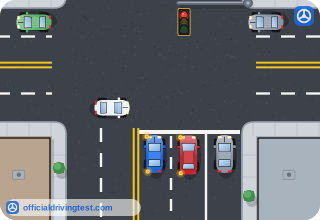
- Use the lane nearest the center line
- Use the lane with the least traffic
- Follow the applicable road signs or markings
- Use the right-hand lane for all turns
Show answer
Correct answer: Follow the applicable road signs or markings
On roads with multiple turning lanes, you should follow the applicable road signs or markings.
Source: Massachusetts Driver's Manual (Revised April 2026), page 96 · Open this page in the manual (Manual page 96)
-
What does the manual say about blocking an intersection with your vehicle?
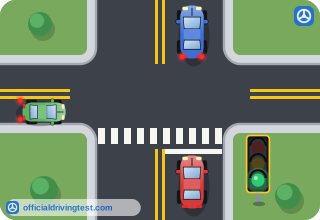
- It is allowed if you entered on a green light
- It is illegal
- It is allowed when traffic is heavy
- It is allowed for no more than one signal cycle
Show answer
Correct answer: It is illegal
It is illegal to block an intersection with your vehicle.
Source: Massachusetts Driver's Manual (Revised April 2026), page 96 · Open this page in the manual (Manual page 96)
-
When may you enter an intersection or drive across a crosswalk?
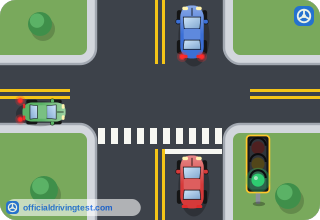
- Whenever the light is green, even if traffic is backed up
- Whenever you can enter before the light changes
- Whenever the vehicle ahead of you has entered
- Only if there is enough room for you to drive through safely
Show answer
Correct answer: Only if there is enough room for you to drive through safely
You may only enter an intersection or drive across a crosswalk if there is enough room for you to drive through safely.
Source: Massachusetts Driver's Manual (Revised April 2026), page 96 · Open this page in the manual (Manual page 96)
-
How far before making a turn should you signal when driving on a road that is not a highway?
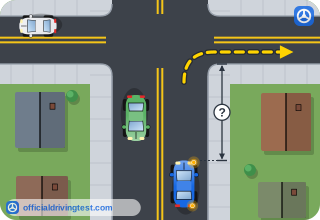
- At least 50 feet
- At least 200 feet
- At least 100 feet
- At least 500 feet
Show answer
Correct answer: At least 100 feet
Signal your turn at least 100 feet before making the turn; on a highway, signal at least 500 feet before a turn.
Source: Massachusetts Driver's Manual (Revised April 2026), page 97 · Open this page in the manual (Manual page 97)
-
How far before making a turn should you signal on a highway?
- At least 100 feet
- At least 500 feet
- At least 300 feet
- At least 1,000 feet
Show answer
Correct answer: At least 500 feet
On a highway, signal at least 500 feet before a turn.
Source: Massachusetts Driver's Manual (Revised April 2026), page 97 · Open this page in the manual (Manual page 97)
-
When is it best to signal a turn?
- After you have reduced your speed
- After you are in the intersection
- Right as you begin the turn
- Before you apply your brakes
Show answer
Correct answer: Before you apply your brakes
It is best to signal before you apply your brakes, so you make your intentions known to other drivers.
Source: Massachusetts Driver's Manual (Revised April 2026), page 97 · Open this page in the manual (Manual page 97)
-
You need to change lanes while making a turn. When should you do so?
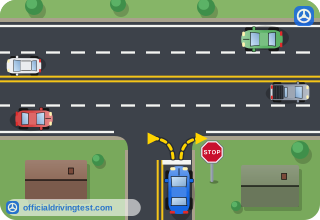
- After you turn
- Before you reach the intersection
- In the middle of the turn
- While you are signaling
Show answer
Correct answer: After you turn
If you need to change lanes, do so after you turn.
Source: Massachusetts Driver's Manual (Revised April 2026), page 97 · Open this page in the manual (Manual page 97)
-
When turning, what should you look for on the road you are turning into?
- Green or red pavement colors marking the lane
- A crossing guard standing in the road
- Yellow or white pavement lines marking the road
- Painted triangles across the road
Show answer
Correct answer: Yellow or white pavement lines marking the road
Look for yellow or white pavement lines marking the road you are turning into.
Source: Massachusetts Driver's Manual (Revised April 2026), page 97 · Open this page in the manual (Manual page 97)
-
From which lane should you make a right turn?
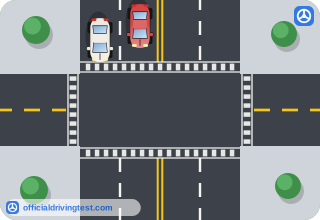
- The lane closest to the center lane
- The far right lane
- The middle lane
- The breakdown lane
Show answer
Correct answer: The far right lane
For a right turn, turn from the far right lane.
Source: Massachusetts Driver's Manual (Revised April 2026), page 98 · Open this page in the manual (Manual page 98)
-
From which lane should you make a left turn?
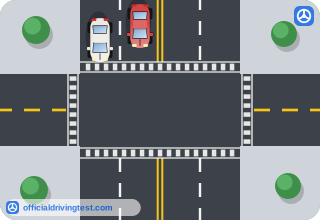
- The far right lane
- The farthest lane from the center
- The breakdown lane
- The lane closest to the center lane
Show answer
Correct answer: The lane closest to the center lane
For a left turn, turn from the lane closest to the center lane.
Source: Massachusetts Driver's Manual (Revised April 2026), page 98 · Open this page in the manual (Manual page 98)
-
While making a turn, where should you keep your vehicle?
- Centered in the middle of the lanes you are leaving and entering
- Along the edge of the lane that you are entering, near the curb
- Out wide of your own lane so that the turn is easier to make
- Close to the center line as you go through the turn
Show answer
Correct answer: Centered in the middle of the lanes you are leaving and entering
Do not swing your vehicle out of your lane or swing wide; keep your vehicle centered in the middle of the lanes you are leaving and entering.
Source: Massachusetts Driver's Manual (Revised April 2026), page 98 · Open this page in the manual (Manual page 98)
-
You have started a turn through an intersection but decide you do not want to make it. What should you do?
- Stop in mid-turn and change direction to go the other way
- Stop in the intersection and back up into your own lane
- Follow through, drive to the next intersection, and work your way back
- Straighten out and drive straight through the crosswalk ahead
Show answer
Correct answer: Follow through, drive to the next intersection, and work your way back
Once you have started a turn you must follow through; if you decide you do not want to make the turn, drive to the next intersection and work your way back.
Source: Massachusetts Driver's Manual (Revised April 2026), page 98 · Open this page in the manual (Manual page 98)
-
At a red traffic light, what must you do before you may turn right?
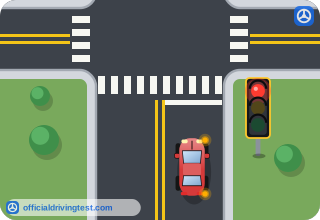
- Slow down and make the turn if no vehicle is behind you
- Stop completely and yield to pedestrians and other vehicles
- Wait for the signal to turn green or yellow before you turn
- Check your mirrors and then turn without stopping at all
Show answer
Correct answer: Stop completely and yield to pedestrians and other vehicles
You must come to a complete stop at a red light and may then turn right unless a NO TURN ON RED sign is posted, after giving the right-of-way to pedestrians and other vehicles.
Source: Massachusetts Driver's Manual (Revised April 2026), page 98 · Open this page in the manual (Manual page 98)
-
What is a U-turn?
- A wide right turn that puts you in the opposite direction
- A turn made by backing into a driveway
- A tight left turn that puts you in the opposite direction
- A turn made in three moves when there is little room
Show answer
Correct answer: A tight left turn that puts you in the opposite direction
A U-turn is a tight left turn that puts you in the opposite direction.
Source: Massachusetts Driver's Manual (Revised April 2026), page 98 · Open this page in the manual (Manual page 98)
-
When may you NOT make a U-turn?
- When another vehicle is waiting behind you
- When a NO U-TURN sign is posted
- When you are in the lane closest to the center line
- When you are at an intersection with a green light
Show answer
Correct answer: When a NO U-TURN sign is posted
You can make a U-turn if your path is clear and it is safe, but you cannot make one if a NO U-TURN sign is posted.
Source: Massachusetts Driver's Manual (Revised April 2026), page 98 · Open this page in the manual (Manual page 98)
-
From which lane may you make a U-turn?
- The far right lane of the road
- Any lane in which the path is clear
- The lane that is closest to the curb
- The lane closest to the center line
Show answer
Correct answer: The lane closest to the center line
You may only make a U-turn from the lane closest to the center line.
Source: Massachusetts Driver's Manual (Revised April 2026), page 98 · Open this page in the manual (Manual page 98)
-
Where must you not make a U-turn because you or other drivers cannot see 500 feet away?
- At the crest of a hill or near a curve
- On a one-way street
- At an intersection with a stop sign
- On a street with a bicycle lane
Show answer
Correct answer: At the crest of a hill or near a curve
Do not make a U-turn at the crest of a hill, near a curve, or anyplace where you or other drivers cannot see 500 feet away.
Source: Massachusetts Driver's Manual (Revised April 2026), page 98 · Open this page in the manual (Manual page 98)
-
On some two-way roads, a center lane may be marked as a common left-turn lane. Who may use it?
- Only vehicles heading in one direction
- Only vehicles that are passing
- Vehicles in both directions
- Only emergency vehicles
Show answer
Correct answer: Vehicles in both directions
A center lane marked as a common left-turn lane is used by vehicles in both directions.
Source: Massachusetts Driver's Manual (Revised April 2026), page 98 · Open this page in the manual (Manual page 98)
-
What may you not do in a center turning lane?
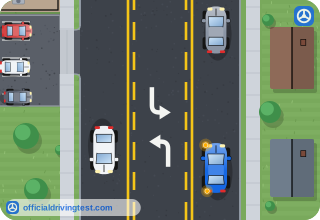
- Make a left turn from it
- Travel in it
- Enter it to make a left turn
- Use it to turn into a driveway
Show answer
Correct answer: Travel in it
The manual says you may not travel in a center turning lane.
Source: Massachusetts Driver's Manual (Revised April 2026), page 98 · Open this page in the manual (Manual page 98)
-
When may you consider a three-point turn?
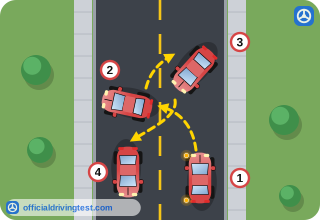
- When a NO U-TURN sign is posted
- When you are on a one-way street
- When you are at the crest of a hill
- When there is not enough room for a U-turn
Show answer
Correct answer: When there is not enough room for a U-turn
When there is not enough room for a U-turn, you may consider a three-point turn, which puts you in the opposite direction.
Source: Massachusetts Driver's Manual (Revised April 2026), page 98 · Open this page in the manual (Manual page 98)
-
Before starting a three-point turn, how large a gap in traffic should you wait for?
- A 20-30 second gap
- A 5-10 second gap
- A 10-15 second gap
- A 45-60 second gap
Show answer
Correct answer: A 20-30 second gap
The manual says to wait until you have a 20-30 second gap to complete a three-point turn.
Source: Massachusetts Driver's Manual (Revised April 2026), page 99 · Open this page in the manual (Manual page 99)
-
Where should you position your vehicle before you begin a three-point turn?
- Near the center line of the street
- As close as possible to the left curb
- As close as possible to the right curb
- Two feet from the right curb
Show answer
Correct answer: As close as possible to the right curb
The first step of a three-point turn is to position yourself as close as possible to the right edge of the curb.
Source: Massachusetts Driver's Manual (Revised April 2026), page 99 · Open this page in the manual (Manual page 99)
-
In a three-point turn, after you move slowly and turn the steering wheel quickly to the left, how far from the curb does the vehicle come to a stop?
- About ten feet
- About two feet
- About six inches
- About five feet
Show answer
Correct answer: About two feet
The quick left turn of the wheel brings the vehicle perpendicular to the street about two feet from the curb, where you stop.
Source: Massachusetts Driver's Manual (Revised April 2026), page 99 · Open this page in the manual (Manual page 99)
-
In a three-point turn, what do you do with the steering wheel after you have stopped perpendicular to the street and before you start backing up?
- Turn it fully to the left
- Straighten it
- Leave it where it is
- Turn it fully to the right
Show answer
Correct answer: Turn it fully to the right
Before shifting into reverse, the manual says to turn the steering wheel fully to the right.
Source: Massachusetts Driver's Manual (Revised April 2026), page 99 · Open this page in the manual (Manual page 99)
-
In a three-point turn, how far do you back up?
- To the opposite curb, stopping just before it
- Halfway across the street
- To the center line of the street
- Until the vehicle is parallel to the curb
Show answer
Correct answer: To the opposite curb, stopping just before it
The manual says to back up to the opposite curb, stopping just before the curb.
Source: Massachusetts Driver's Manual (Revised April 2026), page 99 · Open this page in the manual (Manual page 99)
-
At the end of a three-point turn, which signal do you give before you shift into drive and accelerate?
- A right turn signal
- Hazard lights
- A left turn signal
- No signal is needed
Show answer
Correct answer: A left turn signal
The last step of a three-point turn is to check traffic again, signal left, shift into drive and accelerate to the proper speed.
Source: Massachusetts Driver's Manual (Revised April 2026), page 99 · Open this page in the manual (Manual page 99)
-
When backing up, which way should you look?
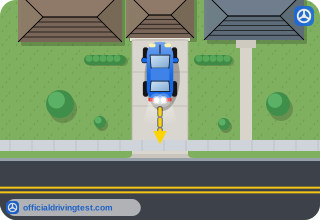
- Over your left shoulder
- Over your right shoulder
- Only in the rearview mirror
- Only at the side mirrors
Show answer
Correct answer: Over your right shoulder
The manual says to shift into reverse and start backing up while looking over your right shoulder.
Source: Massachusetts Driver's Manual (Revised April 2026), page 99 · Open this page in the manual (Manual page 99)
-
Before you back up, what should you check for traffic?
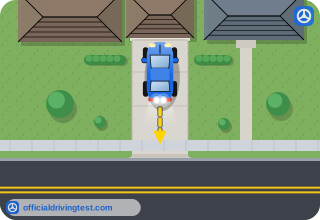
- Only the direction you will back toward
- Only the rearview mirror
- Only the road ahead of you
- Both directions, including your blind spot
Show answer
Correct answer: Both directions, including your blind spot
The manual says to check for traffic in both directions, including your blind spot, before backing up.
Source: Massachusetts Driver's Manual (Revised April 2026), page 99 · Open this page in the manual (Manual page 99)
-
Right-of-way rules help drivers handle traffic situations that are:
- Not controlled by signs or signals
- Controlled only by police officers
- Limited to freeways
- Controlled only by stop signs
Show answer
Correct answer: Not controlled by signs or signals
The manual says right-of-way rules help drivers handle traffic situations not controlled by signs or signals.
Source: Massachusetts Driver's Manual (Revised April 2026), page 99 · Open this page in the manual (Manual page 99)
-
If another driver does not follow the right-of-way rules, what should you do?
- Insist on your right-of-way
- Honk to warn the driver
- Give the right-of-way
- Speed up to pass the driver
Show answer
Correct answer: Give the right-of-way
The manual says that if another driver does not follow these rules, you should always give the right-of-way.
Source: Massachusetts Driver's Manual (Revised April 2026), page 99 · Open this page in the manual (Manual page 99)
-
At an intersection not controlled by signs or signals, which vehicle must you yield the right-of-way to?
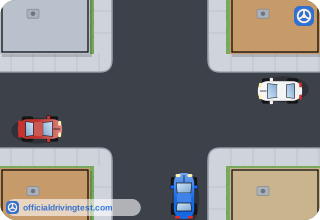
- A vehicle coming from your left
- The faster vehicle
- The larger vehicle
- A vehicle coming from your right
Show answer
Correct answer: A vehicle coming from your right
The manual says you must yield to any vehicle that has entered the intersection from your right or is coming from your right.
Source: Massachusetts Driver's Manual (Revised April 2026), page 100 · Open this page in the manual (Manual page 100)
-
What should you do as you approach an intersection not controlled by signs or signals?
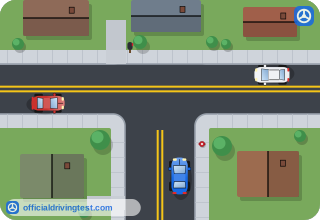
- Slow down and look left and right for oncoming traffic
- Maintain your speed and watch only traffic on the right
- Stop completely and wait for a signal to change
- Speed up to clear the intersection quickly
Show answer
Correct answer: Slow down and look left and right for oncoming traffic
The manual says to slow down at an uncontrolled intersection, look left and right for oncoming traffic and proceed if the way is clear.
Source: Massachusetts Driver's Manual (Revised April 2026), page 100 · Open this page in the manual (Manual page 100)
-
At an intersection not controlled by signs or signals, you may have the legal right-of-way over a vehicle coming from your left. What should you do before you proceed?
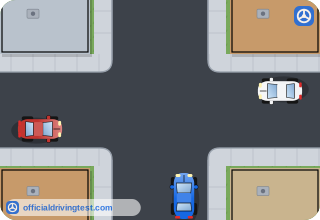
- Sound your horn and proceed at once
- Flash your headlights and then go ahead
- Make sure the other driver is yielding
- Proceed immediately, since you have the legal right-of-way
Show answer
Correct answer: Make sure the other driver is yielding
The manual says that even if you may have the legal right-of-way, you should make sure the other driver is yielding before you proceed.
Source: Massachusetts Driver's Manual (Revised April 2026), page 100 · Open this page in the manual (Manual page 100)
-
At an intersection with stop signs in all directions, you reach the stop line at the same time as another vehicle. Which vehicle must you yield to?
- The vehicle directly to your left
- The vehicle directly to your right
- The vehicle that is going straight
- The larger vehicle
Show answer
Correct answer: The vehicle directly to your right
The manual says to yield to a vehicle directly to your right that has stopped at the same time as you.
Source: Massachusetts Driver's Manual (Revised April 2026), page 100 · Open this page in the manual (Manual page 100)
-
At a four-way stop, in what order do vehicles go?
- Largest vehicles first
- Vehicles going straight first
- Vehicles on the left first
- The order in which they stopped
Show answer
Correct answer: The order in which they stopped
The manual says vehicles must go in the order they stopped: the first to stop is the next to go.
Source: Massachusetts Driver's Manual (Revised April 2026), page 100 · Open this page in the manual (Manual page 100)
-
At a four-way stop, if you are in doubt about who should go, to whom should you give the right-of-way?
- The driver on your right
- The driver on your left
- The driver across from you
- The driver behind you
Show answer
Correct answer: The driver on your right
The manual says that if in doubt at a four-way stop, you give the right-of-way to the driver on your right.
Source: Massachusetts Driver's Manual (Revised April 2026), page 100 · Open this page in the manual (Manual page 100)
-
What does the manual suggest you do at a four-way stop to judge the intentions of other drivers?
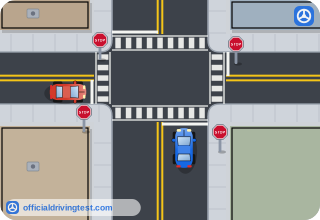
- Flash your headlights at them
- Sound your horn to get their attention
- Try to make eye contact with them
- Wave them through the intersection
Show answer
Correct answer: Try to make eye contact with them
The manual says to try to make eye contact with the drivers of other vehicles to judge their intentions and avoid crashes.
Source: Massachusetts Driver's Manual (Revised April 2026), page 100 · Open this page in the manual (Manual page 100)
-
Who must you yield the right-of-way to first when making any left turn?
- Vehicles stopped behind you
- Oncoming vehicles
- Vehicles parked at the curb
- No one, if you have signaled
Show answer
Correct answer: Oncoming vehicles
The manual says that when making any left turn you must first yield to any oncoming vehicle, vehicle already in the intersection, and pedestrians or bicyclists crossing your path.
Source: Massachusetts Driver's Manual (Revised April 2026), page 100 · Open this page in the manual (Manual page 100)
-
What must you do when entering a paved thoroughfare from a driveway?
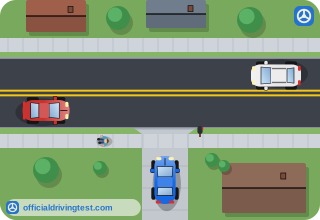
- Slow down and merge ahead of traffic
- Look both ways and go if it is clear
- Honk and then pull out
- Stop, then give the right-of-way
Show answer
Correct answer: Stop, then give the right-of-way
The manual says that entering a paved thoroughfare from a private road, driveway or unpaved road, you must stop and then give the right-of-way to pedestrians, bicyclists or vehicles on the road.
Source: Massachusetts Driver's Manual (Revised April 2026), page 100 · Open this page in the manual (Manual page 100)
-
Before you turn at a designated throughway, you must yield the right-of-way to:
- Traffic on the throughway
- Traffic on the cross street
- Pedestrians only
- Vehicles behind you
Show answer
Correct answer: Traffic on the throughway
The manual says that on a designated throughway you must yield the right-of-way to traffic on the throughway before you turn.
Source: Massachusetts Driver's Manual (Revised April 2026), page 101 · Open this page in the manual (Manual page 101)
-
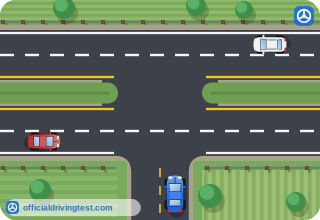
You are on a single or two-lane road and come to an intersection with a divided highway or a roadway with three or more lanes. What must you do?
- Take the right-of-way if you arrived first
- Go ahead of the traffic if you signal
- Yield the right-of-way
- Proceed without stopping
Show answer
Correct answer: Yield the right-of-way
The manual says you must yield the right-of-way at such an intersection.
Source: Massachusetts Driver's Manual (Revised April 2026), page 101 · Open this page in the manual (Manual page 101)
-
What is found at the entrance to a rotary?
- Stop signs
- Yield signs
- Traffic signals
- Flashing red lights
Show answer
Correct answer: Yield signs
The manual says there are yield signs at the entrance to a rotary.
Source: Massachusetts Driver's Manual (Revised April 2026), page 101 · Open this page in the manual (Manual page 101)
-
Big rotaries are designed to handle traffic traveling at up to what speed?
- 25 miles per hour
- 30 miles per hour
- 50 miles per hour
- 40 miles per hour
Show answer
Correct answer: 40 miles per hour
The manual says big rotaries are designed to handle traffic traveling at up to 40 miles per hour.
Source: Massachusetts Driver's Manual (Revised April 2026), page 101 · Open this page in the manual (Manual page 101)
-
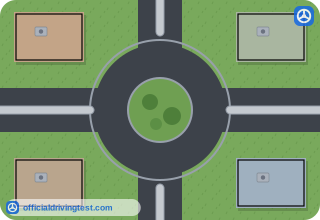
In which direction does traffic travel in a rotary?
- Counter-clockwise
- Clockwise
- Whichever way is shorter
- Straight through the center
Show answer
Correct answer: Counter-clockwise
The manual says traffic travels counter-clockwise in a rotary.
Source: Massachusetts Driver's Manual (Revised April 2026), page 101 · Open this page in the manual (Manual page 101)
-
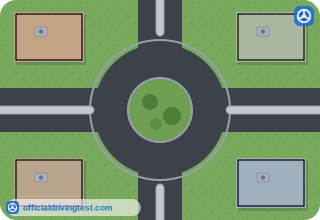
When entering a rotary, you must always yield the right-of-way to:
- Vehicles about to enter after you
- Vehicles that signal first
- Vehicles already in the rotary
- Trucks only
Show answer
Correct answer: Vehicles already in the rotary
The manual says to always yield the right-of-way to vehicles already in the rotary and to pedestrians, unless told differently by signs or police officers.
Source: Massachusetts Driver's Manual (Revised April 2026), page 101 · Open this page in the manual (Manual page 101)
-
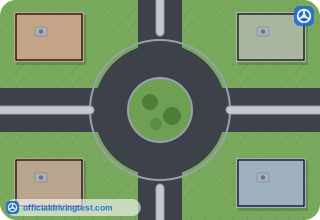
Which signal do you use in a rotary when you are ready to exit?
- Your left turn signal
- Your right turn signal
- Your hazard lights
- No signal is needed in a rotary
Show answer
Correct answer: Your right turn signal
The manual says that when you are ready to exit a rotary, you use your right turn signal.
Source: Massachusetts Driver's Manual (Revised April 2026), page 101 · Open this page in the manual (Manual page 101)
-
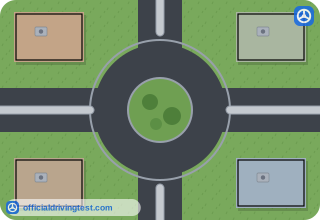
In a single-lane rotary, onto which lane must you exit?
- The left lane of the road you intend to travel on
- Whichever lane is open
- The middle lane of the road you intend to travel on
- The right lane of the road you intend to travel on
Show answer
Correct answer: The right lane of the road you intend to travel on
The manual says that in a single-lane rotary you must exit onto the right lane of the road you intend to travel on.
Source: Massachusetts Driver's Manual (Revised April 2026), page 101 · Open this page in the manual (Manual page 101)
-
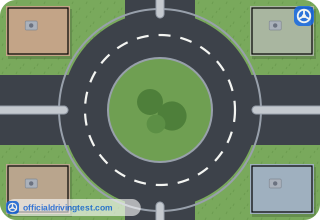
A multiple-lane rotary has no signs. You want to continue straight ahead. From which lane do you enter the rotary?
- The right lane
- The left lane
- The middle lane
- Any lane
Show answer
Correct answer: The right lane
The manual says to enter from the right lane for a quarter-turn or to continue straight ahead, stay in that lane and exit onto the right lane.
Source: Massachusetts Driver's Manual (Revised April 2026), page 101 · Open this page in the manual (Manual page 101)
-
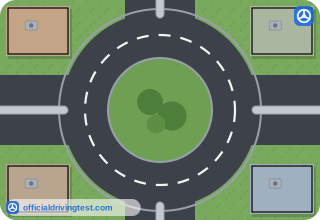
A multiple-lane rotary has no signs. You want to make a U-turn. From which lane do you enter the rotary?
- The right lane
- The lane with the least traffic
- The left lane
- The lane that is closest to the exit
Show answer
Correct answer: The left lane
The manual says that for a three-quarter-turn or a U-turn you enter the rotary from the left lane.
Source: Massachusetts Driver's Manual (Revised April 2026), page 101 · Open this page in the manual (Manual page 101)
-
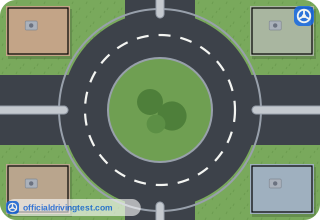
You are making a three-quarter-turn in a rotary after coming from a road with a single lane. Which lane should you stay in?
- The left lane for the entire turn
- The right lane for the entire turn
- The inner lane after you enter
- The middle lane once you are inside
Show answer
Correct answer: The right lane for the entire turn
The manual says that if coming from a road with a single lane, you should stay in the right lane for the entire turn.
Source: Massachusetts Driver's Manual (Revised April 2026), page 101 · Open this page in the manual (Manual page 101)
-
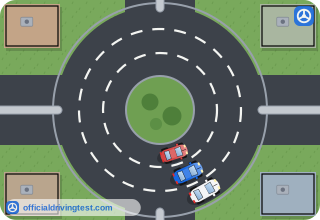
In a multiple-lane rotary, there may be traffic on both sides of your vehicle. When may you move out of your lane?
- Whenever you signal first
- Whenever you are near your exit
- Whenever the lane beside you is slower
- Only when it is safe to do so
Show answer
Correct answer: Only when it is safe to do so
The manual says not to attempt to move out of your lane until it is safe to do so.
Source: Massachusetts Driver's Manual (Revised April 2026), page 101 · Open this page in the manual (Manual page 101)
-
You miss your exit in a rotary. What should you do?
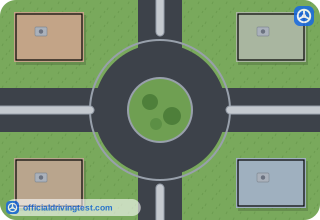
- Go around again when it is safe to do so
- Stop in the rotary and wait for a gap
- Back up to the exit
- Cross the lanes quickly to reach the exit
Show answer
Correct answer: Go around again when it is safe to do so
The manual says to check the traffic and, if it is safe, go around again; you must not stop in the rotary.
Source: Massachusetts Driver's Manual (Revised April 2026), page 102 · Open this page in the manual (Manual page 102)
-
Roundabouts require vehicles to reduce speed to what?
- 35 miles per hour or less
- 40 miles per hour or less
- 25 miles per hour or less
- 15 miles per hour or less
Show answer
Correct answer: 25 miles per hour or less
The manual says the small size of a roundabout requires vehicles to reduce speed to 25 miles per hour or less.
Source: Massachusetts Driver's Manual (Revised April 2026), page 102 · Open this page in the manual (Manual page 102)
-
What do most roundabouts have?
- Stop lines and overhead traffic signals
- Yield lines and pedestrian crosswalks
- Stop signs at every entrance
- Flashing red beacons at each entrance
Show answer
Correct answer: Yield lines and pedestrian crosswalks
The manual says most roundabouts have yield lines on the pavement and crosswalks for pedestrians.
Source: Massachusetts Driver's Manual (Revised April 2026), page 102 · Open this page in the manual (Manual page 102)
-
Roundabouts reduce the need to do what?
- Use turn signals
- Look for pedestrians
- Slow down
- Change lanes
Show answer
Correct answer: Change lanes
The manual says roundabouts reduce the need to change lanes.
Source: Massachusetts Driver's Manual (Revised April 2026), page 102 · Open this page in the manual (Manual page 102)
-
When entering a roundabout and choosing a lane, which rules should you follow?
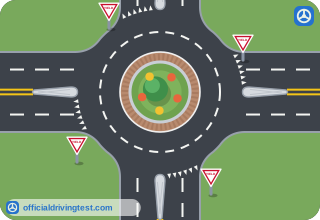
- The same rules as for a rotary
- The same rules as for a four-way stop
- The same rules as for a throughway
- No lane rules apply in a roundabout
Show answer
Correct answer: The same rules as for a rotary
The manual says that when entering a roundabout and choosing a lane, you should follow the same rules as for a rotary.
Source: Massachusetts Driver's Manual (Revised April 2026), page 102 · Open this page in the manual (Manual page 102)
-
Slow speeds in roundabouts make them safe for which road users?
- Large trucks
- Buses
- Bicyclists
- Horse-drawn vehicles
Show answer
Correct answer: Bicyclists
The manual says slow speeds in roundabouts make them safe for bicyclists.
Source: Massachusetts Driver's Manual (Revised April 2026), page 102 · Open this page in the manual (Manual page 102)
-
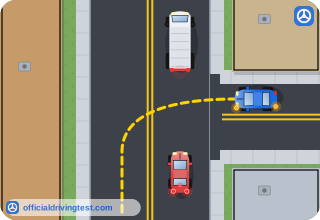
According to the manual, what does waving people in through stopped traffic create?
- A safer intersection
- A dangerous situation
- A faster flow of traffic
- A legal right-of-way
Show answer
Correct answer: A dangerous situation
The manual says waving people in through stopped traffic creates a dangerous situation and can easily result in a crash.
Source: Massachusetts Driver's Manual (Revised April 2026), page 102 · Open this page in the manual (Manual page 102)
-
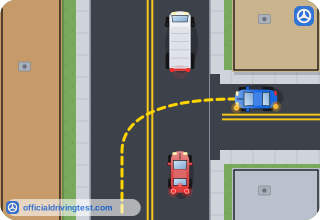
Someone waves you to turn across stopped traffic. Who has the right-of-way?
- The driver who waved you on
- The vehicle that stopped first
- You, since you were waved on
- The oncoming traffic
Show answer
Correct answer: The oncoming traffic
The manual says that oncoming traffic has the right-of-way, regardless of whether someone is waving at you.
Source: Massachusetts Driver's Manual (Revised April 2026), page 102 · Open this page in the manual (Manual page 102)
-
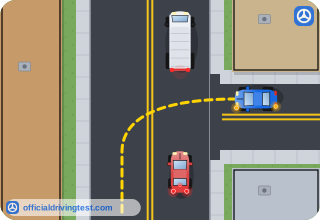
According to the manual, what should your decision to make a turn depend on?
- Traffic and visibility
- A wave from another driver
- The speed limit
- The vehicles behind you
Show answer
Correct answer: Traffic and visibility
The manual says making the turn should depend on traffic and visibility, not on a wave.
Source: Massachusetts Driver's Manual (Revised April 2026), page 102 · Open this page in the manual (Manual page 102)
-
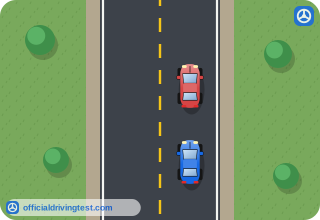
When passing is allowed, on which side should you pass?
- On the right
- On whichever side is clearer
- On the left
- On the shoulder
Show answer
Correct answer: On the left
The manual says that when passing is allowed, you should pass on the left; passing on the right is allowed only in certain situations.
Source: Massachusetts Driver's Manual (Revised April 2026), page 102 · Open this page in the manual (Manual page 102)
-
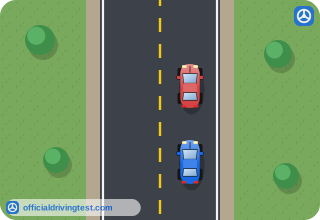
When should you pass a pedestrian, bicyclist, or motor vehicle?
- Whenever the other road user is slower than you want to go
- Only when it is necessary and safe
- Whenever there is a gap in oncoming traffic
- Whenever it will save you time
Show answer
Correct answer: Only when it is necessary and safe
The manual says you should pass only when it is necessary and safe to do so.
Source: Massachusetts Driver's Manual (Revised April 2026), page 102 · Open this page in the manual (Manual page 102)
-
If you have any doubt about whether to pass, what should you do?
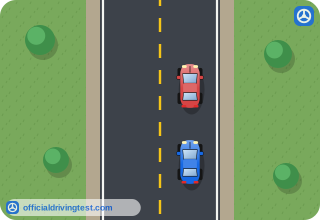
- Do not pass
- Pass quickly
- Honk and pass
- Pass on the right
Show answer
Correct answer: Do not pass
The manual says that if you have any doubt, do not pass.
Source: Massachusetts Driver's Manual (Revised April 2026), page 102 · Open this page in the manual (Manual page 102)
-
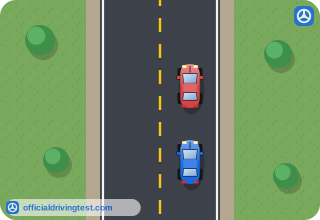
Which of these may you never use for passing another vehicle?
- The left side of a slower vehicle, when passing is allowed
- The right side, on a one-way street
- The shoulder of the road
- The oncoming lane across a broken yellow line, when it is safe
Show answer
Correct answer: The shoulder of the road
The manual says never to use a breakdown lane, the shoulder of a road, or a sidewalk for passing another vehicle.
Source: Massachusetts Driver's Manual (Revised April 2026), page 102 · Open this page in the manual (Manual page 102)
-
If you are crossing a broken yellow line to pass, how far in front of you must you be able to see clearly?
- At least 200 feet
- At least 300 feet
- At least 400 feet
- At least 600 feet
Show answer
Correct answer: At least 400 feet
The manual says that if you are crossing a broken yellow line to pass, you must be able to see clearly at least 400 feet in front of you.
Source: Massachusetts Driver's Manual (Revised April 2026), page 103 · Open this page in the manual (Manual page 103)
-
While passing, once you are safely past the other vehicle, which signal do you give?
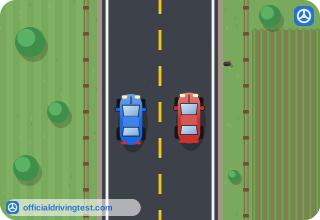
- A left turn signal
- A right turn signal
- Hazard lights
- No signal
Show answer
Correct answer: A right turn signal
The manual says to maintain your speed until safely past the other vehicle, then signal right.
Source: Massachusetts Driver's Manual (Revised April 2026), page 103 · Open this page in the manual (Manual page 103)
-
After passing, how far ahead of the other vehicle should you be before you move back into the right lane?
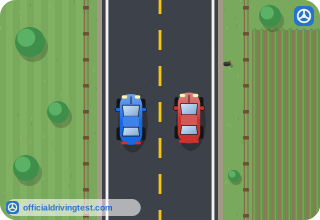
- Far enough that it is no longer visible to you
- One car length ahead of its bumper
- Just far enough to clear its bumper
- Far enough to see its headlights in your mirror
Show answer
Correct answer: Far enough to see its headlights in your mirror
The manual says to wait at least until you can see the vehicle’s headlights in your mirror before moving back into the right lane.
Source: Massachusetts Driver's Manual (Revised April 2026), page 103 · Open this page in the manual (Manual page 103)
-
When passing, you must return to the right lane before any oncoming vehicle comes within what distance of you?
- 200 feet
- 100 feet
- 400 feet
- 1,000 feet
Show answer
Correct answer: 200 feet
The manual says you must return to the right lane before any oncoming vehicle comes within 200 feet of you.
Source: Massachusetts Driver's Manual (Revised April 2026), page 103 · Open this page in the manual (Manual page 103)
-
After you have returned to the right lane following a pass, what do you do with your signal?
- Leave it on for ten seconds
- Switch it to hazard lights
- Turn it off
- Leave it on until your next turn
Show answer
Correct answer: Turn it off
The manual says to turn off your signal once you have returned to the right lane.
Source: Massachusetts Driver's Manual (Revised April 2026), page 103 · Open this page in the manual (Manual page 103)
-
Passing on the right is allowed in which of these circumstances?
- The vehicle you are passing is about to make a right turn
- You are driving on a one-way street
- The vehicle you are passing is driving below the speed limit
- The vehicle ahead of you has slowed down for traffic
Show answer
Correct answer: You are driving on a one-way street
The manual says you can pass on the right when you are driving on a one-way street.
Source: Massachusetts Driver's Manual (Revised April 2026), page 103 · Open this page in the manual (Manual page 103)
-
Passing on the right can only be done when the road is clear and wide enough for what?
- A single line of vehicles plus the shoulder
- One vehicle and one bicycle
- One vehicle and a parked car
- Two or more lines of motor vehicles
Show answer
Correct answer: Two or more lines of motor vehicles
The manual says passing on the right can only be done when the road is clear and wide enough for two or more lines of motor vehicles.
Source: Massachusetts Driver's Manual (Revised April 2026), page 103 · Open this page in the manual (Manual page 103)
-
If you are being passed by another vehicle, what must you do?
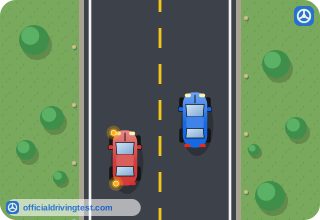
- Slow down and stay to the right
- Speed up to stay ahead
- Move to the left to give room
- Keep your speed and stay in the center
Show answer
Correct answer: Slow down and stay to the right
The manual says that if you are being passed you must slow down and stay to the right, and not speed up.
Source: Massachusetts Driver's Manual (Revised April 2026), page 103 · Open this page in the manual (Manual page 103)
-
Why should you not pass a vehicle that is stopped?
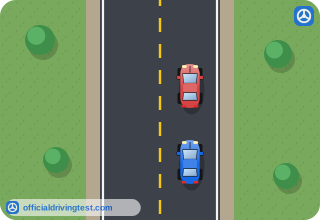
- The driver may be about to back up into your lane without warning
- They may be stopped for another vehicle, a person, or an animal you cannot see
- The driver may be waiting for you to give a signal before moving
- It is difficult for the driver to see a vehicle passing alongside
Show answer
Correct answer: They may be stopped for another vehicle, a person, or an animal you cannot see
The manual says such vehicles may be stopped for another vehicle, a person, or an animal that you cannot see.
Source: Massachusetts Driver's Manual (Revised April 2026), page 104 · Open this page in the manual (Manual page 104)
-
You pass a bicycle near an intersection or driveway where you want to turn right. When may you make the turn?
- As soon as you are ahead of the bicycle and have used your turn signal
- Only after the bicyclist has stopped and has waved you on
- Only at a safe distance from the bicyclist, at a reasonable and proper speed
- Right away, so that you do not block the bicyclist behind you
Show answer
Correct answer: Only at a safe distance from the bicyclist, at a reasonable and proper speed
The manual says you cannot turn unless you are at a safe distance from the bicyclist and can make the turn at a reasonable and proper speed.
Source: Massachusetts Driver's Manual (Revised April 2026), page 115 · Open this page in the manual (Manual page 115)
-
You are turning left at an intersection or into an alley, private road, or driveway. What must you yield to?
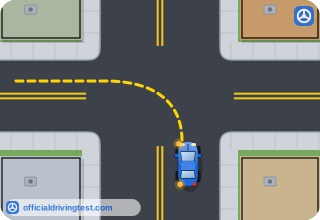
- Only oncoming motor vehicles that are already in the intersection, not bicycles
- Only oncoming vehicles traveling faster than 25 mph, since slower ones can stop
- Only oncoming vehicles that have a green light or a green arrow to proceed
- An oncoming vehicle, bicycles included, in the intersection or an immediate hazard
Show answer
Correct answer: An oncoming vehicle, bicycles included, in the intersection or an immediate hazard
The manual says you must yield the right of way to a vehicle approaching from the opposite direction, including a bicycle, if it is in the intersection or close enough to be an immediate hazard.
Source: Massachusetts Driver's Manual (Revised April 2026), page 115 · Open this page in the manual (Manual page 115)
-
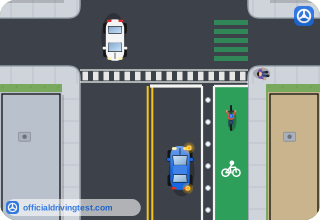
At intersections with separated bicycle lanes, what must drivers do at the stop line?
- Stop past the stop line to see the crossing traffic better
- Slow down but keep rolling through the crossing slowly
- Stop only if a bicyclist is already in the crossing area
- Stop at the stop line to let pedestrians and bicyclists cross safely
Show answer
Correct answer: Stop at the stop line to let pedestrians and bicyclists cross safely
The manual says that at intersections drivers must stop at the stop line to allow pedestrians and bicyclists to cross safely.
Source: Massachusetts Driver's Manual (Revised April 2026), page 117 · Open this page in the manual (Manual page 117)
-
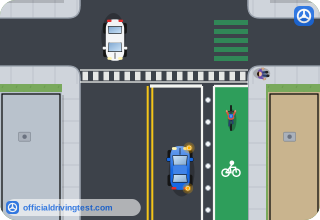
When you turn right where pedestrians and bicyclists are crossing, who must you yield to?
- Only pedestrians who are crossing
- Pedestrians and bicyclists who are crossing
- Only bicyclists who are in the green lane
- Only vehicles that are driving straight
Show answer
Correct answer: Pedestrians and bicyclists who are crossing
The manual says that when turning right, drivers must yield to pedestrians and bicyclists who are crossing.
Source: Massachusetts Driver's Manual (Revised April 2026), page 117 · Open this page in the manual (Manual page 117)
-
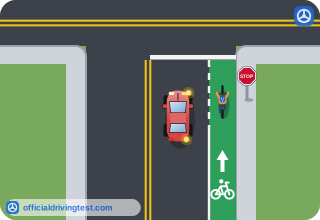
What must drivers always check for when turning across a bike lane?
- Only pedestrians, by looking straight ahead at the windshield
- Only vehicles that are turning in the opposite direction
- Oncoming bicyclists, which may mean looking to the side and behind
- Bicyclists coming from the front, with no head movement needed
Show answer
Correct answer: Oncoming bicyclists, which may mean looking to the side and behind
The manual says drivers must always check for oncoming bicyclists when turning across a bike lane, which may require looking to the side and behind the vehicle.
Source: Massachusetts Driver's Manual (Revised April 2026), page 117 · Open this page in the manual (Manual page 117)