Massachusetts: Right-of-way, turning and passing — Part 3 Practice Test
Questions in this part include: “Where should you position your vehicle before you begin a three-point turn?” · “If another driver does not follow the right-of-way rules, what should you do?”
Independent educational site · not affiliated with any government agency or DMV
Ready? Test yourself
- Instant feedback with an explanation
- Every answer cites its source in the manual
- Your best score is saved on this device
Questions are original and based on the official manual "Massachusetts Driver's Manual" (Revised April 2026), Massachusetts Registry of Motor Vehicles.
All 19 questions in this practice test
Take the test above first, then use this list to study. Tap “Show answer” to see the correct answer and explanation.
Show the questions and answersHide the questions
-
Where should you position your vehicle before you begin a three-point turn?
- Near the center line of the street
- As close as possible to the left curb
- As close as possible to the right curb
- Two feet from the right curb
Show answer
Correct answer: As close as possible to the right curb
The first step of a three-point turn is to position yourself as close as possible to the right edge of the curb.
Source: Massachusetts Driver's Manual (Revised April 2026), page 99 · Open this page in the manual (Manual page 99)
-
In a three-point turn, after you move slowly and turn the steering wheel quickly to the left, how far from the curb does the vehicle come to a stop?
- About ten feet
- About two feet
- About six inches
- About five feet
Show answer
Correct answer: About two feet
The quick left turn of the wheel brings the vehicle perpendicular to the street about two feet from the curb, where you stop.
Source: Massachusetts Driver's Manual (Revised April 2026), page 99 · Open this page in the manual (Manual page 99)
-
In a three-point turn, what do you do with the steering wheel after you have stopped perpendicular to the street and before you start backing up?
- Turn it fully to the left
- Straighten it
- Leave it where it is
- Turn it fully to the right
Show answer
Correct answer: Turn it fully to the right
Before shifting into reverse, the manual says to turn the steering wheel fully to the right.
Source: Massachusetts Driver's Manual (Revised April 2026), page 99 · Open this page in the manual (Manual page 99)
-
In a three-point turn, how far do you back up?
- To the opposite curb, stopping just before it
- Halfway across the street
- To the center line of the street
- Until the vehicle is parallel to the curb
Show answer
Correct answer: To the opposite curb, stopping just before it
The manual says to back up to the opposite curb, stopping just before the curb.
Source: Massachusetts Driver's Manual (Revised April 2026), page 99 · Open this page in the manual (Manual page 99)
-
At the end of a three-point turn, which signal do you give before you shift into drive and accelerate?
- A right turn signal
- Hazard lights
- A left turn signal
- No signal is needed
Show answer
Correct answer: A left turn signal
The last step of a three-point turn is to check traffic again, signal left, shift into drive and accelerate to the proper speed.
Source: Massachusetts Driver's Manual (Revised April 2026), page 99 · Open this page in the manual (Manual page 99)
-
When backing up, which way should you look?
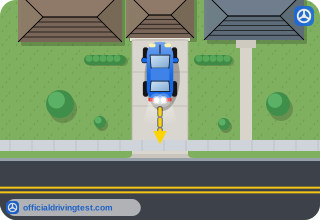
- Over your left shoulder
- Over your right shoulder
- Only in the rearview mirror
- Only at the side mirrors
Show answer
Correct answer: Over your right shoulder
The manual says to shift into reverse and start backing up while looking over your right shoulder.
Source: Massachusetts Driver's Manual (Revised April 2026), page 99 · Open this page in the manual (Manual page 99)
-
Before you back up, what should you check for traffic?
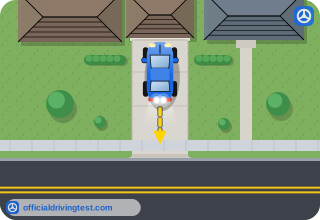
- Only the direction you will back toward
- Only the rearview mirror
- Only the road ahead of you
- Both directions, including your blind spot
Show answer
Correct answer: Both directions, including your blind spot
The manual says to check for traffic in both directions, including your blind spot, before backing up.
Source: Massachusetts Driver's Manual (Revised April 2026), page 99 · Open this page in the manual (Manual page 99)
-
Right-of-way rules help drivers handle traffic situations that are:
- Not controlled by signs or signals
- Controlled only by police officers
- Limited to freeways
- Controlled only by stop signs
Show answer
Correct answer: Not controlled by signs or signals
The manual says right-of-way rules help drivers handle traffic situations not controlled by signs or signals.
Source: Massachusetts Driver's Manual (Revised April 2026), page 99 · Open this page in the manual (Manual page 99)
-
If another driver does not follow the right-of-way rules, what should you do?
- Insist on your right-of-way
- Honk to warn the driver
- Give the right-of-way
- Speed up to pass the driver
Show answer
Correct answer: Give the right-of-way
The manual says that if another driver does not follow these rules, you should always give the right-of-way.
Source: Massachusetts Driver's Manual (Revised April 2026), page 99 · Open this page in the manual (Manual page 99)
-
At an intersection not controlled by signs or signals, which vehicle must you yield the right-of-way to?
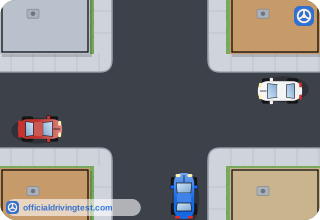
- A vehicle coming from your left
- The faster vehicle
- The larger vehicle
- A vehicle coming from your right
Show answer
Correct answer: A vehicle coming from your right
The manual says you must yield to any vehicle that has entered the intersection from your right or is coming from your right.
Source: Massachusetts Driver's Manual (Revised April 2026), page 100 · Open this page in the manual (Manual page 100)
-
What should you do as you approach an intersection not controlled by signs or signals?
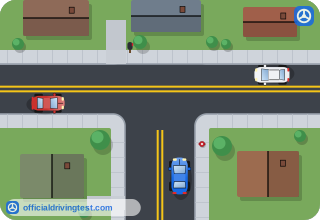
- Slow down and look left and right for oncoming traffic
- Maintain your speed and watch only traffic on the right
- Stop completely and wait for a signal to change
- Speed up to clear the intersection quickly
Show answer
Correct answer: Slow down and look left and right for oncoming traffic
The manual says to slow down at an uncontrolled intersection, look left and right for oncoming traffic and proceed if the way is clear.
Source: Massachusetts Driver's Manual (Revised April 2026), page 100 · Open this page in the manual (Manual page 100)
-
At an intersection not controlled by signs or signals, you may have the legal right-of-way over a vehicle coming from your left. What should you do before you proceed?
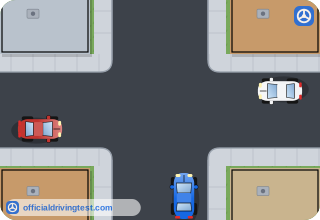
- Sound your horn and proceed at once
- Flash your headlights and then go ahead
- Make sure the other driver is yielding
- Proceed immediately, since you have the legal right-of-way
Show answer
Correct answer: Make sure the other driver is yielding
The manual says that even if you may have the legal right-of-way, you should make sure the other driver is yielding before you proceed.
Source: Massachusetts Driver's Manual (Revised April 2026), page 100 · Open this page in the manual (Manual page 100)
-
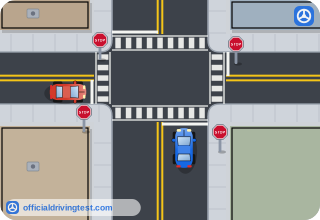
At an intersection with stop signs in all directions, you reach the stop line at the same time as another vehicle. Which vehicle must you yield to?
- The vehicle directly to your left
- The vehicle directly to your right
- The vehicle that is going straight
- The larger vehicle
Show answer
Correct answer: The vehicle directly to your right
The manual says to yield to a vehicle directly to your right that has stopped at the same time as you.
Source: Massachusetts Driver's Manual (Revised April 2026), page 100 · Open this page in the manual (Manual page 100)
-
At a four-way stop, in what order do vehicles go?
- Largest vehicles first
- Vehicles going straight first
- Vehicles on the left first
- The order in which they stopped
Show answer
Correct answer: The order in which they stopped
The manual says vehicles must go in the order they stopped: the first to stop is the next to go.
Source: Massachusetts Driver's Manual (Revised April 2026), page 100 · Open this page in the manual (Manual page 100)
-
At a four-way stop, if you are in doubt about who should go, to whom should you give the right-of-way?
- The driver on your right
- The driver on your left
- The driver across from you
- The driver behind you
Show answer
Correct answer: The driver on your right
The manual says that if in doubt at a four-way stop, you give the right-of-way to the driver on your right.
Source: Massachusetts Driver's Manual (Revised April 2026), page 100 · Open this page in the manual (Manual page 100)
-
What does the manual suggest you do at a four-way stop to judge the intentions of other drivers?
- Flash your headlights at them
- Sound your horn to get their attention
- Try to make eye contact with them
- Wave them through the intersection
Show answer
Correct answer: Try to make eye contact with them
The manual says to try to make eye contact with the drivers of other vehicles to judge their intentions and avoid crashes.
Source: Massachusetts Driver's Manual (Revised April 2026), page 100 · Open this page in the manual (Manual page 100)
-
Who must you yield the right-of-way to first when making any left turn?
- Vehicles stopped behind you
- Oncoming vehicles
- Vehicles parked at the curb
- No one, if you have signaled
Show answer
Correct answer: Oncoming vehicles
The manual says that when making any left turn you must first yield to any oncoming vehicle, vehicle already in the intersection, and pedestrians or bicyclists crossing your path.
Source: Massachusetts Driver's Manual (Revised April 2026), page 100 · Open this page in the manual (Manual page 100)
-
What must you do when entering a paved thoroughfare from a driveway?
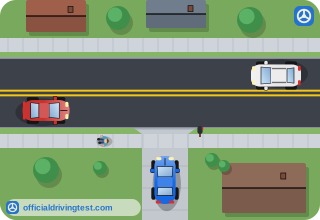
- Slow down and merge ahead of traffic
- Look both ways and go if it is clear
- Honk and then pull out
- Stop, then give the right-of-way
Show answer
Correct answer: Stop, then give the right-of-way
The manual says that entering a paved thoroughfare from a private road, driveway or unpaved road, you must stop and then give the right-of-way to pedestrians, bicyclists or vehicles on the road.
Source: Massachusetts Driver's Manual (Revised April 2026), page 100 · Open this page in the manual (Manual page 100)
-
Before you turn at a designated throughway, you must yield the right-of-way to:
- Traffic on the throughway
- Traffic on the cross street
- Pedestrians only
- Vehicles behind you
Show answer
Correct answer: Traffic on the throughway
The manual says that on a designated throughway you must yield the right-of-way to traffic on the throughway before you turn.
Source: Massachusetts Driver's Manual (Revised April 2026), page 101 · Open this page in the manual (Manual page 101)