Massachusetts: Right-of-way, turning and passing — Part 1 Practice Test
Questions in this part include: “What does the manual say about right-of-way?” · “On a roadway with two or more lanes in your direction, which of these is a time you may leave the right lane?”
Independent educational site · not affiliated with any government agency or DMV
Ready? Test yourself
- Instant feedback with an explanation
- Every answer cites its source in the manual
- Your best score is saved on this device
Questions are original and based on the official manual "Massachusetts Driver's Manual" (Revised April 2026), Massachusetts Registry of Motor Vehicles.
All 19 questions in this practice test
Take the test above first, then use this list to study. Tap “Show answer” to see the correct answer and explanation.
Show the questions and answersHide the questions
-
What does the manual say about right-of-way?
- It is something you give
- It always belongs to the larger vehicle
- It belongs to the faster driver
- It is something you take only at stop signs
Show answer
Correct answer: It is something you give
The manual says right-of-way is something you give, and giving it helps prevent unsafe traffic situations.
Source: Massachusetts Driver's Manual (Revised April 2026), page 41 · Open this page in the manual (Manual page 41)
-
What does the manual say is safer than creating an unsafe condition when others may not hear you?
- Honking, even if you are in a hurry
- Passing quickly, if you have the right of way
- Yielding, even if you have the right of way
- Stopping suddenly in the lane
Show answer
Correct answer: Yielding, even if you have the right of way
It is always safer for you to yield, even if you have the right of way, than to create an unsafe condition.
Source: Massachusetts Driver's Manual (Revised April 2026), page 50 · Open this page in the manual (Manual page 50)
-
When you turn left in front of an oncoming motorcycle, what should you do?
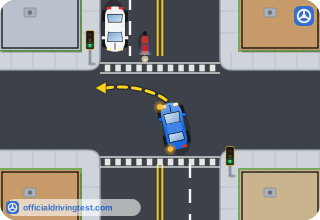
- Turn quickly before the motorcycle gets close to you in the intersection
- Flash your lights and turn
- Let the motorcycle safely pass through the intersection first
- Honk and turn at once
Show answer
Correct answer: Let the motorcycle safely pass through the intersection first
Even if you have enough time to turn, an oncoming motorcyclist may not have time to safely change speed, so let the motorcycle pass first.
Source: Massachusetts Driver's Manual (Revised April 2026), page 52 · Open this page in the manual (Manual page 52)
-
What does a STOP sign always mean?
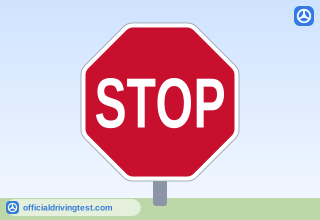
- Slow down and be prepared to stop
- Stop only if other vehicles are present
- Come to a complete halt
- Stop only if pedestrians are crossing
Show answer
Correct answer: Come to a complete halt
A STOP sign always means come to a complete halt and applies to each vehicle that comes to the sign.
Source: Massachusetts Driver's Manual (Revised April 2026), page 86 · Open this page in the manual (Manual page 86)
-
When approaching a stop sign, where must you stop?
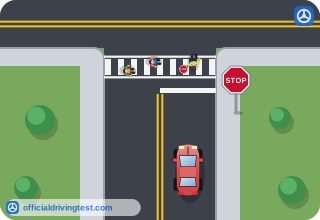
- Within 15 feet past the crosswalk
- In the middle of the crosswalk
- Past the stop line, to see cross traffic
- Before any crosswalk or painted stop line
Show answer
Correct answer: Before any crosswalk or painted stop line
You must stop before any crosswalk or stop line painted on the pavement.
Source: Massachusetts Driver's Manual (Revised April 2026), page 86 · Open this page in the manual (Manual page 86)
-
At a STOP sign, is just slowing down enough?
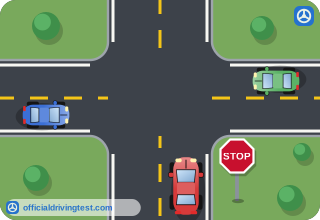
- No, you must come to a complete stop
- Yes, if no other vehicle is near
- Yes, if you are turning right
- Yes, if you are on a main road
Show answer
Correct answer: No, you must come to a complete stop
At a stop sign you must come to a complete stop; just slowing down is not enough.
Source: Massachusetts Driver's Manual (Revised April 2026), page 86 · Open this page in the manual (Manual page 86)
-
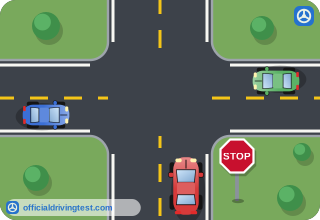
What must you do at a stop sign after coming to a complete stop?
- Go at once without looking again
- Yield to pedestrians or vehicles, and go carefully
- Honk your horn and then go ahead
- Go if the road on your left is clear of cars
Show answer
Correct answer: Yield to pedestrians or vehicles, and go carefully
After a complete stop you must yield to pedestrians or other vehicles and go carefully.
Source: Massachusetts Driver's Manual (Revised April 2026), page 86 · Open this page in the manual (Manual page 86)
-
If a 4-WAY or ALL WAY sign is added to a STOP sign at an intersection, who must stop?
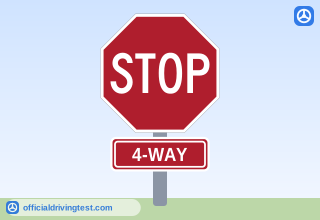
- All traffic coming to the intersection
- Only the vehicles on the main road
- Only vehicles turning left
- Only the first vehicle to arrive
Show answer
Correct answer: All traffic coming to the intersection
A 4-WAY or ALL WAY sign added to a STOP sign means all traffic coming to the intersection must stop.
Source: Massachusetts Driver's Manual (Revised April 2026), page 86 · Open this page in the manual (Manual page 86)
-
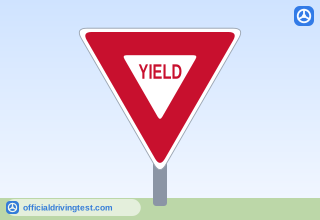
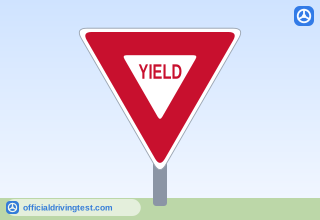
What should you do when you see a YIELD sign?
- Come to a complete stop every time
- Speed up to pass before traffic arrives
- Stop only if a pedestrian is present
- Slow down and be prepared to stop
Show answer
Correct answer: Slow down and be prepared to stop
At a YIELD sign you slow down and be prepared to stop.
Source: Massachusetts Driver's Manual (Revised April 2026), page 86 · Open this page in the manual (Manual page 86)
-
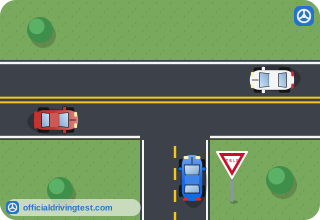
At a YIELD sign, whom must you let go before you proceed?
- Only vehicles on your left
- Vehicles, bicyclists, and pedestrians
- Only emergency vehicles
- Only pedestrians in the crosswalk
Show answer
Correct answer: Vehicles, bicyclists, and pedestrians
At a YIELD sign, let vehicles, bicyclists, and pedestrians go before you proceed.
Source: Massachusetts Driver's Manual (Revised April 2026), page 86 · Open this page in the manual (Manual page 86)
-
When must you come to a complete stop at a YIELD sign?
- If traffic conditions require it
- Never, because yield means slow down only
- Only at night
- Only when a police officer is present
Show answer
Correct answer: If traffic conditions require it
You must come to a complete stop at a YIELD sign if traffic conditions require it.
Source: Massachusetts Driver's Manual (Revised April 2026), page 86 · Open this page in the manual (Manual page 86)
-
How must you use traffic lanes?
- Following the vehicles that are ahead of you
- In whichever lane has the fewest vehicles
- As they are defined by pavement markings and road signs
- Based on the lane you used last time on that road
Show answer
Correct answer: As they are defined by pavement markings and road signs
The manual says to always use traffic lanes as defined by pavement markings and road signs.
Source: Massachusetts Driver's Manual (Revised April 2026), page 93 · Open this page in the manual (Manual page 93)
-
On a roadway with two or more lanes in your direction, which of these is a time you may leave the right lane?
- When you are driving below the speed limit
- When you see a vehicle merging from an on-ramp
- When the road ahead curves out of sight
- When you are making a left turn
Show answer
Correct answer: When you are making a left turn
You should use the right lane unless you are passing, making a left turn, or the right lane is blocked.
Source: Massachusetts Driver's Manual (Revised April 2026), page 94 · Open this page in the manual (Manual page 94)
-
What does the manual say about changing lanes in the middle of an intersection?
- It is illegal and dangerous
- It is allowed when no other vehicles are nearby
- It is allowed if you have signaled
- It is allowed on roads with three or more lanes
Show answer
Correct answer: It is illegal and dangerous
Never change lanes in the middle of an intersection; the manual says it is illegal and dangerous.
Source: Massachusetts Driver's Manual (Revised April 2026), page 94 · Open this page in the manual (Manual page 94)
-
You come to a curve in the road and cannot see ahead. What should you do?
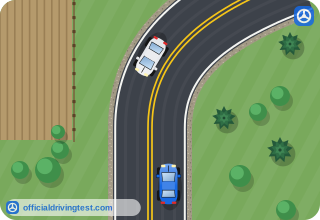
- Move to the center of the road and keep your speed
- Keep to the left and slow down
- Sound your horn and speed up
- Keep to the right and slow down
Show answer
Correct answer: Keep to the right and slow down
If you come to a curve and cannot see ahead, keep to the right and slow down.
Source: Massachusetts Driver's Manual (Revised April 2026), page 94 · Open this page in the manual (Manual page 94)
-
When may you drive in a lane that is posted as restricted?
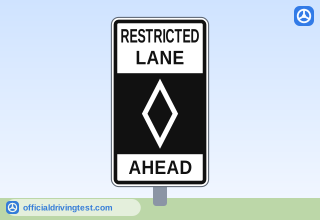
- Only when you are passing another vehicle
- Only when the other lanes are blocked
- Only during rush hour
- Only when preparing for a turn
Show answer
Correct answer: Only when preparing for a turn
You must not drive in lanes posted as restricted, except when preparing for a turn.
Source: Massachusetts Driver's Manual (Revised April 2026), page 94 · Open this page in the manual (Manual page 94)
-
What is an intersection?
- A place where two or more roadways meet
- A place where a road crosses a railroad track
- A place where a ramp joins the shoulder
- A place where a bicycle lane ends
Show answer
Correct answer: A place where two or more roadways meet
Intersections are where two or more roadways meet.
Source: Massachusetts Driver's Manual (Revised April 2026), page 96 · Open this page in the manual (Manual page 96)
-
What should you do on roads that have multiple turning lanes?
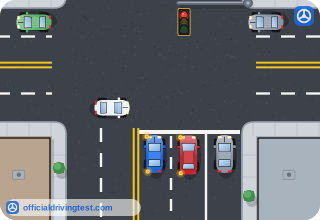
- Use the lane nearest the center line
- Use the lane with the least traffic
- Follow the applicable road signs or markings
- Use the right-hand lane for all turns
Show answer
Correct answer: Follow the applicable road signs or markings
On roads with multiple turning lanes, you should follow the applicable road signs or markings.
Source: Massachusetts Driver's Manual (Revised April 2026), page 96 · Open this page in the manual (Manual page 96)
-
What does the manual say about blocking an intersection with your vehicle?
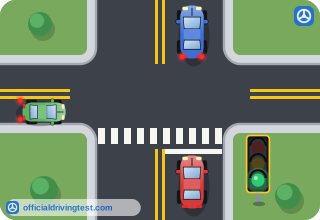
- It is allowed if you entered on a green light
- It is illegal
- It is allowed when traffic is heavy
- It is allowed for no more than one signal cycle
Show answer
Correct answer: It is illegal
It is illegal to block an intersection with your vehicle.
Source: Massachusetts Driver's Manual (Revised April 2026), page 96 · Open this page in the manual (Manual page 96)