Massachusetts: Right-of-way, turning and passing — Part 2 Practice Test
Questions in this part include: “How far before making a turn should you signal on a highway?” · “What is a U-turn?”
Independent educational site · not affiliated with any government agency or DMV
Ready? Test yourself
- Instant feedback with an explanation
- Every answer cites its source in the manual
- Your best score is saved on this device
Questions are original and based on the official manual "Massachusetts Driver's Manual" (Revised April 2026), Massachusetts Registry of Motor Vehicles.
All 19 questions in this practice test
Take the test above first, then use this list to study. Tap “Show answer” to see the correct answer and explanation.
Show the questions and answersHide the questions
-
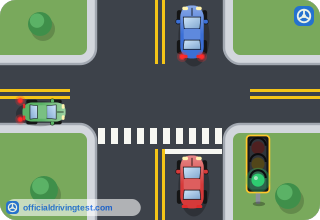
When may you enter an intersection or drive across a crosswalk?
- Whenever the light is green, even if traffic is backed up
- Whenever you can enter before the light changes
- Whenever the vehicle ahead of you has entered
- Only if there is enough room for you to drive through safely
Show answer
Correct answer: Only if there is enough room for you to drive through safely
You may only enter an intersection or drive across a crosswalk if there is enough room for you to drive through safely.
Source: Massachusetts Driver's Manual (Revised April 2026), page 96 · Open this page in the manual (Manual page 96)
-
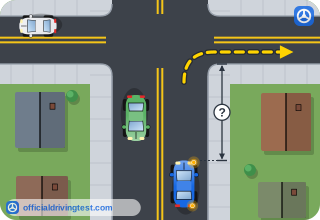
How far before making a turn should you signal when driving on a road that is not a highway?
- At least 50 feet
- At least 200 feet
- At least 100 feet
- At least 500 feet
Show answer
Correct answer: At least 100 feet
Signal your turn at least 100 feet before making the turn; on a highway, signal at least 500 feet before a turn.
Source: Massachusetts Driver's Manual (Revised April 2026), page 97 · Open this page in the manual (Manual page 97)
-
How far before making a turn should you signal on a highway?
- At least 100 feet
- At least 500 feet
- At least 300 feet
- At least 1,000 feet
Show answer
Correct answer: At least 500 feet
On a highway, signal at least 500 feet before a turn.
Source: Massachusetts Driver's Manual (Revised April 2026), page 97 · Open this page in the manual (Manual page 97)
-
When is it best to signal a turn?
- After you have reduced your speed
- After you are in the intersection
- Right as you begin the turn
- Before you apply your brakes
Show answer
Correct answer: Before you apply your brakes
It is best to signal before you apply your brakes, so you make your intentions known to other drivers.
Source: Massachusetts Driver's Manual (Revised April 2026), page 97 · Open this page in the manual (Manual page 97)
-
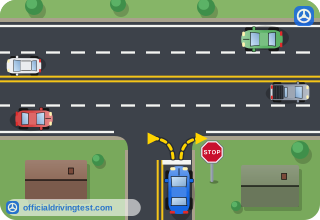
You need to change lanes while making a turn. When should you do so?
- After you turn
- Before you reach the intersection
- In the middle of the turn
- While you are signaling
Show answer
Correct answer: After you turn
If you need to change lanes, do so after you turn.
Source: Massachusetts Driver's Manual (Revised April 2026), page 97 · Open this page in the manual (Manual page 97)
-
When turning, what should you look for on the road you are turning into?
- Green or red pavement colors marking the lane
- A crossing guard standing in the road
- Yellow or white pavement lines marking the road
- Painted triangles across the road
Show answer
Correct answer: Yellow or white pavement lines marking the road
Look for yellow or white pavement lines marking the road you are turning into.
Source: Massachusetts Driver's Manual (Revised April 2026), page 97 · Open this page in the manual (Manual page 97)
-
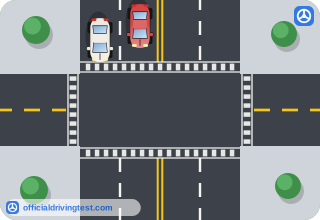
From which lane should you make a right turn?
- The lane closest to the center lane
- The far right lane
- The middle lane
- The breakdown lane
Show answer
Correct answer: The far right lane
For a right turn, turn from the far right lane.
Source: Massachusetts Driver's Manual (Revised April 2026), page 98 · Open this page in the manual (Manual page 98)
-
From which lane should you make a left turn?
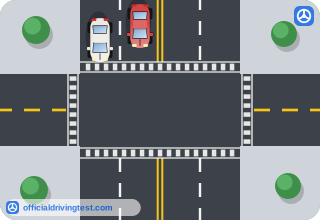
- The far right lane
- The farthest lane from the center
- The breakdown lane
- The lane closest to the center lane
Show answer
Correct answer: The lane closest to the center lane
For a left turn, turn from the lane closest to the center lane.
Source: Massachusetts Driver's Manual (Revised April 2026), page 98 · Open this page in the manual (Manual page 98)
-
While making a turn, where should you keep your vehicle?
- Centered in the middle of the lanes you are leaving and entering
- Along the edge of the lane that you are entering, near the curb
- Out wide of your own lane so that the turn is easier to make
- Close to the center line as you go through the turn
Show answer
Correct answer: Centered in the middle of the lanes you are leaving and entering
Do not swing your vehicle out of your lane or swing wide; keep your vehicle centered in the middle of the lanes you are leaving and entering.
Source: Massachusetts Driver's Manual (Revised April 2026), page 98 · Open this page in the manual (Manual page 98)
-
You have started a turn through an intersection but decide you do not want to make it. What should you do?
- Stop in mid-turn and change direction to go the other way
- Stop in the intersection and back up into your own lane
- Follow through, drive to the next intersection, and work your way back
- Straighten out and drive straight through the crosswalk ahead
Show answer
Correct answer: Follow through, drive to the next intersection, and work your way back
Once you have started a turn you must follow through; if you decide you do not want to make the turn, drive to the next intersection and work your way back.
Source: Massachusetts Driver's Manual (Revised April 2026), page 98 · Open this page in the manual (Manual page 98)
-
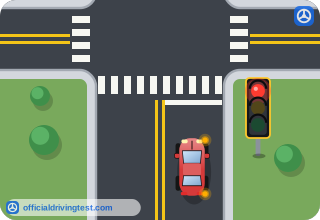
At a red traffic light, what must you do before you may turn right?
- Slow down and make the turn if no vehicle is behind you
- Stop completely and yield to pedestrians and other vehicles
- Wait for the signal to turn green or yellow before you turn
- Check your mirrors and then turn without stopping at all
Show answer
Correct answer: Stop completely and yield to pedestrians and other vehicles
You must come to a complete stop at a red light and may then turn right unless a NO TURN ON RED sign is posted, after giving the right-of-way to pedestrians and other vehicles.
Source: Massachusetts Driver's Manual (Revised April 2026), page 98 · Open this page in the manual (Manual page 98)
-
What is a U-turn?
- A wide right turn that puts you in the opposite direction
- A turn made by backing into a driveway
- A tight left turn that puts you in the opposite direction
- A turn made in three moves when there is little room
Show answer
Correct answer: A tight left turn that puts you in the opposite direction
A U-turn is a tight left turn that puts you in the opposite direction.
Source: Massachusetts Driver's Manual (Revised April 2026), page 98 · Open this page in the manual (Manual page 98)
-
When may you NOT make a U-turn?
- When another vehicle is waiting behind you
- When a NO U-TURN sign is posted
- When you are in the lane closest to the center line
- When you are at an intersection with a green light
Show answer
Correct answer: When a NO U-TURN sign is posted
You can make a U-turn if your path is clear and it is safe, but you cannot make one if a NO U-TURN sign is posted.
Source: Massachusetts Driver's Manual (Revised April 2026), page 98 · Open this page in the manual (Manual page 98)
-
From which lane may you make a U-turn?
- The far right lane of the road
- Any lane in which the path is clear
- The lane that is closest to the curb
- The lane closest to the center line
Show answer
Correct answer: The lane closest to the center line
You may only make a U-turn from the lane closest to the center line.
Source: Massachusetts Driver's Manual (Revised April 2026), page 98 · Open this page in the manual (Manual page 98)
-
Where must you not make a U-turn because you or other drivers cannot see 500 feet away?
- At the crest of a hill or near a curve
- On a one-way street
- At an intersection with a stop sign
- On a street with a bicycle lane
Show answer
Correct answer: At the crest of a hill or near a curve
Do not make a U-turn at the crest of a hill, near a curve, or anyplace where you or other drivers cannot see 500 feet away.
Source: Massachusetts Driver's Manual (Revised April 2026), page 98 · Open this page in the manual (Manual page 98)
-
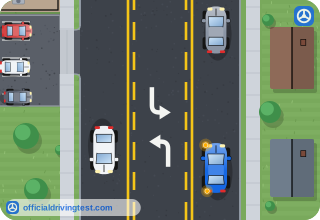
On some two-way roads, a center lane may be marked as a common left-turn lane. Who may use it?
- Only vehicles heading in one direction
- Only vehicles that are passing
- Vehicles in both directions
- Only emergency vehicles
Show answer
Correct answer: Vehicles in both directions
A center lane marked as a common left-turn lane is used by vehicles in both directions.
Source: Massachusetts Driver's Manual (Revised April 2026), page 98 · Open this page in the manual (Manual page 98)
-
What may you not do in a center turning lane?
- Make a left turn from it
- Travel in it
- Enter it to make a left turn
- Use it to turn into a driveway
Show answer
Correct answer: Travel in it
The manual says you may not travel in a center turning lane.
Source: Massachusetts Driver's Manual (Revised April 2026), page 98 · Open this page in the manual (Manual page 98)
-
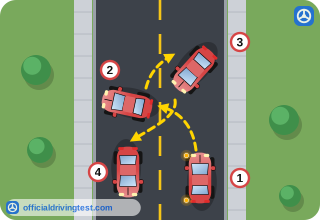
When may you consider a three-point turn?
- When a NO U-TURN sign is posted
- When you are on a one-way street
- When you are at the crest of a hill
- When there is not enough room for a U-turn
Show answer
Correct answer: When there is not enough room for a U-turn
When there is not enough room for a U-turn, you may consider a three-point turn, which puts you in the opposite direction.
Source: Massachusetts Driver's Manual (Revised April 2026), page 98 · Open this page in the manual (Manual page 98)
-
Before starting a three-point turn, how large a gap in traffic should you wait for?
- A 20-30 second gap
- A 5-10 second gap
- A 10-15 second gap
- A 45-60 second gap
Show answer
Correct answer: A 20-30 second gap
The manual says to wait until you have a 20-30 second gap to complete a three-point turn.
Source: Massachusetts Driver's Manual (Revised April 2026), page 99 · Open this page in the manual (Manual page 99)