Massachusetts: Right-of-way, turning and passing — Part 5 Practice Test
Questions in this part include: “If you are crossing a broken yellow line to pass, how far in front of you must you be able to see clearly?” · “Passing on the right is allowed in which of these circumstances?”
Independent educational site · not affiliated with any government agency or DMV
Ready? Test yourself
- Instant feedback with an explanation
- Every answer cites its source in the manual
- Your best score is saved on this device
Questions are original and based on the official manual "Massachusetts Driver's Manual" (Revised April 2026), Massachusetts Registry of Motor Vehicles.
All 19 questions in this practice test
Take the test above first, then use this list to study. Tap “Show answer” to see the correct answer and explanation.
Show the questions and answersHide the questions
-
According to the manual, what should your decision to make a turn depend on?
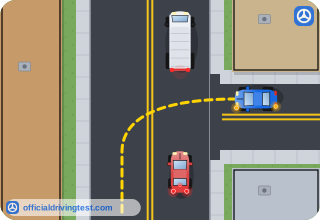
- Traffic and visibility
- A wave from another driver
- The speed limit
- The vehicles behind you
Show answer
Correct answer: Traffic and visibility
The manual says making the turn should depend on traffic and visibility, not on a wave.
Source: Massachusetts Driver's Manual (Revised April 2026), page 102 · Open this page in the manual (Manual page 102)
-
When passing is allowed, on which side should you pass?
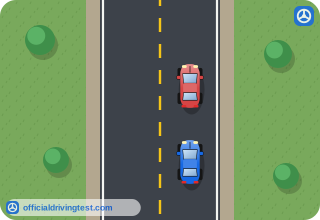
- On the right
- On whichever side is clearer
- On the left
- On the shoulder
Show answer
Correct answer: On the left
The manual says that when passing is allowed, you should pass on the left; passing on the right is allowed only in certain situations.
Source: Massachusetts Driver's Manual (Revised April 2026), page 102 · Open this page in the manual (Manual page 102)
-
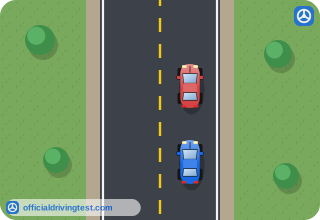
When should you pass a pedestrian, bicyclist, or motor vehicle?
- Whenever the other road user is slower than you want to go
- Only when it is necessary and safe
- Whenever there is a gap in oncoming traffic
- Whenever it will save you time
Show answer
Correct answer: Only when it is necessary and safe
The manual says you should pass only when it is necessary and safe to do so.
Source: Massachusetts Driver's Manual (Revised April 2026), page 102 · Open this page in the manual (Manual page 102)
-
If you have any doubt about whether to pass, what should you do?
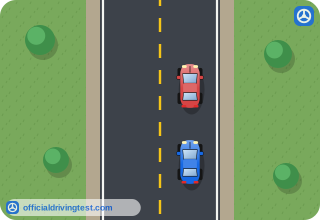
- Do not pass
- Pass quickly
- Honk and pass
- Pass on the right
Show answer
Correct answer: Do not pass
The manual says that if you have any doubt, do not pass.
Source: Massachusetts Driver's Manual (Revised April 2026), page 102 · Open this page in the manual (Manual page 102)
-
Which of these may you never use for passing another vehicle?
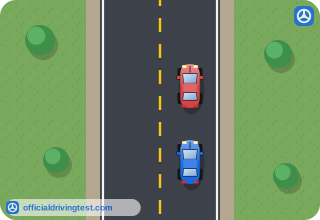
- The left side of a slower vehicle, when passing is allowed
- The right side, on a one-way street
- The shoulder of the road
- The oncoming lane across a broken yellow line, when it is safe
Show answer
Correct answer: The shoulder of the road
The manual says never to use a breakdown lane, the shoulder of a road, or a sidewalk for passing another vehicle.
Source: Massachusetts Driver's Manual (Revised April 2026), page 102 · Open this page in the manual (Manual page 102)
-
If you are crossing a broken yellow line to pass, how far in front of you must you be able to see clearly?
- At least 200 feet
- At least 300 feet
- At least 400 feet
- At least 600 feet
Show answer
Correct answer: At least 400 feet
The manual says that if you are crossing a broken yellow line to pass, you must be able to see clearly at least 400 feet in front of you.
Source: Massachusetts Driver's Manual (Revised April 2026), page 103 · Open this page in the manual (Manual page 103)
-
While passing, once you are safely past the other vehicle, which signal do you give?
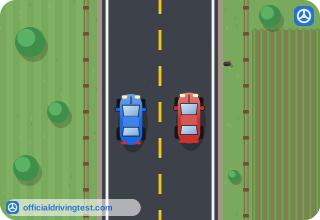
- A left turn signal
- A right turn signal
- Hazard lights
- No signal
Show answer
Correct answer: A right turn signal
The manual says to maintain your speed until safely past the other vehicle, then signal right.
Source: Massachusetts Driver's Manual (Revised April 2026), page 103 · Open this page in the manual (Manual page 103)
-
After passing, how far ahead of the other vehicle should you be before you move back into the right lane?
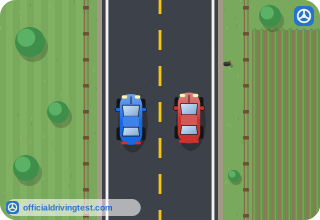
- Far enough that it is no longer visible to you
- One car length ahead of its bumper
- Just far enough to clear its bumper
- Far enough to see its headlights in your mirror
Show answer
Correct answer: Far enough to see its headlights in your mirror
The manual says to wait at least until you can see the vehicle’s headlights in your mirror before moving back into the right lane.
Source: Massachusetts Driver's Manual (Revised April 2026), page 103 · Open this page in the manual (Manual page 103)
-
When passing, you must return to the right lane before any oncoming vehicle comes within what distance of you?
- 200 feet
- 100 feet
- 400 feet
- 1,000 feet
Show answer
Correct answer: 200 feet
The manual says you must return to the right lane before any oncoming vehicle comes within 200 feet of you.
Source: Massachusetts Driver's Manual (Revised April 2026), page 103 · Open this page in the manual (Manual page 103)
-
After you have returned to the right lane following a pass, what do you do with your signal?
- Leave it on for ten seconds
- Switch it to hazard lights
- Turn it off
- Leave it on until your next turn
Show answer
Correct answer: Turn it off
The manual says to turn off your signal once you have returned to the right lane.
Source: Massachusetts Driver's Manual (Revised April 2026), page 103 · Open this page in the manual (Manual page 103)
-
Passing on the right is allowed in which of these circumstances?
- The vehicle you are passing is about to make a right turn
- You are driving on a one-way street
- The vehicle you are passing is driving below the speed limit
- The vehicle ahead of you has slowed down for traffic
Show answer
Correct answer: You are driving on a one-way street
The manual says you can pass on the right when you are driving on a one-way street.
Source: Massachusetts Driver's Manual (Revised April 2026), page 103 · Open this page in the manual (Manual page 103)
-
Passing on the right can only be done when the road is clear and wide enough for what?
- A single line of vehicles plus the shoulder
- One vehicle and one bicycle
- One vehicle and a parked car
- Two or more lines of motor vehicles
Show answer
Correct answer: Two or more lines of motor vehicles
The manual says passing on the right can only be done when the road is clear and wide enough for two or more lines of motor vehicles.
Source: Massachusetts Driver's Manual (Revised April 2026), page 103 · Open this page in the manual (Manual page 103)
-
If you are being passed by another vehicle, what must you do?
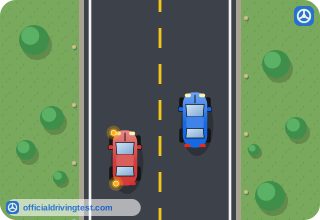
- Slow down and stay to the right
- Speed up to stay ahead
- Move to the left to give room
- Keep your speed and stay in the center
Show answer
Correct answer: Slow down and stay to the right
The manual says that if you are being passed you must slow down and stay to the right, and not speed up.
Source: Massachusetts Driver's Manual (Revised April 2026), page 103 · Open this page in the manual (Manual page 103)
-
Why should you not pass a vehicle that is stopped?
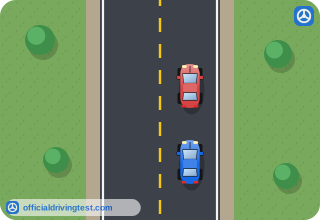
- The driver may be about to back up into your lane without warning
- They may be stopped for another vehicle, a person, or an animal you cannot see
- The driver may be waiting for you to give a signal before moving
- It is difficult for the driver to see a vehicle passing alongside
Show answer
Correct answer: They may be stopped for another vehicle, a person, or an animal you cannot see
The manual says such vehicles may be stopped for another vehicle, a person, or an animal that you cannot see.
Source: Massachusetts Driver's Manual (Revised April 2026), page 104 · Open this page in the manual (Manual page 104)
-
You pass a bicycle near an intersection or driveway where you want to turn right. When may you make the turn?
- As soon as you are ahead of the bicycle and have used your turn signal
- Only after the bicyclist has stopped and has waved you on
- Only at a safe distance from the bicyclist, at a reasonable and proper speed
- Right away, so that you do not block the bicyclist behind you
Show answer
Correct answer: Only at a safe distance from the bicyclist, at a reasonable and proper speed
The manual says you cannot turn unless you are at a safe distance from the bicyclist and can make the turn at a reasonable and proper speed.
Source: Massachusetts Driver's Manual (Revised April 2026), page 115 · Open this page in the manual (Manual page 115)
-
You are turning left at an intersection or into an alley, private road, or driveway. What must you yield to?
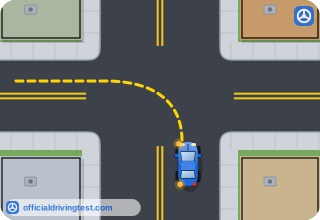
- Only oncoming motor vehicles that are already in the intersection, not bicycles
- Only oncoming vehicles traveling faster than 25 mph, since slower ones can stop
- Only oncoming vehicles that have a green light or a green arrow to proceed
- An oncoming vehicle, bicycles included, in the intersection or an immediate hazard
Show answer
Correct answer: An oncoming vehicle, bicycles included, in the intersection or an immediate hazard
The manual says you must yield the right of way to a vehicle approaching from the opposite direction, including a bicycle, if it is in the intersection or close enough to be an immediate hazard.
Source: Massachusetts Driver's Manual (Revised April 2026), page 115 · Open this page in the manual (Manual page 115)
-
At intersections with separated bicycle lanes, what must drivers do at the stop line?
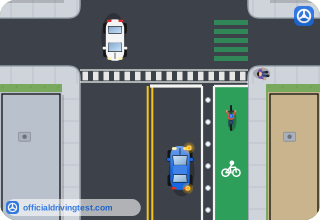
- Stop past the stop line to see the crossing traffic better
- Slow down but keep rolling through the crossing slowly
- Stop only if a bicyclist is already in the crossing area
- Stop at the stop line to let pedestrians and bicyclists cross safely
Show answer
Correct answer: Stop at the stop line to let pedestrians and bicyclists cross safely
The manual says that at intersections drivers must stop at the stop line to allow pedestrians and bicyclists to cross safely.
Source: Massachusetts Driver's Manual (Revised April 2026), page 117 · Open this page in the manual (Manual page 117)
-
When you turn right where pedestrians and bicyclists are crossing, who must you yield to?
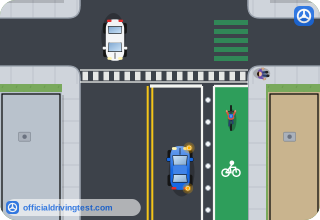
- Only pedestrians who are crossing
- Pedestrians and bicyclists who are crossing
- Only bicyclists who are in the green lane
- Only vehicles that are driving straight
Show answer
Correct answer: Pedestrians and bicyclists who are crossing
The manual says that when turning right, drivers must yield to pedestrians and bicyclists who are crossing.
Source: Massachusetts Driver's Manual (Revised April 2026), page 117 · Open this page in the manual (Manual page 117)
-
What must drivers always check for when turning across a bike lane?
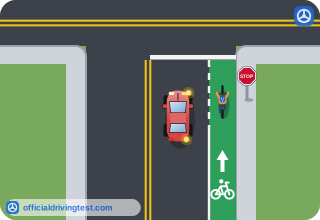
- Only pedestrians, by looking straight ahead at the windshield
- Only vehicles that are turning in the opposite direction
- Oncoming bicyclists, which may mean looking to the side and behind
- Bicyclists coming from the front, with no head movement needed
Show answer
Correct answer: Oncoming bicyclists, which may mean looking to the side and behind
The manual says drivers must always check for oncoming bicyclists when turning across a bike lane, which may require looking to the side and behind the vehicle.
Source: Massachusetts Driver's Manual (Revised April 2026), page 117 · Open this page in the manual (Manual page 117)