Massachusetts: Right-of-way, turning and passing — Part 4 Practice Test
Questions in this part include: “What is found at the entrance to a rotary?” · “Roundabouts require vehicles to reduce speed to what?”
Independent educational site · not affiliated with any government agency or DMV
Ready? Test yourself
- Instant feedback with an explanation
- Every answer cites its source in the manual
- Your best score is saved on this device
Questions are original and based on the official manual "Massachusetts Driver's Manual" (Revised April 2026), Massachusetts Registry of Motor Vehicles.
All 19 questions in this practice test
Take the test above first, then use this list to study. Tap “Show answer” to see the correct answer and explanation.
Show the questions and answersHide the questions
-
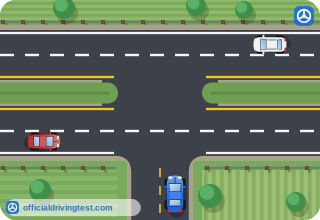
You are on a single or two-lane road and come to an intersection with a divided highway or a roadway with three or more lanes. What must you do?
- Take the right-of-way if you arrived first
- Go ahead of the traffic if you signal
- Yield the right-of-way
- Proceed without stopping
Show answer
Correct answer: Yield the right-of-way
The manual says you must yield the right-of-way at such an intersection.
Source: Massachusetts Driver's Manual (Revised April 2026), page 101 · Open this page in the manual (Manual page 101)
-
What is found at the entrance to a rotary?
- Stop signs
- Yield signs
- Traffic signals
- Flashing red lights
Show answer
Correct answer: Yield signs
The manual says there are yield signs at the entrance to a rotary.
Source: Massachusetts Driver's Manual (Revised April 2026), page 101 · Open this page in the manual (Manual page 101)
-
Big rotaries are designed to handle traffic traveling at up to what speed?
- 25 miles per hour
- 30 miles per hour
- 50 miles per hour
- 40 miles per hour
Show answer
Correct answer: 40 miles per hour
The manual says big rotaries are designed to handle traffic traveling at up to 40 miles per hour.
Source: Massachusetts Driver's Manual (Revised April 2026), page 101 · Open this page in the manual (Manual page 101)
-
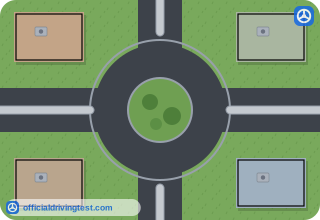
In which direction does traffic travel in a rotary?
- Counter-clockwise
- Clockwise
- Whichever way is shorter
- Straight through the center
Show answer
Correct answer: Counter-clockwise
The manual says traffic travels counter-clockwise in a rotary.
Source: Massachusetts Driver's Manual (Revised April 2026), page 101 · Open this page in the manual (Manual page 101)
-
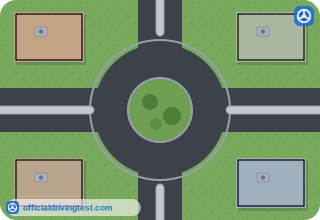
When entering a rotary, you must always yield the right-of-way to:
- Vehicles about to enter after you
- Vehicles that signal first
- Vehicles already in the rotary
- Trucks only
Show answer
Correct answer: Vehicles already in the rotary
The manual says to always yield the right-of-way to vehicles already in the rotary and to pedestrians, unless told differently by signs or police officers.
Source: Massachusetts Driver's Manual (Revised April 2026), page 101 · Open this page in the manual (Manual page 101)
-
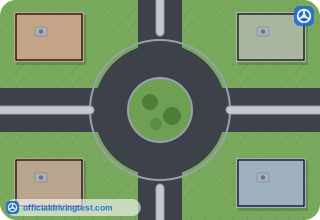
Which signal do you use in a rotary when you are ready to exit?
- Your left turn signal
- Your right turn signal
- Your hazard lights
- No signal is needed in a rotary
Show answer
Correct answer: Your right turn signal
The manual says that when you are ready to exit a rotary, you use your right turn signal.
Source: Massachusetts Driver's Manual (Revised April 2026), page 101 · Open this page in the manual (Manual page 101)
-
In a single-lane rotary, onto which lane must you exit?
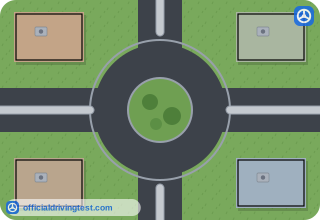
- The left lane of the road you intend to travel on
- Whichever lane is open
- The middle lane of the road you intend to travel on
- The right lane of the road you intend to travel on
Show answer
Correct answer: The right lane of the road you intend to travel on
The manual says that in a single-lane rotary you must exit onto the right lane of the road you intend to travel on.
Source: Massachusetts Driver's Manual (Revised April 2026), page 101 · Open this page in the manual (Manual page 101)
-
A multiple-lane rotary has no signs. You want to continue straight ahead. From which lane do you enter the rotary?
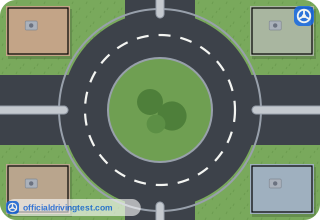
- The right lane
- The left lane
- The middle lane
- Any lane
Show answer
Correct answer: The right lane
The manual says to enter from the right lane for a quarter-turn or to continue straight ahead, stay in that lane and exit onto the right lane.
Source: Massachusetts Driver's Manual (Revised April 2026), page 101 · Open this page in the manual (Manual page 101)
-
A multiple-lane rotary has no signs. You want to make a U-turn. From which lane do you enter the rotary?
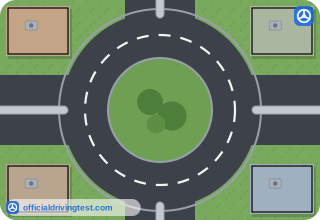
- The right lane
- The lane with the least traffic
- The left lane
- The lane that is closest to the exit
Show answer
Correct answer: The left lane
The manual says that for a three-quarter-turn or a U-turn you enter the rotary from the left lane.
Source: Massachusetts Driver's Manual (Revised April 2026), page 101 · Open this page in the manual (Manual page 101)
-
You are making a three-quarter-turn in a rotary after coming from a road with a single lane. Which lane should you stay in?
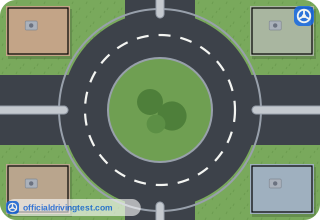
- The left lane for the entire turn
- The right lane for the entire turn
- The inner lane after you enter
- The middle lane once you are inside
Show answer
Correct answer: The right lane for the entire turn
The manual says that if coming from a road with a single lane, you should stay in the right lane for the entire turn.
Source: Massachusetts Driver's Manual (Revised April 2026), page 101 · Open this page in the manual (Manual page 101)
-
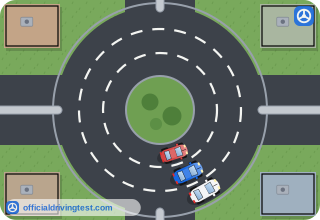
In a multiple-lane rotary, there may be traffic on both sides of your vehicle. When may you move out of your lane?
- Whenever you signal first
- Whenever you are near your exit
- Whenever the lane beside you is slower
- Only when it is safe to do so
Show answer
Correct answer: Only when it is safe to do so
The manual says not to attempt to move out of your lane until it is safe to do so.
Source: Massachusetts Driver's Manual (Revised April 2026), page 101 · Open this page in the manual (Manual page 101)
-
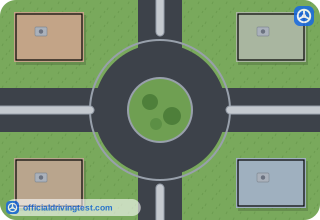
You miss your exit in a rotary. What should you do?
- Go around again when it is safe to do so
- Stop in the rotary and wait for a gap
- Back up to the exit
- Cross the lanes quickly to reach the exit
Show answer
Correct answer: Go around again when it is safe to do so
The manual says to check the traffic and, if it is safe, go around again; you must not stop in the rotary.
Source: Massachusetts Driver's Manual (Revised April 2026), page 102 · Open this page in the manual (Manual page 102)
-
Roundabouts require vehicles to reduce speed to what?
- 35 miles per hour or less
- 40 miles per hour or less
- 25 miles per hour or less
- 15 miles per hour or less
Show answer
Correct answer: 25 miles per hour or less
The manual says the small size of a roundabout requires vehicles to reduce speed to 25 miles per hour or less.
Source: Massachusetts Driver's Manual (Revised April 2026), page 102 · Open this page in the manual (Manual page 102)
-
What do most roundabouts have?
- Stop lines and overhead traffic signals
- Yield lines and pedestrian crosswalks
- Stop signs at every entrance
- Flashing red beacons at each entrance
Show answer
Correct answer: Yield lines and pedestrian crosswalks
The manual says most roundabouts have yield lines on the pavement and crosswalks for pedestrians.
Source: Massachusetts Driver's Manual (Revised April 2026), page 102 · Open this page in the manual (Manual page 102)
-
Roundabouts reduce the need to do what?
- Use turn signals
- Look for pedestrians
- Slow down
- Change lanes
Show answer
Correct answer: Change lanes
The manual says roundabouts reduce the need to change lanes.
Source: Massachusetts Driver's Manual (Revised April 2026), page 102 · Open this page in the manual (Manual page 102)
-
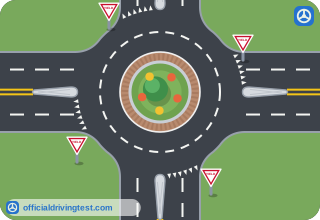
When entering a roundabout and choosing a lane, which rules should you follow?
- The same rules as for a rotary
- The same rules as for a four-way stop
- The same rules as for a throughway
- No lane rules apply in a roundabout
Show answer
Correct answer: The same rules as for a rotary
The manual says that when entering a roundabout and choosing a lane, you should follow the same rules as for a rotary.
Source: Massachusetts Driver's Manual (Revised April 2026), page 102 · Open this page in the manual (Manual page 102)
-
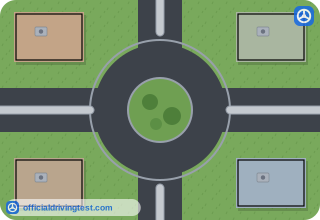
Slow speeds in roundabouts make them safe for which road users?
- Large trucks
- Buses
- Bicyclists
- Horse-drawn vehicles
Show answer
Correct answer: Bicyclists
The manual says slow speeds in roundabouts make them safe for bicyclists.
Source: Massachusetts Driver's Manual (Revised April 2026), page 102 · Open this page in the manual (Manual page 102)
-
According to the manual, what does waving people in through stopped traffic create?
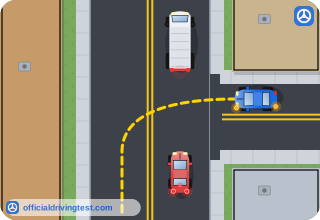
- A safer intersection
- A dangerous situation
- A faster flow of traffic
- A legal right-of-way
Show answer
Correct answer: A dangerous situation
The manual says waving people in through stopped traffic creates a dangerous situation and can easily result in a crash.
Source: Massachusetts Driver's Manual (Revised April 2026), page 102 · Open this page in the manual (Manual page 102)
-
Someone waves you to turn across stopped traffic. Who has the right-of-way?
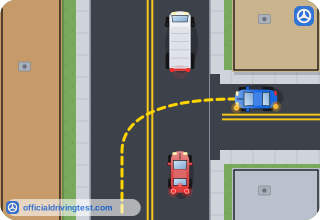
- The driver who waved you on
- The vehicle that stopped first
- You, since you were waved on
- The oncoming traffic
Show answer
Correct answer: The oncoming traffic
The manual says that oncoming traffic has the right-of-way, regardless of whether someone is waving at you.
Source: Massachusetts Driver's Manual (Revised April 2026), page 102 · Open this page in the manual (Manual page 102)