Kentucky: Sharing the road
Bicyclists and their hand signals, motorcycles, scooters and mopeds, large trucks and their No Zones, school buses, slow-moving and animal-drawn vehicles, and ATVs. Split into 6 shorter tests so you're not stuck in one long quiz.
Independent educational site · not affiliated with any government agency or DMV
Choose a part
Sharing the road — Part 1
Questions in this part include: “Are moped operators required to wear helmets or eye-protection devices?”
StartSharing the road — Part 2
Questions in this part include: “When is it particularly important to be careful around bicyclists?”
StartSharing the road — Part 3
Questions in this part include: “Where should you be especially cautious about bicyclists when checking your path before backing?”
StartSharing the road — Part 4
Questions in this part include: “Which traffic rules apply to electric low-speed scooters?”
StartSharing the road — Part 5
Questions in this part include: “About how fast do large vehicles drive when traveling up or down steep hills?”
StartSharing the road — Part 6
Questions in this part include: “How does Kentucky law define an all-terrain vehicle (ATV)?”
StartAll 117 Sharing the road questions with answers
Choose a part above to take a practice test, or study every question and answer here.
Show the questions and answersHide the questions
-
Why does the manual say moped operators should surround themselves with as large a “space cushion” as possible?
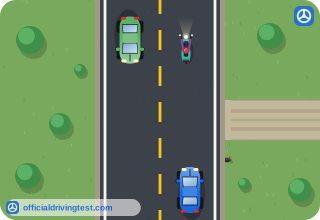
- Mopeds are not easily seen in the traffic flow
- Mopeds stop more slowly than cars
- Mopeds are louder than other vehicles
- Mopeds must keep clear of all traffic by law
Show answer
Correct answer: Mopeds are not easily seen in the traffic flow
Mopeds are not easily seen in the traffic flow, so a large space cushion is vital.
Source: Kentucky Driver Manual (Updated July 23, 2026), page 3 · Open this page in the manual (Manual page 3)
-
What does the manual say will help others see a moped rider?
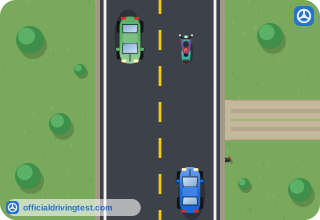
- Riding close behind larger vehicles
- Riding on the shoulder of the road
- Riding with the headlight on and bike flags
- Keeping the engine at idle at every stop
Show answer
Correct answer: Riding with the headlight on and bike flags
Riding with the headlight on and bike flags helps other road users see a moped.
Source: Kentucky Driver Manual (Updated July 23, 2026), page 3 · Open this page in the manual (Manual page 3)
-
Are moped operators required to wear helmets or eye-protection devices?
- Yes, helmets only
- No, but they are strongly recommended
- Yes, eye protection only
- Yes, both helmets and eye protection
Show answer
Correct answer: No, but they are strongly recommended
Moped operators are not required to wear helmets or eye-protection devices, but they are strongly recommended.
Source: Kentucky Driver Manual (Updated July 23, 2026), page 3 · Open this page in the manual (Manual page 3)
-
How do traffic laws apply to motorcycle operators compared with passenger car operators?
- Motorcycle operators are exempt from most speed laws
- All traffic laws and regulations apply equally to both
- Motorcycle operators follow a separate set of traffic laws
- Traffic laws apply only to passenger car operators
Show answer
Correct answer: All traffic laws and regulations apply equally to both
All traffic laws and regulations apply equally to passenger car and motorcycle operators.
Source: Kentucky Driver Manual (Updated July 23, 2026), page 3 · Open this page in the manual (Manual page 3)
-
What should you expect where there are school buses?
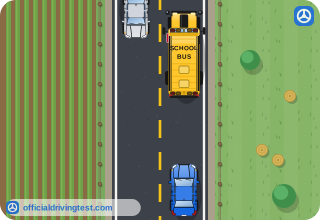
- Frequent changes to the posted speed limit
- Traffic officers directing every vehicle past them
- Reduced speed limits posted on every block
- Children, who are likely to do something unexpected
Show answer
Correct answer: Children, who are likely to do something unexpected
Where there are school buses there are usually children, and children are likely to do something unexpected.
Source: Kentucky Driver Manual (Updated July 23, 2026), page 44 · Open this page in the manual (Manual page 44)
-
When a school or church bus is stopped on a roadway to load or unload passengers, how long must you remain stopped?
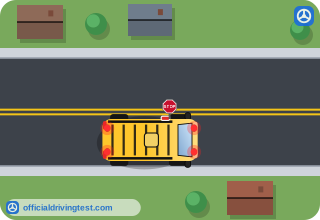
- Until all people are clear of the roadway and the bus is in motion
- Until the bus driver signals you to go ahead
- Until the children have all crossed the roadway
- Until the bus’s red lights have been on for a full minute
Show answer
Correct answer: Until all people are clear of the roadway and the bus is in motion
By law you must remain stopped until all people are clear of the roadway and the bus is in motion.
Source: Kentucky Driver Manual (Updated July 23, 2026), page 44 · Open this page in the manual (Manual page 44)
-
You are approaching a school bus that is stopped on a highway with its stop arm and signal lights activated. What must you do?
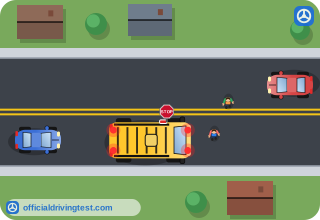
- Slow down and pass with caution
- Pass only on the left side
- Bring your vehicle to a complete stop
- Slow to a crawl and pass on the right
Show answer
Correct answer: Bring your vehicle to a complete stop
The operator of a vehicle approaching such a bus from any direction must bring the vehicle to a complete stop.
Source: Kentucky Driver Manual (Updated July 23, 2026), page 44 · Open this page in the manual (Manual page 44)
-
You are traveling in the opposite direction from a stopped school bus. On which road are you not required to stop?
- A two-lane road where the bus is stopped on the other side of the center line
- A roadway with four or more lanes separated by an elevated barrier or an unpaved median
- Any road with a posted speed limit of 45 mph or more
- A road with three lanes that has a painted center turn lane in the middle
Show answer
Correct answer: A roadway with four or more lanes separated by an elevated barrier or an unpaved median
A stop is not required only when traveling in the opposite direction on a roadway with four or more lanes separated by an elevated barrier or an unpaved median.
Source: Kentucky Driver Manual (Updated July 23, 2026), page 44 · Open this page in the manual (Manual page 44)
-
When overtaking a bicycle or electric low-speed scooter where there is more than one lane in the same direction, what should you do?
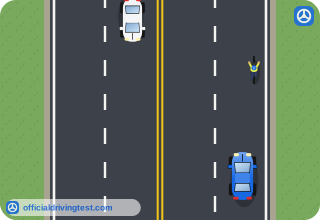
- Stay in your lane and sound your horn until the bicycle or scooter moves to the shoulder
- Pass on the right side of the bicycle or scooter if the right lane is available and safe
- Slow down and follow the bicycle or scooter until it leaves the roadway completely
- Move to the immediate left lane if it is available and moving is reasonably safe
Show answer
Correct answer: Move to the immediate left lane if it is available and moving is reasonably safe
With more than one lane in the same direction, you move to the immediate left lane if it is available and reasonably safe.
Source: Kentucky Driver Manual (Updated July 23, 2026), page 48 · Open this page in the manual (Manual page 48)
-
If there is only one lane for traffic in the same direction, what distance should you keep when passing a bicycle or electric low-speed scooter?
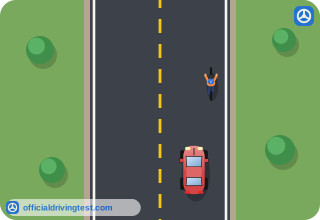
- At least three feet
- At least one foot
- At least five feet
- At least ten feet
Show answer
Correct answer: At least three feet
On a one-lane road, you pass to the left keeping at least three feet between your vehicle and the bicycle or scooter.
Source: Kentucky Driver Manual (Updated July 23, 2026), page 48 · Open this page in the manual (Manual page 48)
-
How long must you maintain the required distance when passing a bicycle or electric low-speed scooter?
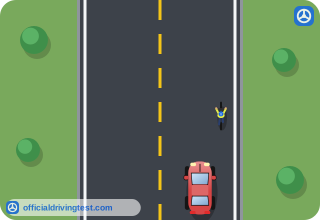
- Until you reach the next intersection
- For the next 100 feet
- Until you are safely past it
- Until the rider signals you to pass
Show answer
Correct answer: Until you are safely past it
You maintain the required distance until you are safely past the bicycle or electric low-speed scooter.
Source: Kentucky Driver Manual (Updated July 23, 2026), page 48 · Open this page in the manual (Manual page 48)
-
If space on the roadway is not available for a three-foot distance when passing a bicycle or electric low-speed scooter, what must you do?
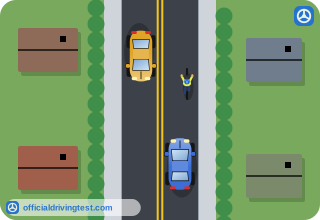
- Wait until the bicycle or scooter stops
- Use reasonable caution in passing
- Pass only after sounding your horn
- Follow behind until the rider leaves the roadway
Show answer
Correct answer: Use reasonable caution in passing
If there is not enough space for three feet, you use reasonable caution in passing.
Source: Kentucky Driver Manual (Updated July 23, 2026), page 48 · Open this page in the manual (Manual page 48)
-
You may drive to the left of the center line, even in a no-passing zone, to pass a bicycle or electric low-speed scooter only if what is true?
- The rider has signaled with a hand that you may go around on the left side of the road and the lane is empty
- The road has a shoulder at least three feet wide on the right side for the rider to use
- The no-passing zone is shorter than 200 feet and no vehicle is following you closely
- The roadway to the left of the center is clear far enough to pass safely without interfering with oncoming traffic
Show answer
Correct answer: The roadway to the left of the center is clear far enough to pass safely without interfering with oncoming traffic
Driving left of the center line to pass a bicycle or scooter is allowed only if the roadway on the left is clear for a sufficient distance and oncoming traffic is not affected.
Source: Kentucky Driver Manual (Updated July 23, 2026), page 48 · Open this page in the manual (Manual page 48)
-
Why should you look to the sides as part of your visual search?
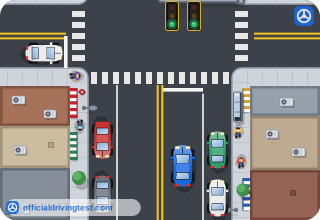
- To find a place where you can safely stop and park
- To read signs located on both sides of the road
- To make sure other roadway users will not cross your travel path
- To check how fast the vehicles that are behind you are moving
Show answer
Correct answer: To make sure other roadway users will not cross your travel path
The manual says you should search to the sides to make sure other roadway users will not cross your travel path.
Source: Kentucky Driver Manual (Updated July 23, 2026), page 49 · Open this page in the manual (Manual page 49)
-
What is the space between your vehicle and other roadway users usually called?
- A safety zone
- A space cushion
- A buffer lane
- A gap interval
Show answer
Correct answer: A space cushion
The manual says the space you allow between your vehicle and other roadway users is usually referred to as a space cushion.
Source: Kentucky Driver Manual (Updated July 23, 2026), page 51 · Open this page in the manual (Manual page 51)
-
Why should you avoid driving on either side slightly to the rear of another vehicle?
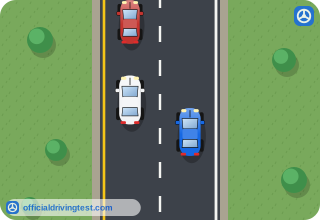
- You may be too close to the center line
- You may block the view of the vehicle behind
- You may be in the other driver’s blind spot
- You may use more fuel at a steady speed
Show answer
Correct answer: You may be in the other driver’s blind spot
Driving slightly to the rear on either side of another vehicle may put you in their blind spot, and it reduces the space you may need to avoid a crash.
Source: Kentucky Driver Manual (Updated July 23, 2026), page 53 · Open this page in the manual (Manual page 53)
-
What should you do instead of remaining in another driver’s blind spot?
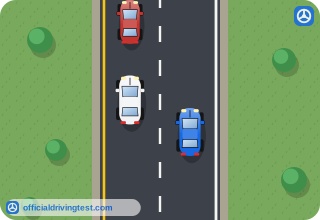
- Either speed up or drop back
- Sound your horn to get the driver’s attention
- Move closer to the other vehicle
- Stay where you are and flash your headlights
Show answer
Correct answer: Either speed up or drop back
The manual says to either speed up or drop back, but not to remain in another driver’s blind spot.
Source: Kentucky Driver Manual (Updated July 23, 2026), page 53 · Open this page in the manual (Manual page 53)
-
Why should you avoid crowding the center line marking?
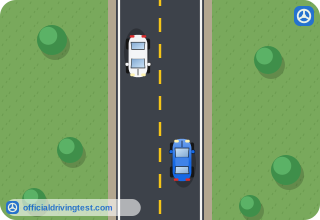
- To keep from drifting toward the shoulder on the right side
- To leave room for vehicles to pass you on the left
- To keep from entering a lane reserved for turning
- To keep as much space as possible between you and oncoming traffic
Show answer
Correct answer: To keep as much space as possible between you and oncoming traffic
The manual says to avoid crowding the center line and to keep as much space as possible between you and oncoming traffic.
Source: Kentucky Driver Manual (Updated July 23, 2026), page 53 · Open this page in the manual (Manual page 53)
-
Vehicles are entering a multiple-lane or limited access roadway beside you. How can you make space for them?
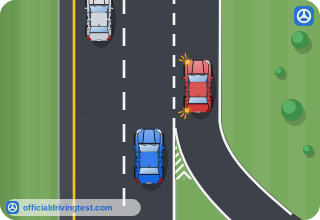
- Stay in your lane and sound your horn
- Move over a lane or adjust your speed
- Keep your lane and speed so they must wait
- Move to the shoulder and stop
Show answer
Correct answer: Move over a lane or adjust your speed
The manual says to make space for vehicles entering a multiple-lane or limited access roadway by moving over a lane or adjusting your speed.
Source: Kentucky Driver Manual (Updated July 23, 2026), page 53 · Open this page in the manual (Manual page 53)
-
You should give extra space to pedestrians, especially to whom?
- Children and bicyclists
- Adults walking in groups
- Joggers and people walking dogs
- Delivery drivers and mail carriers
Show answer
Correct answer: Children and bicyclists
The manual says to give extra space to pedestrians, especially children and bicyclists.
Source: Kentucky Driver Manual (Updated July 23, 2026), page 53 · Open this page in the manual (Manual page 53)
-
A tractor trailer is passing you. How can you leave a little more space between you and the tractor trailer?
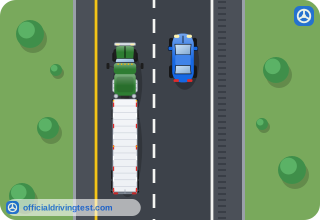
- Move toward the center line of your lane
- Speed up to stay even with the trailer
- Move to the outside portion of your lane
- Brake hard and stop in your lane
Show answer
Correct answer: Move to the outside portion of your lane
The manual says to leave a little more space by moving to the outside portion of your lane and to keep away from the tractor trailer as it passes.
Source: Kentucky Driver Manual (Updated July 23, 2026), page 53 · Open this page in the manual (Manual page 53)
-
Why should you keep a space between yourself and parked vehicles?
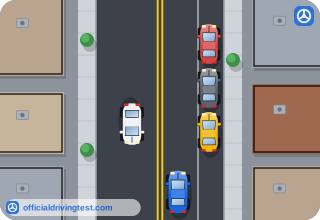
- The parked vehicles may be required to turn on their lights
- Someone may step out, or a vehicle may start to pull out suddenly
- The parked vehicles may block your view of the speedometer
- Someone may open a lane to let you pass
Show answer
Correct answer: Someone may step out, or a vehicle may start to pull out suddenly
The manual says to keep a space between you and parked vehicles because someone may step out of a vehicle or from between them, or a vehicle may pull out suddenly.
Source: Kentucky Driver Manual (Updated July 23, 2026), page 53 · Open this page in the manual (Manual page 53)
-
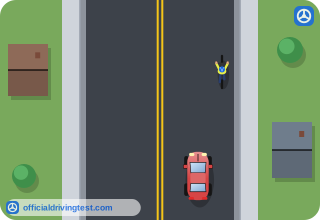
How does the manual treat bicycles when they are on roadways?
- As pedestrians who must yield to every motor vehicle
- As vehicles that must follow the same rules of the road
- As vehicles that are exempt from traffic signs and signals
- As vehicles that only need to obey speed limits
Show answer
Correct answer: As vehicles that must follow the same rules of the road
Bicycles are considered vehicles on roadways, and bicyclists are required and expected to follow the same rules of the road as motorized vehicles.
Source: Kentucky Driver Manual (Updated July 23, 2026), page 60 · Open this page in the manual (Manual page 60)
-
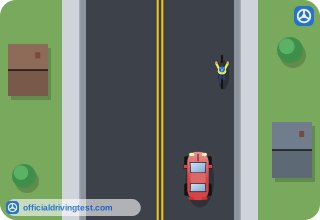
Which description fits a skillful bicyclist?
- Swerves unpredictably to avoid obstacles
- Ignores traffic signs when the road is clear
- Rides at night without a light
- Rides predictably and holds a steady line
Show answer
Correct answer: Rides predictably and holds a steady line
A skillful bicyclist rides predictably and holds a steady line.
Source: Kentucky Driver Manual (Updated July 23, 2026), page 60 · Open this page in the manual (Manual page 60)
-
What should you do if you see an unskillful bicyclist?
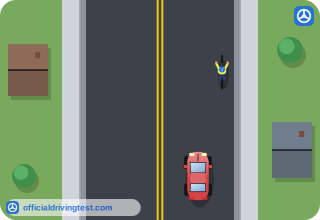
- Be ready for any sudden movements
- Sound your horn to warn the bicyclist
- Pass as quickly as possible
- Stop and wait until the bicyclist leaves the road
Show answer
Correct answer: Be ready for any sudden movements
An unskillful bicyclist may swerve unpredictably, so you should be ready for any sudden movements.
Source: Kentucky Driver Manual (Updated July 23, 2026), page 60 · Open this page in the manual (Manual page 60)
-
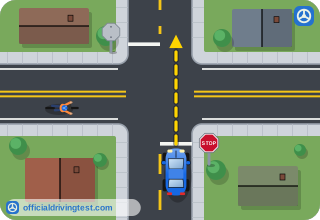
How must a driver treat bicyclists in intersections?
- Expect them to yield to all motor vehicles
- Pass them before they enter the intersection
- Yield to them as you would for pedestrians and other vehicles
- Treat them as pedestrians who have the right of way only in crosswalks
Show answer
Correct answer: Yield to them as you would for pedestrians and other vehicles
Drivers must yield to bicyclists in intersections as they would for pedestrians and other vehicles.
Source: Kentucky Driver Manual (Updated July 23, 2026), page 60 · Open this page in the manual (Manual page 60)
-
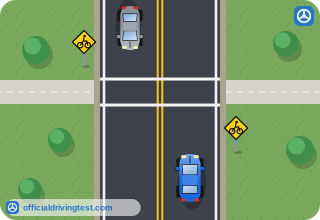
A bicycle path or bike lane intersects the road you are on. What must you do?
- Speed up to cross before bicyclists arrive
- Yield the right of way
- Stop and park on the bike lane until it is clear
- Sound your horn and proceed
Show answer
Correct answer: Yield the right of way
A driver must yield right of way when a bicycle path or bike lane intersects a road.
Source: Kentucky Driver Manual (Updated July 23, 2026), page 60 · Open this page in the manual (Manual page 60)
-
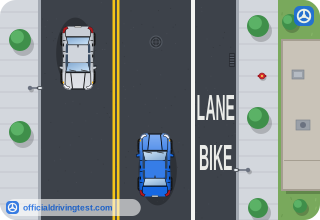
Under which of these conditions may you drive on a designated bicycle lane?
- When you need to pass a slow-moving vehicle
- When no bicyclists are in sight
- When you are waiting to turn right at a red light
- When entering or leaving an alley or driveway
Show answer
Correct answer: When entering or leaving an alley or driveway
You may not stop, park, or drive on a designated bicycle path or lane unless you are entering or leaving an alley or driveway, performing official duties, directed by a police officer, or an emergency exists.
Source: Kentucky Driver Manual (Updated July 23, 2026), page 60 · Open this page in the manual (Manual page 60)
-
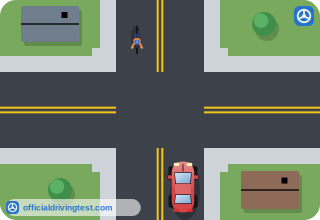
What should you do before making a turn when a bicyclist is approaching the intersection?
- Slow down and let the cyclist clear the intersection
- Turn quickly in front of the cyclist
- Sound your horn to hurry the cyclist along
- Stop in the bike lane and wait for it to clear
Show answer
Correct answer: Slow down and let the cyclist clear the intersection
You should slow down and let the cyclist clear the intersection before making your turn.
Source: Kentucky Driver Manual (Updated July 23, 2026), page 60 · Open this page in the manual (Manual page 60)
-
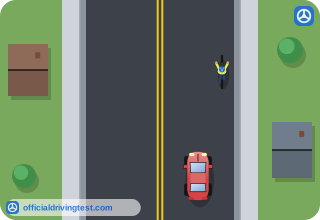
Why should you avoid slowing down or stopping quickly near a bicyclist?
- A bicycle has no brakes and cannot slow down at all
- A quick stop would block the bicyclist’s view of the road
- A motor vehicle’s brakes are more powerful than a bicycle’s
- Bicyclists never expect a driver to stop
Show answer
Correct answer: A motor vehicle’s brakes are more powerful than a bicycle’s
A motor vehicle’s brakes are more powerful than a bicycle’s, so slowing or stopping quickly could cause a crash.
Source: Kentucky Driver Manual (Updated July 23, 2026), page 60 · Open this page in the manual (Manual page 60)
-
When should you sound your horn close to a bicyclist?
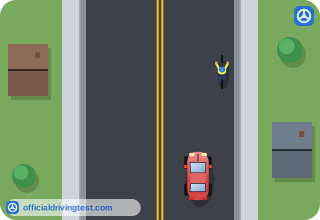
- Whenever you approach a bicyclist from behind
- Only when there is a chance of a crash
- Whenever a bicyclist rides at the edge of the road
- Whenever you want to announce that you are passing
Show answer
Correct answer: Only when there is a chance of a crash
Sounding your horn to alert your presence may startle bicyclists and cause them to steer into your path, so avoid it unless there is a chance of a crash.
Source: Kentucky Driver Manual (Updated July 23, 2026), page 60 · Open this page in the manual (Manual page 60)
-
Why should you be especially careful if you see children riding bikes on the sidewalk?
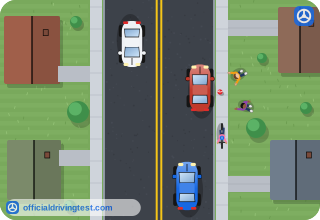
- They always ride faster than traffic
- They are required to ride on the left side of the road
- They cannot see motor vehicles
- They may come onto the road
Show answer
Correct answer: They may come onto the road
You should watch carefully for bicyclists entering your lane, especially children riding on the sidewalk, because they may come onto the road.
Source: Kentucky Driver Manual (Updated July 23, 2026), page 60 · Open this page in the manual (Manual page 60)
-
What should you avoid doing when you turn near a bicyclist?
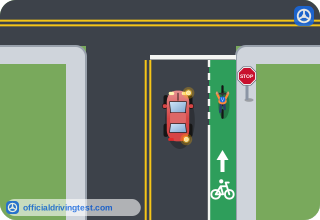
- Turning sharply in front of the bicyclist
- Slowing down before the turn
- Signaling before the turn
- Checking your mirrors before the turn
Show answer
Correct answer: Turning sharply in front of the bicyclist
A driver should avoid turning sharply in front of a bicyclist and should not force a bicyclist off the road.
Source: Kentucky Driver Manual (Updated July 23, 2026), page 60 · Open this page in the manual (Manual page 60)
-
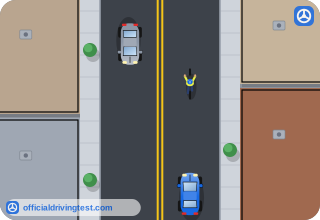
Although bicyclists are required to ride in the direction of traffic, where should you look for them?
- Only in the bike lane
- Only along the right edge of the road
- Anywhere on the roadway
- Only in the center of the lane
Show answer
Correct answer: Anywhere on the roadway
Drivers should look for bicyclists riding anywhere on the roadway.
Source: Kentucky Driver Manual (Updated July 23, 2026), page 60 · Open this page in the manual (Manual page 60)
-
When is it particularly important to be careful around bicyclists?
- When the roadway is dry and clear
- When the roadway is wet or covered with sand or gravel
- When there is no other traffic on the road
- When the bicyclist is traveling in a bike lane
Show answer
Correct answer: When the roadway is wet or covered with sand or gravel
Wet roads and sand or gravel affect bicycles much more than vehicles.
Source: Kentucky Driver Manual (Updated July 23, 2026), page 60 · Open this page in the manual (Manual page 60)
-
A bicycle that is not a motor vehicle must give a turn signal intermittently for the last how many feet traveled before the turn?
- 25 feet
- 75 feet
- 150 feet
- 50 feet
Show answer
Correct answer: 50 feet
The signal for a bicycle must be given intermittently for the last fifty (50) feet traveled before the turn.
Source: Kentucky Driver Manual (Updated July 23, 2026), page 60 · Open this page in the manual (Manual page 60)
-
By which means may a bicycle give its required turn signal?
- Hand signals, signal lamps, or mechanical signal devices
- By hand signals only, because lamps are not allowed on bicycles
- By sounding a bell or horn before every turn
- By calling out the direction to nearby drivers
Show answer
Correct answer: Hand signals, signal lamps, or mechanical signal devices
A bicycle’s signal may be given by hand signals, signal lamps, or mechanical signal devices.
Source: Kentucky Driver Manual (Updated July 23, 2026), page 60 · Open this page in the manual (Manual page 60)
-
A bicyclist may be unable to signal because both hands must stay on the handlebars. What can you look for to know the bicyclist’s intent?
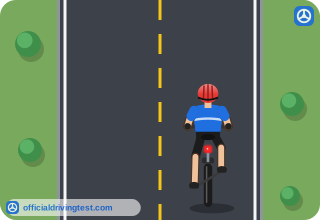
- The bicyclist moving to the right edge of the road
- The bicyclist ringing a bell
- The bicyclist looking over his or her shoulder
- The bicyclist slowing down to a stop
Show answer
Correct answer: The bicyclist looking over his or her shoulder
Clues such as turning the head or looking over the shoulder before changing lane position show a bicyclist’s intent.
Source: Kentucky Driver Manual (Updated July 23, 2026), page 61 · Open this page in the manual (Manual page 61)
-
A bicyclist ahead of you holds the left arm straight out to the side. What does this hand signal mean?
- Right turn
- Left turn
- Stop
- Slowing down to let you pass
Show answer
Correct answer: Left turn
A bicyclist with the left arm held straight out to the side is signaling a left turn.
Source: Kentucky Driver Manual (Updated July 23, 2026), page 61 · Open this page in the manual (Manual page 61)
-
A bicyclist ahead of you holds the left arm out and angled downward. What does this hand signal mean?
- Left turn
- Right turn
- Starting to pass
- Stop
Show answer
Correct answer: Stop
A bicyclist with the left arm held out and angled downward is signaling to stop.
Source: Kentucky Driver Manual (Updated July 23, 2026), page 61 · Open this page in the manual (Manual page 61)
-
A bicyclist ahead of you holds the left arm out with the forearm bent upward at the elbow. What does this hand signal mean?
- Right turn
- Left turn
- Stop
- Moving to the left lane
Show answer
Correct answer: Right turn
A bicyclist with the left arm bent upward at the elbow is signaling a right turn; extending the right arm straight out also signals a right turn.
Source: Kentucky Driver Manual (Updated July 23, 2026), page 61 · Open this page in the manual (Manual page 61)
-
What should you do before you open your vehicle door when parked on the street?
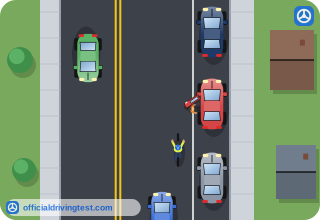
- Sound your horn to warn passing traffic
- Turn on your hazard flashers
- Check to the sides and rear for bicyclists
- Wait for a bicyclist to pass in front of you
Show answer
Correct answer: Check to the sides and rear for bicyclists
When parked on the street, a driver must check to the sides and rear for bicyclists before opening the vehicle door.
Source: Kentucky Driver Manual (Updated July 23, 2026), page 61 · Open this page in the manual (Manual page 61)
-
Where should you be especially cautious about bicyclists when checking your path before backing?
- On interstate highways
- Near schools or residential areas
- On long rural highways with no side streets
- In freeway work zones
Show answer
Correct answer: Near schools or residential areas
You should check for bicyclists in your path before backing, especially near schools or residential areas where bicyclists may be present.
Source: Kentucky Driver Manual (Updated July 23, 2026), page 61 · Open this page in the manual (Manual page 61)
-
After passing a bicyclist, when should the passing vehicle move back into the right lane?
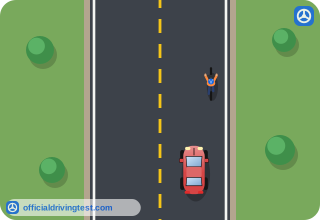
- Only when well clear of the bicyclist
- As soon as the front of your vehicle is even with the bicyclist
- As soon as the bicyclist is in your mirror
- After you have honked at the bicyclist
Show answer
Correct answer: Only when well clear of the bicyclist
Passing vehicles should move back into the right lane only when well clear of the bicyclist.
Source: Kentucky Driver Manual (Updated July 23, 2026), page 61 · Open this page in the manual (Manual page 61)
-
What do local ordinances in some counties control, according to the manual?
- The maximum speed of vehicles on interstates
- The licensing of motorcycle riders
- The operation and parking of bicycles within city limits
- The routes that trucks must take through small towns
Show answer
Correct answer: The operation and parking of bicycles within city limits
Some counties have local ordinances that control the operation and parking of bicycles within city limits, and drivers should know and obey them.
Source: Kentucky Driver Manual (Updated July 23, 2026), page 61 · Open this page in the manual (Manual page 61)
-
Where must bicyclists never ride?
- On a bike path next to the roadway
- On interstates and parkways
- On the right side of the road
- In the direction of traffic
Show answer
Correct answer: On interstates and parkways
One of the rules for bicyclists is to never ride on interstates and parkways.
Source: Kentucky Driver Manual (Updated July 23, 2026), page 61 · Open this page in the manual (Manual page 61)
-
What must a bicyclist do at a stop sign or a stop light?
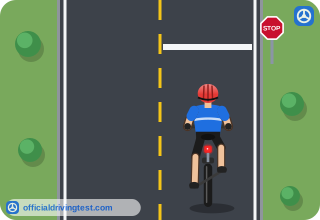
- Slow down and continue if no traffic is coming
- Yield only to pedestrians
- Stop only when a motor vehicle is nearby
- Stop just like a motor vehicle
Show answer
Correct answer: Stop just like a motor vehicle
Bicyclists must obey traffic control signals and signs and stop at stop signs and stop lights just like a motor vehicle.
Source: Kentucky Driver Manual (Updated July 23, 2026), page 61 · Open this page in the manual (Manual page 61)
-
How fast may a bicyclist operate?
- Within posted speed limits or a reasonable rate
- At any speed on a road with a bike lane
- Only at a walking pace
- At no more than 10 miles per hour on any road
Show answer
Correct answer: Within posted speed limits or a reasonable rate
A bicycle must be operated within posted speed limits or at a rate reasonable for existing conditions.
Source: Kentucky Driver Manual (Updated July 23, 2026), page 61 · Open this page in the manual (Manual page 61)
-
On which side of the road must a bicyclist ride?
- The left side, facing traffic
- The center of the road
- The right side, with traffic
- Either side, whichever is clearer
Show answer
Correct answer: The right side, with traffic
Bicyclists must ride on the right side of the road with traffic.
Source: Kentucky Driver Manual (Updated July 23, 2026), page 61 · Open this page in the manual (Manual page 61)
-
What should a bicyclist give before passing pedestrians?
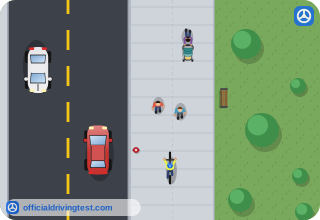
- A hand signal with the arm pointed to the left
- An audible warning, such as a bell or horn
- A flash of the headlight
- A shouted request to stop
Show answer
Correct answer: An audible warning, such as a bell or horn
A bicyclist must yield to pedestrians in crosswalks and on sidewalks and give an audible warning (bell or horn) before passing pedestrians.
Source: Kentucky Driver Manual (Updated July 23, 2026), page 61 · Open this page in the manual (Manual page 61)
-
What lighting must a bicycle have when ridden at night?
- A red light visible from the front and a white light visible from the rear
- A white light visible from both the front and the rear
- A yellow reflector visible from the sides only
- A white light visible from the front and a red reflector or light visible from the rear
Show answer
Correct answer: A white light visible from the front and a red reflector or light visible from the rear
At night a bicycle must have a white light visible from the front and a red reflector or light visible from the rear.
Source: Kentucky Driver Manual (Updated July 23, 2026), page 61 · Open this page in the manual (Manual page 61)
-
Where shall slower-moving vehicles, including bicycles, drive?
- As closely as practical to the right-hand boundary of the highway
- In the center of the lane
- As close to the center line as is safe
- In the left lane so faster traffic can pass on the right
Show answer
Correct answer: As closely as practical to the right-hand boundary of the highway
All slower-moving vehicles, including bicycles, shall drive as closely as practical to the right-hand boundary of the highway.
Source: Kentucky Driver Manual (Updated July 23, 2026), page 61 · Open this page in the manual (Manual page 61)
-
Where should a bicyclist not ride?
- On a bike path next to the roadway
- On the right side of the road
- On the sidewalk
- In the same direction as traffic
Show answer
Correct answer: On the sidewalk
The rules for bicyclists say not to ride on the sidewalk.
Source: Kentucky Driver Manual (Updated July 23, 2026), page 61 · Open this page in the manual (Manual page 61)
-
In what way must a bicycle never be parked on a sidewalk?
- Facing the street instead of the building
- So that it interferes with pedestrian traffic
- Without being locked to a fixed object
- Closer than two feet to a building wall
Show answer
Correct answer: So that it interferes with pedestrian traffic
A bicyclist must never park a bicycle on a sidewalk in such a way as to interfere with pedestrian traffic.
Source: Kentucky Driver Manual (Updated July 23, 2026), page 61 · Open this page in the manual (Manual page 61)
-
If a bike path adjacent to the roadway is provided, what should a bicyclist do?
- Ride on the sidewalk
- Ride in the center of the roadway
- Ride on the roadway shoulder
- Ride on the bike path
Show answer
Correct answer: Ride on the bike path
A bicyclist should ride on a bike path adjacent to the roadway, if one is provided.
Source: Kentucky Driver Manual (Updated July 23, 2026), page 61 · Open this page in the manual (Manual page 61)
-
How many persons may a bicycle carry?
- No more than the number for which it is designed and equipped
- No more than one person unless the rider is an adult
- Two persons at a time if the rider is an adult
- Any number if all of them wear helmets
Show answer
Correct answer: No more than the number for which it is designed and equipped
A bicycle must carry no more persons than the number for which it is designed and equipped.
Source: Kentucky Driver Manual (Updated July 23, 2026), page 62 · Open this page in the manual (Manual page 62)
-
How many bicyclists may ride abreast?
- Up to three if the road has a bike lane
- Any number, as long as they ride in the right lane
- Never more than two, so as not to interfere with traffic
- Only one at any time
Show answer
Correct answer: Never more than two, so as not to interfere with traffic
Bicyclists must never ride more than two abreast so as to interfere with the normal movement of traffic.
Source: Kentucky Driver Manual (Updated July 23, 2026), page 62 · Open this page in the manual (Manual page 62)
-
An electric low-speed scooter is defined as a device that weighs less than how much?
- 50 pounds
- 100 pounds
- 150 pounds
- 200 pounds
Show answer
Correct answer: 100 pounds
An electric low-speed scooter weighs less than one hundred (100) pounds.
Source: Kentucky Driver Manual (Updated July 23, 2026), page 62 · Open this page in the manual (Manual page 62)
-
An electric low-speed scooter is designed to operate at a maximum speed of how many miles per hour on a paved level surface?
- 10 miles per hour
- 15 miles per hour
- 25 miles per hour
- 20 miles per hour
Show answer
Correct answer: 20 miles per hour
An electric low-speed scooter is designed to operate at a maximum speed of twenty (20) miles per hour on a paved level surface.
Source: Kentucky Driver Manual (Updated July 23, 2026), page 62 · Open this page in the manual (Manual page 62)
-
What is the minimum age to operate an electric low-speed scooter on a highway, bicycle lane, or bicycle path?
- 16 years
- 12 years
- 14 years
- 18 years
Show answer
Correct answer: 16 years
A person sixteen (16) years of age or older may operate an electric low-speed scooter on a highway, bicycle lane, or bicycle path.
Source: Kentucky Driver Manual (Updated July 23, 2026), page 62 · Open this page in the manual (Manual page 62)
-
Which traffic rules apply to electric low-speed scooters?
- The same traffic regulations that apply to trucks
- Only the regulations for pedestrians
- The same traffic regulations that apply to bicycles
- None, because they are not motor vehicles
Show answer
Correct answer: The same traffic regulations that apply to bicycles
Electric low-speed scooters are subject to traffic regulation in the same way that bicycles are required to obey traffic laws.
Source: Kentucky Driver Manual (Updated July 23, 2026), page 62 · Open this page in the manual (Manual page 62)
-
What lights must an electric low-speed scooter be equipped with?
- One white headlamp only
- At least one headlamp and at least one rear red light
- Two headlamps and one rear amber light
- At least one headlamp and a rear white reflector
Show answer
Correct answer: At least one headlamp and at least one rear red light
An electric low-speed scooter shall be equipped with at least one headlamp and at least one rear red light.
Source: Kentucky Driver Manual (Updated July 23, 2026), page 62 · Open this page in the manual (Manual page 62)
-
When must the lights of an electric low-speed scooter be illuminated?
- From one hour after sunset to one hour before sunrise
- From sunset to sunrise only
- Only when it is raining or foggy
- From one-half hour after sunset to one-half hour before sunrise
Show answer
Correct answer: From one-half hour after sunset to one-half hour before sunrise
The lights must be illuminated from one-half hour after sunset to one-half hour before sunrise or at other times when there is low visibility.
Source: Kentucky Driver Manual (Updated July 23, 2026), page 62 · Open this page in the manual (Manual page 62)
-
When may an electric low-speed scooter be parked on a sidewalk?
- If it does not impede pedestrian or other traffic
- Never, under any circumstances
- Only if it is parked against a building wall
- Only between sunrise and sunset
Show answer
Correct answer: If it does not impede pedestrian or other traffic
An electric low-speed scooter may be parked on a sidewalk if it does not impede the reasonable movement of pedestrian or other traffic.
Source: Kentucky Driver Manual (Updated July 23, 2026), page 62 · Open this page in the manual (Manual page 62)
-
What is required of an electric low-speed scooter operator regarding local government ordinances?
- Compliance only in cities with more than one county
- No compliance if state law permits the scooter
- Compliance with all of them
- Compliance only on sidewalks
Show answer
Correct answer: Compliance with all of them
Compliance with all local government ordinances is required.
Source: Kentucky Driver Manual (Updated July 23, 2026), page 62 · Open this page in the manual (Manual page 62)
-
How do motorcyclists’ rights and responsibilities compare with those of other drivers?
- Motorcyclists have the right of way in all situations
- They are the same
- Motorcyclists have fewer responsibilities
- Motorcyclists must yield to all other vehicles
Show answer
Correct answer: They are the same
Motorcyclists have the same rights and responsibilities as other drivers, although they may be more difficult to see.
Source: Kentucky Driver Manual (Updated July 23, 2026), page 62 · Open this page in the manual (Manual page 62)
-
How much of a lane should you allow a motorcyclist?
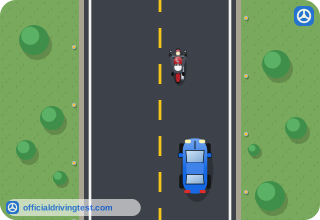
- Half of the lane
- The left side of the lane only
- Whatever width is left by other traffic
- A full lane width
Show answer
Correct answer: A full lane width
A motorcyclist should be allowed a full lane width, and you should not share the lane.
Source: Kentucky Driver Manual (Updated July 23, 2026), page 62 · Open this page in the manual (Manual page 62)
-
Why should you not share a lane with a motorcycle?
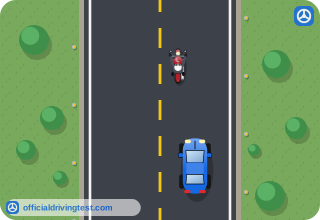
- The motorcycle needs space for the motorcyclist to react to other traffic
- Motorcycles are not allowed to use the same lane as other vehicles
- Motorcycles always travel faster than cars
- Motorcycles need a lane to carry passengers
Show answer
Correct answer: The motorcycle needs space for the motorcyclist to react to other traffic
The motorcycle needs space for the motorcyclist to react to other traffic.
Source: Kentucky Driver Manual (Updated July 23, 2026), page 62 · Open this page in the manual (Manual page 62)
-
Because motorcycles are small and hard to see, what should you always check?
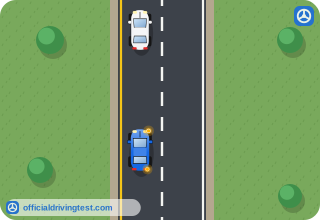
- Only the road ahead of you
- Only your left mirror
- Your mirrors and blind spots
- The lane markings on both sides
Show answer
Correct answer: Your mirrors and blind spots
The manual says to always check your mirrors and blind spots for motorcycles, which can be part of the traffic mix.
Source: Kentucky Driver Manual (Updated July 23, 2026), page 62 · Open this page in the manual (Manual page 62)
-
Before turning left, how should you watch for motorcycles?
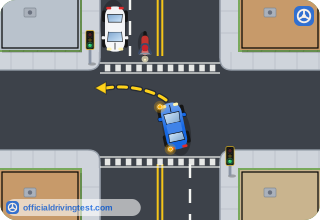
- Look only in your rear-view mirror and side mirrors
- Look carefully to the front and sides of your vehicle
- Sound your horn before turning
- Wait until the motorcycle signals
Show answer
Correct answer: Look carefully to the front and sides of your vehicle
Before turning left, a driver should be alert for motorcycles by looking carefully to the front and sides of the vehicle.
Source: Kentucky Driver Manual (Updated July 23, 2026), page 62 · Open this page in the manual (Manual page 62)
-
A motorcycle ahead of you has its turn signal flashing. What should you do?
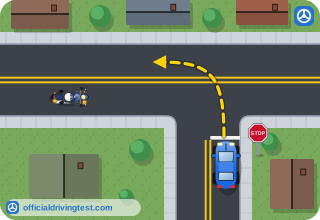
- Assume the rider is turning and go ahead
- Assume the signal is a mistake and pass the rider
- Sound your horn to tell the rider to cancel the signal
- Wait to be sure the rider is going to turn before you proceed
Show answer
Correct answer: Wait to be sure the rider is going to turn before you proceed
Motorcycle turn signals may not self-cancel, so a driver should not assume the motorcycle is turning and should wait to be sure.
Source: Kentucky Driver Manual (Updated July 23, 2026), page 62 · Open this page in the manual (Manual page 62)
-
What minimum following distance should you allow when following a motorcyclist?
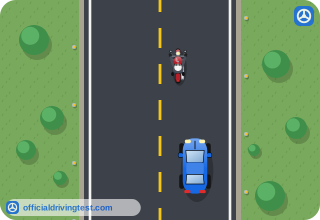
- 4 seconds, or more in wet conditions
- 2 seconds in any weather
- 3 seconds in any weather
- 6 seconds in dry conditions only
Show answer
Correct answer: 4 seconds, or more in wet conditions
When following a motorcyclist, allow a minimum 4-second following distance, or more in wet conditions.
Source: Kentucky Driver Manual (Updated July 23, 2026), page 62 · Open this page in the manual (Manual page 62)
-
What is the “no zone” around large trucks and buses?
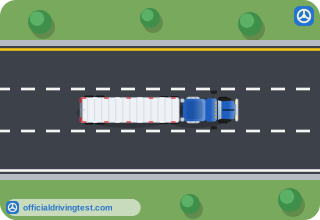
- The area around the vehicle where other vehicles disappear from the driver’s view into blind spots
- The area beside a truck or bus where passing other vehicles is against the law
- The distance behind a truck or bus that a following car must keep clear of traffic
- The stretch of roadway before a weigh station where trucks and buses may not be passed
Show answer
Correct answer: The area around the vehicle where other vehicles disappear from the driver’s view into blind spots
The no zone is the area around large trucks or buses where vehicles disappear from the commercial driver’s view into blind spots.
Source: Kentucky Driver Manual (Updated July 23, 2026), page 63 · Open this page in the manual (Manual page 63)
-
Which side of a large truck has the larger blind spot, starting behind the cab and extending up to the length of the truck?
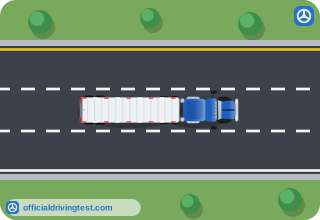
- The left side
- The front end
- The right side
- The roof
Show answer
Correct answer: The right side
Trucks have a larger blind spot on their right side, starting behind the cab and extending up to the length of the truck.
Source: Kentucky Driver Manual (Updated July 23, 2026), page 63 · Open this page in the manual (Manual page 63)
-
If you cannot see a truck driver’s face in the side view mirror, what does that mean?
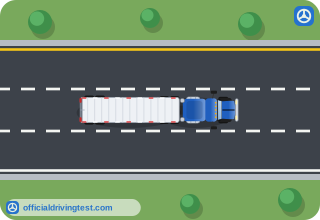
- The driver is about to change lanes
- The driver cannot see you
- You are safely out of the blind spot
- The driver is slowing down for you
Show answer
Correct answer: The driver cannot see you
If you cannot see the driver’s face in the side view mirror, he or she cannot see you, so you are in the large vehicle’s no zone.
Source: Kentucky Driver Manual (Updated July 23, 2026), page 63 · Open this page in the manual (Manual page 63)
-
Under ideal conditions, a loaded truck with good tires and properly adjusted brakes traveling at 55 mph needs at least how far to come to a complete stop?
- 155 feet
- 235 feet
- 450 feet
- 335 feet
Show answer
Correct answer: 335 feet
Such a truck needs at least 335 feet to stop, which is greater than 1½ times the stopping distance of a car.
Source: Kentucky Driver Manual (Updated July 23, 2026), page 63 · Open this page in the manual (Manual page 63)
-
When passing a large vehicle, what should you look for in your rear-view mirror before pulling in front of it?
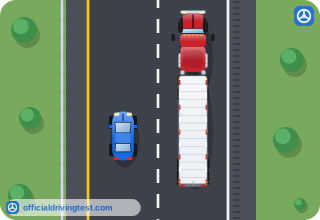
- The truck’s headlights
- The truck’s turn signal
- The trailer’s rear wheels
- The whole front of the vehicle
Show answer
Correct answer: The whole front of the vehicle
Before pulling in front of a large vehicle you have passed, you should see the whole front of it in your rear-view mirror and then maintain speed.
Source: Kentucky Driver Manual (Updated July 23, 2026), page 63 · Open this page in the manual (Manual page 63)
-
How far can the huge blind spots directly behind a large vehicle extend?
- Up to 50 feet
- Up to 200 feet
- Up to 100 feet
- Up to 400 feet
Show answer
Correct answer: Up to 200 feet
Unlike cars, large vehicles have huge blind spots directly behind them that extend up to 200 feet.
Source: Kentucky Driver Manual (Updated July 23, 2026), page 63 · Open this page in the manual (Manual page 63)
-
When following a large vehicle, how should you position your vehicle?
- So the driver can see it in his or her side mirrors
- Directly behind the vehicle, where you can see its brake lights best
- Alongside the cab so the driver can see you through the window
- Close behind the trailer so other drivers cannot cut in between
Show answer
Correct answer: So the driver can see it in his or her side mirrors
You should avoid following too closely and position your vehicle so the driver can see it in his or her side mirrors.
Source: Kentucky Driver Manual (Updated July 23, 2026), page 63 · Open this page in the manual (Manual page 63)
-
About how fast do large vehicles drive when traveling up or down steep hills?
- Approximately 15 mph
- Approximately 45 mph
- Approximately 35 mph
- Approximately 50 mph
Show answer
Correct answer: Approximately 35 mph
On steep hills large vehicles must drive slowly, approximately 35 mph, and therefore use the right lane.
Source: Kentucky Driver Manual (Updated July 23, 2026), page 63 · Open this page in the manual (Manual page 63)
-
Which lane should you avoid, if possible, when traveling up or down hills?
- The left lane
- The right lane
- The center lane
- The shoulder
Show answer
Correct answer: The right lane
Large vehicles drive slowly on steep hills and use the right lane, so avoiding it reduces the possibility of a crash.
Source: Kentucky Driver Manual (Updated July 23, 2026), page 63 · Open this page in the manual (Manual page 63)
-
When a truck or bus needs to make a right turn, what will the driver sometimes do?
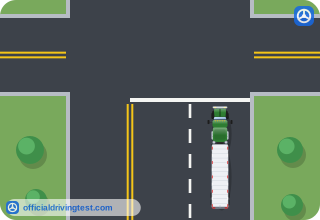
- Swing the vehicle wide to the left
- Swing the vehicle wide to the right, close to the curb
- Stop in the intersection until traffic yields
- Start the turn from the left-turn lane
Show answer
Correct answer: Swing the vehicle wide to the left
The driver will sometimes swing the vehicle wide to the left to safely turn right and clear the corner of a curb or other obstruction.
Source: Kentucky Driver Manual (Updated July 23, 2026), page 64 · Open this page in the manual (Manual page 64)
-
To avoid a crash near a truck or bus that is making a turn, when should you turn?
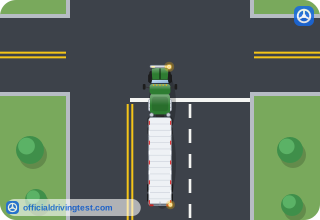
- As soon as its turn signal comes on
- Right away, if there is space between it and the curb
- As soon as the truck begins to swing wide
- Not until the truck or bus has completed its turn
Show answer
Correct answer: Not until the truck or bus has completed its turn
If you get between the turning truck or bus and the curb you can be squeezed in, so wait until it has completed its turn.
Source: Kentucky Driver Manual (Updated July 23, 2026), page 64 · Open this page in the manual (Manual page 64)
-
When you meet a truck coming from the opposite direction, where should you keep your vehicle?
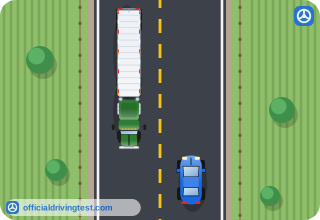
- Close to the center line of the roadway
- On the shoulder with your wheels off the pavement
- As far as possible to the right side of the roadway
- In the middle of your lane, away from both edges
Show answer
Correct answer: As far as possible to the right side of the roadway
Keeping as far right as possible avoids a side-swept crash and reduces the wind turbulence between the two vehicles, which pushes them apart.
Source: Kentucky Driver Manual (Updated July 23, 2026), page 64 · Open this page in the manual (Manual page 64)
-
If you are in doubt about the speed of an oncoming truck or bus, what should you do?
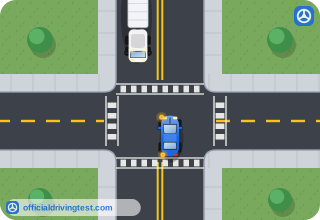
- Turn left as fast as you can before it arrives
- Speed up and turn left before it gets closer
- Do not turn left in its path
- Turn left slowly so the driver can adjust
Show answer
Correct answer: Do not turn left in its path
The truck or bus may be going faster than you think, and it takes longer for it to stop than a car.
Source: Kentucky Driver Manual (Updated July 23, 2026), page 64 · Open this page in the manual (Manual page 64)
-
Why do stop lines at intersections matter when large vehicles are nearby?
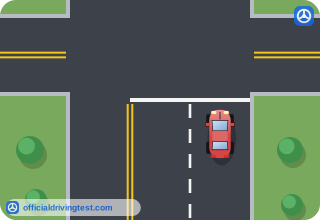
- They set you farther back so larger vehicles have more turning space
- They show large vehicles where they must wait for you
- They mark the lane that only large vehicles may use
- They keep large vehicles out of the crosswalk while turning
Show answer
Correct answer: They set you farther back so larger vehicles have more turning space
Stop lines help to set you farther back at an intersection to give larger vehicles more turning space, so you should always stop behind them.
Source: Kentucky Driver Manual (Updated July 23, 2026), page 64 · Open this page in the manual (Manual page 64)
-
Which of these should you NOT do around large vehicles?
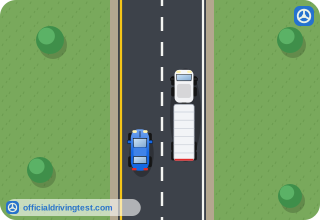
- Stop behind the stop line at an intersection with a large vehicle
- Give a turning truck or bus plenty of room to maneuver
- Keep as far right as possible when meeting a truck
- Cut off a truck to beat it into a single-lane construction zone
Show answer
Correct answer: Cut off a truck to beat it into a single-lane construction zone
You should not cut off a large vehicle in traffic or on the highway; the few seconds that might be saved are not worth a life.
Source: Kentucky Driver Manual (Updated July 23, 2026), page 64 · Open this page in the manual (Manual page 64)
-
On mountain roads or downgrades, what should you do if a truck seems out of control or unable to slow down?
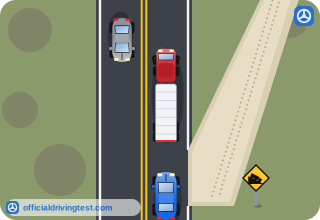
- Stay in your lane and sound your horn
- Get out of the way
- Speed up to stay ahead of it
- Stop in your lane and wait for it to pass
Show answer
Correct answer: Get out of the way
On mountain roads or downgrades you should watch for fast-approaching trucks, and if one seems out of control you should get out of the way.
Source: Kentucky Driver Manual (Updated July 23, 2026), page 64 · Open this page in the manual (Manual page 64)
-
Who may use the special “escape” or “runaway” ramps found on some long downgrades?
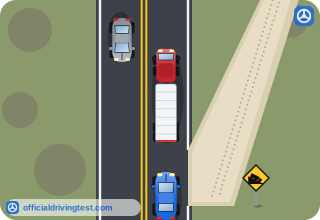
- Only large vehicles that are out of control or cannot stop
- Any vehicle whose driver needs to rest or check the brakes
- Any vehicle that is driving faster than the speed limit
- Trucks and passenger cars that need to pull off the road
Show answer
Correct answer: Only large vehicles that are out of control or cannot stop
These ramps are for use only by large vehicles that are out of control or cannot stop because of brake failure.
Source: Kentucky Driver Manual (Updated July 23, 2026), page 64 · Open this page in the manual (Manual page 64)
-
What should you never do in the vicinity of truck “escape” or “runaway” ramps?
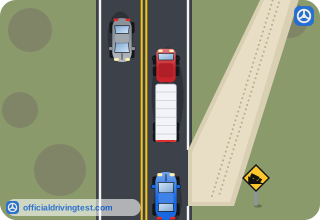
- Drive faster than the posted limit
- Use your turn signal
- Stop or park
- Drive in the right lane
Show answer
Correct answer: Stop or park
Never stop or park in the vicinity of escape or runaway ramps, which are only for large vehicles that cannot stop.
Source: Kentucky Driver Manual (Updated July 23, 2026), page 64 · Open this page in the manual (Manual page 64)
-
When you are stopped behind a truck on an upgrade, where should you position your vehicle?
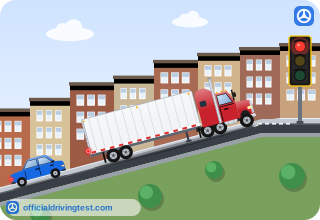
- In the center of your lane, close behind the truck
- To the left of your lane, where the driver can see you
- To the right of your lane, near the shoulder
- Directly behind the truck, as close as possible
Show answer
Correct answer: To the left of your lane, where the driver can see you
When stopped behind a truck on an upgrade, you should stay to the left of your lane where the driver can see you.
Source: Kentucky Driver Manual (Updated July 23, 2026), page 64 · Open this page in the manual (Manual page 64)
-
Why should you leave extra space between your vehicle and a truck stopped ahead of you on an upgrade?
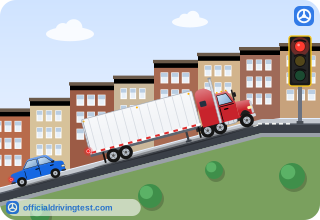
- The truck may need room to turn around
- The truck driver cannot see anything ahead
- The truck may need to stop for its brakes to cool
- The truck may drift backwards slightly
Show answer
Correct answer: The truck may drift backwards slightly
You should allow extra space in case the truck drifts backwards slightly.
Source: Kentucky Driver Manual (Updated July 23, 2026), page 64 · Open this page in the manual (Manual page 64)
-
Why should you avoid driving in the right lane near truck weigh stations?
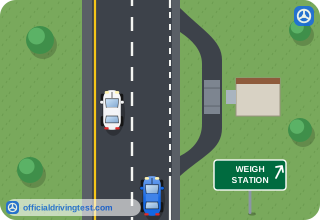
- Trucks stopped at the station block the right lane for inspection
- Trucks leaving the station must stop at the end of the lane
- The right lane is reserved for trucks near weigh stations
- Slow-moving trucks will be trying to reenter faster-moving traffic
Show answer
Correct answer: Slow-moving trucks will be trying to reenter faster-moving traffic
Slow-moving trucks will be attempting to reenter faster-moving traffic, so avoiding the right lane reduces the possibility of rear-ending or being rear-ended by a large vehicle.
Source: Kentucky Driver Manual (Updated July 23, 2026), page 64 · Open this page in the manual (Manual page 64)
-
What must vehicles carrying hazardous materials do at all railroad crossings?
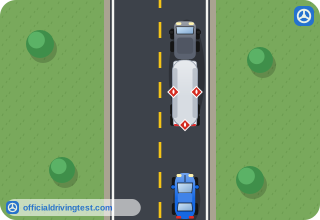
- Slow down but not stop
- Stop
- Stop only if a train is coming
- Stop only when the gates are down
Show answer
Correct answer: Stop
Vehicles carrying hazardous materials must stop at all railroad crossings, so you should be prepared for it.
Source: Kentucky Driver Manual (Updated July 23, 2026), page 64 · Open this page in the manual (Manual page 64)
-
How are vehicles carrying hazardous materials marked?
- Clearly marked with the type of hazardous materials
- With a flashing yellow light on the cab roof
- Only with a sign on the rear bumper that says HAZARD
- They have no special marking you can see
Show answer
Correct answer: Clearly marked with the type of hazardous materials
These vehicles are clearly marked with the type of hazardous materials they are transporting, and you should avoid driving near them.
Source: Kentucky Driver Manual (Updated July 23, 2026), page 64 · Open this page in the manual (Manual page 64)
-
What does a fluorescent or reflective orange and red triangle on the rear of a vehicle drawn by an animal, or of farm or construction equipment, mean?
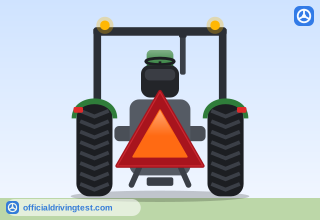
- The vehicle is carrying hazardous materials
- The vehicle is about to stop in the roadway
- The vehicle is traveling less than 45 mph
- The vehicle is traveling less than 25 mph
Show answer
Correct answer: The vehicle is traveling less than 25 mph
The triangle on the rear of vehicles drawn by animals, farm equipment, or construction equipment means the vehicle is traveling less than 25 mph.
Source: Kentucky Driver Manual (Updated July 23, 2026), page 66 · Open this page in the manual (Manual page 66)
-
On a slow-moving vehicle triangle, what part do you see during the day?
- The reflective red border of the symbol
- The fluorescent orange triangle in the center
- A white triangle in the center of the symbol
- A flashing amber light above the symbol
Show answer
Correct answer: The fluorescent orange triangle in the center
During the day you see the fluorescent orange triangle in the center of the slow-moving vehicle symbol.
Source: Kentucky Driver Manual (Updated July 23, 2026), page 66 · Open this page in the manual (Manual page 66)
-
On a slow-moving vehicle triangle, what part do you see during night driving?
- The reflective red border of the symbol
- The fluorescent orange triangle in the center
- A white triangle in the center of the symbol
- A flashing amber light above the symbol
Show answer
Correct answer: The reflective red border of the symbol
During night driving you see the reflective red border of the slow-moving vehicle symbol.
Source: Kentucky Driver Manual (Updated July 23, 2026), page 66 · Open this page in the manual (Manual page 66)
-
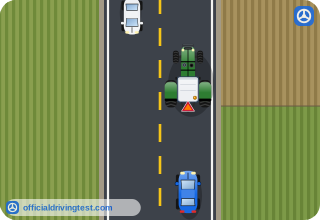
What must you be sure of before you pass a slow-moving vehicle?
- That the vehicle has stopped
- That the driver has waved you around
- That it is safe to pass
- That the vehicle is traveling under 15 mph
Show answer
Correct answer: That it is safe to pass
You should use caution when approaching a slow-moving vehicle and be sure it is safe before you pass.
Source: Kentucky Driver Manual (Updated July 23, 2026), page 66 · Open this page in the manual (Manual page 66)
-
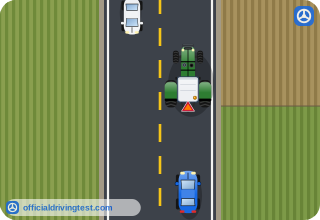
What should you remember when passing tractors, combines, and other farm machinery on state highways in rural areas?
- The operator will always pull onto the shoulder for you
- The operator cannot hear approaching vehicles
- The operator can see you in the side mirrors
- Farm machinery always travels faster than 25 mph
Show answer
Correct answer: The operator cannot hear approaching vehicles
You should pass farm machinery with caution because its operator cannot hear approaching vehicles.
Source: Kentucky Driver Manual (Updated July 23, 2026), page 66 · Open this page in the manual (Manual page 66)
-
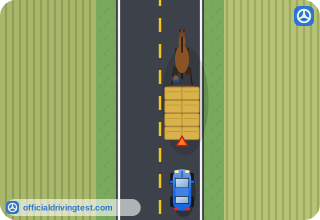
What rights do animal-drawn vehicles and horseback riders have to use the road?
- They may use the road only when no motor vehicle is nearby
- They have the right-of-way over motor vehicles at all times
- They are exempt from the rules of the road on rural roads
- The same rights to use the road as a motor vehicle
Show answer
Correct answer: The same rights to use the road as a motor vehicle
Animal-drawn vehicles and horseback riders have the same rights to use the road as a motor vehicle and must follow the same rules of the road.
Source: Kentucky Driver Manual (Updated July 23, 2026), page 66 · Open this page in the manual (Manual page 66)
-
When passing animal-drawn vehicles and horseback riders, what should you not do?
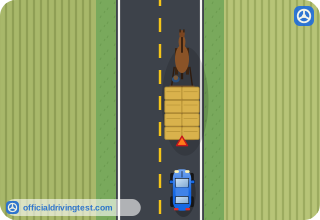
- Pass with caution around the animal
- Anticipate left turns into driveways
- Watch for posted warning signs
- Use your horn or “rev” the engine
Show answer
Correct answer: Use your horn or “rev” the engine
You should not use your horn or “rev” the engine because this may scare the horse and cause a crash.
Source: Kentucky Driver Manual (Updated July 23, 2026), page 66 · Open this page in the manual (Manual page 66)
-
What should you anticipate from animal-drawn vehicles to avoid possible crashes?
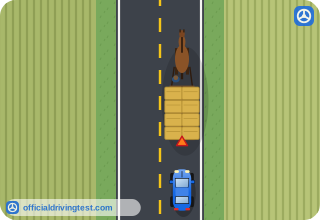
- Right turns onto the shoulder
- Left turns into fields and driveways
- Sudden stops in the middle of the road
- Turns made without slowing down
Show answer
Correct answer: Left turns into fields and driveways
You should anticipate left turns made by animal-drawn vehicles into fields and driveways.
Source: Kentucky Driver Manual (Updated July 23, 2026), page 66 · Open this page in the manual (Manual page 66)
-
How will you know that you are likely to find animal-drawn vehicles and horseback riders in an area?
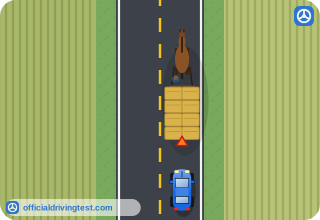
- Warning signs will be posted there
- A flashing amber light will be installed there
- The pavement will be marked with a special line
- There will be a rural speed limit sign there
Show answer
Correct answer: Warning signs will be posted there
Warning signs will be posted in areas where you are likely to find animal-drawn vehicles and horseback riders.
Source: Kentucky Driver Manual (Updated July 23, 2026), page 66 · Open this page in the manual (Manual page 66)
-
How does Kentucky law define an all-terrain vehicle (ATV)?
- Any motor vehicle with three or more wheels
- Any motor vehicle with a seat for the operator
- Any motor vehicle used for recreational off-road use
- Any vehicle used only on farm property
Show answer
Correct answer: Any motor vehicle used for recreational off-road use
Kentucky law defines an ATV as any motor vehicle used for recreational off-road use.
Source: Kentucky Driver Manual (Updated July 23, 2026), page 66 · Open this page in the manual (Manual page 66)
-
What is the general rule about operating an ATV on a public highway or its right-of-way in Kentucky?
- It is allowed in daylight on any public highway
- It is not allowed, with some exceptions
- It is allowed on highways with a posted limit of 35 mph or less
- It is allowed on any highway if the ATV has a license plate
Show answer
Correct answer: It is not allowed, with some exceptions
A person shall not operate an ATV upon any public highway or roadway or its right-of-way, though there are some exceptions.
Source: Kentucky Driver Manual (Updated July 23, 2026), page 66 · Open this page in the manual (Manual page 66)
-
What protective gear must an ATV operator wear at all times when in motion on public property?
- Transportation Cabinet approved protective headgear
- Any helmet that the operator chooses to wear
- A reflective safety vest and bright clothing
- Eye protection and heavy gloves or boots
Show answer
Correct answer: Transportation Cabinet approved protective headgear
An ATV operator may not operate without wearing Transportation Cabinet approved protective headgear at all times when in motion on public property.
Source: Kentucky Driver Manual (Updated July 23, 2026), page 67 · Open this page in the manual (Manual page 67)
-
Under what condition may a person under sixteen (16) years of age operate an ATV?
- Only when riding on private property in daylight
- Only if accompanied by any licensed driver
- Only after passing a written test
- Only under direct parental supervision
Show answer
Correct answer: Only under direct parental supervision
A person under sixteen may not operate an ATV except under direct parental supervision and may not do so without approved protective headgear at all times the vehicle is in motion.
Source: Kentucky Driver Manual (Updated July 23, 2026), page 67 · Open this page in the manual (Manual page 67)
-
A parent or legal guardian of a minor under sixteen (16), or of someone without a permit or license, shall not knowingly allow that person to do what on an ATV?
- Operate it on private property
- Wear protective headgear
- Carry a passenger while operating it
- Operate it in daylight
Show answer
Correct answer: Carry a passenger while operating it
A parent or legal guardian shall not knowingly allow such a person to carry a passenger while operating an ATV.
Source: Kentucky Driver Manual (Updated July 23, 2026), page 67 · Open this page in the manual (Manual page 67)
-
When an ATV crosses a two-lane public highway, at what angle must the operator cross?
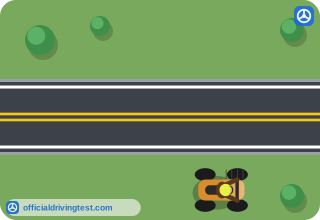
- At a forty-five (45) degree angle
- At the angle that crosses the fastest
- Close to a ninety (90) degree angle
- At a thirty (30) degree angle
Show answer
Correct answer: Close to a ninety (90) degree angle
The operator shall cross at as close to a ninety (90) degree angle as is practical and safe.
Source: Kentucky Driver Manual (Updated July 23, 2026), page 67 · Open this page in the manual (Manual page 67)
-
While crossing a two-lane public highway, an ATV operator shall not travel on the highway for more than how far?
- Two-tenths (2/10) of a mile
- One-tenth (1/10) of a mile
- Half a mile
- One mile
Show answer
Correct answer: Two-tenths (2/10) of a mile
The operator shall not travel on the highway for more than two-tenths (2/10) of a mile while crossing.
Source: Kentucky Driver Manual (Updated July 23, 2026), page 67 · Open this page in the manual (Manual page 67)
-
Which of these allows a person to operate an ATV on a two-lane public highway?
- Riding for recreation during daylight hours
- Traveling to a friend’s house on a nearby road
- Delivering mail along a rural route
- Being engaged in farm or agricultural activities
Show answer
Correct answer: Being engaged in farm or agricultural activities
A person may operate an ATV on any two-lane public highway if engaged in farm or agricultural related activities, construction, road maintenance, or snow removal.
Source: Kentucky Driver Manual (Updated July 23, 2026), page 67 · Open this page in the manual (Manual page 67)
-
What lights must be illuminated at all times on an ATV operated on a public highway?
- Two headlights and one working taillight
- At least one headlight and two taillights
- One headlight and one working taillight
- Two headlights and two working taillights
Show answer
Correct answer: At least one headlight and two taillights
A person who operates an ATV on a public highway must have at least one headlight and two taillights illuminated at all times.
Source: Kentucky Driver Manual (Updated July 23, 2026), page 67 · Open this page in the manual (Manual page 67)
-
When may an ATV be operated on a public highway, other than when engaged in snow removal or emergency road maintenance?
- Only during daylight hours
- Only at night with the lights on
- Only before noon
- At any hour with a reflective vest
Show answer
Correct answer: Only during daylight hours
An ATV on a public highway may only be operated during daylight hours, unless engaged in snow removal efforts or emergency road maintenance.
Source: Kentucky Driver Manual (Updated July 23, 2026), page 67 · Open this page in the manual (Manual page 67)
-
What license must a person have to operate an ATV on a public highway?
- A motorcycle endorsement
- An instruction permit
- A valid operator’s license
- No license is required
Show answer
Correct answer: A valid operator’s license
A person who operates an ATV on a public highway must have a valid operator’s license and comply with all traffic regulations.
Source: Kentucky Driver Manual (Updated July 23, 2026), page 67 · Open this page in the manual (Manual page 67)
-
Why may a motorcycle rider ahead of you suddenly change speed or lane position?
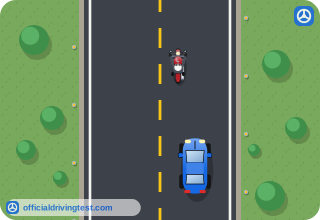
- To avoid hazards such as potholes, gravel or wet pavement
- To signal that you may pass on the shoulder
- To show that the motorcycle is about to park
- To keep other drivers from following too closely
Show answer
Correct answer: To avoid hazards such as potholes, gravel or wet pavement
Motorcycle riders may suddenly need to change speed or adjust lane position to avoid hazards such as potholes, gravel, wet or slippery surfaces, pavement seams, railroad crossings and grooved pavement.
Source: Kentucky Driver Manual (Updated July 23, 2026), page 63 · Open this page in the manual (Manual page 63)
-
Compared with motorcycles, how fast do scooters and mopeds travel?
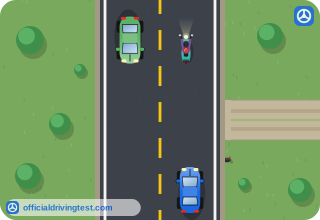
- At about the same speed
- At higher speeds on highways
- At much lower speeds
- Faster in city traffic only
Show answer
Correct answer: At much lower speeds
Keep in mind that scooters and mopeds travel at much lower speeds than motorcycles.
Source: Kentucky Driver Manual (Updated July 23, 2026), page 63 · Open this page in the manual (Manual page 63)