Kentucky: Sharing the road — Part 4 Practice Test
Questions in this part include: “Which traffic rules apply to electric low-speed scooters?” · “What is required of an electric low-speed scooter operator regarding local government ordinances?”
Independent educational site · not affiliated with any government agency or DMV
Ready? Test yourself
- Instant feedback with an explanation
- Every answer cites its source in the manual
- Your best score is saved on this device
Questions are original and based on the official manual "Kentucky Driver Manual" (Updated July 23, 2026), Kentucky State Police.
All 19 questions in this practice test
Take the test above first, then use this list to study. Tap “Show answer” to see the correct answer and explanation.
Show the questions and answersHide the questions
-
Which traffic rules apply to electric low-speed scooters?
- The same traffic regulations that apply to trucks
- Only the regulations for pedestrians
- The same traffic regulations that apply to bicycles
- None, because they are not motor vehicles
Show answer
Correct answer: The same traffic regulations that apply to bicycles
Electric low-speed scooters are subject to traffic regulation in the same way that bicycles are required to obey traffic laws.
Source: Kentucky Driver Manual (Updated July 23, 2026), page 62 · Open this page in the manual (Manual page 62)
-
What lights must an electric low-speed scooter be equipped with?
- One white headlamp only
- At least one headlamp and at least one rear red light
- Two headlamps and one rear amber light
- At least one headlamp and a rear white reflector
Show answer
Correct answer: At least one headlamp and at least one rear red light
An electric low-speed scooter shall be equipped with at least one headlamp and at least one rear red light.
Source: Kentucky Driver Manual (Updated July 23, 2026), page 62 · Open this page in the manual (Manual page 62)
-
When must the lights of an electric low-speed scooter be illuminated?
- From one hour after sunset to one hour before sunrise
- From sunset to sunrise only
- Only when it is raining or foggy
- From one-half hour after sunset to one-half hour before sunrise
Show answer
Correct answer: From one-half hour after sunset to one-half hour before sunrise
The lights must be illuminated from one-half hour after sunset to one-half hour before sunrise or at other times when there is low visibility.
Source: Kentucky Driver Manual (Updated July 23, 2026), page 62 · Open this page in the manual (Manual page 62)
-
When may an electric low-speed scooter be parked on a sidewalk?
- If it does not impede pedestrian or other traffic
- Never, under any circumstances
- Only if it is parked against a building wall
- Only between sunrise and sunset
Show answer
Correct answer: If it does not impede pedestrian or other traffic
An electric low-speed scooter may be parked on a sidewalk if it does not impede the reasonable movement of pedestrian or other traffic.
Source: Kentucky Driver Manual (Updated July 23, 2026), page 62 · Open this page in the manual (Manual page 62)
-
What is required of an electric low-speed scooter operator regarding local government ordinances?
- Compliance only in cities with more than one county
- No compliance if state law permits the scooter
- Compliance with all of them
- Compliance only on sidewalks
Show answer
Correct answer: Compliance with all of them
Compliance with all local government ordinances is required.
Source: Kentucky Driver Manual (Updated July 23, 2026), page 62 · Open this page in the manual (Manual page 62)
-
How do motorcyclists’ rights and responsibilities compare with those of other drivers?
- Motorcyclists have the right of way in all situations
- They are the same
- Motorcyclists have fewer responsibilities
- Motorcyclists must yield to all other vehicles
Show answer
Correct answer: They are the same
Motorcyclists have the same rights and responsibilities as other drivers, although they may be more difficult to see.
Source: Kentucky Driver Manual (Updated July 23, 2026), page 62 · Open this page in the manual (Manual page 62)
-
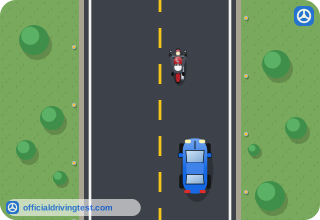
How much of a lane should you allow a motorcyclist?
- Half of the lane
- The left side of the lane only
- Whatever width is left by other traffic
- A full lane width
Show answer
Correct answer: A full lane width
A motorcyclist should be allowed a full lane width, and you should not share the lane.
Source: Kentucky Driver Manual (Updated July 23, 2026), page 62 · Open this page in the manual (Manual page 62)
-
Why should you not share a lane with a motorcycle?
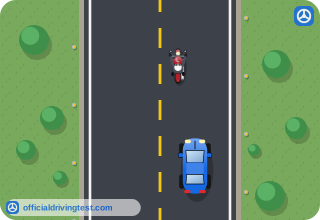
- The motorcycle needs space for the motorcyclist to react to other traffic
- Motorcycles are not allowed to use the same lane as other vehicles
- Motorcycles always travel faster than cars
- Motorcycles need a lane to carry passengers
Show answer
Correct answer: The motorcycle needs space for the motorcyclist to react to other traffic
The motorcycle needs space for the motorcyclist to react to other traffic.
Source: Kentucky Driver Manual (Updated July 23, 2026), page 62 · Open this page in the manual (Manual page 62)
-
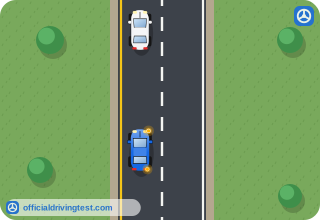
Because motorcycles are small and hard to see, what should you always check?
- Only the road ahead of you
- Only your left mirror
- Your mirrors and blind spots
- The lane markings on both sides
Show answer
Correct answer: Your mirrors and blind spots
The manual says to always check your mirrors and blind spots for motorcycles, which can be part of the traffic mix.
Source: Kentucky Driver Manual (Updated July 23, 2026), page 62 · Open this page in the manual (Manual page 62)
-
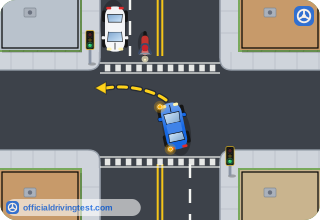
Before turning left, how should you watch for motorcycles?
- Look only in your rear-view mirror and side mirrors
- Look carefully to the front and sides of your vehicle
- Sound your horn before turning
- Wait until the motorcycle signals
Show answer
Correct answer: Look carefully to the front and sides of your vehicle
Before turning left, a driver should be alert for motorcycles by looking carefully to the front and sides of the vehicle.
Source: Kentucky Driver Manual (Updated July 23, 2026), page 62 · Open this page in the manual (Manual page 62)
-
A motorcycle ahead of you has its turn signal flashing. What should you do?
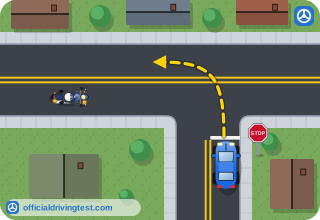
- Assume the rider is turning and go ahead
- Assume the signal is a mistake and pass the rider
- Sound your horn to tell the rider to cancel the signal
- Wait to be sure the rider is going to turn before you proceed
Show answer
Correct answer: Wait to be sure the rider is going to turn before you proceed
Motorcycle turn signals may not self-cancel, so a driver should not assume the motorcycle is turning and should wait to be sure.
Source: Kentucky Driver Manual (Updated July 23, 2026), page 62 · Open this page in the manual (Manual page 62)
-
What minimum following distance should you allow when following a motorcyclist?
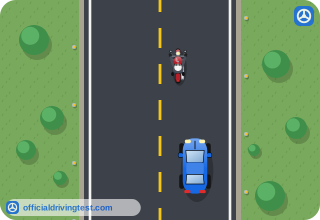
- 4 seconds, or more in wet conditions
- 2 seconds in any weather
- 3 seconds in any weather
- 6 seconds in dry conditions only
Show answer
Correct answer: 4 seconds, or more in wet conditions
When following a motorcyclist, allow a minimum 4-second following distance, or more in wet conditions.
Source: Kentucky Driver Manual (Updated July 23, 2026), page 62 · Open this page in the manual (Manual page 62)
-
What is the “no zone” around large trucks and buses?
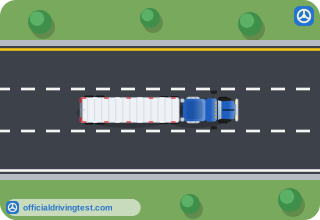
- The area around the vehicle where other vehicles disappear from the driver’s view into blind spots
- The area beside a truck or bus where passing other vehicles is against the law
- The distance behind a truck or bus that a following car must keep clear of traffic
- The stretch of roadway before a weigh station where trucks and buses may not be passed
Show answer
Correct answer: The area around the vehicle where other vehicles disappear from the driver’s view into blind spots
The no zone is the area around large trucks or buses where vehicles disappear from the commercial driver’s view into blind spots.
Source: Kentucky Driver Manual (Updated July 23, 2026), page 63 · Open this page in the manual (Manual page 63)
-
Which side of a large truck has the larger blind spot, starting behind the cab and extending up to the length of the truck?
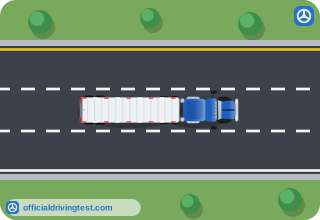
- The left side
- The front end
- The right side
- The roof
Show answer
Correct answer: The right side
Trucks have a larger blind spot on their right side, starting behind the cab and extending up to the length of the truck.
Source: Kentucky Driver Manual (Updated July 23, 2026), page 63 · Open this page in the manual (Manual page 63)
-
If you cannot see a truck driver’s face in the side view mirror, what does that mean?
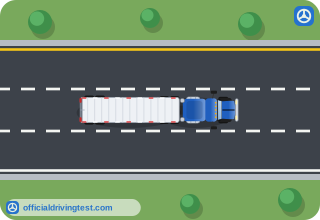
- The driver is about to change lanes
- The driver cannot see you
- You are safely out of the blind spot
- The driver is slowing down for you
Show answer
Correct answer: The driver cannot see you
If you cannot see the driver’s face in the side view mirror, he or she cannot see you, so you are in the large vehicle’s no zone.
Source: Kentucky Driver Manual (Updated July 23, 2026), page 63 · Open this page in the manual (Manual page 63)
-
Under ideal conditions, a loaded truck with good tires and properly adjusted brakes traveling at 55 mph needs at least how far to come to a complete stop?
- 155 feet
- 235 feet
- 450 feet
- 335 feet
Show answer
Correct answer: 335 feet
Such a truck needs at least 335 feet to stop, which is greater than 1½ times the stopping distance of a car.
Source: Kentucky Driver Manual (Updated July 23, 2026), page 63 · Open this page in the manual (Manual page 63)
-
When passing a large vehicle, what should you look for in your rear-view mirror before pulling in front of it?
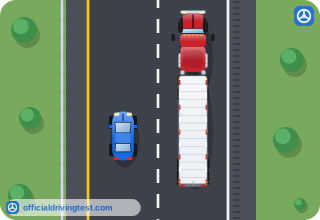
- The truck’s headlights
- The truck’s turn signal
- The trailer’s rear wheels
- The whole front of the vehicle
Show answer
Correct answer: The whole front of the vehicle
Before pulling in front of a large vehicle you have passed, you should see the whole front of it in your rear-view mirror and then maintain speed.
Source: Kentucky Driver Manual (Updated July 23, 2026), page 63 · Open this page in the manual (Manual page 63)
-
How far can the huge blind spots directly behind a large vehicle extend?
- Up to 50 feet
- Up to 200 feet
- Up to 100 feet
- Up to 400 feet
Show answer
Correct answer: Up to 200 feet
Unlike cars, large vehicles have huge blind spots directly behind them that extend up to 200 feet.
Source: Kentucky Driver Manual (Updated July 23, 2026), page 63 · Open this page in the manual (Manual page 63)
-
When following a large vehicle, how should you position your vehicle?
- So the driver can see it in his or her side mirrors
- Directly behind the vehicle, where you can see its brake lights best
- Alongside the cab so the driver can see you through the window
- Close behind the trailer so other drivers cannot cut in between
Show answer
Correct answer: So the driver can see it in his or her side mirrors
You should avoid following too closely and position your vehicle so the driver can see it in his or her side mirrors.
Source: Kentucky Driver Manual (Updated July 23, 2026), page 63 · Open this page in the manual (Manual page 63)