Kentucky: Sharing the road — Part 1 Practice Test
Questions in this part include: “Are moped operators required to wear helmets or eye-protection devices?” · “You are traveling in the opposite direction from a stopped school bus. On which road are you not required to stop?”
Independent educational site · not affiliated with any government agency or DMV
Ready? Test yourself
- Instant feedback with an explanation
- Every answer cites its source in the manual
- Your best score is saved on this device
Questions are original and based on the official manual "Kentucky Driver Manual" (Updated July 23, 2026), Kentucky State Police.
All 20 questions in this practice test
Take the test above first, then use this list to study. Tap “Show answer” to see the correct answer and explanation.
Show the questions and answersHide the questions
-
Why does the manual say moped operators should surround themselves with as large a “space cushion” as possible?
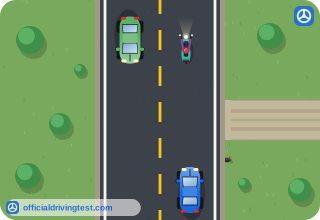
- Mopeds are not easily seen in the traffic flow
- Mopeds stop more slowly than cars
- Mopeds are louder than other vehicles
- Mopeds must keep clear of all traffic by law
Show answer
Correct answer: Mopeds are not easily seen in the traffic flow
Mopeds are not easily seen in the traffic flow, so a large space cushion is vital.
Source: Kentucky Driver Manual (Updated July 23, 2026), page 3 · Open this page in the manual (Manual page 3)
-
What does the manual say will help others see a moped rider?
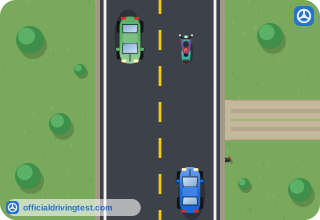
- Riding close behind larger vehicles
- Riding on the shoulder of the road
- Riding with the headlight on and bike flags
- Keeping the engine at idle at every stop
Show answer
Correct answer: Riding with the headlight on and bike flags
Riding with the headlight on and bike flags helps other road users see a moped.
Source: Kentucky Driver Manual (Updated July 23, 2026), page 3 · Open this page in the manual (Manual page 3)
-
Are moped operators required to wear helmets or eye-protection devices?
- Yes, helmets only
- No, but they are strongly recommended
- Yes, eye protection only
- Yes, both helmets and eye protection
Show answer
Correct answer: No, but they are strongly recommended
Moped operators are not required to wear helmets or eye-protection devices, but they are strongly recommended.
Source: Kentucky Driver Manual (Updated July 23, 2026), page 3 · Open this page in the manual (Manual page 3)
-
How do traffic laws apply to motorcycle operators compared with passenger car operators?
- Motorcycle operators are exempt from most speed laws
- All traffic laws and regulations apply equally to both
- Motorcycle operators follow a separate set of traffic laws
- Traffic laws apply only to passenger car operators
Show answer
Correct answer: All traffic laws and regulations apply equally to both
All traffic laws and regulations apply equally to passenger car and motorcycle operators.
Source: Kentucky Driver Manual (Updated July 23, 2026), page 3 · Open this page in the manual (Manual page 3)
-
What should you expect where there are school buses?
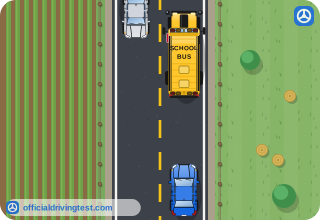
- Frequent changes to the posted speed limit
- Traffic officers directing every vehicle past them
- Reduced speed limits posted on every block
- Children, who are likely to do something unexpected
Show answer
Correct answer: Children, who are likely to do something unexpected
Where there are school buses there are usually children, and children are likely to do something unexpected.
Source: Kentucky Driver Manual (Updated July 23, 2026), page 44 · Open this page in the manual (Manual page 44)
-
When a school or church bus is stopped on a roadway to load or unload passengers, how long must you remain stopped?
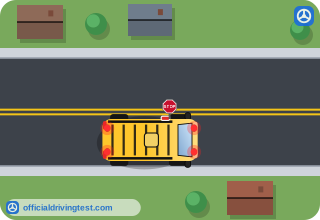
- Until all people are clear of the roadway and the bus is in motion
- Until the bus driver signals you to go ahead
- Until the children have all crossed the roadway
- Until the bus’s red lights have been on for a full minute
Show answer
Correct answer: Until all people are clear of the roadway and the bus is in motion
By law you must remain stopped until all people are clear of the roadway and the bus is in motion.
Source: Kentucky Driver Manual (Updated July 23, 2026), page 44 · Open this page in the manual (Manual page 44)
-
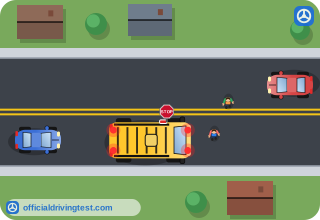
You are approaching a school bus that is stopped on a highway with its stop arm and signal lights activated. What must you do?
- Slow down and pass with caution
- Pass only on the left side
- Bring your vehicle to a complete stop
- Slow to a crawl and pass on the right
Show answer
Correct answer: Bring your vehicle to a complete stop
The operator of a vehicle approaching such a bus from any direction must bring the vehicle to a complete stop.
Source: Kentucky Driver Manual (Updated July 23, 2026), page 44 · Open this page in the manual (Manual page 44)
-
You are traveling in the opposite direction from a stopped school bus. On which road are you not required to stop?
- A two-lane road where the bus is stopped on the other side of the center line
- A roadway with four or more lanes separated by an elevated barrier or an unpaved median
- Any road with a posted speed limit of 45 mph or more
- A road with three lanes that has a painted center turn lane in the middle
Show answer
Correct answer: A roadway with four or more lanes separated by an elevated barrier or an unpaved median
A stop is not required only when traveling in the opposite direction on a roadway with four or more lanes separated by an elevated barrier or an unpaved median.
Source: Kentucky Driver Manual (Updated July 23, 2026), page 44 · Open this page in the manual (Manual page 44)
-
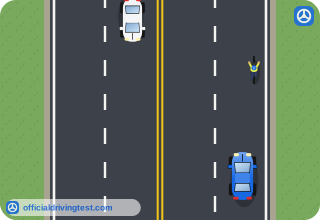
When overtaking a bicycle or electric low-speed scooter where there is more than one lane in the same direction, what should you do?
- Stay in your lane and sound your horn until the bicycle or scooter moves to the shoulder
- Pass on the right side of the bicycle or scooter if the right lane is available and safe
- Slow down and follow the bicycle or scooter until it leaves the roadway completely
- Move to the immediate left lane if it is available and moving is reasonably safe
Show answer
Correct answer: Move to the immediate left lane if it is available and moving is reasonably safe
With more than one lane in the same direction, you move to the immediate left lane if it is available and reasonably safe.
Source: Kentucky Driver Manual (Updated July 23, 2026), page 48 · Open this page in the manual (Manual page 48)
-
If there is only one lane for traffic in the same direction, what distance should you keep when passing a bicycle or electric low-speed scooter?
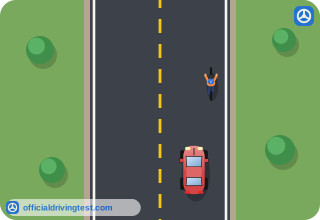
- At least three feet
- At least one foot
- At least five feet
- At least ten feet
Show answer
Correct answer: At least three feet
On a one-lane road, you pass to the left keeping at least three feet between your vehicle and the bicycle or scooter.
Source: Kentucky Driver Manual (Updated July 23, 2026), page 48 · Open this page in the manual (Manual page 48)
-
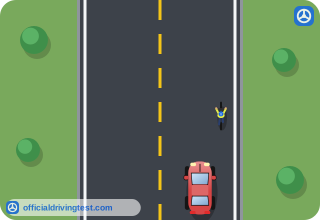
How long must you maintain the required distance when passing a bicycle or electric low-speed scooter?
- Until you reach the next intersection
- For the next 100 feet
- Until you are safely past it
- Until the rider signals you to pass
Show answer
Correct answer: Until you are safely past it
You maintain the required distance until you are safely past the bicycle or electric low-speed scooter.
Source: Kentucky Driver Manual (Updated July 23, 2026), page 48 · Open this page in the manual (Manual page 48)
-
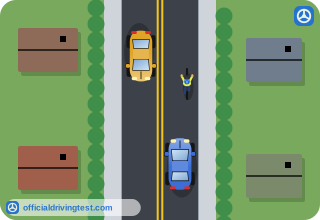
If space on the roadway is not available for a three-foot distance when passing a bicycle or electric low-speed scooter, what must you do?
- Wait until the bicycle or scooter stops
- Use reasonable caution in passing
- Pass only after sounding your horn
- Follow behind until the rider leaves the roadway
Show answer
Correct answer: Use reasonable caution in passing
If there is not enough space for three feet, you use reasonable caution in passing.
Source: Kentucky Driver Manual (Updated July 23, 2026), page 48 · Open this page in the manual (Manual page 48)
-
You may drive to the left of the center line, even in a no-passing zone, to pass a bicycle or electric low-speed scooter only if what is true?
- The rider has signaled with a hand that you may go around on the left side of the road and the lane is empty
- The road has a shoulder at least three feet wide on the right side for the rider to use
- The no-passing zone is shorter than 200 feet and no vehicle is following you closely
- The roadway to the left of the center is clear far enough to pass safely without interfering with oncoming traffic
Show answer
Correct answer: The roadway to the left of the center is clear far enough to pass safely without interfering with oncoming traffic
Driving left of the center line to pass a bicycle or scooter is allowed only if the roadway on the left is clear for a sufficient distance and oncoming traffic is not affected.
Source: Kentucky Driver Manual (Updated July 23, 2026), page 48 · Open this page in the manual (Manual page 48)
-
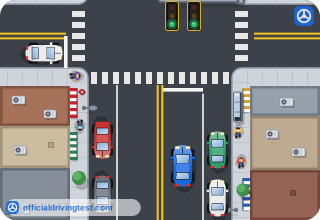
Why should you look to the sides as part of your visual search?
- To find a place where you can safely stop and park
- To read signs located on both sides of the road
- To make sure other roadway users will not cross your travel path
- To check how fast the vehicles that are behind you are moving
Show answer
Correct answer: To make sure other roadway users will not cross your travel path
The manual says you should search to the sides to make sure other roadway users will not cross your travel path.
Source: Kentucky Driver Manual (Updated July 23, 2026), page 49 · Open this page in the manual (Manual page 49)
-
What is the space between your vehicle and other roadway users usually called?
- A safety zone
- A space cushion
- A buffer lane
- A gap interval
Show answer
Correct answer: A space cushion
The manual says the space you allow between your vehicle and other roadway users is usually referred to as a space cushion.
Source: Kentucky Driver Manual (Updated July 23, 2026), page 51 · Open this page in the manual (Manual page 51)
-
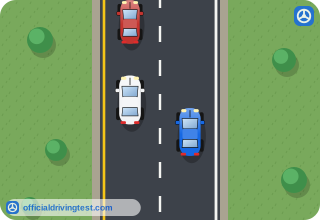
Why should you avoid driving on either side slightly to the rear of another vehicle?
- You may be too close to the center line
- You may block the view of the vehicle behind
- You may be in the other driver’s blind spot
- You may use more fuel at a steady speed
Show answer
Correct answer: You may be in the other driver’s blind spot
Driving slightly to the rear on either side of another vehicle may put you in their blind spot, and it reduces the space you may need to avoid a crash.
Source: Kentucky Driver Manual (Updated July 23, 2026), page 53 · Open this page in the manual (Manual page 53)
-
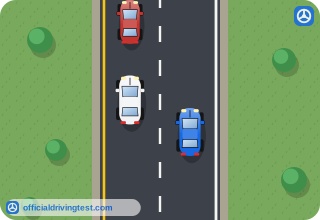
What should you do instead of remaining in another driver’s blind spot?
- Either speed up or drop back
- Sound your horn to get the driver’s attention
- Move closer to the other vehicle
- Stay where you are and flash your headlights
Show answer
Correct answer: Either speed up or drop back
The manual says to either speed up or drop back, but not to remain in another driver’s blind spot.
Source: Kentucky Driver Manual (Updated July 23, 2026), page 53 · Open this page in the manual (Manual page 53)
-
Why should you avoid crowding the center line marking?
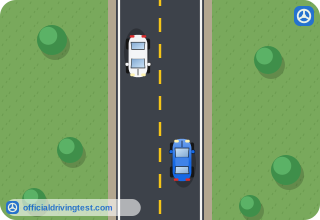
- To keep from drifting toward the shoulder on the right side
- To leave room for vehicles to pass you on the left
- To keep from entering a lane reserved for turning
- To keep as much space as possible between you and oncoming traffic
Show answer
Correct answer: To keep as much space as possible between you and oncoming traffic
The manual says to avoid crowding the center line and to keep as much space as possible between you and oncoming traffic.
Source: Kentucky Driver Manual (Updated July 23, 2026), page 53 · Open this page in the manual (Manual page 53)
-
Vehicles are entering a multiple-lane or limited access roadway beside you. How can you make space for them?
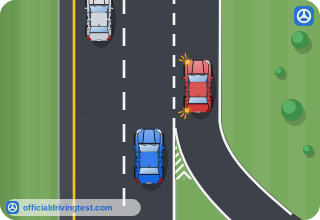
- Stay in your lane and sound your horn
- Move over a lane or adjust your speed
- Keep your lane and speed so they must wait
- Move to the shoulder and stop
Show answer
Correct answer: Move over a lane or adjust your speed
The manual says to make space for vehicles entering a multiple-lane or limited access roadway by moving over a lane or adjusting your speed.
Source: Kentucky Driver Manual (Updated July 23, 2026), page 53 · Open this page in the manual (Manual page 53)
-
You should give extra space to pedestrians, especially to whom?
- Children and bicyclists
- Adults walking in groups
- Joggers and people walking dogs
- Delivery drivers and mail carriers
Show answer
Correct answer: Children and bicyclists
The manual says to give extra space to pedestrians, especially children and bicyclists.
Source: Kentucky Driver Manual (Updated July 23, 2026), page 53 · Open this page in the manual (Manual page 53)