Kentucky: Sharing the road — Part 5 Practice Test
Questions in this part include: “About how fast do large vehicles drive when traveling up or down steep hills?” · “How are vehicles carrying hazardous materials marked?”
Independent educational site · not affiliated with any government agency or DMV
Ready? Test yourself
- Instant feedback with an explanation
- Every answer cites its source in the manual
- Your best score is saved on this device
Questions are original and based on the official manual "Kentucky Driver Manual" (Updated July 23, 2026), Kentucky State Police.
All 19 questions in this practice test
Take the test above first, then use this list to study. Tap “Show answer” to see the correct answer and explanation.
Show the questions and answersHide the questions
-
About how fast do large vehicles drive when traveling up or down steep hills?
- Approximately 15 mph
- Approximately 45 mph
- Approximately 35 mph
- Approximately 50 mph
Show answer
Correct answer: Approximately 35 mph
On steep hills large vehicles must drive slowly, approximately 35 mph, and therefore use the right lane.
Source: Kentucky Driver Manual (Updated July 23, 2026), page 63 · Open this page in the manual (Manual page 63)
-
Which lane should you avoid, if possible, when traveling up or down hills?
- The left lane
- The right lane
- The center lane
- The shoulder
Show answer
Correct answer: The right lane
Large vehicles drive slowly on steep hills and use the right lane, so avoiding it reduces the possibility of a crash.
Source: Kentucky Driver Manual (Updated July 23, 2026), page 63 · Open this page in the manual (Manual page 63)
-
When a truck or bus needs to make a right turn, what will the driver sometimes do?
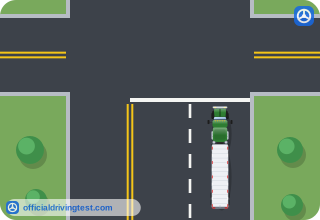
- Swing the vehicle wide to the left
- Swing the vehicle wide to the right, close to the curb
- Stop in the intersection until traffic yields
- Start the turn from the left-turn lane
Show answer
Correct answer: Swing the vehicle wide to the left
The driver will sometimes swing the vehicle wide to the left to safely turn right and clear the corner of a curb or other obstruction.
Source: Kentucky Driver Manual (Updated July 23, 2026), page 64 · Open this page in the manual (Manual page 64)
-
To avoid a crash near a truck or bus that is making a turn, when should you turn?
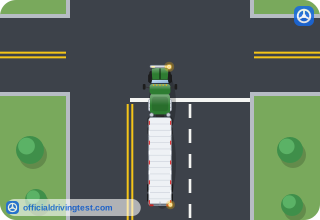
- As soon as its turn signal comes on
- Right away, if there is space between it and the curb
- As soon as the truck begins to swing wide
- Not until the truck or bus has completed its turn
Show answer
Correct answer: Not until the truck or bus has completed its turn
If you get between the turning truck or bus and the curb you can be squeezed in, so wait until it has completed its turn.
Source: Kentucky Driver Manual (Updated July 23, 2026), page 64 · Open this page in the manual (Manual page 64)
-
When you meet a truck coming from the opposite direction, where should you keep your vehicle?
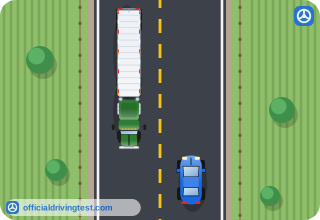
- Close to the center line of the roadway
- On the shoulder with your wheels off the pavement
- As far as possible to the right side of the roadway
- In the middle of your lane, away from both edges
Show answer
Correct answer: As far as possible to the right side of the roadway
Keeping as far right as possible avoids a side-swept crash and reduces the wind turbulence between the two vehicles, which pushes them apart.
Source: Kentucky Driver Manual (Updated July 23, 2026), page 64 · Open this page in the manual (Manual page 64)
-
If you are in doubt about the speed of an oncoming truck or bus, what should you do?
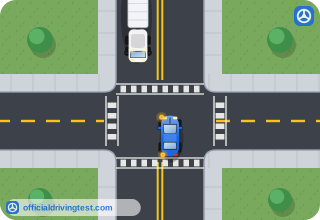
- Turn left as fast as you can before it arrives
- Speed up and turn left before it gets closer
- Do not turn left in its path
- Turn left slowly so the driver can adjust
Show answer
Correct answer: Do not turn left in its path
The truck or bus may be going faster than you think, and it takes longer for it to stop than a car.
Source: Kentucky Driver Manual (Updated July 23, 2026), page 64 · Open this page in the manual (Manual page 64)
-
Why do stop lines at intersections matter when large vehicles are nearby?
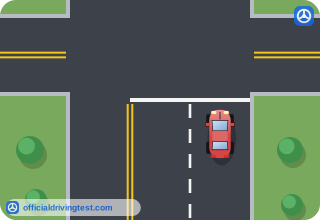
- They set you farther back so larger vehicles have more turning space
- They show large vehicles where they must wait for you
- They mark the lane that only large vehicles may use
- They keep large vehicles out of the crosswalk while turning
Show answer
Correct answer: They set you farther back so larger vehicles have more turning space
Stop lines help to set you farther back at an intersection to give larger vehicles more turning space, so you should always stop behind them.
Source: Kentucky Driver Manual (Updated July 23, 2026), page 64 · Open this page in the manual (Manual page 64)
-
Which of these should you NOT do around large vehicles?
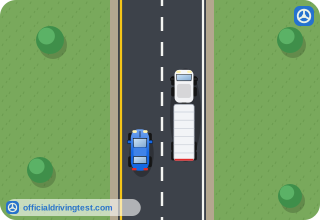
- Stop behind the stop line at an intersection with a large vehicle
- Give a turning truck or bus plenty of room to maneuver
- Keep as far right as possible when meeting a truck
- Cut off a truck to beat it into a single-lane construction zone
Show answer
Correct answer: Cut off a truck to beat it into a single-lane construction zone
You should not cut off a large vehicle in traffic or on the highway; the few seconds that might be saved are not worth a life.
Source: Kentucky Driver Manual (Updated July 23, 2026), page 64 · Open this page in the manual (Manual page 64)
-
On mountain roads or downgrades, what should you do if a truck seems out of control or unable to slow down?
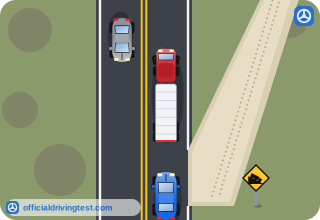
- Stay in your lane and sound your horn
- Get out of the way
- Speed up to stay ahead of it
- Stop in your lane and wait for it to pass
Show answer
Correct answer: Get out of the way
On mountain roads or downgrades you should watch for fast-approaching trucks, and if one seems out of control you should get out of the way.
Source: Kentucky Driver Manual (Updated July 23, 2026), page 64 · Open this page in the manual (Manual page 64)
-
Who may use the special “escape” or “runaway” ramps found on some long downgrades?
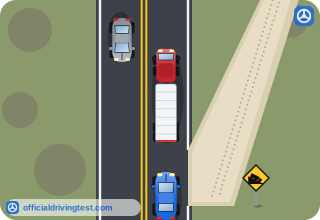
- Only large vehicles that are out of control or cannot stop
- Any vehicle whose driver needs to rest or check the brakes
- Any vehicle that is driving faster than the speed limit
- Trucks and passenger cars that need to pull off the road
Show answer
Correct answer: Only large vehicles that are out of control or cannot stop
These ramps are for use only by large vehicles that are out of control or cannot stop because of brake failure.
Source: Kentucky Driver Manual (Updated July 23, 2026), page 64 · Open this page in the manual (Manual page 64)
-
What should you never do in the vicinity of truck “escape” or “runaway” ramps?
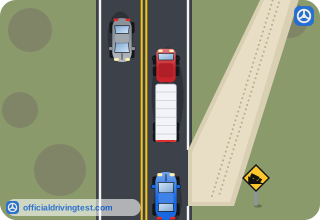
- Drive faster than the posted limit
- Use your turn signal
- Stop or park
- Drive in the right lane
Show answer
Correct answer: Stop or park
Never stop or park in the vicinity of escape or runaway ramps, which are only for large vehicles that cannot stop.
Source: Kentucky Driver Manual (Updated July 23, 2026), page 64 · Open this page in the manual (Manual page 64)
-
When you are stopped behind a truck on an upgrade, where should you position your vehicle?
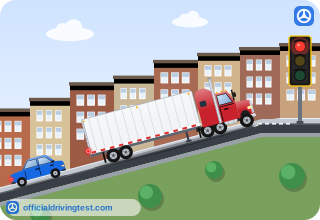
- In the center of your lane, close behind the truck
- To the left of your lane, where the driver can see you
- To the right of your lane, near the shoulder
- Directly behind the truck, as close as possible
Show answer
Correct answer: To the left of your lane, where the driver can see you
When stopped behind a truck on an upgrade, you should stay to the left of your lane where the driver can see you.
Source: Kentucky Driver Manual (Updated July 23, 2026), page 64 · Open this page in the manual (Manual page 64)
-
Why should you leave extra space between your vehicle and a truck stopped ahead of you on an upgrade?
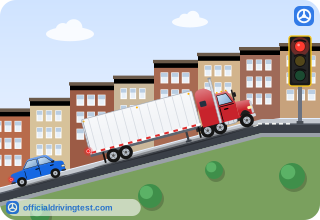
- The truck may need room to turn around
- The truck driver cannot see anything ahead
- The truck may need to stop for its brakes to cool
- The truck may drift backwards slightly
Show answer
Correct answer: The truck may drift backwards slightly
You should allow extra space in case the truck drifts backwards slightly.
Source: Kentucky Driver Manual (Updated July 23, 2026), page 64 · Open this page in the manual (Manual page 64)
-
Why should you avoid driving in the right lane near truck weigh stations?
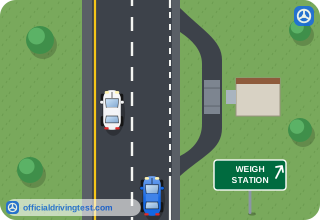
- Trucks stopped at the station block the right lane for inspection
- Trucks leaving the station must stop at the end of the lane
- The right lane is reserved for trucks near weigh stations
- Slow-moving trucks will be trying to reenter faster-moving traffic
Show answer
Correct answer: Slow-moving trucks will be trying to reenter faster-moving traffic
Slow-moving trucks will be attempting to reenter faster-moving traffic, so avoiding the right lane reduces the possibility of rear-ending or being rear-ended by a large vehicle.
Source: Kentucky Driver Manual (Updated July 23, 2026), page 64 · Open this page in the manual (Manual page 64)
-
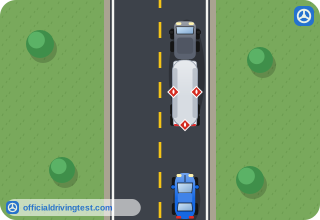
What must vehicles carrying hazardous materials do at all railroad crossings?
- Slow down but not stop
- Stop
- Stop only if a train is coming
- Stop only when the gates are down
Show answer
Correct answer: Stop
Vehicles carrying hazardous materials must stop at all railroad crossings, so you should be prepared for it.
Source: Kentucky Driver Manual (Updated July 23, 2026), page 64 · Open this page in the manual (Manual page 64)
-
How are vehicles carrying hazardous materials marked?
- Clearly marked with the type of hazardous materials
- With a flashing yellow light on the cab roof
- Only with a sign on the rear bumper that says HAZARD
- They have no special marking you can see
Show answer
Correct answer: Clearly marked with the type of hazardous materials
These vehicles are clearly marked with the type of hazardous materials they are transporting, and you should avoid driving near them.
Source: Kentucky Driver Manual (Updated July 23, 2026), page 64 · Open this page in the manual (Manual page 64)
-
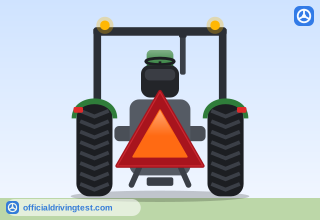
What does a fluorescent or reflective orange and red triangle on the rear of a vehicle drawn by an animal, or of farm or construction equipment, mean?
- The vehicle is carrying hazardous materials
- The vehicle is about to stop in the roadway
- The vehicle is traveling less than 45 mph
- The vehicle is traveling less than 25 mph
Show answer
Correct answer: The vehicle is traveling less than 25 mph
The triangle on the rear of vehicles drawn by animals, farm equipment, or construction equipment means the vehicle is traveling less than 25 mph.
Source: Kentucky Driver Manual (Updated July 23, 2026), page 66 · Open this page in the manual (Manual page 66)
-
On a slow-moving vehicle triangle, what part do you see during the day?
- The reflective red border of the symbol
- The fluorescent orange triangle in the center
- A white triangle in the center of the symbol
- A flashing amber light above the symbol
Show answer
Correct answer: The fluorescent orange triangle in the center
During the day you see the fluorescent orange triangle in the center of the slow-moving vehicle symbol.
Source: Kentucky Driver Manual (Updated July 23, 2026), page 66 · Open this page in the manual (Manual page 66)
-
On a slow-moving vehicle triangle, what part do you see during night driving?
- The reflective red border of the symbol
- The fluorescent orange triangle in the center
- A white triangle in the center of the symbol
- A flashing amber light above the symbol
Show answer
Correct answer: The reflective red border of the symbol
During night driving you see the reflective red border of the slow-moving vehicle symbol.
Source: Kentucky Driver Manual (Updated July 23, 2026), page 66 · Open this page in the manual (Manual page 66)