Kentucky: Sharing the road — Part 6 Practice Test
Questions in this part include: “How does Kentucky law define an all-terrain vehicle (ATV)?” · “While crossing a two-lane public highway, an ATV operator shall not travel on the highway for more than how far?”
Independent educational site · not affiliated with any government agency or DMV
Ready? Test yourself
- Instant feedback with an explanation
- Every answer cites its source in the manual
- Your best score is saved on this device
Questions are original and based on the official manual "Kentucky Driver Manual" (Updated July 23, 2026), Kentucky State Police.
All 19 questions in this practice test
Take the test above first, then use this list to study. Tap “Show answer” to see the correct answer and explanation.
Show the questions and answersHide the questions
-
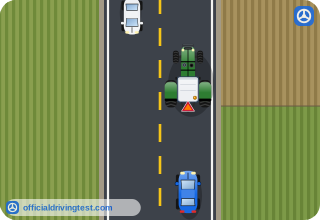
What must you be sure of before you pass a slow-moving vehicle?
- That the vehicle has stopped
- That the driver has waved you around
- That it is safe to pass
- That the vehicle is traveling under 15 mph
Show answer
Correct answer: That it is safe to pass
You should use caution when approaching a slow-moving vehicle and be sure it is safe before you pass.
Source: Kentucky Driver Manual (Updated July 23, 2026), page 66 · Open this page in the manual (Manual page 66)
-
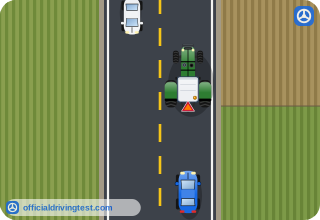
What should you remember when passing tractors, combines, and other farm machinery on state highways in rural areas?
- The operator will always pull onto the shoulder for you
- The operator cannot hear approaching vehicles
- The operator can see you in the side mirrors
- Farm machinery always travels faster than 25 mph
Show answer
Correct answer: The operator cannot hear approaching vehicles
You should pass farm machinery with caution because its operator cannot hear approaching vehicles.
Source: Kentucky Driver Manual (Updated July 23, 2026), page 66 · Open this page in the manual (Manual page 66)
-
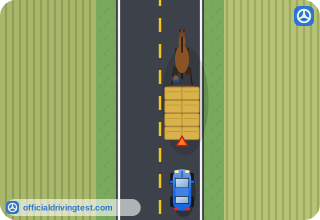
What rights do animal-drawn vehicles and horseback riders have to use the road?
- They may use the road only when no motor vehicle is nearby
- They have the right-of-way over motor vehicles at all times
- They are exempt from the rules of the road on rural roads
- The same rights to use the road as a motor vehicle
Show answer
Correct answer: The same rights to use the road as a motor vehicle
Animal-drawn vehicles and horseback riders have the same rights to use the road as a motor vehicle and must follow the same rules of the road.
Source: Kentucky Driver Manual (Updated July 23, 2026), page 66 · Open this page in the manual (Manual page 66)
-
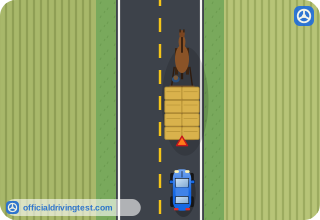
When passing animal-drawn vehicles and horseback riders, what should you not do?
- Pass with caution around the animal
- Anticipate left turns into driveways
- Watch for posted warning signs
- Use your horn or “rev” the engine
Show answer
Correct answer: Use your horn or “rev” the engine
You should not use your horn or “rev” the engine because this may scare the horse and cause a crash.
Source: Kentucky Driver Manual (Updated July 23, 2026), page 66 · Open this page in the manual (Manual page 66)
-
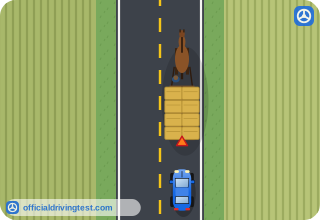
What should you anticipate from animal-drawn vehicles to avoid possible crashes?
- Right turns onto the shoulder
- Left turns into fields and driveways
- Sudden stops in the middle of the road
- Turns made without slowing down
Show answer
Correct answer: Left turns into fields and driveways
You should anticipate left turns made by animal-drawn vehicles into fields and driveways.
Source: Kentucky Driver Manual (Updated July 23, 2026), page 66 · Open this page in the manual (Manual page 66)
-
How will you know that you are likely to find animal-drawn vehicles and horseback riders in an area?
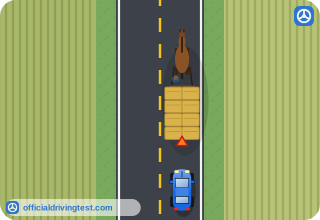
- Warning signs will be posted there
- A flashing amber light will be installed there
- The pavement will be marked with a special line
- There will be a rural speed limit sign there
Show answer
Correct answer: Warning signs will be posted there
Warning signs will be posted in areas where you are likely to find animal-drawn vehicles and horseback riders.
Source: Kentucky Driver Manual (Updated July 23, 2026), page 66 · Open this page in the manual (Manual page 66)
-
How does Kentucky law define an all-terrain vehicle (ATV)?
- Any motor vehicle with three or more wheels
- Any motor vehicle with a seat for the operator
- Any motor vehicle used for recreational off-road use
- Any vehicle used only on farm property
Show answer
Correct answer: Any motor vehicle used for recreational off-road use
Kentucky law defines an ATV as any motor vehicle used for recreational off-road use.
Source: Kentucky Driver Manual (Updated July 23, 2026), page 66 · Open this page in the manual (Manual page 66)
-
What is the general rule about operating an ATV on a public highway or its right-of-way in Kentucky?
- It is allowed in daylight on any public highway
- It is not allowed, with some exceptions
- It is allowed on highways with a posted limit of 35 mph or less
- It is allowed on any highway if the ATV has a license plate
Show answer
Correct answer: It is not allowed, with some exceptions
A person shall not operate an ATV upon any public highway or roadway or its right-of-way, though there are some exceptions.
Source: Kentucky Driver Manual (Updated July 23, 2026), page 66 · Open this page in the manual (Manual page 66)
-
What protective gear must an ATV operator wear at all times when in motion on public property?
- Transportation Cabinet approved protective headgear
- Any helmet that the operator chooses to wear
- A reflective safety vest and bright clothing
- Eye protection and heavy gloves or boots
Show answer
Correct answer: Transportation Cabinet approved protective headgear
An ATV operator may not operate without wearing Transportation Cabinet approved protective headgear at all times when in motion on public property.
Source: Kentucky Driver Manual (Updated July 23, 2026), page 67 · Open this page in the manual (Manual page 67)
-
Under what condition may a person under sixteen (16) years of age operate an ATV?
- Only when riding on private property in daylight
- Only if accompanied by any licensed driver
- Only after passing a written test
- Only under direct parental supervision
Show answer
Correct answer: Only under direct parental supervision
A person under sixteen may not operate an ATV except under direct parental supervision and may not do so without approved protective headgear at all times the vehicle is in motion.
Source: Kentucky Driver Manual (Updated July 23, 2026), page 67 · Open this page in the manual (Manual page 67)
-
A parent or legal guardian of a minor under sixteen (16), or of someone without a permit or license, shall not knowingly allow that person to do what on an ATV?
- Operate it on private property
- Wear protective headgear
- Carry a passenger while operating it
- Operate it in daylight
Show answer
Correct answer: Carry a passenger while operating it
A parent or legal guardian shall not knowingly allow such a person to carry a passenger while operating an ATV.
Source: Kentucky Driver Manual (Updated July 23, 2026), page 67 · Open this page in the manual (Manual page 67)
-
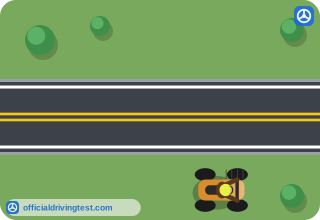
When an ATV crosses a two-lane public highway, at what angle must the operator cross?
- At a forty-five (45) degree angle
- At the angle that crosses the fastest
- Close to a ninety (90) degree angle
- At a thirty (30) degree angle
Show answer
Correct answer: Close to a ninety (90) degree angle
The operator shall cross at as close to a ninety (90) degree angle as is practical and safe.
Source: Kentucky Driver Manual (Updated July 23, 2026), page 67 · Open this page in the manual (Manual page 67)
-
While crossing a two-lane public highway, an ATV operator shall not travel on the highway for more than how far?
- Two-tenths (2/10) of a mile
- One-tenth (1/10) of a mile
- Half a mile
- One mile
Show answer
Correct answer: Two-tenths (2/10) of a mile
The operator shall not travel on the highway for more than two-tenths (2/10) of a mile while crossing.
Source: Kentucky Driver Manual (Updated July 23, 2026), page 67 · Open this page in the manual (Manual page 67)
-
Which of these allows a person to operate an ATV on a two-lane public highway?
- Riding for recreation during daylight hours
- Traveling to a friend’s house on a nearby road
- Delivering mail along a rural route
- Being engaged in farm or agricultural activities
Show answer
Correct answer: Being engaged in farm or agricultural activities
A person may operate an ATV on any two-lane public highway if engaged in farm or agricultural related activities, construction, road maintenance, or snow removal.
Source: Kentucky Driver Manual (Updated July 23, 2026), page 67 · Open this page in the manual (Manual page 67)
-
What lights must be illuminated at all times on an ATV operated on a public highway?
- Two headlights and one working taillight
- At least one headlight and two taillights
- One headlight and one working taillight
- Two headlights and two working taillights
Show answer
Correct answer: At least one headlight and two taillights
A person who operates an ATV on a public highway must have at least one headlight and two taillights illuminated at all times.
Source: Kentucky Driver Manual (Updated July 23, 2026), page 67 · Open this page in the manual (Manual page 67)
-
When may an ATV be operated on a public highway, other than when engaged in snow removal or emergency road maintenance?
- Only during daylight hours
- Only at night with the lights on
- Only before noon
- At any hour with a reflective vest
Show answer
Correct answer: Only during daylight hours
An ATV on a public highway may only be operated during daylight hours, unless engaged in snow removal efforts or emergency road maintenance.
Source: Kentucky Driver Manual (Updated July 23, 2026), page 67 · Open this page in the manual (Manual page 67)
-
What license must a person have to operate an ATV on a public highway?
- A motorcycle endorsement
- An instruction permit
- A valid operator’s license
- No license is required
Show answer
Correct answer: A valid operator’s license
A person who operates an ATV on a public highway must have a valid operator’s license and comply with all traffic regulations.
Source: Kentucky Driver Manual (Updated July 23, 2026), page 67 · Open this page in the manual (Manual page 67)
-
Why may a motorcycle rider ahead of you suddenly change speed or lane position?
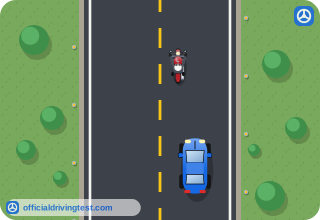
- To avoid hazards such as potholes, gravel or wet pavement
- To signal that you may pass on the shoulder
- To show that the motorcycle is about to park
- To keep other drivers from following too closely
Show answer
Correct answer: To avoid hazards such as potholes, gravel or wet pavement
Motorcycle riders may suddenly need to change speed or adjust lane position to avoid hazards such as potholes, gravel, wet or slippery surfaces, pavement seams, railroad crossings and grooved pavement.
Source: Kentucky Driver Manual (Updated July 23, 2026), page 63 · Open this page in the manual (Manual page 63)
-
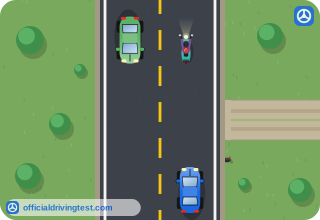
Compared with motorcycles, how fast do scooters and mopeds travel?
- At about the same speed
- At higher speeds on highways
- At much lower speeds
- Faster in city traffic only
Show answer
Correct answer: At much lower speeds
Keep in mind that scooters and mopeds travel at much lower speeds than motorcycles.
Source: Kentucky Driver Manual (Updated July 23, 2026), page 63 · Open this page in the manual (Manual page 63)