Kentucky: Sharing the road — Part 3 Practice Test
Questions in this part include: “Where should you be especially cautious about bicyclists when checking your path before backing?” · “Where should a bicyclist not ride?”
Independent educational site · not affiliated with any government agency or DMV
Ready? Test yourself
- Instant feedback with an explanation
- Every answer cites its source in the manual
- Your best score is saved on this device
Questions are original and based on the official manual "Kentucky Driver Manual" (Updated July 23, 2026), Kentucky State Police.
All 20 questions in this practice test
Take the test above first, then use this list to study. Tap “Show answer” to see the correct answer and explanation.
Show the questions and answersHide the questions
-
A bicyclist ahead of you holds the left arm out with the forearm bent upward at the elbow. What does this hand signal mean?
- Right turn
- Left turn
- Stop
- Moving to the left lane
Show answer
Correct answer: Right turn
A bicyclist with the left arm bent upward at the elbow is signaling a right turn; extending the right arm straight out also signals a right turn.
Source: Kentucky Driver Manual (Updated July 23, 2026), page 61 · Open this page in the manual (Manual page 61)
-
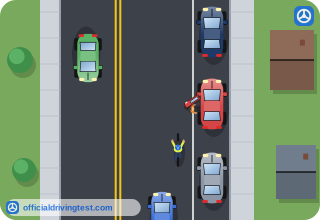
What should you do before you open your vehicle door when parked on the street?
- Sound your horn to warn passing traffic
- Turn on your hazard flashers
- Check to the sides and rear for bicyclists
- Wait for a bicyclist to pass in front of you
Show answer
Correct answer: Check to the sides and rear for bicyclists
When parked on the street, a driver must check to the sides and rear for bicyclists before opening the vehicle door.
Source: Kentucky Driver Manual (Updated July 23, 2026), page 61 · Open this page in the manual (Manual page 61)
-
Where should you be especially cautious about bicyclists when checking your path before backing?
- On interstate highways
- Near schools or residential areas
- On long rural highways with no side streets
- In freeway work zones
Show answer
Correct answer: Near schools or residential areas
You should check for bicyclists in your path before backing, especially near schools or residential areas where bicyclists may be present.
Source: Kentucky Driver Manual (Updated July 23, 2026), page 61 · Open this page in the manual (Manual page 61)
-
After passing a bicyclist, when should the passing vehicle move back into the right lane?
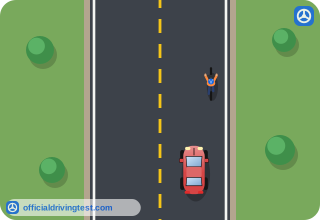
- Only when well clear of the bicyclist
- As soon as the front of your vehicle is even with the bicyclist
- As soon as the bicyclist is in your mirror
- After you have honked at the bicyclist
Show answer
Correct answer: Only when well clear of the bicyclist
Passing vehicles should move back into the right lane only when well clear of the bicyclist.
Source: Kentucky Driver Manual (Updated July 23, 2026), page 61 · Open this page in the manual (Manual page 61)
-
What do local ordinances in some counties control, according to the manual?
- The maximum speed of vehicles on interstates
- The licensing of motorcycle riders
- The operation and parking of bicycles within city limits
- The routes that trucks must take through small towns
Show answer
Correct answer: The operation and parking of bicycles within city limits
Some counties have local ordinances that control the operation and parking of bicycles within city limits, and drivers should know and obey them.
Source: Kentucky Driver Manual (Updated July 23, 2026), page 61 · Open this page in the manual (Manual page 61)
-
Where must bicyclists never ride?
- On a bike path next to the roadway
- On interstates and parkways
- On the right side of the road
- In the direction of traffic
Show answer
Correct answer: On interstates and parkways
One of the rules for bicyclists is to never ride on interstates and parkways.
Source: Kentucky Driver Manual (Updated July 23, 2026), page 61 · Open this page in the manual (Manual page 61)
-
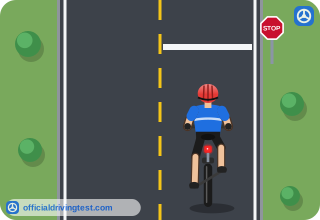
What must a bicyclist do at a stop sign or a stop light?
- Slow down and continue if no traffic is coming
- Yield only to pedestrians
- Stop only when a motor vehicle is nearby
- Stop just like a motor vehicle
Show answer
Correct answer: Stop just like a motor vehicle
Bicyclists must obey traffic control signals and signs and stop at stop signs and stop lights just like a motor vehicle.
Source: Kentucky Driver Manual (Updated July 23, 2026), page 61 · Open this page in the manual (Manual page 61)
-
How fast may a bicyclist operate?
- Within posted speed limits or a reasonable rate
- At any speed on a road with a bike lane
- Only at a walking pace
- At no more than 10 miles per hour on any road
Show answer
Correct answer: Within posted speed limits or a reasonable rate
A bicycle must be operated within posted speed limits or at a rate reasonable for existing conditions.
Source: Kentucky Driver Manual (Updated July 23, 2026), page 61 · Open this page in the manual (Manual page 61)
-
On which side of the road must a bicyclist ride?
- The left side, facing traffic
- The center of the road
- The right side, with traffic
- Either side, whichever is clearer
Show answer
Correct answer: The right side, with traffic
Bicyclists must ride on the right side of the road with traffic.
Source: Kentucky Driver Manual (Updated July 23, 2026), page 61 · Open this page in the manual (Manual page 61)
-
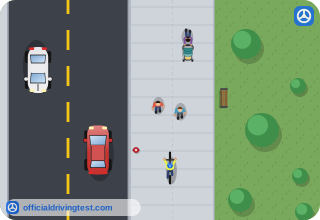
What should a bicyclist give before passing pedestrians?
- A hand signal with the arm pointed to the left
- An audible warning, such as a bell or horn
- A flash of the headlight
- A shouted request to stop
Show answer
Correct answer: An audible warning, such as a bell or horn
A bicyclist must yield to pedestrians in crosswalks and on sidewalks and give an audible warning (bell or horn) before passing pedestrians.
Source: Kentucky Driver Manual (Updated July 23, 2026), page 61 · Open this page in the manual (Manual page 61)
-
What lighting must a bicycle have when ridden at night?
- A red light visible from the front and a white light visible from the rear
- A white light visible from both the front and the rear
- A yellow reflector visible from the sides only
- A white light visible from the front and a red reflector or light visible from the rear
Show answer
Correct answer: A white light visible from the front and a red reflector or light visible from the rear
At night a bicycle must have a white light visible from the front and a red reflector or light visible from the rear.
Source: Kentucky Driver Manual (Updated July 23, 2026), page 61 · Open this page in the manual (Manual page 61)
-
Where shall slower-moving vehicles, including bicycles, drive?
- As closely as practical to the right-hand boundary of the highway
- In the center of the lane
- As close to the center line as is safe
- In the left lane so faster traffic can pass on the right
Show answer
Correct answer: As closely as practical to the right-hand boundary of the highway
All slower-moving vehicles, including bicycles, shall drive as closely as practical to the right-hand boundary of the highway.
Source: Kentucky Driver Manual (Updated July 23, 2026), page 61 · Open this page in the manual (Manual page 61)
-
Where should a bicyclist not ride?
- On a bike path next to the roadway
- On the right side of the road
- On the sidewalk
- In the same direction as traffic
Show answer
Correct answer: On the sidewalk
The rules for bicyclists say not to ride on the sidewalk.
Source: Kentucky Driver Manual (Updated July 23, 2026), page 61 · Open this page in the manual (Manual page 61)
-
In what way must a bicycle never be parked on a sidewalk?
- Facing the street instead of the building
- So that it interferes with pedestrian traffic
- Without being locked to a fixed object
- Closer than two feet to a building wall
Show answer
Correct answer: So that it interferes with pedestrian traffic
A bicyclist must never park a bicycle on a sidewalk in such a way as to interfere with pedestrian traffic.
Source: Kentucky Driver Manual (Updated July 23, 2026), page 61 · Open this page in the manual (Manual page 61)
-
If a bike path adjacent to the roadway is provided, what should a bicyclist do?
- Ride on the sidewalk
- Ride in the center of the roadway
- Ride on the roadway shoulder
- Ride on the bike path
Show answer
Correct answer: Ride on the bike path
A bicyclist should ride on a bike path adjacent to the roadway, if one is provided.
Source: Kentucky Driver Manual (Updated July 23, 2026), page 61 · Open this page in the manual (Manual page 61)
-
How many persons may a bicycle carry?
- No more than the number for which it is designed and equipped
- No more than one person unless the rider is an adult
- Two persons at a time if the rider is an adult
- Any number if all of them wear helmets
Show answer
Correct answer: No more than the number for which it is designed and equipped
A bicycle must carry no more persons than the number for which it is designed and equipped.
Source: Kentucky Driver Manual (Updated July 23, 2026), page 62 · Open this page in the manual (Manual page 62)
-
How many bicyclists may ride abreast?
- Up to three if the road has a bike lane
- Any number, as long as they ride in the right lane
- Never more than two, so as not to interfere with traffic
- Only one at any time
Show answer
Correct answer: Never more than two, so as not to interfere with traffic
Bicyclists must never ride more than two abreast so as to interfere with the normal movement of traffic.
Source: Kentucky Driver Manual (Updated July 23, 2026), page 62 · Open this page in the manual (Manual page 62)
-
An electric low-speed scooter is defined as a device that weighs less than how much?
- 50 pounds
- 100 pounds
- 150 pounds
- 200 pounds
Show answer
Correct answer: 100 pounds
An electric low-speed scooter weighs less than one hundred (100) pounds.
Source: Kentucky Driver Manual (Updated July 23, 2026), page 62 · Open this page in the manual (Manual page 62)
-
An electric low-speed scooter is designed to operate at a maximum speed of how many miles per hour on a paved level surface?
- 10 miles per hour
- 15 miles per hour
- 25 miles per hour
- 20 miles per hour
Show answer
Correct answer: 20 miles per hour
An electric low-speed scooter is designed to operate at a maximum speed of twenty (20) miles per hour on a paved level surface.
Source: Kentucky Driver Manual (Updated July 23, 2026), page 62 · Open this page in the manual (Manual page 62)
-
What is the minimum age to operate an electric low-speed scooter on a highway, bicycle lane, or bicycle path?
- 16 years
- 12 years
- 14 years
- 18 years
Show answer
Correct answer: 16 years
A person sixteen (16) years of age or older may operate an electric low-speed scooter on a highway, bicycle lane, or bicycle path.
Source: Kentucky Driver Manual (Updated July 23, 2026), page 62 · Open this page in the manual (Manual page 62)