Kansas: Emergencies
Skids, brake failure, tire blowouts, a stuck accelerator, running off the road, rollovers, crashes, animals, winter weather, tornadoes, lightning and floods. Split into 6 shorter tests so you're not stuck in one long quiz.
Independent educational site · not affiliated with any government agency or DMV
Choose a part
Emergencies — Part 1
Questions in this part include: “If you must stop because of vehicle trouble, which kind of place should you avoid?”
StartEmergencies — Part 2
Questions in this part include: “When may it be best or necessary to accelerate to avoid a collision?”
StartEmergencies — Part 3
Questions in this part include: “What should you follow to greatly reduce the chance that your vehicle will have a problem while driving?”
StartEmergencies — Part 4
Questions in this part include: “After your wheels leave the pavement, you steer straight ahead and slow to what speed or less?”
StartEmergencies — Part 5
Questions in this part include: “When should you report a crash with an animal to the police?”
StartEmergencies — Part 6
Questions in this part include: “When stranded, how long is it recommended to run the engine each hour to charge the battery and warm the interior?”
StartAll 107 Emergencies questions with answers
Choose a part above to take a practice test, or study every question and answer here.
Show the questions and answersHide the questions
-
If you are having vehicle trouble and must stop, where should you try to get your vehicle if possible?
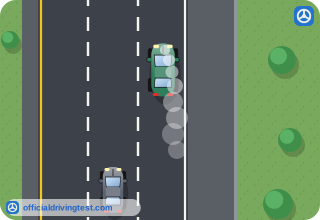
- Into the lane with the slowest traffic, where drivers can go around you
- Off the road and away from traffic
- Onto the center of the roadway, where everyone can see it
- Next to the curb of the nearest intersection, even if it blocks the crosswalk
Show answer
Correct answer: Off the road and away from traffic
The manual says to get your vehicle off the road and away from traffic, if possible.
Source: Kansas Driving Handbook (Revised February 2022), page 68
-
If you must stop because of vehicle trouble, which kind of place should you avoid?
- A place where other roadway users have a clear view of your vehicle
- A place off the road and away from traffic, if possible
- A place where you can turn on your emergency flashers
- Just around a curve where visibility is limited
Show answer
Correct answer: Just around a curve where visibility is limited
Other roadway users must be able to see your vehicle, so you should not stop just over a hill or just around a curve where visibility is limited.
Source: Kansas Driving Handbook (Revised February 2022), page 68
-
What should you turn on to show other roadway users that your vehicle is disabled?
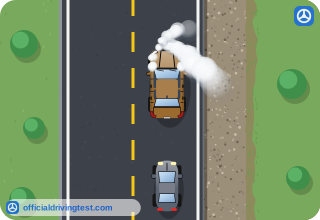
- Your emergency flashers
- Your high beams
- Your windshield wipers
- Your reverse lights
Show answer
Correct answer: Your emergency flashers
If you are having vehicle trouble and must stop, you turn on your emergency flashers to show your vehicle is disabled.
Source: Kansas Driving Handbook (Revised February 2022), page 68
-
When warning other roadway users of your disabled vehicle, about how far behind the vehicle should you place emergency flares?
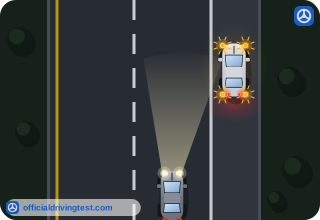
- About 50 to 100 feet
- About 400 to 500 feet
- About 200 to 300 feet
- About 600 to 700 feet
Show answer
Correct answer: About 200 to 300 feet
Flares placed about 200 to 300 feet behind the vehicle give other drivers some time to change lanes if necessary.
Source: Kansas Driving Handbook (Revised February 2022), page 69
-
What does the manual say about changing a tire when your vehicle is disabled on the roadway?
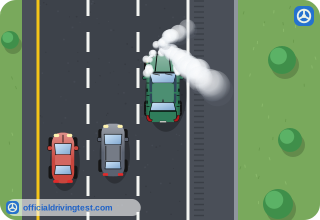
- Change it quickly in the lane while your flashers are on
- Change it in the lane, but only if you stand on the side away from traffic
- Change it in the lane after placing flares behind the vehicle
- Do not try to change a tire in traffic lanes
Show answer
Correct answer: Do not try to change a tire in traffic lanes
You should never stand or remain on the roadway and should not try to change a tire in traffic lanes.
Source: Kansas Driving Handbook (Revised February 2022), page 69
-
What does a white cloth attached to a vehicle indicate?
- That the vehicle is being towed
- That the vehicle is disabled
- That the driver is a new driver
- That the vehicle is carrying a wide load
Show answer
Correct answer: That the vehicle is disabled
A white cloth on the antenna, side mirror or door handle signals a disabled vehicle, so tie one on to signal an emergency.
Source: Kansas Driving Handbook (Revised February 2022), page 69
-
Besides tying a white cloth to the vehicle, what else can you do to indicate a disabled vehicle?
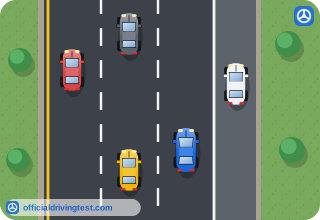
- Open the driver’s door
- Turn off all of your lights
- Lift the hood
- Lower all of the windows
Show answer
Correct answer: Lift the hood
Lifting the hood also tells other roadway users that the vehicle is disabled.
Source: Kansas Driving Handbook (Revised February 2022), page 69
-
In avoiding a collision, what three options do you have?
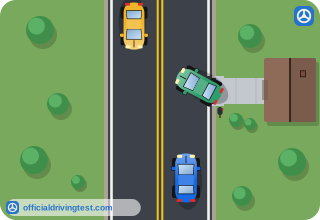
- Brake, honk or signal
- Brake, steer or accelerate
- Steer, signal or park
- Accelerate, honk or reverse
Show answer
Correct answer: Brake, steer or accelerate
The manual says that to avoid a collision you can brake, steer or accelerate.
Source: Kansas Driving Handbook (Revised February 2022), page 73
-
What will an anti-lock braking system (ABS) allow you to do?
- Stop in half the distance
- Brake without pressing the pedal
- Stop without skidding
- Steer without turning the wheel
Show answer
Correct answer: Stop without skidding
The ABS system will allow you to stop without skidding.
Source: Kansas Driving Handbook (Revised February 2022), page 73
-
You have anti-lock brakes and need to stop quickly. What should you do?
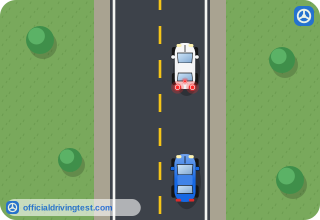
- Press on the brake pedal as hard as you can and keep pressing on it
- Pump the brake pedal quickly and repeatedly until you stop
- Press lightly at first and add pressure little by little
- Press once, then lift off to let the wheels roll again
Show answer
Correct answer: Press on the brake pedal as hard as you can and keep pressing on it
With ABS you press on the brake pedal as hard as you can and keep pressing on it.
Source: Kansas Driving Handbook (Revised February 2022), page 73
-
You have ABS and feel the brake pedal pushing back while you stop. What should you do?
- Do not let up on the brake pedal
- Ease up on the pedal and then reapply it
- Take your foot off the pedal for a moment
- Pump the pedal several times
Show answer
Correct answer: Do not let up on the brake pedal
The pedal pushing back means the ABS is working, and it only works with the brake pedal pushed down fully.
Source: Kansas Driving Handbook (Revised February 2022), page 73
-
You must stop quickly and your vehicle does not have an anti-lock braking system. How hard should you apply the brakes?
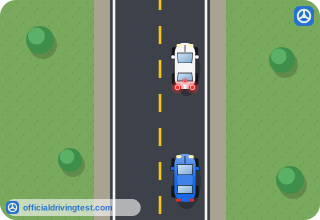
- As hard as you can until the vehicle skids
- Lightly, and add pressure slowly
- As hard as you can without locking them
- Only with the parking brake
Show answer
Correct answer: As hard as you can without locking them
Without ABS you apply the brakes as hard as you can without locking them, because braking too hard can cause a skid.
Source: Kansas Driving Handbook (Revised February 2022), page 73
-
Without ABS, you stop quickly and the brakes lock up so that the vehicle starts to skid. What should you do?
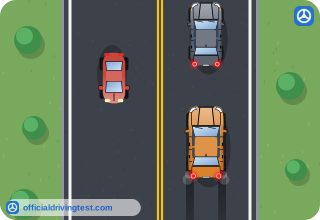
- Take your foot off the brake pedal completely
- Ease up on the brake pedal and then reapply it with control
- Press the brake pedal down even harder than before
- Release the pedal and shift the vehicle into neutral
Show answer
Correct answer: Ease up on the brake pedal and then reapply it with control
When the brakes lock up, you ease up on the brake pedal and then reapply it with control, without taking your foot off the pedal.
Source: Kansas Driving Handbook (Revised February 2022), page 73
-
Without ABS, you are braking and the vehicle has just stopped skidding. What should you do?
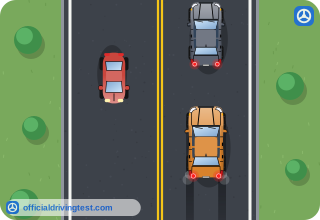
- Keep your foot off the brake pedal until you steer straight
- Hold the pedal at the same pressure until the vehicle stops
- Shift to a lower gear and release the brake pedal
- Push down on the brake pedal again until the vehicle has stopped
Show answer
Correct answer: Push down on the brake pedal again until the vehicle has stopped
As soon as the vehicle stops skidding you push down on the brake pedal again and repeat until the vehicle stops.
Source: Kansas Driving Handbook (Revised February 2022), page 73
-
In most cases, which can you do more quickly?
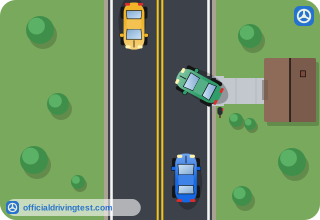
- Stop the vehicle
- Accelerate the vehicle
- Steer the vehicle
- Shift gears
Show answer
Correct answer: Steer the vehicle
In most cases you can steer the vehicle quicker than you can stop it, so you should consider steering to avoid a collision.
Source: Kansas Driving Handbook (Revised February 2022), page 73
-
How should you hold the steering wheel when you steer quickly to avoid a collision?
- With a good grip with both hands
- With one hand at the top of the wheel
- With your hands loosely resting on the wheel
- With one hand, keeping the other on the gearshift
Show answer
Correct answer: With a good grip with both hands
You should make sure you have a good grip with both hands on the steering wheel so you can keep control once you have turned or changed lanes.
Source: Kansas Driving Handbook (Revised February 2022), page 73
-
In which direction should you steer when you steer to avoid a collision?
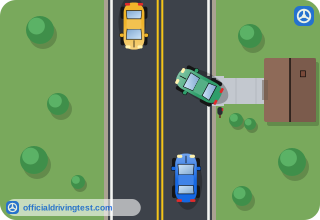
- Toward the hazard you are trying to avoid
- Toward the nearest vehicle
- Away from the direction you want to travel
- In the direction you want the vehicle to go
Show answer
Correct answer: In the direction you want the vehicle to go
The manual says to always steer in the direction you want the vehicle to go.
Source: Kansas Driving Handbook (Revised February 2022), page 73
-
You have ABS and need to steer quickly. What should you do with the brake pedal?
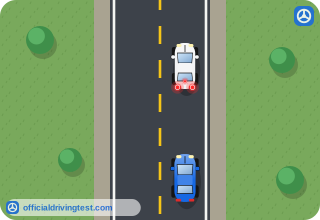
- Release it while you steer, then press it again
- Keep pressing on it as hard as you can while you steer
- Pump it quickly while you steer the vehicle
- Press it lightly so the wheels can turn
Show answer
Correct answer: Keep pressing on it as hard as you can while you steer
With ABS you continue pressing on the brake pedal as hard as you can while steering in the direction you want to travel.
Source: Kansas Driving Handbook (Revised February 2022), page 73
-
You must steer quickly and do not have an anti-lock braking system. What should you do about braking while steering?
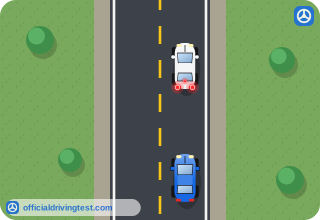
- Brake as hard as you can while you steer
- Lock the brakes before you start to steer
- Pump the brakes hard throughout the turn
- Avoid hard braking while steering, if possible
Show answer
Correct answer: Avoid hard braking while steering, if possible
Without ABS you avoid hard braking while steering, if possible.
Source: Kansas Driving Handbook (Revised February 2022), page 73
-
Without ABS, when can you begin to brake harder after steering to avoid a collision?
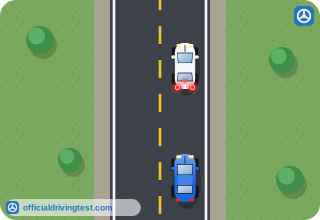
- Once you are on your intended path and the vehicle is straight
- As soon as you begin to turn the steering wheel
- Only after the vehicle has come to a complete stop on the shoulder
- Once you have crossed over the center line
Show answer
Correct answer: Once you are on your intended path and the vehicle is straight
After you have steered to your intended path and the vehicle is straight, you can begin to brake harder.
Source: Kansas Driving Handbook (Revised February 2022), page 73
-
When may it be best or necessary to accelerate to avoid a collision?
- When a vehicle is about to hit you head on and there is room behind you
- When you are approaching a red traffic signal
- When a vehicle is about to hit you from the side or behind and there is room ahead
- When a pedestrian is about to step in front of your vehicle
Show answer
Correct answer: When a vehicle is about to hit you from the side or behind and there is room ahead
Accelerating may be needed when a vehicle is about to hit you from the side or behind and there is room in front of your vehicle to get out of danger.
Source: Kansas Driving Handbook (Revised February 2022), page 73
-
After you have accelerated to avoid a collision, what should you do once the danger has passed?
- Keep accelerating
- Brake as hard as you can
- Switch off the engine
- Slow down
Show answer
Correct answer: Slow down
The manual says to be sure to slow down once the danger has passed.
Source: Kansas Driving Handbook (Revised February 2022), page 73
-
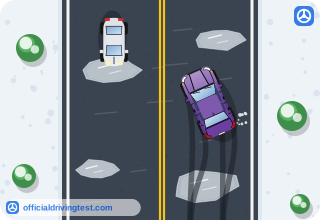
Which of these causes a vehicle to skid?
- Driving slower than the speed limit
- Stopping too suddenly
- Keeping both hands on the steering wheel
- Applying the brakes gradually
Show answer
Correct answer: Stopping too suddenly
Skids are caused when you are traveling too fast for conditions, when you stop too suddenly or when the tires can no longer grip the roadway.
Source: Kansas Driving Handbook (Revised February 2022), page 74
-
What does the manual say about controlling a vehicle while it is skidding?
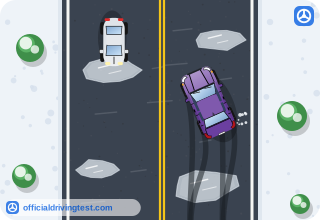
- You can control it if you steer hard against the skid
- You can control it if you brake as hard as possible
- You cannot control it, so it is best to avoid a skid
- You can control it if you accelerate away from the skid
Show answer
Correct answer: You cannot control it, so it is best to avoid a skid
As you cannot control a vehicle when it is skidding, it is best to avoid a skid in the first place.
Source: Kansas Driving Handbook (Revised February 2022), page 74
-
When your vehicle begins to lose traction, where should you look?
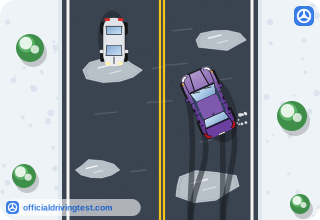
- For open space, and not at the hazard
- At the hazard you are trying to avoid
- At the speedometer to check your speed
- Into the oncoming lane to see what is coming
Show answer
Correct answer: For open space, and not at the hazard
You must pay attention to where your vehicle can go and not fixate on the hazard you are trying to avoid.
Source: Kansas Driving Handbook (Revised February 2022), page 74
-
When your vehicle begins to lose traction, why should you lift off the pedals?
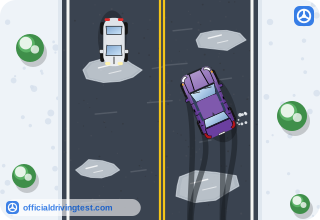
- To release brake or accelerator pressure and see which tires lost traction
- To let the engine cool down while the tires grip again on the road
- To shift the vehicle into neutral before you steer
- To signal other drivers that you are losing control of the vehicle
Show answer
Correct answer: To release brake or accelerator pressure and see which tires lost traction
Releasing the pedals lets you determine if the vehicle is losing traction to the front or rear tires.
Source: Kansas Driving Handbook (Revised February 2022), page 74
-
While you are steering, the vehicle continues straight. What does this mean?
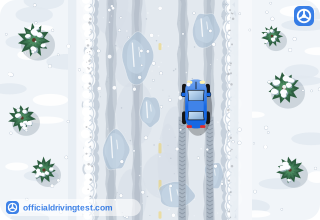
- Traction is lost to the rear tires
- Traction is lost to all four tires
- Traction is lost to the front tires
- The tires have grip and the steering is working
Show answer
Correct answer: Traction is lost to the front tires
If the vehicle continues straight while steering, traction is lost to the front tires.
Source: Kansas Driving Handbook (Revised February 2022), page 74
-
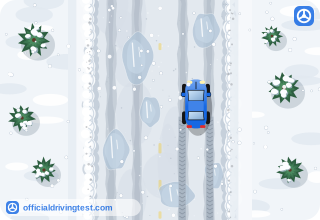
The vehicle is moving sideways without any additional steering input. What does this mean?
- The front tires have lost traction
- The rear tires have lost traction
- The brakes have failed
- The steering wheel is stuck
Show answer
Correct answer: The rear tires have lost traction
If the vehicle is moving sideways without any additional steering input, the rear tires have lost traction.
Source: Kansas Driving Handbook (Revised February 2022), page 74
-
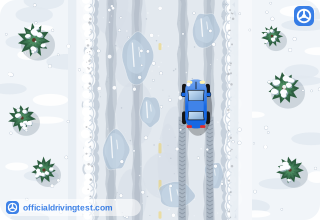
The front tires have lost traction and your vehicle does not have ABS. What should you do with the brakes?
- Brake harder to slow the front tires down quickly
- Hold the brakes at the same pressure while you steer
- Take your foot off the brakes and do not use them again
- Ease off to regain traction, then reapply without skidding
Show answer
Correct answer: Ease off to regain traction, then reapply without skidding
If front traction is lost, you ease off the brakes to regain traction and reapply the brakes without skidding to continue steering.
Source: Kansas Driving Handbook (Revised February 2022), page 74
-
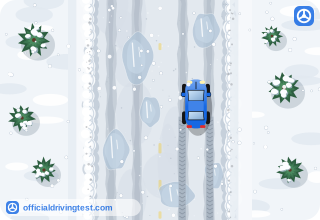
The front tires have lost traction and your vehicle has ABS. What should you do?
- Ease off the brakes completely until the tires grip again
- Pump the brakes lightly several times in a row
- Apply the brakes fully to gain steering control to the front tires
- Release the brakes and use the parking brake instead
Show answer
Correct answer: Apply the brakes fully to gain steering control to the front tires
If the vehicle has ABS, you apply the brakes fully to gain steering control to the front tires.
Source: Kansas Driving Handbook (Revised February 2022), page 74
-
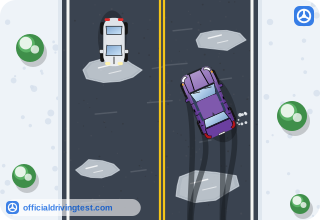
The rear tires have lost traction. How should you steer?
- Steer the way you want to go, and keep steering and counter-steering
- Turn the wheel away from the direction you want to go
- Hold the wheel still until the tires grip the road again
- Turn the wheel sharply toward the oncoming lane to avoid a spin
Show answer
Correct answer: Steer the way you want to go, and keep steering and counter-steering
If rear traction is lost, you turn the steering wheel in the direction of your intended path of travel and continue to steer and counter-steer until the vehicle is traveling straight.
Source: Kansas Driving Handbook (Revised February 2022), page 74
-
When steering out of a skid caused by rear traction loss, why should you avoid looking into the oncoming lane?
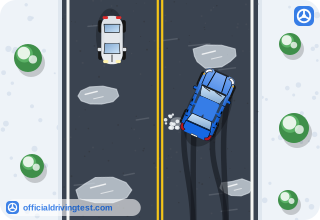
- So that you do not blind the drivers who are coming toward you
- So that your tires can regain their grip sooner
- So that you can watch your speedometer carefully
- So that your vehicle does not travel across the centerline
Show answer
Correct answer: So that your vehicle does not travel across the centerline
You should keep looking in the direction you want to go and avoid looking into the oncoming lane so the vehicle does not travel across the centerline.
Source: Kansas Driving Handbook (Revised February 2022), page 74
-
Your vehicle is equipped with traction technology and begins to skid. What should you do?
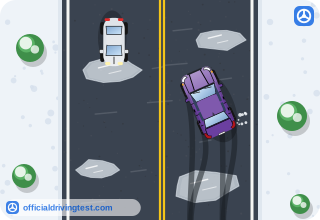
- Turn the steering wheel away from the path of travel
- Keep steering toward the path of travel to aid the vehicle technology
- Let go of the steering wheel so the technology works alone
- Brake as hard as you can and stop steering
Show answer
Correct answer: Keep steering toward the path of travel to aid the vehicle technology
If your vehicle has traction technology, you keep steering toward the path of travel to aid the vehicle technology.
Source: Kansas Driving Handbook (Revised February 2022), page 74
-
Your vehicle is hit from the rear. What should you do with your body?
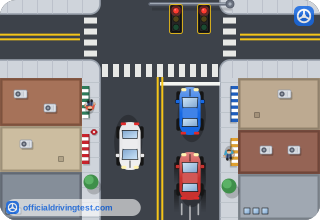
- Lean forward and brace both hands against the dashboard until it is over
- Turn your head to look at the vehicle that is behind you at once
- Duck down below the level of the steering wheel and hold your head
- Press yourself against the seat back and put your head on the head restraint
Show answer
Correct answer: Press yourself against the seat back and put your head on the head restraint
When hit from the rear your head and body are thrown backwards, so you press against the back of the seat and put your head against the head restraint.
Source: Kansas Driving Handbook (Revised February 2022), page 74
-
Your vehicle is hit from the rear. What should you be ready to do so that you will not be pushed into another vehicle?
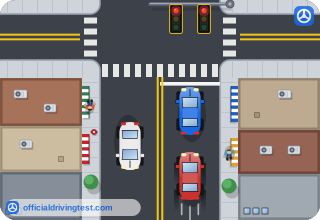
- Apply your brakes
- Steer to the shoulder
- Accelerate
- Shift into reverse
Show answer
Correct answer: Apply your brakes
The manual says to be ready to apply your brakes so that you will not be pushed into another vehicle.
Source: Kansas Driving Handbook (Revised February 2022), page 74
-
Your vehicle is hit from the side. What does the manual say about frontal air bags?
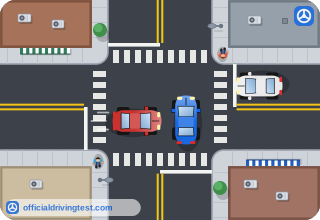
- They protect you better than a safety belt
- They deploy and keep you behind the wheel
- They will not help in this situation
- They are needed only when the vehicle is hit from behind
Show answer
Correct answer: They will not help in this situation
When a vehicle is hit from the side, frontal air bags will not help, so lap and shoulder belts are needed to keep you behind the wheel.
Source: Kansas Driving Handbook (Revised February 2022), page 74
-
Your vehicle is about to be hit from the front. What is it important to try to have?
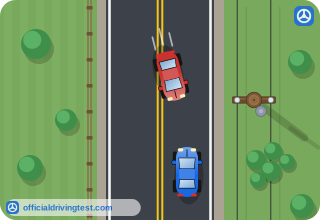
- A head-on impact, as long as your speed is low
- A glancing blow rather than being struck head on
- A second crash on the road shoulder
- A sudden stop with the wheels locked up
Show answer
Correct answer: A glancing blow rather than being struck head on
If a frontal collision is going to happen, you should try to turn the vehicle so that you take a glancing blow or miss it.
Source: Kansas Driving Handbook (Revised February 2022), page 74
-
If a frontal impact is severe, what will the air bag do?
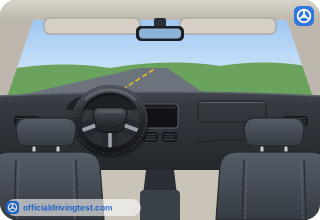
- Stay inflated until you remove your safety belt
- Deploy only if you are not wearing a safety belt
- Deploy and then deflate
- Deploy only if you are hit from the side
Show answer
Correct answer: Deploy and then deflate
In a severe frontal impact the air bag will deploy and then deflate, so you should be ready.
Source: Kansas Driving Handbook (Revised February 2022), page 74
-
What should you follow to greatly reduce the chance that your vehicle will have a problem while driving?
- The recommended maintenance schedule in the vehicle owner’s manual
- The posted speed limit for the type of road you drive on
- The fuel gauge reading each time you stop for gas
- The advice of other drivers you meet on the road
Show answer
Correct answer: The recommended maintenance schedule in the vehicle owner’s manual
Following the recommended maintenance schedule in the owner’s manual greatly reduces the chance of a vehicle problem.
Source: Kansas Driving Handbook (Revised February 2022), page 75
-
Your brakes stop working. What should you do first?
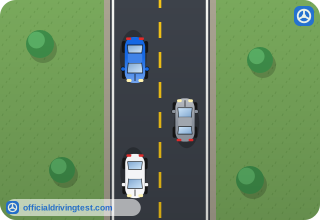
- Rapidly pump the brake pedal several times
- Pull on the parking brake as hard as you can
- Shift into park
- Turn off the engine
Show answer
Correct answer: Rapidly pump the brake pedal several times
Rapidly pumping the brake pedal several times will often build up enough brake pressure to allow you to stop.
Source: Kansas Driving Handbook (Revised February 2022), page 75
-
Pumping does not restore your brakes. How should you use the parking brake foot pedal?
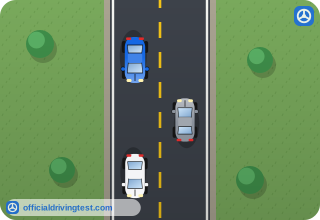
- Push it down hard and quickly to stop at once
- Push it down and keep it down until the vehicle stops
- Push it slowly so you will not lock the rear wheels and cause a skid
- Do not use it, because using it can damage the rear brakes
Show answer
Correct answer: Push it slowly so you will not lock the rear wheels and cause a skid
The parking brake foot pedal is pushed slowly so you will not lock the rear wheels and cause a skid, and you should be ready to release it if the vehicle skids.
Source: Kansas Driving Handbook (Revised February 2022), page 75
-
The brakes have failed and the parking brake does not work. What should you do?
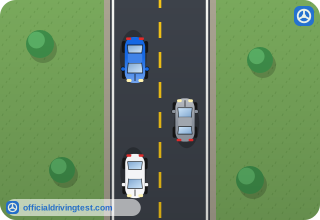
- Continue to drive carefully to the nearest repair shop
- Look for a safe place to slow to a stop off the roadway
- Shift into reverse to stop the vehicle
- Turn off the ignition and coast in the traffic lane
Show answer
Correct answer: Look for a safe place to slow to a stop off the roadway
You should look for a safe place to slow to a stop off the roadway, and not continue to drive the vehicle without working brakes.
Source: Kansas Driving Handbook (Revised February 2022), page 75
-
What will a vehicle do if a front tire blows out?
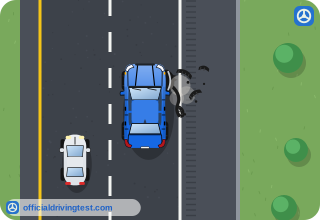
- Wobble and shake, but never pull at all
- Pull sharply away from the blowout
- Continue straight with no change
- Pull sharply in the direction of the blowout
Show answer
Correct answer: Pull sharply in the direction of the blowout
If a front tire blows out, the vehicle will pull sharply in the direction of the blowout.
Source: Kansas Driving Handbook (Revised February 2022), page 75
-
What will a vehicle do if a rear tire blows out?
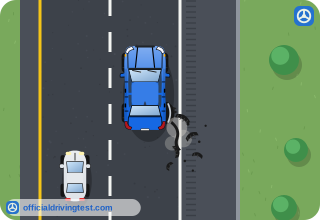
- Pull sharply away from the blowout
- Pull sharply in the direction of the blowout without shaking
- Wobble, shake and pull some in the direction of the blowout
- Continue straight with no change
Show answer
Correct answer: Wobble, shake and pull some in the direction of the blowout
If a rear tire blows out, the vehicle will wobble, shake and pull some in the direction of the blowout.
Source: Kansas Driving Handbook (Revised February 2022), page 75
-
A tire blows out or suddenly goes flat. How should you hold the steering wheel?
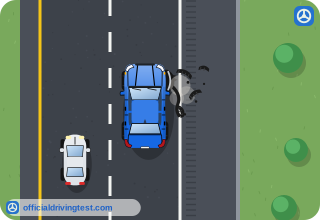
- Grip it firmly and keep the vehicle going straight
- Turn it sharply toward the road shoulder at once
- Hold it loosely to let the vehicle settle
- Turn it away from the blown tire at once
Show answer
Correct answer: Grip it firmly and keep the vehicle going straight
In a tire blowout you grip the steering wheel firmly and keep the vehicle going straight.
Source: Kansas Driving Handbook (Revised February 2022), page 75
-
A tire blows out. How should you slow the vehicle?
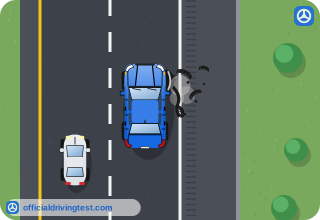
- Brake as hard as you can as soon as the tire blows out
- Press the accelerator to keep control
- Shift into reverse to stop faster
- Gradually, off the accelerator, braking gently only if needed
Show answer
Correct answer: Gradually, off the accelerator, braking gently only if needed
Slow down gradually with your foot off the accelerator. Do not brake; let the vehicle slow by itself, or brake gently only if necessary.
Source: Kansas Driving Handbook (Revised February 2022), page 75
-
After a tire blowout, where should you stop if possible?
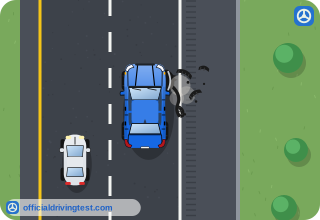
- In the lane where it happened with the emergency flashers on
- Off the road in a safe place, with the emergency flashers on
- On the road beside the center line
- Wherever the vehicle stops by itself
Show answer
Correct answer: Off the road in a safe place, with the emergency flashers on
The manual says not to stop on the road if possible; pull off in a safe place and turn on emergency flashers.
Source: Kansas Driving Handbook (Revised February 2022), page 75
-
The engine shuts off while you are driving. What should you know about the steering wheel?
- It will lock and you cannot turn it
- It may be difficult to turn, but you can turn it
- It will turn more easily than usual
- It will turn only after the engine restarts
Show answer
Correct answer: It may be difficult to turn, but you can turn it
The manual says to keep a strong grip, because the steering wheel may be difficult to turn but you can turn it.
Source: Kansas Driving Handbook (Revised February 2022), page 75
-
The engine shuts off while you are driving. How should you brake?
- Brake as hard as you can while the engine is still in gear
- Pump the pedal quickly and repeatedly
- Do not brake and wait for the vehicle to stop
- Brake with steady pressure on the pedal, not hard braking
Show answer
Correct answer: Brake with steady pressure on the pedal, not hard braking
The manual says to shift to neutral and look for an escape path, then brake with steady pressure on the pedal, slow down and pull off the roadway.
Source: Kansas Driving Handbook (Revised February 2022), page 75
-
The engine shut off, you stopped, and you could not restart it. What should you do?
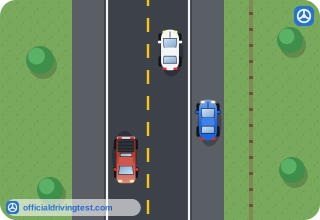
- Raise the hood, turn on the emergency flashers and call for help
- Leave the vehicle in the traffic lane and walk away to find help
- Keep trying to restart it until the battery dies
- Place the vehicle in gear and push it
Show answer
Correct answer: Raise the hood, turn on the emergency flashers and call for help
If the engine will not restart, you raise the hood, turn on the emergency flashers and call for help.
Source: Kansas Driving Handbook (Revised February 2022), page 75
-
Which can cause accelerator failure?
- A flat tire or a steering wheel that is loose
- A dirty windshield or a horn that does not work
- A broken spring or a pedal stuck in the down position
- A full fuel tank or an engine that is still cold
Show answer
Correct answer: A broken spring or a pedal stuck in the down position
Accelerator failure could be caused by either a broken spring or the pedal getting stuck in the down position.
Source: Kansas Driving Handbook (Revised February 2022), page 75
-
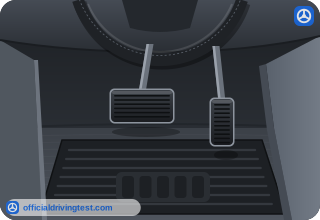
The accelerator is stuck. What should you do first?
- Turn off the ignition and lock the steering
- Brake as hard as you can in gear
- Pump the accelerator several times
- Shift to neutral and search for an escape path
Show answer
Correct answer: Shift to neutral and search for an escape path
In either case of accelerator failure you shift to neutral and search for an escape path.
Source: Kansas Driving Handbook (Revised February 2022), page 75
-
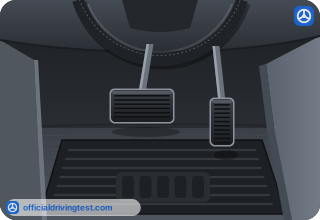
After shifting to neutral because the accelerator is stuck, how should you steer and brake?
- Steer sharply and brake as hard as you can
- Steer smoothly, brake gently and pull off the roadway
- Keep steering straight and do not brake
- Turn the wheel as far as it goes and release the brake
Show answer
Correct answer: Steer smoothly, brake gently and pull off the roadway
You steer smoothly, brake gently and pull off the roadway.
Source: Kansas Driving Handbook (Revised February 2022), page 75
-
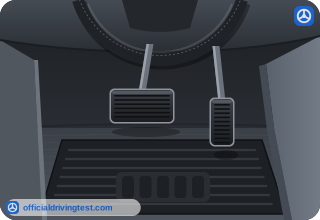
After the vehicle is stopped with a stuck accelerator, what should you do before driving again?
- Restart the engine and test the pedal again on the road
- Adjust the pedal yourself at the side of the road and go
- Turn off the vehicle and have the pedal repaired at a service center
- Drive slowly and carefully to the nearest service center for repairs
Show answer
Correct answer: Turn off the vehicle and have the pedal repaired at a service center
The vehicle should be turned off and the pedal repaired at a service center before driving again.
Source: Kansas Driving Handbook (Revised February 2022), page 75
-
What is "panic steering" after your wheels drop off the edge of the pavement?
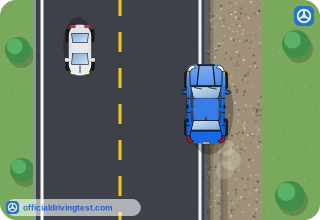
- Trying to return to the pavement as soon as your wheels leave it
- Steering straight ahead while easing off the accelerator
- Braking gently while keeping the wheel steady
- Driving entirely onto the shoulder and stopping
Show answer
Correct answer: Trying to return to the pavement as soon as your wheels leave it
Panic steering means trying to get back onto the pavement the moment the wheels leave it, which can lead to too much steering input before you have slowed down.
Source: Kansas Driving Handbook (Revised February 2022), page 76
-
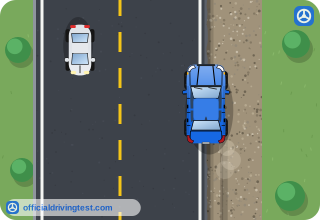
Your wheels leave the pavement. How should you slow down?
- Brake as hard as you can to stop quickly
- Press the accelerator to pull back onto the road
- Ease off the accelerator and brake gently, not hard
- Jerk the steering wheel back toward the road
Show answer
Correct answer: Ease off the accelerator and brake gently, not hard
Braking hard can put the vehicle into a skid and make it hard to steer, so ease off the accelerator and apply the brakes gently.
Source: Kansas Driving Handbook (Revised February 2022), page 76
-
After your wheels leave the pavement, you steer straight ahead and slow to what speed or less?
- 15 mph
- 25 mph
- 35 mph
- 45 mph
Show answer
Correct answer: 25 mph
When recovering from an uneven surface drop-off, you steer straight ahead and slow to 25 mph or less.
Source: Kansas Driving Handbook (Revised February 2022), page 76
-
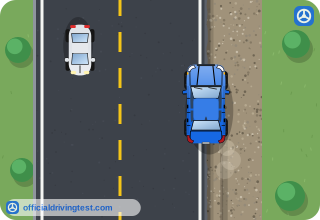
Why should you straddle the pavement edge when returning to the road after a drop-off?
- It lets you speed up to return to the road sooner
- It keeps both wheels on the soft shoulder for better grip
- It means you can skip slowing down before the return
- It keeps the inside edge of your tires from rubbing
Show answer
Correct answer: It keeps the inside edge of your tires from rubbing
Straddling the pavement edge keeps the inside edge of the tires from rubbing and lets you approach the edge at a higher angle, which helps the tire return to the road.
Source: Kansas Driving Handbook (Revised February 2022), page 76
-
When there is a gap in traffic from all directions, about how far should you turn the steering wheel to return to the pavement after a drop-off?
- About a half turn
- About one full turn
- About one quarter-turn
- About two full turns
Show answer
Correct answer: About one quarter-turn
You turn the steering wheel about one quarter-turn to return to the pavement and must not oversteer.
Source: Kansas Driving Handbook (Revised February 2022), page 76
-
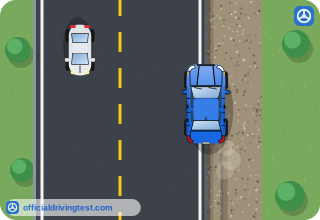
Traffic is heavy when you leave the road and the shoulder is wide. What should you do?
- Drive entirely onto the shoulder and stop
- Steer back onto the pavement at once
- Keep driving along the shoulder at full speed
- Stop with one set of wheels still on the pavement
Show answer
Correct answer: Drive entirely onto the shoulder and stop
With heavy traffic and a wide shoulder, you drive entirely onto the shoulder, stop, and wait for a large gap in traffic before you reenter.
Source: Kansas Driving Handbook (Revised February 2022), page 76
-
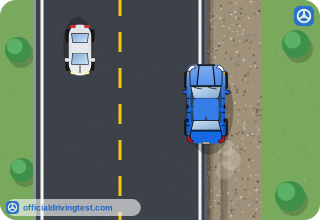
What should you do if you cannot get your vehicle back onto the pavement after leaving the road?
- Keep trying to steer back onto the pavement at speed
- Stop in the lane of travel and leave the vehicle
- Back up along the road until you reach pavement
- Pull as far from the road as possible and wait for help
Show answer
Correct answer: Pull as far from the road as possible and wait for help
If you cannot get back onto the pavement, you should pull as far from the road as possible and wait for help.
Source: Kansas Driving Handbook (Revised February 2022), page 76
-
Why are rollover crashes more common for SUVs, vans, pickups, and small trucks than for passenger cars?
- Their tires wear out much faster than car tires
- Their higher centers of gravity make them top heavy
- Their brakes are weaker than those of cars
- Their drivers are generally less experienced
Show answer
Correct answer: Their higher centers of gravity make them top heavy
These vehicles have higher centers of gravity, which makes them top heavy and more likely to tip over.
Source: Kansas Driving Handbook (Revised February 2022), page 76
-
Which of these can increase the chances of a rollover?
- Driving with a nearly empty vehicle
- Lowering the height of the vehicle
- Driving below the posted speed limit
- Additional cargo and passengers
Show answer
Correct answer: Additional cargo and passengers
Additional cargo and passengers can increase the chances of a rollover, as can a higher center of gravity.
Source: Kansas Driving Handbook (Revised February 2022), page 76
-
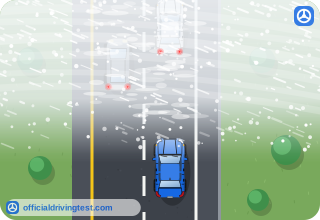
What should you do when bad weather limits visibility so much that you may not be able to see well enough to drive?
- Follow the taillights of the vehicle ahead of you
- Pull off the roadway in a safe place and wait until it clears
- Drive on slowly in the center of the lane
- Stop in the traffic lane and turn on your hazard flashers
Show answer
Correct answer: Pull off the roadway in a safe place and wait until it clears
When adverse weather limits visibility that much, you should pull off the roadway in a safe place and wait until it clears.
Source: Kansas Driving Handbook (Revised February 2022), page 77
-
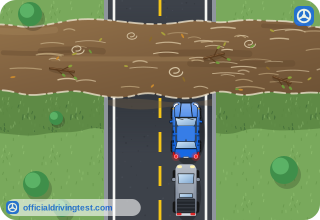
How quickly can flash floods occur?
- Within a few minutes or hours of excessive rainfall
- Only after several days of steady rainfall
- Only after snow has melted in the spring
- Only after a river has been rising for a full day
Show answer
Correct answer: Within a few minutes or hours of excessive rainfall
Flash floods can come rapidly and unexpectedly, within a few minutes or hours of excessive rainfall.
Source: Kansas Driving Handbook (Revised February 2022), page 91
-
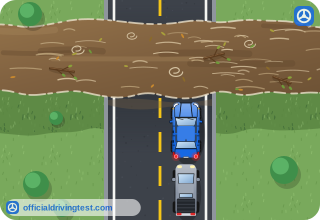
Where can floodwaters be found?
- Only on roads next to rivers
- On roads, bridges and low areas
- Only in low areas near streams
- Only on gravel and dirt roads
Show answer
Correct answer: On roads, bridges and low areas
Floodwaters can be found on roads, bridges and low areas.
Source: Kansas Driving Handbook (Revised February 2022), page 91
-
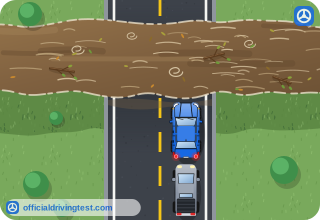
What should you do if you see a flooded roadway ahead?
- Drive through slowly in a low gear
- Follow the vehicle ahead through the water
- Cross only if the water looks shallow
- Turn around and find another route
Show answer
Correct answer: Turn around and find another route
Do not drive through flooded areas; turn around and find another route to your destination.
Source: Kansas Driving Handbook (Revised February 2022), page 91
-
How much water will reach the bottom of most passenger cars, causing loss of control or possible stalling?
- 6 inches
- 2 inches
- 12 inches
- 18 inches
Show answer
Correct answer: 6 inches
Six inches of water will reach the bottom of most passenger cars, causing loss of control or possible stalling.
Source: Kansas Driving Handbook (Revised February 2022), page 91
-
How much rushing water can carry away most vehicles?
- 3 inches
- 8 inches
- 2 feet
- 1 foot
Show answer
Correct answer: 2 feet
Two feet of rushing water can carry away most vehicles.
Source: Kansas Driving Handbook (Revised February 2022), page 91
-
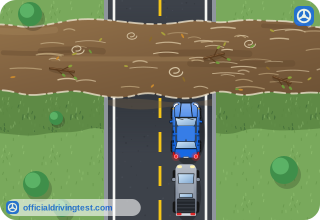
Why should you not try to cross a flooded road even when the water appears shallow?
- Shallow water always contains debris that can block the exhaust pipe
- Floodwater is too cold for the tires to grip the road surface
- Water can hide dips and floodwaters can wash away the road beneath
- Tires lose air pressure whenever they are in standing water
Show answer
Correct answer: Water can hide dips and floodwaters can wash away the road beneath
Water can hide dips, and floodwaters can damage roadways by washing away the underlying road surface.
Source: Kansas Driving Handbook (Revised February 2022), page 91
-
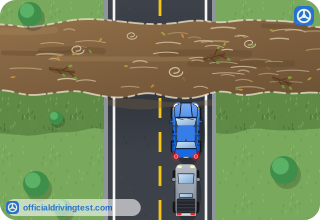
If there is no other route around a flooded road, what should you do?
- Proceed to higher ground and wait for the waters to subside
- Wait at the edge of the water for a tow truck
- Drive through at the narrowest part of the flooding
- Park in the lowest spot nearby and keep the engine on
Show answer
Correct answer: Proceed to higher ground and wait for the waters to subside
If there is no other route, you should go to higher ground and wait for the waters to subside.
Source: Kansas Driving Handbook (Revised February 2022), page 91
-
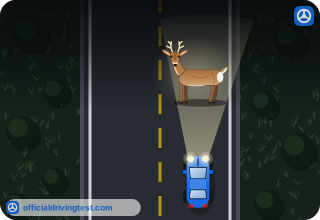
What does the manual say about swerving to avoid an animal that suddenly runs in front of your vehicle?
- Swerve into the next lane if it looks clear of traffic
- Swerve onto the shoulder to be safe from the animal
- Do not swerve into oncoming traffic or off the roadway
- Swerve only if the animal is a deer or other big game
Show answer
Correct answer: Do not swerve into oncoming traffic or off the roadway
Do not swerve into oncoming traffic or off the roadway to avoid hitting the animal.
Source: Kansas Driving Handbook (Revised February 2022), page 92
-
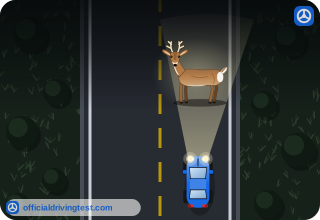
Compared with hitting a large animal such as a deer, what may the drastic action taken to avoid it result in?
- A more serious crash than hitting the animal
- A smaller crash with less damage
- No crash, because deer move out of the way
- Only minor damage to the tires
Show answer
Correct answer: A more serious crash than hitting the animal
The size of a big game animal may cause drastic action that results in a more serious crash than hitting the animal.
Source: Kansas Driving Handbook (Revised February 2022), page 92
-
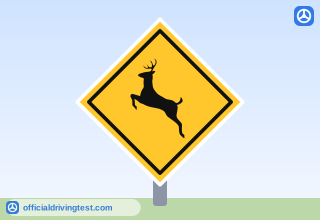
When are animals most active, so that you should use extra caution?
- At midday and from June through August
- Only after dark and from March through May
- Only at noon and from January through March
- At dawn and dusk and from October through December
Show answer
Correct answer: At dawn and dusk and from October through December
Use caution at dawn and dusk and between October and December, when animals are most active.
Source: Kansas Driving Handbook (Revised February 2022), page 92
-
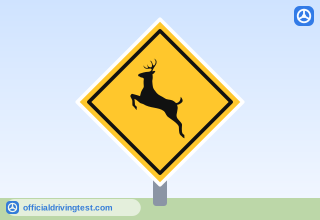
Why are deer crossing signs placed where they are?
- Wildlife agencies release deer in and around those areas
- Those areas have had a large number of deer/vehicle collisions
- Hunting is allowed along the roads in those areas
- Those roads have no fences or guardrails along the edge
Show answer
Correct answer: Those areas have had a large number of deer/vehicle collisions
Deer crossing signs are placed in areas that have had a large number of deer/vehicle collisions.
Source: Kansas Driving Handbook (Revised February 2022), page 92
-
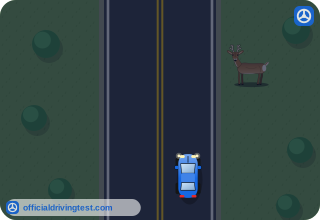
At night, what should you watch for as you scan the sides of the road for animals?
- The reflection of your headlights in the eyes of animals
- Animal tracks leading across the shoulder of the road
- Shadows moving across the lanes ahead of your vehicle
- Tire marks that lead off the pavement into the ditch
Show answer
Correct answer: The reflection of your headlights in the eyes of animals
Scanning the road sides for the reflection of your headlights in animals' eyes helps you spot them, especially near woods and water.
Source: Kansas Driving Handbook (Revised February 2022), page 92
-
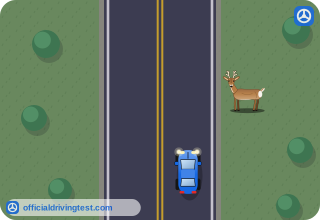
What should you do when approaching animals that are standing near the roadway?
- Speed up so they run off before you arrive
- Move to the center of the lane and keep your speed
- Slow down and use caution
- Stop in the lane and wait for them to leave
Show answer
Correct answer: Slow down and use caution
You should slow down and use caution when approaching animals standing near the roadway.
Source: Kansas Driving Handbook (Revised February 2022), page 92
-
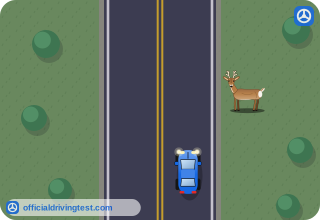
Why should you slow down and use caution when deer are standing near the roadway?
- They will wait quietly until your vehicle has passed by
- They may bolt at the last minute, and other deer may be following
- They always walk away from the road when a vehicle nears it
- They cannot hear a vehicle that approaches from behind
Show answer
Correct answer: They may bolt at the last minute, and other deer may be following
Animals near the road may bolt or change direction at the last minute, and other deer may follow because they travel in groups.
Source: Kansas Driving Handbook (Revised February 2022), page 92
-
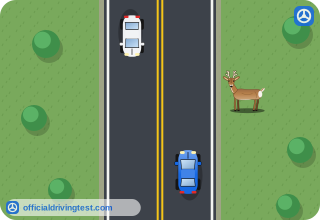
How can you warn other drivers when you spot animals on or near the road?
- Use your turn signal on the side where the animals are
- Roll down your window and wave
- Park on the shoulder beside the animals
- Use your flashers or a headlight signal
Show answer
Correct answer: Use your flashers or a headlight signal
You can use flashers or a headlight signal to warn other drivers when animals are spotted on or near the road.
Source: Kansas Driving Handbook (Revised February 2022), page 92
-
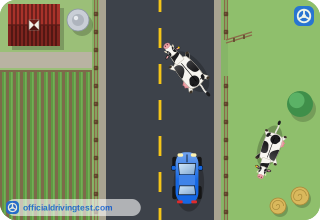
If you think you have time to avoid hitting an animal, what should you do?
- Accelerate to pass ahead of the animal
- Stop at once and turn off your headlights
- Swerve into the opposite lane and brake lightly
- Reduce your speed, tap your brakes and sound your horn
Show answer
Correct answer: Reduce your speed, tap your brakes and sound your horn
Reduce your speed, tap your brakes to warn other drivers and sound your horn.
Source: Kansas Driving Handbook (Revised February 2022), page 92
-
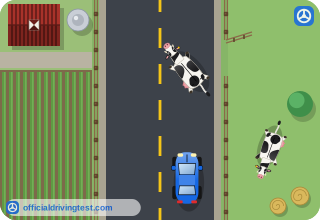
An animal is in your path and no vehicles are close behind you. How should you brake?
- Brake lightly so you do not frighten the animal
- Brake hard but do not lock the wheels and cause a skid
- Lock the wheels to stop as quickly as possible
- Do not brake and coast toward the animal
Show answer
Correct answer: Brake hard but do not lock the wheels and cause a skid
If no vehicles are close behind, brake hard but do not lock the wheels, which would cause a skid.
Source: Kansas Driving Handbook (Revised February 2022), page 92
-
If a collision with an animal is inevitable, what should you do?
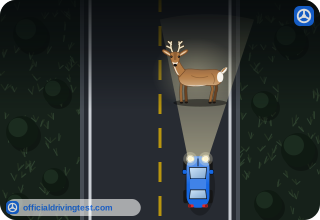
- Swerve to protect yourself from injury
- Steer onto the shoulder and brake hard
- Keep your vehicle under control and on the roadway
- Brace yourself and take your hands off the wheel
Show answer
Correct answer: Keep your vehicle under control and on the roadway
Do not swerve; keep your vehicle under control and on the roadway when you hit the animal.
Source: Kansas Driving Handbook (Revised February 2022), page 92
-
When should you report a crash with an animal to the police?
- When it involves a large animal such as a deer or farm animal
- Only when the animal that was hit is a domestic pet
- Only when your vehicle is too damaged to be driven away
- Only when the animal has died at the scene of the crash
Show answer
Correct answer: When it involves a large animal such as a deer or farm animal
A crash involving a large animal such as a deer or farm animal should be reported to the police.
Source: Kansas Driving Handbook (Revised February 2022), page 93
-
You hit a domestic pet and homes are nearby. What should you do?
- Go inside the nearest home to look for the pet's owner
- Try to notify the pet's owner, but do not go inside a home
- Leave the area without contacting anyone about the pet
- Wait in your vehicle until the owner finds you there
Show answer
Correct answer: Try to notify the pet's owner, but do not go inside a home
Try to notify the pet's owner if possible, but do not go inside someone's home.
Source: Kansas Driving Handbook (Revised February 2022), page 93
-
How should you handle a dog that is chasing your vehicle?
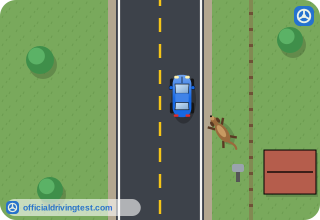
- Speed up at once to outrun the dog before it reaches you
- Stop in the road and wait for the dog to lose interest
- Swerve back and forth across the lane to avoid the dog
- Slow down until it is near, then accelerate away from it
Show answer
Correct answer: Slow down until it is near, then accelerate away from it
Dogs that chase vehicles tend to approach in a straight line, so slow down until the dog is near your vehicle and then accelerate away.
Source: Kansas Driving Handbook (Revised February 2022), page 93
-
Where are dogs likely to be seen on the roadway?
- In residential, rural or farm areas
- Only on interstate highways
- Only in downtown business districts
- Only near railroad crossings
Show answer
Correct answer: In residential, rural or farm areas
Dogs are likely to be seen in residential, rural or farm areas.
Source: Kansas Driving Handbook (Revised February 2022), page 93
-
How should a winter survival kit be kept?
- It should be taken out of the vehicle after each trip
- It should be packed only before a long trip in winter weather
- It should be replaced in full once at the start of each winter
- It should always stay in the vehicle and be replenished after use
Show answer
Correct answer: It should always stay in the vehicle and be replenished after use
A survival kit should always remain in the vehicle and be replenished after each use.
Source: Kansas Driving Handbook (Revised February 2022), page 109
-
Which item does the manual list as part of a winter survival kit?
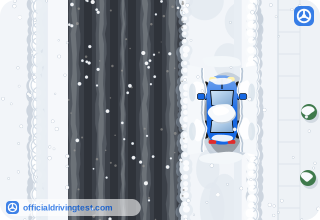
- A spare can of gasoline for emergencies
- Matches in a waterproof container
- A portable charcoal heater for warmth
- An extra car battery for jump starts
Show answer
Correct answer: Matches in a waterproof container
The kit includes matches in a waterproof container, along with blankets, woolen gloves, socks and a hat.
Source: Kansas Driving Handbook (Revised February 2022), page 109
-
Which foods does the manual give as examples for a winter survival kit?
- Salted crackers, canned soup and processed cheese
- Fresh fruit, sandwiches and fresh vegetables
- Unsalted canned nuts, dried fruits and hard candy
- Chocolate bars, bottled juice and potato chips
Show answer
Correct answer: Unsalted canned nuts, dried fruits and hard candy
The kit should hold water and non-perishable foods that give you energy, such as unsalted canned nuts, dried fruits and hard candy.
Source: Kansas Driving Handbook (Revised February 2022), page 109
-
If you become stranded while traveling in cold weather, what should you do?
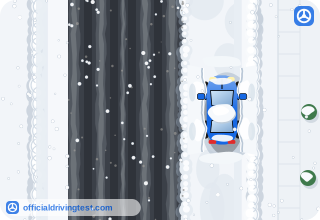
- Stay with your vehicle unless you know exactly where you are and how far help is
- Leave your vehicle at once and walk along the road until you find help
- Leave your vehicle as soon as the snow stops falling and go look for help
- Stay with your vehicle only until the first hour has passed, then go for help
Show answer
Correct answer: Stay with your vehicle unless you know exactly where you are and how far help is
Do not leave your vehicle unless you know exactly where you are and how far it is to help.
Source: Kansas Driving Handbook (Revised February 2022), page 109
-
If you are stranded in cold weather, which lights should you turn on?
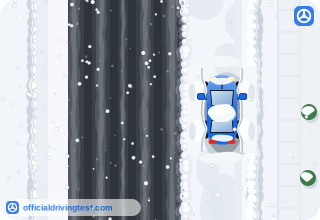
- Your high beam headlights
- Your hazard warning lights
- Your interior dome light only
- Your fog lights
Show answer
Correct answer: Your hazard warning lights
One tip for a stranded driver is to turn on the hazard warning lights.
Source: Kansas Driving Handbook (Revised February 2022), page 109
-
If you are stranded in cold weather, where should you place two lit flares to attract attention?
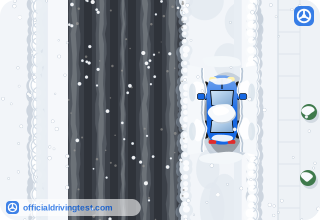
- Both on the roof of the vehicle so they are seen
- Both beside the driver's door where you can reach them
- Both on the hood of the vehicle, in front of the windshield
- One at each end of the vehicle, a safe distance away
Show answer
Correct answer: One at each end of the vehicle, a safe distance away
To attract attention, light two flares and place one at each end of the vehicle a safe distance away.
Source: Kansas Driving Handbook (Revised February 2022), page 109
-
What should you hang from your driver side window, mirror, or door handle to attract attention when stranded in cold weather?
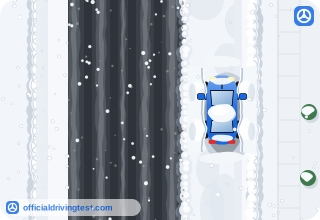
- A brightly colored cloth
- A flashlight on a string
- Your vehicle registration
- A dark-colored blanket
Show answer
Correct answer: A brightly colored cloth
Hanging a brightly colored cloth from the driver side window, mirror or door handle helps attract attention.
Source: Kansas Driving Handbook (Revised February 2022), page 109
-
Why should you keep the exhaust pipe clear of snow and debris when stranded in cold weather?
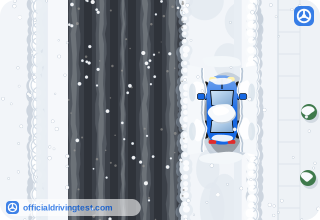
- The engine will overheat quickly if snow blocks the pipe
- Snow in the pipe can freeze the tires to the ground below
- Fumes can leak into the vehicle and cause you to black out or die
- The battery cannot charge while the exhaust pipe is blocked
Show answer
Correct answer: Fumes can leak into the vehicle and cause you to black out or die
Exhaust fumes can leak into the vehicle and can cause you to black out or even cause death.
Source: Kansas Driving Handbook (Revised February 2022), page 109
-
When stranded, how long is it recommended to run the engine each hour to charge the battery and warm the interior?
- Approximately 30 minutes
- Approximately 45 minutes
- Approximately 10 minutes
- The whole hour without stopping
Show answer
Correct answer: Approximately 10 minutes
Running the engine for approximately 10 minutes each hour is recommended, then turn it off.
Source: Kansas Driving Handbook (Revised February 2022), page 109
-
Even in extremely cold weather, what should you do about ventilation in a stranded vehicle?
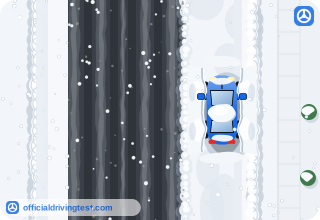
- Leave at least one window partially open to let fresh air in
- Keep all windows tightly closed to hold in heat
- Open all of the doors for a few minutes every hour
- Keep the vents on and the windows closed
Show answer
Correct answer: Leave at least one window partially open to let fresh air in
Leave at least one window partially open, because occupants of an idling vehicle can suffer carbon monoxide poisoning if ventilation is not adequate.
Source: Kansas Driving Handbook (Revised February 2022), page 109
-
When people are stranded together in a vehicle in cold weather, how many of them should stay awake?
- Everyone should sleep to save body heat
- Everyone should stay awake until help arrives
- Only the passengers should rest while the driver sleeps
- At least one person should always remain awake
Show answer
Correct answer: At least one person should always remain awake
At least one person in the vehicle should always remain awake.
Source: Kansas Driving Handbook (Revised February 2022), page 109
-
What should you use to protect yourself from frostbite and hypothermia when stranded in cold weather?
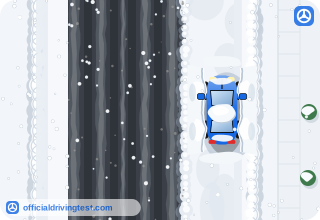
- The engine and heater running at all times
- Woolen items and blankets
- Light cotton clothing in layers
- Sunglasses and a pair of gloves
Show answer
Correct answer: Woolen items and blankets
To protect yourself from frostbite and hypothermia, use woolen items and blankets to keep warm.
Source: Kansas Driving Handbook (Revised February 2022), page 109
-
If you spot a tornado while driving, what should you do?
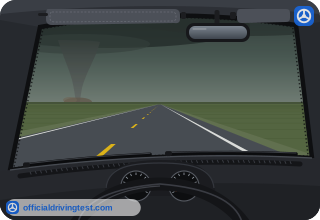
- Leave the vehicle for sturdy shelter or drive out of the tornado's path
- Park under a bridge or overpass and stay in the vehicle
- Stay in your vehicle on the shoulder and wait for it to pass
- Drive toward the tornado to get through it quickly
Show answer
Correct answer: Leave the vehicle for sturdy shelter or drive out of the tornado's path
Either leave the vehicle for sturdy shelter or drive out of the tornado's path, and avoid seeking shelter under bridges or overpasses.
Source: Kansas Driving Handbook (Revised February 2022), page 110
-
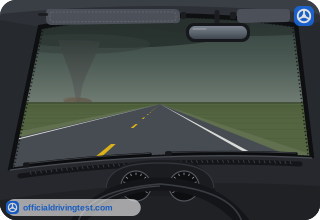
Why should you avoid seeking shelter under a bridge or overpass during a tornado?
- Lightning is more likely to strike a bridge
- Winds are stronger beneath the overpass due to a wind tunnel effect
- Bridges are often used as staging areas by emergency vehicles
- Overpasses are more likely to flood than other places
Show answer
Correct answer: Winds are stronger beneath the overpass due to a wind tunnel effect
If a tornado moves through, winds will be stronger beneath the overpass due to a wind tunnel effect, and bridges provide little protection from flying objects.
Source: Kansas Driving Handbook (Revised February 2022), page 110
-
Which type of vehicle will protect you in a lightning storm?
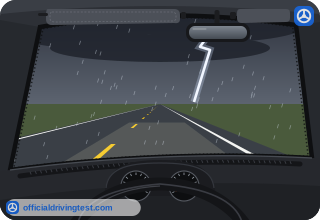
- A convertible with the top down
- A soft-top vehicle with the top raised
- Any vehicle parked under a tree
- A hard-topped vehicle
Show answer
Correct answer: A hard-topped vehicle
Only a hard-topped vehicle will protect you in a lightning storm.
Source: Kansas Driving Handbook (Revised February 2022), page 110
-
In a vehicle during a lightning storm, what should you do with the doors and windows?
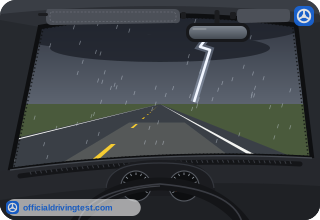
- Make sure all doors are closed and windows are up
- Keep the windows slightly open for fresh air
- Keep the doors unlocked in case you need to leave
- Open the windows so the storm noise does not startle you
Show answer
Correct answer: Make sure all doors are closed and windows are up
In a hard-topped vehicle during a lightning storm, make sure all doors are closed and windows are up.
Source: Kansas Driving Handbook (Revised February 2022), page 110
-
In a vehicle during a lightning storm, what should you not touch?
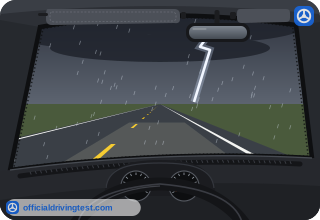
- The plastic parts of the dashboard
- The rubber floor mats
- Any metal surfaces
- The seat belt buckle
Show answer
Correct answer: Any metal surfaces
During a lightning storm you should not touch any metal surfaces.
Source: Kansas Driving Handbook (Revised February 2022), page 110
-
In a vehicle during a lightning storm, which kind of radio should you not use?
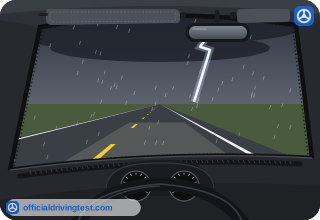
- A radio that plays only music from a phone or player
- A radio with the volume turned down to a very low level
- A radio connected to an external antenna on the vehicle
- A hand-held radio with its own built-in antenna
Show answer
Correct answer: A radio connected to an external antenna on the vehicle
Do not use radios connected to an external antenna mounted on the vehicle during a lightning storm.
Source: Kansas Driving Handbook (Revised February 2022), page 110
-
Other than a hard-topped vehicle, where is the safest place to be during a thunderstorm?
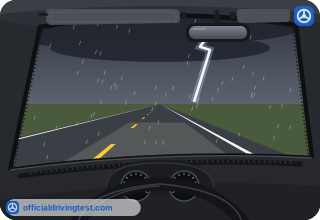
- Inside a well-built building with plumbing and electric wiring
- Under a large tree that stands well away from the road
- In an open field a good distance away from any vehicles
- Under a highway bridge or overpass close to the storm
Show answer
Correct answer: Inside a well-built building with plumbing and electric wiring
Otherwise, the safest place during a thunderstorm is inside a well-constructed building with plumbing and electric wiring.
Source: Kansas Driving Handbook (Revised February 2022), page 110
-
If you are in a vehicle in the water and cannot open the door or window, where will there be a small air pocket?
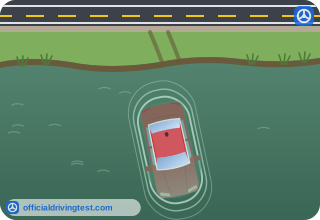
- Near the part of the vehicle that is lowest in the water
- Under the dashboard on the driver's side
- Near the floor behind the front seats
- Near the part of the vehicle that is highest in the water
Show answer
Correct answer: Near the part of the vehicle that is highest in the water
There will be a small air pocket near the part of the vehicle which is highest in the water.
Source: Kansas Driving Handbook (Revised February 2022), page 110
-
If you are in a vehicle in the water and cannot get a side window open, what should you do?
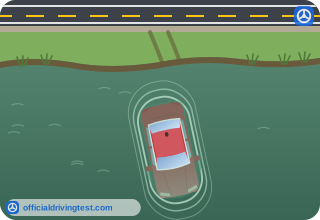
- Wait inside until the water stops rising
- Take a breath and kick the window out
- Break the windshield with your hands
- Sound the horn until help comes
Show answer
Correct answer: Take a breath and kick the window out
Take a breath and kick the window out, then go to the air pocket for one more breath and escape.
Source: Kansas Driving Handbook (Revised February 2022), page 110