Kansas: Emergencies — Part 2 Practice Test
Questions in this part include: “When may it be best or necessary to accelerate to avoid a collision?” · “After you have accelerated to avoid a collision, what should you do once the danger has passed?”
Independent educational site · not affiliated with any government agency or DMV
Ready? Test yourself
- Instant feedback with an explanation
- Every answer cites its source in the manual
- Your best score is saved on this device
Questions are original and based on the official manual "Kansas Driving Handbook" (Revised February 2022), Kansas Department of Revenue, Division of Vehicles.
All 18 questions in this practice test
Take the test above first, then use this list to study. Tap “Show answer” to see the correct answer and explanation.
Show the questions and answersHide the questions
-
You must steer quickly and do not have an anti-lock braking system. What should you do about braking while steering?
- Brake as hard as you can while you steer
- Lock the brakes before you start to steer
- Pump the brakes hard throughout the turn
- Avoid hard braking while steering, if possible
Show answer
Correct answer: Avoid hard braking while steering, if possible
Without ABS you avoid hard braking while steering, if possible.
Source: Kansas Driving Handbook (Revised February 2022), page 73
-
Without ABS, when can you begin to brake harder after steering to avoid a collision?
- Once you are on your intended path and the vehicle is straight
- As soon as you begin to turn the steering wheel
- Only after the vehicle has come to a complete stop on the shoulder
- Once you have crossed over the center line
Show answer
Correct answer: Once you are on your intended path and the vehicle is straight
After you have steered to your intended path and the vehicle is straight, you can begin to brake harder.
Source: Kansas Driving Handbook (Revised February 2022), page 73
-
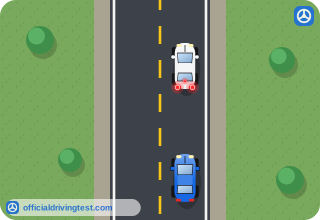
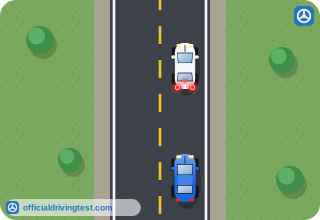
When may it be best or necessary to accelerate to avoid a collision?
- When a vehicle is about to hit you head on and there is room behind you
- When you are approaching a red traffic signal
- When a vehicle is about to hit you from the side or behind and there is room ahead
- When a pedestrian is about to step in front of your vehicle
Show answer
Correct answer: When a vehicle is about to hit you from the side or behind and there is room ahead
Accelerating may be needed when a vehicle is about to hit you from the side or behind and there is room in front of your vehicle to get out of danger.
Source: Kansas Driving Handbook (Revised February 2022), page 73
-
After you have accelerated to avoid a collision, what should you do once the danger has passed?
- Keep accelerating
- Brake as hard as you can
- Switch off the engine
- Slow down
Show answer
Correct answer: Slow down
The manual says to be sure to slow down once the danger has passed.
Source: Kansas Driving Handbook (Revised February 2022), page 73
-
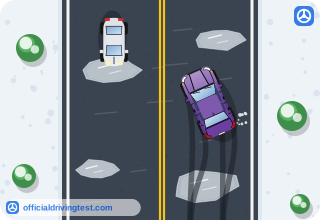
Which of these causes a vehicle to skid?
- Driving slower than the speed limit
- Stopping too suddenly
- Keeping both hands on the steering wheel
- Applying the brakes gradually
Show answer
Correct answer: Stopping too suddenly
Skids are caused when you are traveling too fast for conditions, when you stop too suddenly or when the tires can no longer grip the roadway.
Source: Kansas Driving Handbook (Revised February 2022), page 74
-
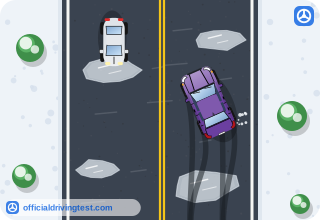
What does the manual say about controlling a vehicle while it is skidding?
- You can control it if you steer hard against the skid
- You can control it if you brake as hard as possible
- You cannot control it, so it is best to avoid a skid
- You can control it if you accelerate away from the skid
Show answer
Correct answer: You cannot control it, so it is best to avoid a skid
As you cannot control a vehicle when it is skidding, it is best to avoid a skid in the first place.
Source: Kansas Driving Handbook (Revised February 2022), page 74
-
When your vehicle begins to lose traction, where should you look?
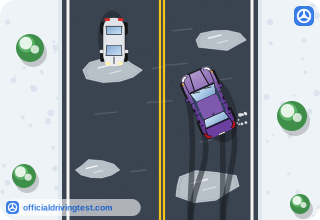
- For open space, and not at the hazard
- At the hazard you are trying to avoid
- At the speedometer to check your speed
- Into the oncoming lane to see what is coming
Show answer
Correct answer: For open space, and not at the hazard
You must pay attention to where your vehicle can go and not fixate on the hazard you are trying to avoid.
Source: Kansas Driving Handbook (Revised February 2022), page 74
-
When your vehicle begins to lose traction, why should you lift off the pedals?
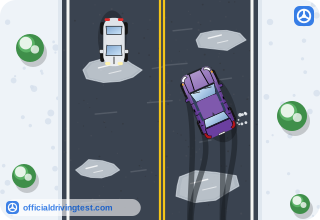
- To release brake or accelerator pressure and see which tires lost traction
- To let the engine cool down while the tires grip again on the road
- To shift the vehicle into neutral before you steer
- To signal other drivers that you are losing control of the vehicle
Show answer
Correct answer: To release brake or accelerator pressure and see which tires lost traction
Releasing the pedals lets you determine if the vehicle is losing traction to the front or rear tires.
Source: Kansas Driving Handbook (Revised February 2022), page 74
-
While you are steering, the vehicle continues straight. What does this mean?
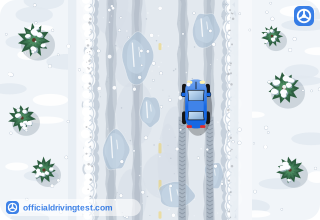
- Traction is lost to the rear tires
- Traction is lost to all four tires
- Traction is lost to the front tires
- The tires have grip and the steering is working
Show answer
Correct answer: Traction is lost to the front tires
If the vehicle continues straight while steering, traction is lost to the front tires.
Source: Kansas Driving Handbook (Revised February 2022), page 74
-
The vehicle is moving sideways without any additional steering input. What does this mean?
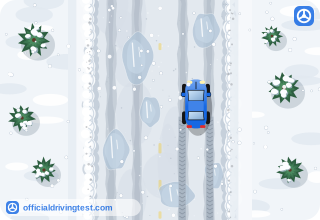
- The front tires have lost traction
- The rear tires have lost traction
- The brakes have failed
- The steering wheel is stuck
Show answer
Correct answer: The rear tires have lost traction
If the vehicle is moving sideways without any additional steering input, the rear tires have lost traction.
Source: Kansas Driving Handbook (Revised February 2022), page 74
-
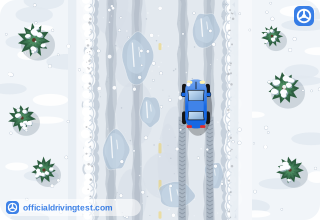
The front tires have lost traction and your vehicle does not have ABS. What should you do with the brakes?
- Brake harder to slow the front tires down quickly
- Hold the brakes at the same pressure while you steer
- Take your foot off the brakes and do not use them again
- Ease off to regain traction, then reapply without skidding
Show answer
Correct answer: Ease off to regain traction, then reapply without skidding
If front traction is lost, you ease off the brakes to regain traction and reapply the brakes without skidding to continue steering.
Source: Kansas Driving Handbook (Revised February 2022), page 74
-
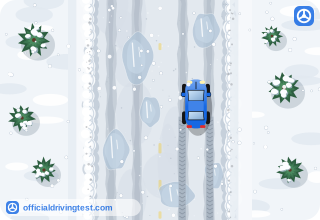
The front tires have lost traction and your vehicle has ABS. What should you do?
- Ease off the brakes completely until the tires grip again
- Pump the brakes lightly several times in a row
- Apply the brakes fully to gain steering control to the front tires
- Release the brakes and use the parking brake instead
Show answer
Correct answer: Apply the brakes fully to gain steering control to the front tires
If the vehicle has ABS, you apply the brakes fully to gain steering control to the front tires.
Source: Kansas Driving Handbook (Revised February 2022), page 74
-
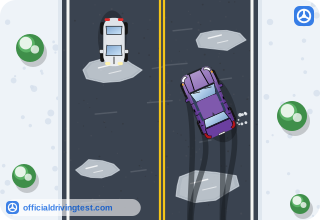
The rear tires have lost traction. How should you steer?
- Steer the way you want to go, and keep steering and counter-steering
- Turn the wheel away from the direction you want to go
- Hold the wheel still until the tires grip the road again
- Turn the wheel sharply toward the oncoming lane to avoid a spin
Show answer
Correct answer: Steer the way you want to go, and keep steering and counter-steering
If rear traction is lost, you turn the steering wheel in the direction of your intended path of travel and continue to steer and counter-steer until the vehicle is traveling straight.
Source: Kansas Driving Handbook (Revised February 2022), page 74
-
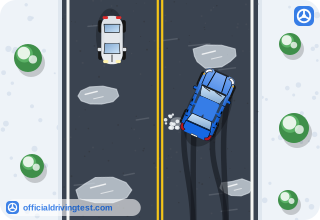
When steering out of a skid caused by rear traction loss, why should you avoid looking into the oncoming lane?
- So that you do not blind the drivers who are coming toward you
- So that your tires can regain their grip sooner
- So that you can watch your speedometer carefully
- So that your vehicle does not travel across the centerline
Show answer
Correct answer: So that your vehicle does not travel across the centerline
You should keep looking in the direction you want to go and avoid looking into the oncoming lane so the vehicle does not travel across the centerline.
Source: Kansas Driving Handbook (Revised February 2022), page 74
-
Your vehicle is equipped with traction technology and begins to skid. What should you do?
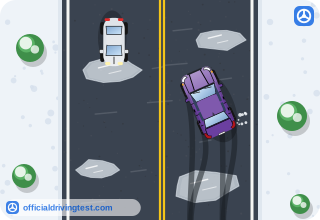
- Turn the steering wheel away from the path of travel
- Keep steering toward the path of travel to aid the vehicle technology
- Let go of the steering wheel so the technology works alone
- Brake as hard as you can and stop steering
Show answer
Correct answer: Keep steering toward the path of travel to aid the vehicle technology
If your vehicle has traction technology, you keep steering toward the path of travel to aid the vehicle technology.
Source: Kansas Driving Handbook (Revised February 2022), page 74
-
Your vehicle is hit from the rear. What should you do with your body?
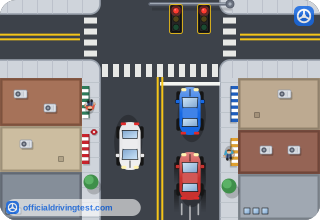
- Lean forward and brace both hands against the dashboard until it is over
- Turn your head to look at the vehicle that is behind you at once
- Duck down below the level of the steering wheel and hold your head
- Press yourself against the seat back and put your head on the head restraint
Show answer
Correct answer: Press yourself against the seat back and put your head on the head restraint
When hit from the rear your head and body are thrown backwards, so you press against the back of the seat and put your head against the head restraint.
Source: Kansas Driving Handbook (Revised February 2022), page 74
-
Your vehicle is hit from the rear. What should you be ready to do so that you will not be pushed into another vehicle?
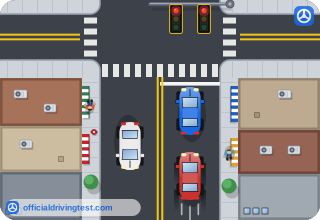
- Apply your brakes
- Steer to the shoulder
- Accelerate
- Shift into reverse
Show answer
Correct answer: Apply your brakes
The manual says to be ready to apply your brakes so that you will not be pushed into another vehicle.
Source: Kansas Driving Handbook (Revised February 2022), page 74
-
Your vehicle is hit from the side. What does the manual say about frontal air bags?
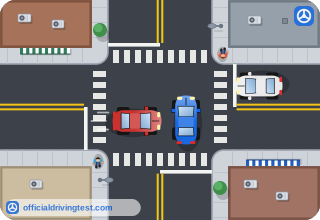
- They protect you better than a safety belt
- They deploy and keep you behind the wheel
- They will not help in this situation
- They are needed only when the vehicle is hit from behind
Show answer
Correct answer: They will not help in this situation
When a vehicle is hit from the side, frontal air bags will not help, so lap and shoulder belts are needed to keep you behind the wheel.
Source: Kansas Driving Handbook (Revised February 2022), page 74