Kansas: Emergencies — Part 5 Practice Test
Questions in this part include: “When should you report a crash with an animal to the police?” · “Where are dogs likely to be seen on the roadway?”
Independent educational site · not affiliated with any government agency or DMV
Ready? Test yourself
- Instant feedback with an explanation
- Every answer cites its source in the manual
- Your best score is saved on this device
Questions are original and based on the official manual "Kansas Driving Handbook" (Revised February 2022), Kansas Department of Revenue, Division of Vehicles.
All 18 questions in this practice test
Take the test above first, then use this list to study. Tap “Show answer” to see the correct answer and explanation.
Show the questions and answersHide the questions
-
Compared with hitting a large animal such as a deer, what may the drastic action taken to avoid it result in?
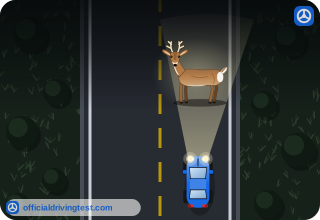
- A more serious crash than hitting the animal
- A smaller crash with less damage
- No crash, because deer move out of the way
- Only minor damage to the tires
Show answer
Correct answer: A more serious crash than hitting the animal
The size of a big game animal may cause drastic action that results in a more serious crash than hitting the animal.
Source: Kansas Driving Handbook (Revised February 2022), page 92
-
When are animals most active, so that you should use extra caution?
- At midday and from June through August
- Only after dark and from March through May
- Only at noon and from January through March
- At dawn and dusk and from October through December
Show answer
Correct answer: At dawn and dusk and from October through December
Use caution at dawn and dusk and between October and December, when animals are most active.
Source: Kansas Driving Handbook (Revised February 2022), page 92
-
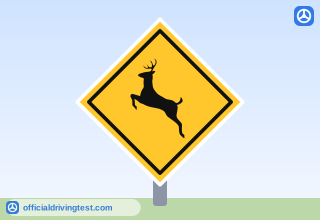
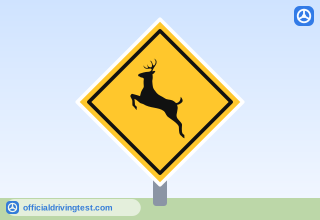
Why are deer crossing signs placed where they are?
- Wildlife agencies release deer in and around those areas
- Those areas have had a large number of deer/vehicle collisions
- Hunting is allowed along the roads in those areas
- Those roads have no fences or guardrails along the edge
Show answer
Correct answer: Those areas have had a large number of deer/vehicle collisions
Deer crossing signs are placed in areas that have had a large number of deer/vehicle collisions.
Source: Kansas Driving Handbook (Revised February 2022), page 92
-
At night, what should you watch for as you scan the sides of the road for animals?
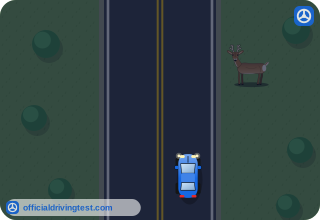
- The reflection of your headlights in the eyes of animals
- Animal tracks leading across the shoulder of the road
- Shadows moving across the lanes ahead of your vehicle
- Tire marks that lead off the pavement into the ditch
Show answer
Correct answer: The reflection of your headlights in the eyes of animals
Scanning the road sides for the reflection of your headlights in animals' eyes helps you spot them, especially near woods and water.
Source: Kansas Driving Handbook (Revised February 2022), page 92
-
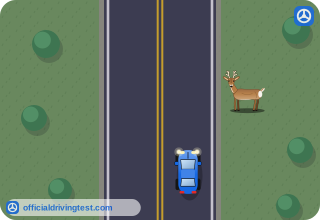
What should you do when approaching animals that are standing near the roadway?
- Speed up so they run off before you arrive
- Move to the center of the lane and keep your speed
- Slow down and use caution
- Stop in the lane and wait for them to leave
Show answer
Correct answer: Slow down and use caution
You should slow down and use caution when approaching animals standing near the roadway.
Source: Kansas Driving Handbook (Revised February 2022), page 92
-
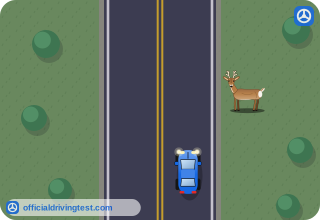
Why should you slow down and use caution when deer are standing near the roadway?
- They will wait quietly until your vehicle has passed by
- They may bolt at the last minute, and other deer may be following
- They always walk away from the road when a vehicle nears it
- They cannot hear a vehicle that approaches from behind
Show answer
Correct answer: They may bolt at the last minute, and other deer may be following
Animals near the road may bolt or change direction at the last minute, and other deer may follow because they travel in groups.
Source: Kansas Driving Handbook (Revised February 2022), page 92
-
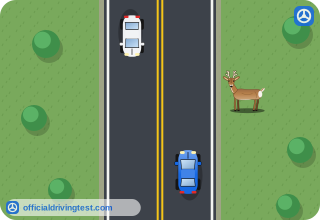
How can you warn other drivers when you spot animals on or near the road?
- Use your turn signal on the side where the animals are
- Roll down your window and wave
- Park on the shoulder beside the animals
- Use your flashers or a headlight signal
Show answer
Correct answer: Use your flashers or a headlight signal
You can use flashers or a headlight signal to warn other drivers when animals are spotted on or near the road.
Source: Kansas Driving Handbook (Revised February 2022), page 92
-
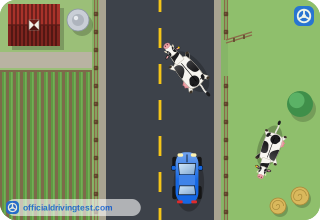
If you think you have time to avoid hitting an animal, what should you do?
- Accelerate to pass ahead of the animal
- Stop at once and turn off your headlights
- Swerve into the opposite lane and brake lightly
- Reduce your speed, tap your brakes and sound your horn
Show answer
Correct answer: Reduce your speed, tap your brakes and sound your horn
Reduce your speed, tap your brakes to warn other drivers and sound your horn.
Source: Kansas Driving Handbook (Revised February 2022), page 92
-
An animal is in your path and no vehicles are close behind you. How should you brake?
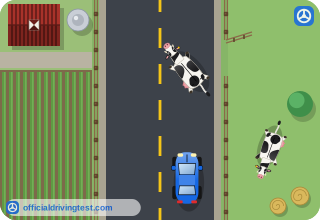
- Brake lightly so you do not frighten the animal
- Brake hard but do not lock the wheels and cause a skid
- Lock the wheels to stop as quickly as possible
- Do not brake and coast toward the animal
Show answer
Correct answer: Brake hard but do not lock the wheels and cause a skid
If no vehicles are close behind, brake hard but do not lock the wheels, which would cause a skid.
Source: Kansas Driving Handbook (Revised February 2022), page 92
-
If a collision with an animal is inevitable, what should you do?
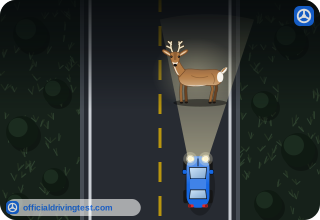
- Swerve to protect yourself from injury
- Steer onto the shoulder and brake hard
- Keep your vehicle under control and on the roadway
- Brace yourself and take your hands off the wheel
Show answer
Correct answer: Keep your vehicle under control and on the roadway
Do not swerve; keep your vehicle under control and on the roadway when you hit the animal.
Source: Kansas Driving Handbook (Revised February 2022), page 92
-
When should you report a crash with an animal to the police?
- When it involves a large animal such as a deer or farm animal
- Only when the animal that was hit is a domestic pet
- Only when your vehicle is too damaged to be driven away
- Only when the animal has died at the scene of the crash
Show answer
Correct answer: When it involves a large animal such as a deer or farm animal
A crash involving a large animal such as a deer or farm animal should be reported to the police.
Source: Kansas Driving Handbook (Revised February 2022), page 93
-
You hit a domestic pet and homes are nearby. What should you do?
- Go inside the nearest home to look for the pet's owner
- Try to notify the pet's owner, but do not go inside a home
- Leave the area without contacting anyone about the pet
- Wait in your vehicle until the owner finds you there
Show answer
Correct answer: Try to notify the pet's owner, but do not go inside a home
Try to notify the pet's owner if possible, but do not go inside someone's home.
Source: Kansas Driving Handbook (Revised February 2022), page 93
-
How should you handle a dog that is chasing your vehicle?
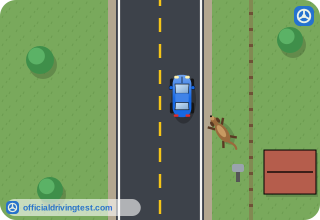
- Speed up at once to outrun the dog before it reaches you
- Stop in the road and wait for the dog to lose interest
- Swerve back and forth across the lane to avoid the dog
- Slow down until it is near, then accelerate away from it
Show answer
Correct answer: Slow down until it is near, then accelerate away from it
Dogs that chase vehicles tend to approach in a straight line, so slow down until the dog is near your vehicle and then accelerate away.
Source: Kansas Driving Handbook (Revised February 2022), page 93
-
Where are dogs likely to be seen on the roadway?
- In residential, rural or farm areas
- Only on interstate highways
- Only in downtown business districts
- Only near railroad crossings
Show answer
Correct answer: In residential, rural or farm areas
Dogs are likely to be seen in residential, rural or farm areas.
Source: Kansas Driving Handbook (Revised February 2022), page 93
-
How should a winter survival kit be kept?
- It should be taken out of the vehicle after each trip
- It should be packed only before a long trip in winter weather
- It should be replaced in full once at the start of each winter
- It should always stay in the vehicle and be replenished after use
Show answer
Correct answer: It should always stay in the vehicle and be replenished after use
A survival kit should always remain in the vehicle and be replenished after each use.
Source: Kansas Driving Handbook (Revised February 2022), page 109
-
Which item does the manual list as part of a winter survival kit?
- A spare can of gasoline for emergencies
- Matches in a waterproof container
- A portable charcoal heater for warmth
- An extra car battery for jump starts
Show answer
Correct answer: Matches in a waterproof container
The kit includes matches in a waterproof container, along with blankets, woolen gloves, socks and a hat.
Source: Kansas Driving Handbook (Revised February 2022), page 109
-
Which foods does the manual give as examples for a winter survival kit?
- Salted crackers, canned soup and processed cheese
- Fresh fruit, sandwiches and fresh vegetables
- Unsalted canned nuts, dried fruits and hard candy
- Chocolate bars, bottled juice and potato chips
Show answer
Correct answer: Unsalted canned nuts, dried fruits and hard candy
The kit should hold water and non-perishable foods that give you energy, such as unsalted canned nuts, dried fruits and hard candy.
Source: Kansas Driving Handbook (Revised February 2022), page 109
-
If you become stranded while traveling in cold weather, what should you do?
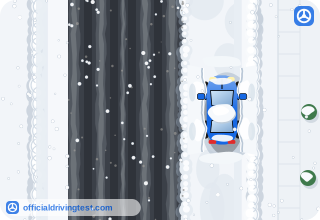
- Stay with your vehicle unless you know exactly where you are and how far help is
- Leave your vehicle at once and walk along the road until you find help
- Leave your vehicle as soon as the snow stops falling and go look for help
- Stay with your vehicle only until the first hour has passed, then go for help
Show answer
Correct answer: Stay with your vehicle unless you know exactly where you are and how far help is
Do not leave your vehicle unless you know exactly where you are and how far it is to help.
Source: Kansas Driving Handbook (Revised February 2022), page 109