Kansas: Emergencies — Part 1 Practice Test
Questions in this part include: “If you must stop because of vehicle trouble, which kind of place should you avoid?” · “What will an anti-lock braking system (ABS) allow you to do?”
Independent educational site · not affiliated with any government agency or DMV
Ready? Test yourself
- Instant feedback with an explanation
- Every answer cites its source in the manual
- Your best score is saved on this device
Questions are original and based on the official manual "Kansas Driving Handbook" (Revised February 2022), Kansas Department of Revenue, Division of Vehicles.
All 18 questions in this practice test
Take the test above first, then use this list to study. Tap “Show answer” to see the correct answer and explanation.
Show the questions and answersHide the questions
-
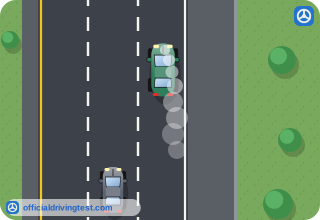
If you are having vehicle trouble and must stop, where should you try to get your vehicle if possible?
- Into the lane with the slowest traffic, where drivers can go around you
- Off the road and away from traffic
- Onto the center of the roadway, where everyone can see it
- Next to the curb of the nearest intersection, even if it blocks the crosswalk
Show answer
Correct answer: Off the road and away from traffic
The manual says to get your vehicle off the road and away from traffic, if possible.
Source: Kansas Driving Handbook (Revised February 2022), page 68
-
If you must stop because of vehicle trouble, which kind of place should you avoid?
- A place where other roadway users have a clear view of your vehicle
- A place off the road and away from traffic, if possible
- A place where you can turn on your emergency flashers
- Just around a curve where visibility is limited
Show answer
Correct answer: Just around a curve where visibility is limited
Other roadway users must be able to see your vehicle, so you should not stop just over a hill or just around a curve where visibility is limited.
Source: Kansas Driving Handbook (Revised February 2022), page 68
-
What should you turn on to show other roadway users that your vehicle is disabled?
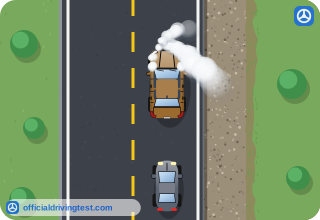
- Your emergency flashers
- Your high beams
- Your windshield wipers
- Your reverse lights
Show answer
Correct answer: Your emergency flashers
If you are having vehicle trouble and must stop, you turn on your emergency flashers to show your vehicle is disabled.
Source: Kansas Driving Handbook (Revised February 2022), page 68
-
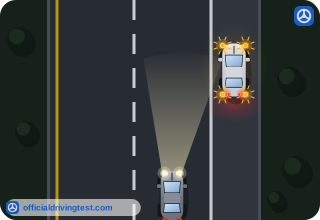
When warning other roadway users of your disabled vehicle, about how far behind the vehicle should you place emergency flares?
- About 50 to 100 feet
- About 400 to 500 feet
- About 200 to 300 feet
- About 600 to 700 feet
Show answer
Correct answer: About 200 to 300 feet
Flares placed about 200 to 300 feet behind the vehicle give other drivers some time to change lanes if necessary.
Source: Kansas Driving Handbook (Revised February 2022), page 69
-
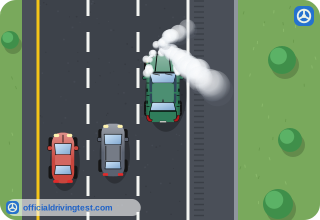
What does the manual say about changing a tire when your vehicle is disabled on the roadway?
- Change it quickly in the lane while your flashers are on
- Change it in the lane, but only if you stand on the side away from traffic
- Change it in the lane after placing flares behind the vehicle
- Do not try to change a tire in traffic lanes
Show answer
Correct answer: Do not try to change a tire in traffic lanes
You should never stand or remain on the roadway and should not try to change a tire in traffic lanes.
Source: Kansas Driving Handbook (Revised February 2022), page 69
-
What does a white cloth attached to a vehicle indicate?
- That the vehicle is being towed
- That the vehicle is disabled
- That the driver is a new driver
- That the vehicle is carrying a wide load
Show answer
Correct answer: That the vehicle is disabled
A white cloth on the antenna, side mirror or door handle signals a disabled vehicle, so tie one on to signal an emergency.
Source: Kansas Driving Handbook (Revised February 2022), page 69
-
Besides tying a white cloth to the vehicle, what else can you do to indicate a disabled vehicle?
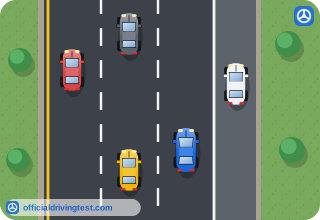
- Open the driver’s door
- Turn off all of your lights
- Lift the hood
- Lower all of the windows
Show answer
Correct answer: Lift the hood
Lifting the hood also tells other roadway users that the vehicle is disabled.
Source: Kansas Driving Handbook (Revised February 2022), page 69
-
In avoiding a collision, what three options do you have?
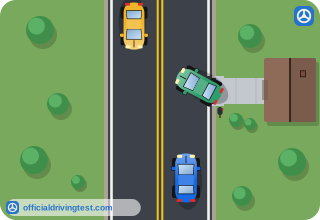
- Brake, honk or signal
- Brake, steer or accelerate
- Steer, signal or park
- Accelerate, honk or reverse
Show answer
Correct answer: Brake, steer or accelerate
The manual says that to avoid a collision you can brake, steer or accelerate.
Source: Kansas Driving Handbook (Revised February 2022), page 73
-
What will an anti-lock braking system (ABS) allow you to do?
- Stop in half the distance
- Brake without pressing the pedal
- Stop without skidding
- Steer without turning the wheel
Show answer
Correct answer: Stop without skidding
The ABS system will allow you to stop without skidding.
Source: Kansas Driving Handbook (Revised February 2022), page 73
-
You have anti-lock brakes and need to stop quickly. What should you do?
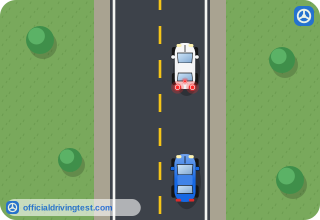
- Press on the brake pedal as hard as you can and keep pressing on it
- Pump the brake pedal quickly and repeatedly until you stop
- Press lightly at first and add pressure little by little
- Press once, then lift off to let the wheels roll again
Show answer
Correct answer: Press on the brake pedal as hard as you can and keep pressing on it
With ABS you press on the brake pedal as hard as you can and keep pressing on it.
Source: Kansas Driving Handbook (Revised February 2022), page 73
-
You have ABS and feel the brake pedal pushing back while you stop. What should you do?
- Do not let up on the brake pedal
- Ease up on the pedal and then reapply it
- Take your foot off the pedal for a moment
- Pump the pedal several times
Show answer
Correct answer: Do not let up on the brake pedal
The pedal pushing back means the ABS is working, and it only works with the brake pedal pushed down fully.
Source: Kansas Driving Handbook (Revised February 2022), page 73
-
You must stop quickly and your vehicle does not have an anti-lock braking system. How hard should you apply the brakes?
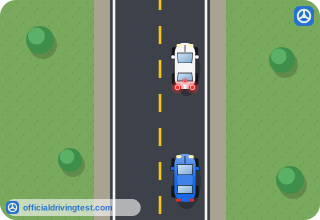
- As hard as you can until the vehicle skids
- Lightly, and add pressure slowly
- As hard as you can without locking them
- Only with the parking brake
Show answer
Correct answer: As hard as you can without locking them
Without ABS you apply the brakes as hard as you can without locking them, because braking too hard can cause a skid.
Source: Kansas Driving Handbook (Revised February 2022), page 73
-
Without ABS, you stop quickly and the brakes lock up so that the vehicle starts to skid. What should you do?
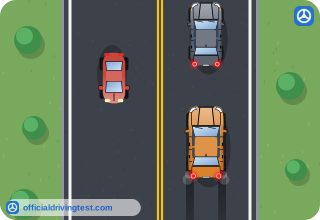
- Take your foot off the brake pedal completely
- Ease up on the brake pedal and then reapply it with control
- Press the brake pedal down even harder than before
- Release the pedal and shift the vehicle into neutral
Show answer
Correct answer: Ease up on the brake pedal and then reapply it with control
When the brakes lock up, you ease up on the brake pedal and then reapply it with control, without taking your foot off the pedal.
Source: Kansas Driving Handbook (Revised February 2022), page 73
-
Without ABS, you are braking and the vehicle has just stopped skidding. What should you do?
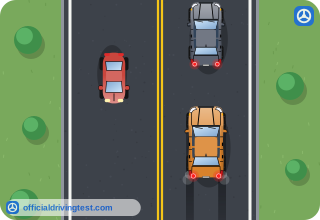
- Keep your foot off the brake pedal until you steer straight
- Hold the pedal at the same pressure until the vehicle stops
- Shift to a lower gear and release the brake pedal
- Push down on the brake pedal again until the vehicle has stopped
Show answer
Correct answer: Push down on the brake pedal again until the vehicle has stopped
As soon as the vehicle stops skidding you push down on the brake pedal again and repeat until the vehicle stops.
Source: Kansas Driving Handbook (Revised February 2022), page 73
-
In most cases, which can you do more quickly?
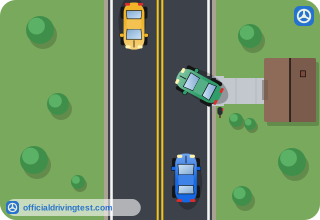
- Stop the vehicle
- Accelerate the vehicle
- Steer the vehicle
- Shift gears
Show answer
Correct answer: Steer the vehicle
In most cases you can steer the vehicle quicker than you can stop it, so you should consider steering to avoid a collision.
Source: Kansas Driving Handbook (Revised February 2022), page 73
-
How should you hold the steering wheel when you steer quickly to avoid a collision?
- With a good grip with both hands
- With one hand at the top of the wheel
- With your hands loosely resting on the wheel
- With one hand, keeping the other on the gearshift
Show answer
Correct answer: With a good grip with both hands
You should make sure you have a good grip with both hands on the steering wheel so you can keep control once you have turned or changed lanes.
Source: Kansas Driving Handbook (Revised February 2022), page 73
-
In which direction should you steer when you steer to avoid a collision?
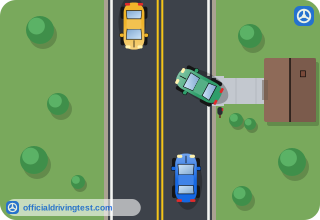
- Toward the hazard you are trying to avoid
- Toward the nearest vehicle
- Away from the direction you want to travel
- In the direction you want the vehicle to go
Show answer
Correct answer: In the direction you want the vehicle to go
The manual says to always steer in the direction you want the vehicle to go.
Source: Kansas Driving Handbook (Revised February 2022), page 73
-
You have ABS and need to steer quickly. What should you do with the brake pedal?
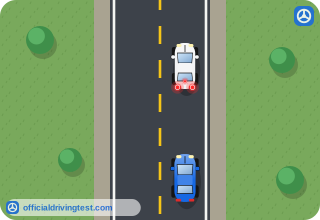
- Release it while you steer, then press it again
- Keep pressing on it as hard as you can while you steer
- Pump it quickly while you steer the vehicle
- Press it lightly so the wheels can turn
Show answer
Correct answer: Keep pressing on it as hard as you can while you steer
With ABS you continue pressing on the brake pedal as hard as you can while steering in the direction you want to travel.
Source: Kansas Driving Handbook (Revised February 2022), page 73