Kansas: Emergencies — Part 4 Practice Test
Questions in this part include: “After your wheels leave the pavement, you steer straight ahead and slow to what speed or less?” · “Which of these can increase the chances of a rollover?”
Independent educational site · not affiliated with any government agency or DMV
Ready? Test yourself
- Instant feedback with an explanation
- Every answer cites its source in the manual
- Your best score is saved on this device
Questions are original and based on the official manual "Kansas Driving Handbook" (Revised February 2022), Kansas Department of Revenue, Division of Vehicles.
All 18 questions in this practice test
Take the test above first, then use this list to study. Tap “Show answer” to see the correct answer and explanation.
Show the questions and answersHide the questions
-
What is "panic steering" after your wheels drop off the edge of the pavement?
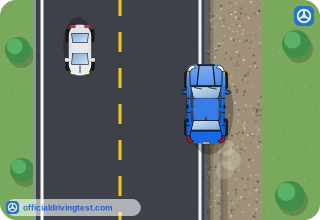
- Trying to return to the pavement as soon as your wheels leave it
- Steering straight ahead while easing off the accelerator
- Braking gently while keeping the wheel steady
- Driving entirely onto the shoulder and stopping
Show answer
Correct answer: Trying to return to the pavement as soon as your wheels leave it
Panic steering means trying to get back onto the pavement the moment the wheels leave it, which can lead to too much steering input before you have slowed down.
Source: Kansas Driving Handbook (Revised February 2022), page 76
-
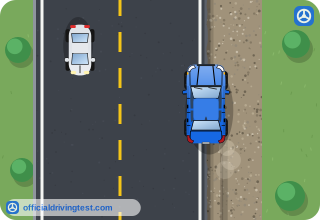
Your wheels leave the pavement. How should you slow down?
- Brake as hard as you can to stop quickly
- Press the accelerator to pull back onto the road
- Ease off the accelerator and brake gently, not hard
- Jerk the steering wheel back toward the road
Show answer
Correct answer: Ease off the accelerator and brake gently, not hard
Braking hard can put the vehicle into a skid and make it hard to steer, so ease off the accelerator and apply the brakes gently.
Source: Kansas Driving Handbook (Revised February 2022), page 76
-
After your wheels leave the pavement, you steer straight ahead and slow to what speed or less?
- 15 mph
- 25 mph
- 35 mph
- 45 mph
Show answer
Correct answer: 25 mph
When recovering from an uneven surface drop-off, you steer straight ahead and slow to 25 mph or less.
Source: Kansas Driving Handbook (Revised February 2022), page 76
-
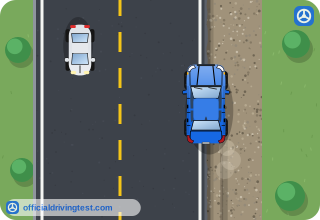
Why should you straddle the pavement edge when returning to the road after a drop-off?
- It lets you speed up to return to the road sooner
- It keeps both wheels on the soft shoulder for better grip
- It means you can skip slowing down before the return
- It keeps the inside edge of your tires from rubbing
Show answer
Correct answer: It keeps the inside edge of your tires from rubbing
Straddling the pavement edge keeps the inside edge of the tires from rubbing and lets you approach the edge at a higher angle, which helps the tire return to the road.
Source: Kansas Driving Handbook (Revised February 2022), page 76
-
When there is a gap in traffic from all directions, about how far should you turn the steering wheel to return to the pavement after a drop-off?
- About a half turn
- About one full turn
- About one quarter-turn
- About two full turns
Show answer
Correct answer: About one quarter-turn
You turn the steering wheel about one quarter-turn to return to the pavement and must not oversteer.
Source: Kansas Driving Handbook (Revised February 2022), page 76
-
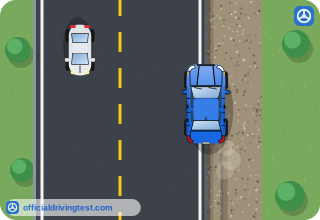
Traffic is heavy when you leave the road and the shoulder is wide. What should you do?
- Drive entirely onto the shoulder and stop
- Steer back onto the pavement at once
- Keep driving along the shoulder at full speed
- Stop with one set of wheels still on the pavement
Show answer
Correct answer: Drive entirely onto the shoulder and stop
With heavy traffic and a wide shoulder, you drive entirely onto the shoulder, stop, and wait for a large gap in traffic before you reenter.
Source: Kansas Driving Handbook (Revised February 2022), page 76
-
What should you do if you cannot get your vehicle back onto the pavement after leaving the road?
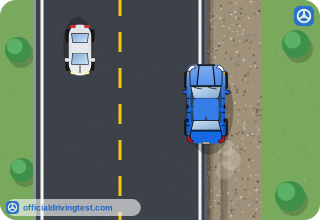
- Keep trying to steer back onto the pavement at speed
- Stop in the lane of travel and leave the vehicle
- Back up along the road until you reach pavement
- Pull as far from the road as possible and wait for help
Show answer
Correct answer: Pull as far from the road as possible and wait for help
If you cannot get back onto the pavement, you should pull as far from the road as possible and wait for help.
Source: Kansas Driving Handbook (Revised February 2022), page 76
-
Why are rollover crashes more common for SUVs, vans, pickups, and small trucks than for passenger cars?
- Their tires wear out much faster than car tires
- Their higher centers of gravity make them top heavy
- Their brakes are weaker than those of cars
- Their drivers are generally less experienced
Show answer
Correct answer: Their higher centers of gravity make them top heavy
These vehicles have higher centers of gravity, which makes them top heavy and more likely to tip over.
Source: Kansas Driving Handbook (Revised February 2022), page 76
-
Which of these can increase the chances of a rollover?
- Driving with a nearly empty vehicle
- Lowering the height of the vehicle
- Driving below the posted speed limit
- Additional cargo and passengers
Show answer
Correct answer: Additional cargo and passengers
Additional cargo and passengers can increase the chances of a rollover, as can a higher center of gravity.
Source: Kansas Driving Handbook (Revised February 2022), page 76
-
What should you do when bad weather limits visibility so much that you may not be able to see well enough to drive?
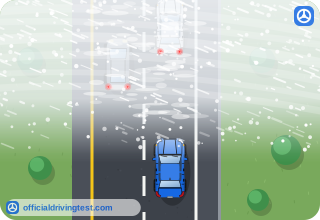
- Follow the taillights of the vehicle ahead of you
- Pull off the roadway in a safe place and wait until it clears
- Drive on slowly in the center of the lane
- Stop in the traffic lane and turn on your hazard flashers
Show answer
Correct answer: Pull off the roadway in a safe place and wait until it clears
When adverse weather limits visibility that much, you should pull off the roadway in a safe place and wait until it clears.
Source: Kansas Driving Handbook (Revised February 2022), page 77
-
How quickly can flash floods occur?
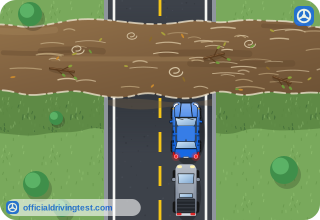
- Within a few minutes or hours of excessive rainfall
- Only after several days of steady rainfall
- Only after snow has melted in the spring
- Only after a river has been rising for a full day
Show answer
Correct answer: Within a few minutes or hours of excessive rainfall
Flash floods can come rapidly and unexpectedly, within a few minutes or hours of excessive rainfall.
Source: Kansas Driving Handbook (Revised February 2022), page 91
-
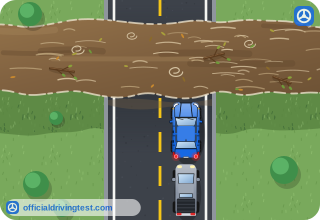
Where can floodwaters be found?
- Only on roads next to rivers
- On roads, bridges and low areas
- Only in low areas near streams
- Only on gravel and dirt roads
Show answer
Correct answer: On roads, bridges and low areas
Floodwaters can be found on roads, bridges and low areas.
Source: Kansas Driving Handbook (Revised February 2022), page 91
-
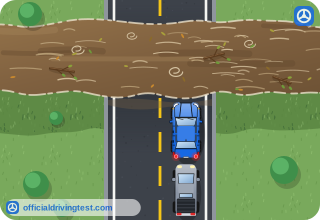
What should you do if you see a flooded roadway ahead?
- Drive through slowly in a low gear
- Follow the vehicle ahead through the water
- Cross only if the water looks shallow
- Turn around and find another route
Show answer
Correct answer: Turn around and find another route
Do not drive through flooded areas; turn around and find another route to your destination.
Source: Kansas Driving Handbook (Revised February 2022), page 91
-
How much water will reach the bottom of most passenger cars, causing loss of control or possible stalling?
- 6 inches
- 2 inches
- 12 inches
- 18 inches
Show answer
Correct answer: 6 inches
Six inches of water will reach the bottom of most passenger cars, causing loss of control or possible stalling.
Source: Kansas Driving Handbook (Revised February 2022), page 91
-
How much rushing water can carry away most vehicles?
- 3 inches
- 8 inches
- 2 feet
- 1 foot
Show answer
Correct answer: 2 feet
Two feet of rushing water can carry away most vehicles.
Source: Kansas Driving Handbook (Revised February 2022), page 91
-
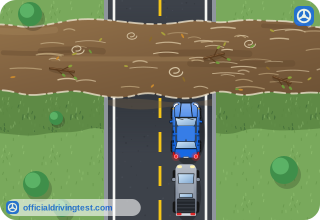
Why should you not try to cross a flooded road even when the water appears shallow?
- Shallow water always contains debris that can block the exhaust pipe
- Floodwater is too cold for the tires to grip the road surface
- Water can hide dips and floodwaters can wash away the road beneath
- Tires lose air pressure whenever they are in standing water
Show answer
Correct answer: Water can hide dips and floodwaters can wash away the road beneath
Water can hide dips, and floodwaters can damage roadways by washing away the underlying road surface.
Source: Kansas Driving Handbook (Revised February 2022), page 91
-
If there is no other route around a flooded road, what should you do?
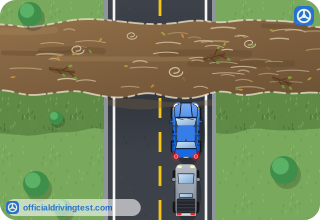
- Proceed to higher ground and wait for the waters to subside
- Wait at the edge of the water for a tow truck
- Drive through at the narrowest part of the flooding
- Park in the lowest spot nearby and keep the engine on
Show answer
Correct answer: Proceed to higher ground and wait for the waters to subside
If there is no other route, you should go to higher ground and wait for the waters to subside.
Source: Kansas Driving Handbook (Revised February 2022), page 91
-
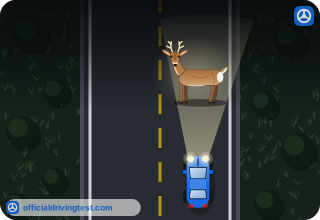
What does the manual say about swerving to avoid an animal that suddenly runs in front of your vehicle?
- Swerve into the next lane if it looks clear of traffic
- Swerve onto the shoulder to be safe from the animal
- Do not swerve into oncoming traffic or off the roadway
- Swerve only if the animal is a deer or other big game
Show answer
Correct answer: Do not swerve into oncoming traffic or off the roadway
Do not swerve into oncoming traffic or off the roadway to avoid hitting the animal.
Source: Kansas Driving Handbook (Revised February 2022), page 92