Iowa: Sharing the road
Large trucks and their blind spots, motorcycles, bicycles and bicycle lanes, school buses, lane use and rural gravel roads. Split into 4 shorter tests so you're not stuck in one long quiz.
Independent educational site · not affiliated with any government agency or DMV
Choose a part
Sharing the road — Part 1
Questions in this part include: “How are bicycle lanes marked?”
StartSharing the road — Part 2
Questions in this part include: “How close to the rear of a school bus may you stop when its stop arm is extended?”
StartSharing the road — Part 3
Questions in this part include: “How does the manual describe rural gravel roadways?”
StartSharing the road — Part 4
Questions in this part include: “Where are car/motorcycle collisions most likely to occur?”
StartAll 73 Sharing the road questions with answers
Choose a part above to take a practice test, or study every question and answer here.
Show the questions and answersHide the questions
-
On which of these might you see a slow-moving vehicle sign?
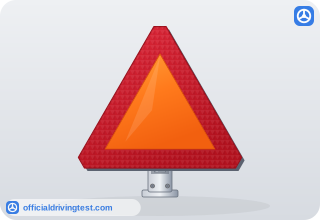
- Passenger cars on county roads
- Mail and package delivery trucks
- Road maintenance equipment
- Public transit buses
Show answer
Correct answer: Road maintenance equipment
You may see the reflective orange triangle on road maintenance equipment, farm vehicles, or horse-drawn wagons.
Source: Iowa Driver’s License Manual (July 2026), page 11
-
On a road with two or more lanes traveling in the same direction, which lane is generally used for passing?
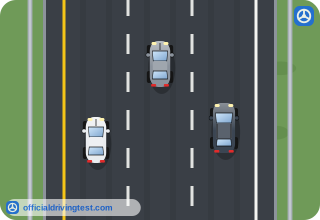
- The right lane
- The left lane
- The center lane
- The lane next to the shoulder
Show answer
Correct answer: The left lane
On a road with two or more lanes in the same direction, the left lane is generally used for passing.
Source: Iowa Driver’s License Manual (July 2026), page 16
-
On a road with three or more lanes in your direction, which lanes should you stay in except to pass?
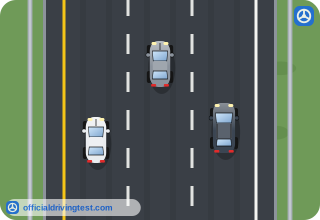
- The left lane
- The lane next to the center line
- Any lane that is open
- The right or center lane
Show answer
Correct answer: The right or center lane
On a road with three or more lanes, you should stay in the right or center lane except to pass.
Source: Iowa Driver’s License Manual (July 2026), page 16
-
On a road with three or more lanes, which lane is best to use if there is a lot of entering traffic?
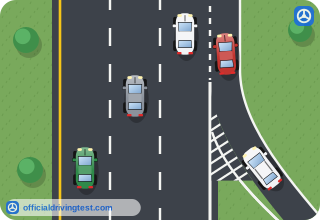
- The right lane
- The left lane
- The center lane
- The shoulder
Show answer
Correct answer: The center lane
If there is a lot of entering traffic, it is best to use the center lane.
Source: Iowa Driver’s License Manual (July 2026), page 16
-
In normal driving, when may you drive on the shoulder of the road?
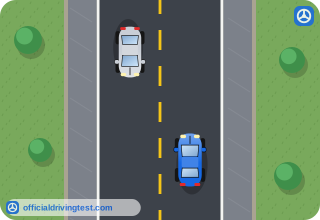
- Only when instructed to by a traffic control device or an official
- Whenever you need to let a faster vehicle pass you safely
- When the shoulder is paved and wide enough for your vehicle
- When traffic ahead is backed up and the other lane is blocked
Show answer
Correct answer: Only when instructed to by a traffic control device or an official
Unless instructed by a traffic control device or an official, you should never drive on the shoulder of the road.
Source: Iowa Driver’s License Manual (July 2026), page 16
-
Why should you never pass on the shoulder, whether it is paved or not?
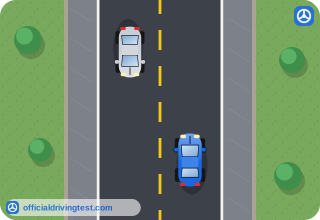
- The shoulder is always too narrow for any vehicle to fit on it safely
- The shoulder is reserved for vehicles that are broken down or stopped
- Passing on the shoulder is allowed only when the shoulder is paved
- Other drivers will not expect you there and may pull off the road without looking
Show answer
Correct answer: Other drivers will not expect you there and may pull off the road without looking
Other drivers will not expect you to be on the shoulder and may pull off the road without looking.
Source: Iowa Driver’s License Manual (July 2026), page 16
-
How are bicycle lanes marked?
- By dashed yellow lines, along with turn arrows and warning signs
- By a solid yellow line, along with a green diamond painted on the lane
- By solid white lines, along with bicycle pavement markings and signs
- By white triangles pointing toward approaching vehicles, along with signs
Show answer
Correct answer: By solid white lines, along with bicycle pavement markings and signs
Bicycle lanes are intended for use by bicyclists and are marked by solid white lines, along with bicycle pavement markings and signs.
Source: Iowa Driver’s License Manual (July 2026), page 17
-
What may be used to separate some bike lanes from traffic?
- Double white lines, curbs, posts, or planters
- Guardrails, rumble strips, or cable barriers
- Solid yellow lines, cones, or barrels
- Reflectors and dashed white lines
Show answer
Correct answer: Double white lines, curbs, posts, or planters
Some bike lanes are further separated from traffic with double white lines, curbs, posts, or planters.
Source: Iowa Driver’s License Manual (July 2026), page 17
-
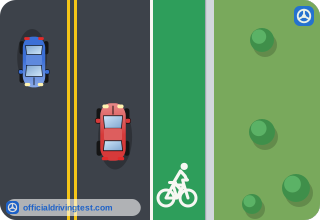
What should motorists do before crossing green pavement in a bicycle lane?
- Speed up to clear the lane quickly
- Stop on the green pavement and wait
- Honk to warn bicyclists that you are crossing
- Pay close attention and look for bicyclists
Show answer
Correct answer: Pay close attention and look for bicyclists
Bicycle lanes may be filled with green paint, and motorists should pay close attention and look for bicyclists before crossing green pavement.
Source: Iowa Driver’s License Manual (July 2026), page 17
-
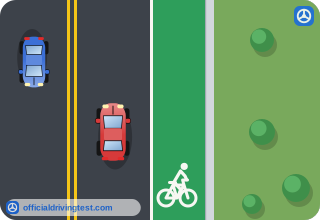
What should motorists not do on green pavement in a bicycle lane?
- Slow down
- Stop
- Cross it
- Look for bicyclists
Show answer
Correct answer: Stop
Motorists should not stop on green pavement.
Source: Iowa Driver’s License Manual (July 2026), page 17
-
When may motorists drive in a bicycle lane?
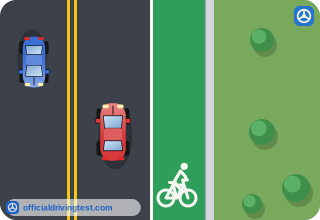
- Only when making turning movements
- Only when the traffic lane is blocked
- Only when passing a slow vehicle
- Only when no bicyclists are in sight
Show answer
Correct answer: Only when making turning movements
Motorists may only drive in bicycle lanes when making turning movements.
Source: Iowa Driver’s License Manual (July 2026), page 17
-
A motorist is driving in a bicycle lane to make a turn. What must the motorist do?
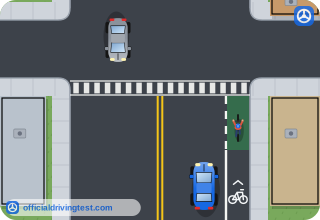
- Stay in the bicycle lane for a full block before making the turn
- Sound the horn and cross the lane quickly before bicyclists arrive
- Look carefully beside and behind the vehicle for bicyclists and cross with care
- Look only ahead at the road you are turning into and then turn as usual
Show answer
Correct answer: Look carefully beside and behind the vehicle for bicyclists and cross with care
Motorists in a bicycle lane when turning must look carefully beside and behind their vehicle for bicyclists and cross with care.
Source: Iowa Driver’s License Manual (July 2026), page 17
-
What are shared lane pavement markings also called?
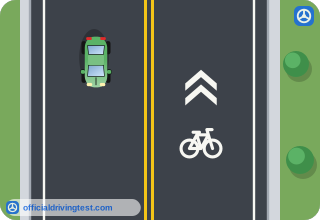
- Bike boxes
- Sharrows
- Bike detectors
- Green lanes
Show answer
Correct answer: Sharrows
Shared lane pavement markings are also called "sharrows."
Source: Iowa Driver’s License Manual (July 2026), page 17
-
What is one thing shared lane markings (sharrows) do?
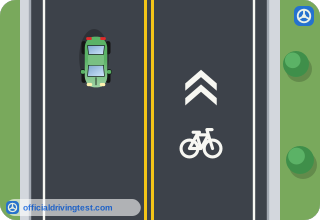
- Mark a lane for the exclusive use of bicycles
- Show bicyclists where to stop at a red light
- Show motorists where to park next to a bike lane
- Alert motorists to the presence of bicyclists
Show answer
Correct answer: Alert motorists to the presence of bicyclists
Shared lane markings alert motorists of the presence of bicyclists and encourage safe passing of bicyclists by motorists.
Source: Iowa Driver’s License Manual (July 2026), page 17
-
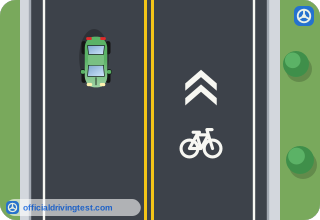
How do shared lane markings (sharrows) differ from bike lanes?
- They are used only on roads that already have a green bicycle lane
- They are painted in solid green across the whole travel lane
- They do not set aside part of the roadway for the exclusive use of bicycles
- They are used only at intersections that have traffic signals
Show answer
Correct answer: They do not set aside part of the roadway for the exclusive use of bicycles
Unlike bike lanes, sharrows do not designate a particular portion of the roadway for the exclusive use of bicycles.
Source: Iowa Driver’s License Manual (July 2026), page 17
-
What is the purpose of a bicycle box?
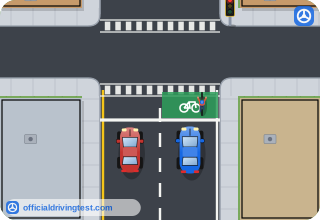
- To give bicyclists a safe way to turn at a signalized intersection
- To show motorists where to park near a crosswalk on a busy street
- To mark where a bicyclist should wait on a road without signals
- To separate a bike lane from the traffic lane next to it
Show answer
Correct answer: To give bicyclists a safe way to turn at a signalized intersection
Bicycle boxes are pavement markings installed to allow bicyclists a safe way to turn at a signalized intersection.
Source: Iowa Driver’s License Manual (July 2026), page 17
-
What does a bicycle box look like?
- It is solid white and has a row of triangles
- It is dashed yellow and has a turn arrow
- It is solid red and has the word "STOP"
- It is solid green and has an image of a bicyclist
Show answer
Correct answer: It is solid green and has an image of a bicyclist
Bicycle boxes are solid green and have an image of a bicyclist.
Source: Iowa Driver’s License Manual (July 2026), page 17
-
Where is a bicycle box located?
- Beyond the crosswalk, covering only half of the travel lane
- Next to the crosswalk, covering the entire width of the travel lane
- In the center of the intersection, between the lanes
- Along the edge of the lane, beside the curb or shoulder
Show answer
Correct answer: Next to the crosswalk, covering the entire width of the travel lane
Bicycle boxes are located adjacent to the crosswalk and cover the entire width of the travel lane.
Source: Iowa Driver’s License Manual (July 2026), page 17
-
What does the bicycle detector symbol on the pavement indicate?
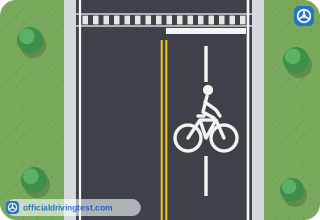
- The best position for a bicyclist to trigger the traffic signal
- The place where motorists should stop to wait for bicyclists
- The start of a lane that is reserved for bicycles only
- The spot where bicyclists must get off and walk their bicycles
Show answer
Correct answer: The best position for a bicyclist to trigger the traffic signal
A bicycle detector symbol on the pavement shows the optimum position for a bicyclist to activate the traffic signal.
Source: Iowa Driver’s License Manual (July 2026), page 17
-
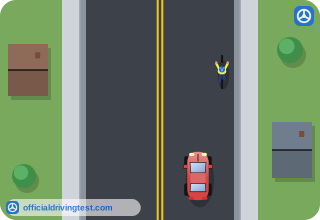
How should you handle the right-of-way when you meet a bicyclist?
- Expect bicyclists to yield to you whenever the law says they must
- Insist on your right-of-way, since bicyclists must always yield
- Be ready to yield, even at times the bicyclist should yield to you
- Assume bicyclists will always move out of your way when you approach
Show answer
Correct answer: Be ready to yield, even at times the bicyclist should yield to you
Bicyclists have no defense against a vehicle, so a driver should be ready to yield the right-of-way even when the bicyclist should yield.
Source: Iowa Driver’s License Manual (July 2026), page 18
-
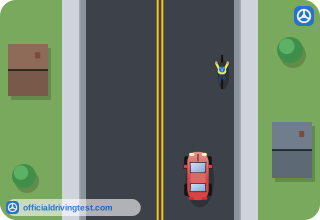
Why should motor vehicle drivers use good defensive driving skills around bicyclists?
- Bicycle riders always have the right-of-way
- Bicycle riders are very vulnerable in crashes
- Bicycle riders do not have to obey traffic signals
- Bicycle riders cannot see vehicles behind them
Show answer
Correct answer: Bicycle riders are very vulnerable in crashes
Bicycle riders are very vulnerable in crashes, so drivers should use defensive driving skills to avoid collisions with them.
Source: Iowa Driver’s License Manual (July 2026), page 18
-
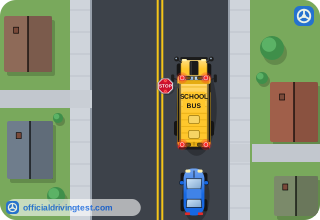
You approach a school bus from the rear and see flashing red or amber warning lights. What are you not permitted to do?
- Prepare to stop
- Pass the school bus
- Stop behind the bus
- Slow your vehicle
Show answer
Correct answer: Pass the school bus
When a school bus shows flashing red or amber warning lights, drivers approaching from the rear are not permitted to pass it.
Source: Iowa Driver’s License Manual (July 2026), page 20
-
How close to the rear of a school bus may you stop when its stop arm is extended?
- No closer than 5 feet
- No closer than 25 feet
- No closer than 30 feet
- No closer than 15 feet
Show answer
Correct answer: No closer than 15 feet
Drivers must stop no closer than 15 feet from the rear of a school bus that has stopped with its stop arm extended.
Source: Iowa Driver’s License Manual (July 2026), page 20
-
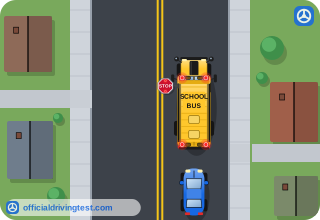
How long must you remain stopped behind a school bus whose stop arm is extended?
- Until the stop arm is retracted and the bus starts moving again
- Until the bus driver waves you around the stopped bus
- Until all of the children have crossed the whole road
- Until the bus has moved far enough ahead to be out of sight
Show answer
Correct answer: Until the stop arm is retracted and the bus starts moving again
You remain stopped until the stop arm is retracted and the school bus starts moving again, then proceed with caution.
Source: Iowa Driver’s License Manual (July 2026), page 20
-
You are meeting a school bus from the front on a two- or three-lane road and its amber warning lights are flashing. You must slow to no more than what speed?
- 10 mph
- 30 mph
- 20 mph
- 35 mph
Show answer
Correct answer: 20 mph
On a two- or three-lane road, you must slow to no more than 20 mph when you see amber warning lights flashing on a school bus approaching from the front.
Source: Iowa Driver’s License Manual (July 2026), page 20
-
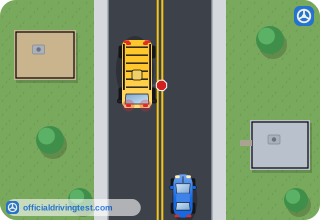
On a two- or three-lane road, how long must you stay stopped when meeting a school bus from the front with its stop arm extended?
- Until the bus driver signals you to pass
- Until the stop arm is retracted
- Until the bus has driven out of sight
- Until any children have reached the sidewalk
Show answer
Correct answer: Until the stop arm is retracted
When meeting a stopped school bus with its stop arm extended, remain stopped until the stop arm is retracted, then proceed with caution.
Source: Iowa Driver’s License Manual (July 2026), page 20
-
For how long may your license be suspended for violating the school bus stopping law?
- Up to 30 days
- Up to 90 days
- Up to 120 days
- Up to 180 days
Show answer
Correct answer: Up to 180 days
Violating the school bus law may result in a license suspension of up to 180 days.
Source: Iowa Driver’s License Manual (July 2026), page 20
-
On a road with three lanes or fewer, which vehicles must stop for a school bus that has stopped with its stop arm extended?
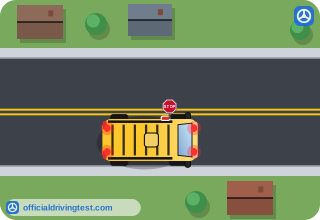
- All vehicles, from both directions
- Only vehicles approaching from the rear
- Only vehicles in the same lane as the bus
- Only large vehicles such as trucks and buses
Show answer
Correct answer: All vehicles, from both directions
On roads with three lanes or fewer, all vehicles must stop for a stopped school bus.
Source: Iowa Driver’s License Manual (July 2026), page 20
-
On a road with four or more lanes, what must you do when you approach a school bus from the rear and it stops with its stop arm extended?
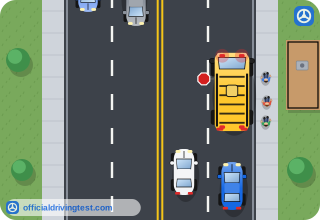
- Pass it carefully using any open lane to its left
- Slow to 20 mph and pass on the left
- Stop behind it, the same as on a two- or three-lane road
- Stop only if you are in the lane next to the bus
Show answer
Correct answer: Stop behind it, the same as on a two- or three-lane road
When approaching from the rear on a road with four or more lanes, the rules are the same as for a two- or three-lane road.
Source: Iowa Driver’s License Manual (July 2026), page 20
-
On a road with four or more lanes, when may you pass a school bus that is stopped with its stop arm extended?
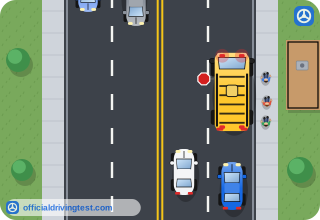
- When you approach from behind and no children are visible
- When you meet it in one of the two or more opposite lanes
- When you approach from behind in a lane to its left
- When the bus is stopped in the right-hand lane only
Show answer
Correct answer: When you meet it in one of the two or more opposite lanes
When meeting the bus in one of the opposite two (or more) lanes, you do not need to stop; this is the only time you may pass a stopped school bus with its stop arm extended.
Source: Iowa Driver’s License Manual (July 2026), page 20
-
Even when a vehicle has bicycle, pedestrian, and obstacle detection, where does the manual say to check especially often for bicyclists and pedestrians?
- In urban areas
- On interstate highways
- On empty rural roads
- In long highway tunnels
Show answer
Correct answer: In urban areas
You should not depend on detection and should check for bicyclists, pedestrians, or obstacles regularly, especially in urban areas.
Source: Iowa Driver’s License Manual (July 2026), page 29
-
What should you do instead of driving in another driver’s blind spot?
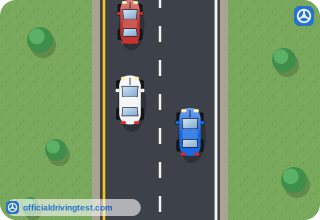
- Stay beside the vehicle and signal your intentions
- Speed up or slow down so the other driver can see your vehicle
- Drive close behind the vehicle and flash your headlights
- Keep the same speed so the other driver can predict your position
Show answer
Correct answer: Speed up or slow down so the other driver can see your vehicle
Do not drive in another driver’s blind spot: either speed up or slow down so the other driver can see your vehicle.
Source: Iowa Driver’s License Manual (July 2026), page 34
-
When passing another vehicle, what should you do about the other driver’s blind spot?
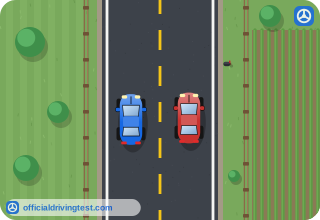
- Stay in it for a few seconds so the driver notices you
- Pass at a constant, slower speed to give the driver time to see you
- Flash your headlights before and during the pass
- Get through it as quickly as you can
Show answer
Correct answer: Get through it as quickly as you can
When passing another vehicle, you should get through the other driver’s blind spot as quickly as you can.
Source: Iowa Driver’s License Manual (July 2026), page 34
-
Why should you never stay alongside a large vehicle such as a truck or bus?
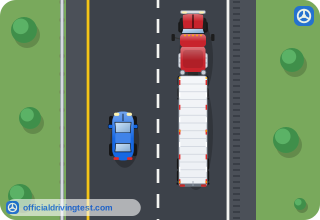
- Their tires often blow out and can throw heavy pieces of rubber at you
- Their drivers are not allowed to look at traffic beside them while moving
- These vehicles have large blind spots and it is hard for them to see you
- They always accelerate faster than cars and will run into your side
Show answer
Correct answer: These vehicles have large blind spots and it is hard for them to see you
Trucks and buses have large blind spots, so it is hard for their drivers to see you when you stay alongside.
Source: Iowa Driver’s License Manual (July 2026), page 34
-
Another driver is showing signs of aggressive driving. What should you do?
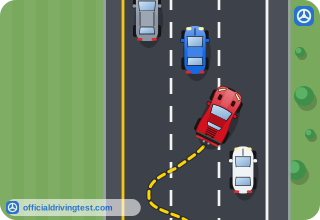
- Speed up to stay ahead of the driver
- Stay close behind the driver to watch the driving
- Slow down or pull over to avoid the driver
- Flash your headlights to warn the driver
Show answer
Correct answer: Slow down or pull over to avoid the driver
If another driver shows signs of aggressive driving, you should slow down or pull over to avoid them.
Source: Iowa Driver’s License Manual (July 2026), page 47
-
A driver is driving so dangerously that you are worried. What does the manual suggest?
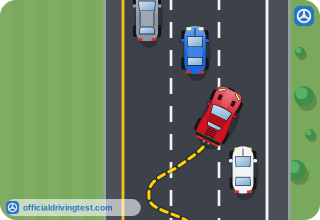
- Turn right or take the next exit to get off the roadway, if it is safe
- Pull alongside the driver and signal the driver to slow down
- Stay close behind the driver so you can report the license plate
- Speed up and pass the driver as quickly as you can
Show answer
Correct answer: Turn right or take the next exit to get off the roadway, if it is safe
If you are worried about a driver's dangerous driving, try to get off the roadway by turning right or taking the next exit if it is safe to do so.
Source: Iowa Driver’s License Manual (July 2026), page 47
-
What may farm vehicles, horse-drawn vehicles, ATVs/UTVs, and roadway maintenance vehicles have on the back?
- A white square plate with a black border and a red reflector
- A slow-moving vehicle sign (an orange triangle or flashing lights)
- A red triangle with a white center or a steady white light
- A yellow diamond-shaped sign or a green flag on a pole
Show answer
Correct answer: A slow-moving vehicle sign (an orange triangle or flashing lights)
These slower vehicles may have a slow-moving vehicle sign on the back, which is an orange triangle or flashing lights.
Source: Iowa Driver’s License Manual (July 2026), page 48
-
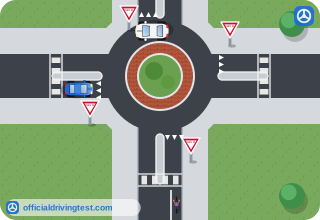
How should cyclists generally cross a roundabout crosswalk?
- Ride across the crosswalk without stopping for any traffic
- Ride on the sidewalk behind the splitter island
- Ride in the crosswalk and yield only to vehicles
- Walk their bicycles across, using the same rules as pedestrians
Show answer
Correct answer: Walk their bicycles across, using the same rules as pedestrians
Cyclists should generally walk their bicycles across the crosswalk using the same rules as pedestrians.
Source: Iowa Driver’s License Manual (July 2026), page 54
-
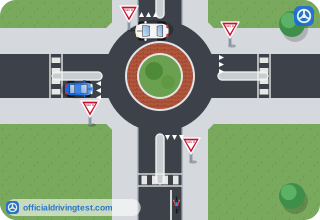
Where in the lane should an experienced cyclist ride when using a roundabout like a motorist?
- In the middle of the lane, to prevent vehicles from passing
- Next to the curb, to leave room for vehicles to pass
- In the crosswalk
- On the edge of the lane that is nearest the center island
Show answer
Correct answer: In the middle of the lane, to prevent vehicles from passing
Bicyclists using the roundabout should ride in the middle of the lane to prevent vehicles from passing and should not hug the curb.
Source: Iowa Driver’s License Manual (July 2026), page 54
-
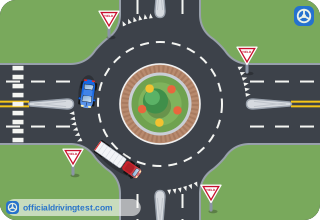
In a multi-lane roundabout, why should you not pass or drive beside trucks or buses?
- They always stop in the roundabout
- They must yield to every other vehicle
- They are not allowed in the inside lane
- They may straddle lanes or may not see you
Show answer
Correct answer: They may straddle lanes or may not see you
Trucks and buses may straddle lanes or may not see you, so do not pass or drive beside them.
Source: Iowa Driver’s License Manual (July 2026), page 54
-
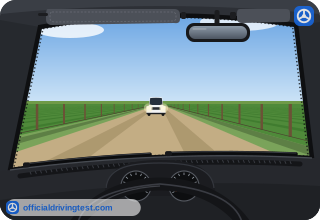
On a rural gravel roadway, what should you do when you meet oncoming vehicles?
- Slow down and move as far to the right as is safe
- Keep to the center of the road because it has no lane markings
- Speed up so that you pass the oncoming vehicles quickly
- Stop in the middle of the roadway until they have passed
Show answer
Correct answer: Slow down and move as far to the right as is safe
Rural gravel roadways are narrower and have no lane markings, so you slow down, proceed with caution and move as far to the right as is safe.
Source: Iowa Driver’s License Manual (July 2026), page 56
-
How does the manual describe rural gravel roadways?
- They are wider than paved roads and have center lines
- They have the same lane markings as major roads
- They are narrower and do not contain lane markings
- They are narrower but have painted lane markings
Show answer
Correct answer: They are narrower and do not contain lane markings
Rural gravel roadways are narrower than other roads and do not contain lane markings.
Source: Iowa Driver’s License Manual (July 2026), page 56
-
What do multiple vehicles create on rural gravel roadways?
- Standing water that hides the road edge
- Dust clouds and reduced visibility
- Ice patches that form on the gravel
- Loud noise that hides the sound of a train
Show answer
Correct answer: Dust clouds and reduced visibility
Multiple vehicles on a gravel roadway create dust clouds and reduced visibility.
Source: Iowa Driver’s License Manual (July 2026), page 56
-
Many bridges on rural gravel roads can only accommodate one vehicle at a time. What should you be prepared to do when approaching one?
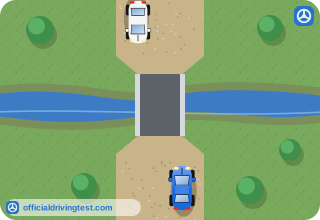
- Speed up to cross before oncoming vehicles arrive
- Drive in the center of the bridge
- Keep moving and sound your horn
- Stop for oncoming traffic
Show answer
Correct answer: Stop for oncoming traffic
Many bridges on rural gravel roads are narrower than the roadway and fit one vehicle at a time, so you must be prepared to stop for oncoming traffic.
Source: Iowa Driver’s License Manual (July 2026), page 56
-
When you approach slow-moving and large vehicles on rural roads, such as farm equipment or horse drawn vehicles, what is important?
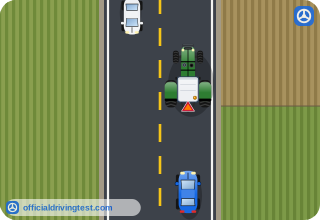
- Pass them as soon as you see them
- Follow them closely so the driver can see you
- Speed up so you can pass before an entrance
- Identify them early and slow down when approaching
Show answer
Correct answer: Identify them early and slow down when approaching
It is common to meet slow-moving and large vehicles on rural roads, so it is important to identify them early and slow down when approaching.
Source: Iowa Driver’s License Manual (July 2026), page 56
-
What may large farm equipment do at unmarked entrances?
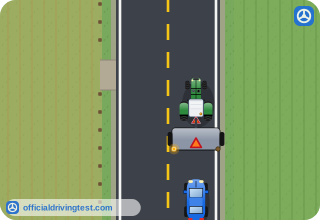
- Make wide turns
- Stop and wait for all traffic to pass
- Back out onto the road without turning
- Make turns only from the left shoulder
Show answer
Correct answer: Make wide turns
The manual warns that large farm equipment may make wide turns at unmarked entrances.
Source: Iowa Driver’s License Manual (July 2026), page 56
-
Why should you proceed with extreme caution when attempting to pass large farm equipment?
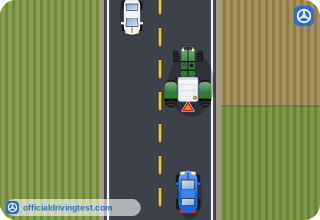
- It always speeds up whenever a vehicle tries to pass it on the road
- It is not allowed to travel on rural roads at night
- It may not see your vehicle and its turn signal may be difficult to detect
- Its driver is required to stop whenever a vehicle passes
Show answer
Correct answer: It may not see your vehicle and its turn signal may be difficult to detect
Farm equipment drivers may not see your vehicle, and a turn signal on the equipment may be difficult to detect.
Source: Iowa Driver’s License Manual (July 2026), page 56
-
When should you be especially on the lookout for animals while driving?
- At sunrise and sunset
- At midday and in the early afternoon
- Only after the middle of the night
- Only on interstate highways
Show answer
Correct answer: At sunrise and sunset
The manual says to be on the lookout for animals while driving, especially at sunrise and sunset.
Source: Iowa Driver’s License Manual (July 2026), page 57
-
Which months are the peak months for deer collisions in Iowa?
- June, July and August
- December, January and February
- October, November and May
- March, April and September
Show answer
Correct answer: October, November and May
October, November and May are the peak months for deer collisions, although they can occur at any time of the year.
Source: Iowa Driver’s License Manual (July 2026), page 57
-
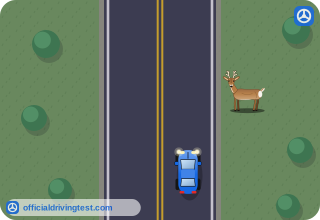
Deer travel in groups. What should you do if you see one deer?
- Assume the rest have already crossed
- Always look for more animals
- Speed up to get past before others appear
- Flash your high beams and keep your speed
Show answer
Correct answer: Always look for more animals
Because deer travel in groups, you should always look for more animals if one is seen.
Source: Iowa Driver’s License Manual (July 2026), page 57
-
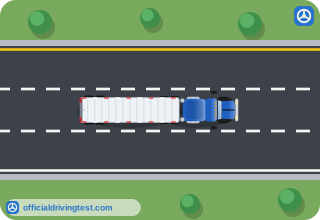
What are the blind spots around the front, back and sides of a large truck called?
- “No-zones”
- “Dead lanes”
- “Stop zones”
- “Danger lanes”
Show answer
Correct answer: “No-zones”
Large trucks have blind spots called “no-zones” around the front, back and sides of the vehicle.
Source: Iowa Driver’s License Manual (July 2026), page 57
-
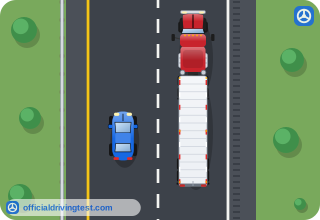
You cannot see a truck driver in the truck's mirror. What does this mean?
- The truck driver can see you in another mirror
- The truck is about to stop
- The truck driver cannot see you
- The truck driver is about to change lanes
Show answer
Correct answer: The truck driver cannot see you
If you cannot see the truck driver in the truck's mirror, the truck driver cannot see you.
Source: Iowa Driver’s License Manual (July 2026), page 57
-
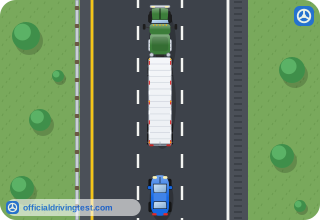
Compared with cars, how long do trucks and buses take to stop?
- About the same time
- Much longer
- Slightly less time
- Half as long
Show answer
Correct answer: Much longer
Trucks and buses take much longer to stop in comparison to cars.
Source: Iowa Driver’s License Manual (July 2026), page 57
-
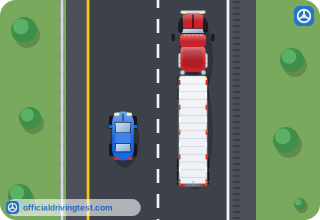
When passing a large truck, what should you look for before pulling in front of it?
- The truck driver's face in your windshield
- The truck's rear tires in your side window
- The truck's turn signal in your rearview mirror
- The front of the truck in your rearview mirror
Show answer
Correct answer: The front of the truck in your rearview mirror
Look for the front of the truck in your rearview mirror before pulling in front, and avoid pulling out in front of trucks, which creates an emergency braking situation.
Source: Iowa Driver’s License Manual (July 2026), page 57
-
To safely negotiate a right turn, in which direction do truck drivers sometimes need to swing widely?
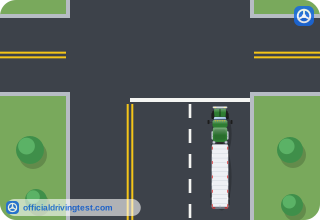
- To the left
- To the right
- Straight across the intersection
- Toward the curb
Show answer
Correct answer: To the left
Truck drivers sometimes need to swing widely to the left in order to safely negotiate a right turn.
Source: Iowa Driver’s License Manual (July 2026), page 57
-
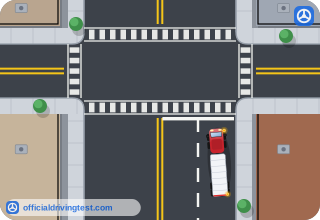
What increases the possibility of a crash when a truck is making a wide right turn?
- Paying attention to the truck's signals
- Giving the truck lots of room to maneuver
- Cutting in between the truck and the curb
- Staying well behind the truck
Show answer
Correct answer: Cutting in between the truck and the curb
Cutting in between the truck and the curb increases the possibility of a crash, so pay attention to truck signals and give the truck lots of room.
Source: Iowa Driver’s License Manual (July 2026), page 57
-
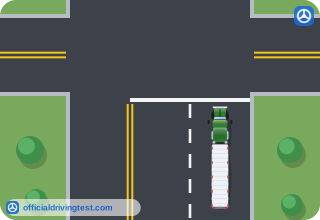
Which cars can't a truck driver see when making a wide right turn?
- Cars several blocks ahead of the truck
- Cars directly behind or beside the truck
- Oncoming cars in the opposite lanes
- Cars two lanes away from the truck
Show answer
Correct answer: Cars directly behind or beside the truck
Truck drivers can't see cars directly behind or beside them when they swing wide for a right turn.
Source: Iowa Driver’s License Manual (July 2026), page 57
-
Where are car/motorcycle collisions most likely to occur?
- On freeway entrance ramps
- In parking lots
- On rural gravel roads
- At intersections
Show answer
Correct answer: At intersections
Intersections are the most likely places for car/motorcycle collisions to occur.
Source: Iowa Driver’s License Manual (July 2026), page 58
-
Before you start to turn or enter an intersection, what should you make sure of regarding a motorcycle?
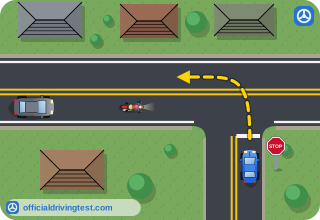
- That you see the motorcycle and know its speed
- That the rider is already slowing to a stop
- That the motorcycle's turn signal is flashing
- That the motorcycle is behind your vehicle
Show answer
Correct answer: That you see the motorcycle and know its speed
Make sure you see the motorcycle and know its speed before you start to turn or enter an intersection.
Source: Iowa Driver’s License Manual (July 2026), page 58
-
Why must you make sure you know what a motorcycle rider is going to do before you move into the motorcycle's path?
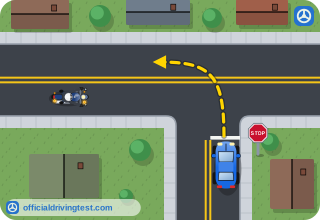
- Their turn signals flash much faster than those of cars, so they are easy to misread
- Riders turn on their signals whenever they slow down, even when not turning
- Their turn signals do not shut off by themselves, so riders may forget to cancel them
- Their turn signals are too small to be seen by drivers who are behind them
Show answer
Correct answer: Their turn signals do not shut off by themselves, so riders may forget to cancel them
Turn signals do not automatically shut off on a motorcycle and riders occasionally forget to cancel them after a turn.
Source: Iowa Driver’s License Manual (July 2026), page 58
-
What is the minimum following distance when driving behind a motorcycle?
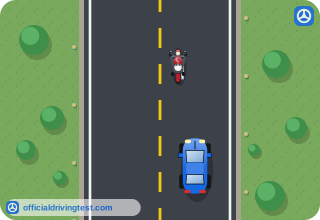
- At least 1 second
- At least 3-4 seconds
- At least 2 seconds
- At least 2-3 seconds
Show answer
Correct answer: At least 3-4 seconds
When driving behind a motorcycle, allow at least a 3-4 second following distance so the cyclist has enough room to maneuver or stop in an emergency.
Source: Iowa Driver’s License Manual (July 2026), page 58
-
What should you do when following a motorcycle on a wet or slippery road?
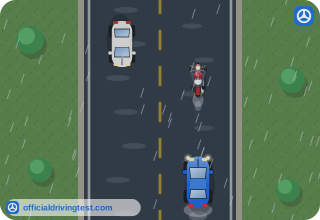
- Stay closer so the rider can see you
- Keep the same following distance as on dry pavement
- Pass it as quickly as possible
- Stay further behind it
Show answer
Correct answer: Stay further behind it
When the road is wet or slippery, you should stay further behind a motorcycle.
Source: Iowa Driver’s License Manual (July 2026), page 58
-
Why may motorcycles be very unstable when trying to stop quickly?
- Only two wheels are in contact with the pavement
- They are much heavier than most cars
- Their tires have less tread than car tires
- They do not have brake lights
Show answer
Correct answer: Only two wheels are in contact with the pavement
With only two wheels in contact with the pavement, motorcycles may be very unstable when trying to stop quickly.
Source: Iowa Driver’s License Manual (July 2026), page 58
-
When passing a motorcycle, how much room should you allow for it?
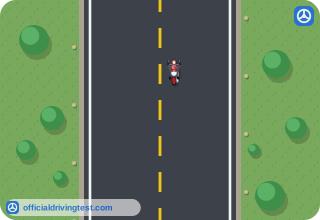
- Half a lane
- Only the width of the motorcycle
- A full lane
- Half of the shoulder
Show answer
Correct answer: A full lane
When passing a motorcycle, allow a full lane for it and never crowd into the same lane as the cycle.
Source: Iowa Driver’s License Manual (July 2026), page 58
-
People riding bicycles are often prohibited from riding where?
- In bike lanes
- On rural roads
- On sidewalks
- On residential streets
Show answer
Correct answer: On sidewalks
People riding bicycles have the right to be on the road and are often prohibited from riding on sidewalks, so you should respect their right to be there.
Source: Iowa Driver’s License Manual (July 2026), page 58
-
What must you do when passing bicyclists?
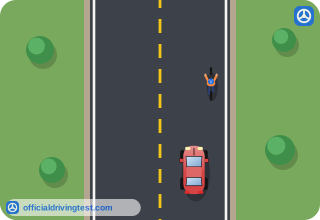
- Move to the edge of your lane and sound your horn to warn them
- Completely change lanes, giving the bicyclist the entire lane
- Straddle the lane line while you pass
- Stay in your lane and pass with extra speed
Show answer
Correct answer: Completely change lanes, giving the bicyclist the entire lane
When passing bicyclists, you must completely change lanes and give the bicyclist the entire lane, as you would with any other vehicle.
Source: Iowa Driver’s License Manual (July 2026), page 58
-
When may you return to the right after passing a bicyclist?
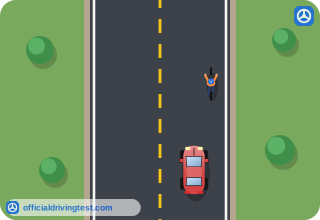
- As soon as your rear bumper passes the bicyclist's front wheel
- After you sound your horn to warn the bicyclist
- When the bicyclist has moved onto the sidewalk
- When you can see the bicyclist in your rearview mirror
Show answer
Correct answer: When you can see the bicyclist in your rearview mirror
Do not return to the right until you can see the bicyclist(s) in your rearview mirror.
Source: Iowa Driver’s License Manual (July 2026), page 58
-
How can you spot bicyclists at night?
- Watch for their reflectors or lights
- Listen for their bicycle bells
- Look for their shadows on the road ahead
- Watch for the glow of their helmets
Show answer
Correct answer: Watch for their reflectors or lights
At night, look for bicyclists and watch for their reflectors or lights.
Source: Iowa Driver’s License Manual (July 2026), page 58
-
From which direction should you especially watch for bicyclists before turning right?
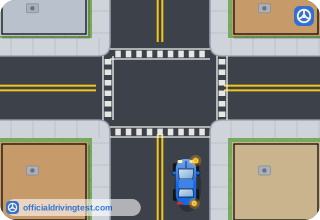
- From the left side
- From the oncoming lane
- From behind
- From straight ahead
Show answer
Correct answer: From behind
Watch for bicyclists coming from behind, especially before turning right.
Source: Iowa Driver’s License Manual (July 2026), page 58
-
At what speed do snowplows typically operate?
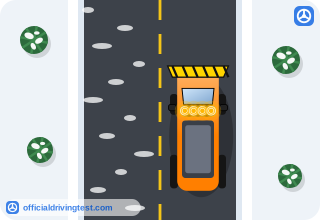
- 10-15 mph
- 25-35 mph
- 40-50 mph
- 55-65 mph
Show answer
Correct answer: 25-35 mph
Snowplows typically operate at 25-35 mph, and many drivers fail to realize this and hit them from behind.
Source: Iowa Driver’s License Manual (July 2026), page 61
-
On which side of a snowplow should you never pass?
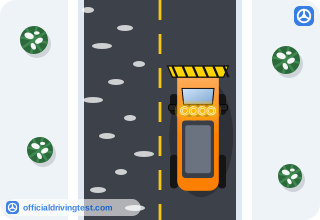
- The left side
- The side facing oncoming traffic
- The side with the blade angled out
- The shoulder side
Show answer
Correct answer: The shoulder side
Never pass on the shoulder side of a plow, because plows will move snow to the shoulders.
Source: Iowa Driver’s License Manual (July 2026), page 61
-
Why should you stay back from a snowplow and be patient until you can safely pass?
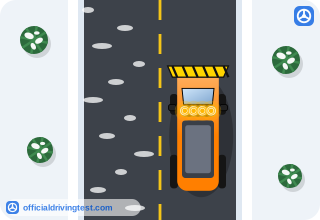
- It has large blind spots and may kick up a cloud of snow
- It must stop often to refill with salt
- It cannot drive faster than 10 mph
- It always turns without signaling or checking mirrors
Show answer
Correct answer: It has large blind spots and may kick up a cloud of snow
Snowplows have large blind spots and may kick up a cloud of snow, making it hard for you and them to see each other.
Source: Iowa Driver’s License Manual (July 2026), page 61
-
Why should you allow plenty of room when passing a snowplow?
- Its tires may throw gravel at your windshield
- It may stop suddenly to unload salt
- Its blades may stick out wider than the plow vehicle
- Its driver may swerve to the left
Show answer
Correct answer: Its blades may stick out wider than the plow vehicle
Plow blades may be sticking out further than the width of the plow vehicle.
Source: Iowa Driver’s License Manual (July 2026), page 61