Iowa: Sharing the road — Part 2 Practice Test
Questions in this part include: “How close to the rear of a school bus may you stop when its stop arm is extended?” · “For how long may your license be suspended for violating the school bus stopping law?”
Independent educational site · not affiliated with any government agency or DMV
Ready? Test yourself
- Instant feedback with an explanation
- Every answer cites its source in the manual
- Your best score is saved on this device
Questions are original and based on the official manual "Iowa Driver’s License Manual" (July 2026), Iowa Department of Transportation.
All 18 questions in this practice test
Take the test above first, then use this list to study. Tap “Show answer” to see the correct answer and explanation.
Show the questions and answersHide the questions
-
How should you handle the right-of-way when you meet a bicyclist?
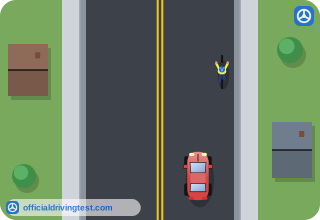
- Expect bicyclists to yield to you whenever the law says they must
- Insist on your right-of-way, since bicyclists must always yield
- Be ready to yield, even at times the bicyclist should yield to you
- Assume bicyclists will always move out of your way when you approach
Show answer
Correct answer: Be ready to yield, even at times the bicyclist should yield to you
Bicyclists have no defense against a vehicle, so a driver should be ready to yield the right-of-way even when the bicyclist should yield.
Source: Iowa Driver’s License Manual (July 2026), page 18
-
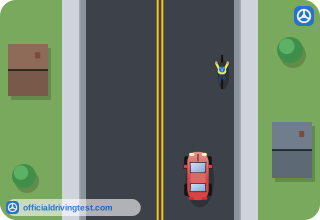
Why should motor vehicle drivers use good defensive driving skills around bicyclists?
- Bicycle riders always have the right-of-way
- Bicycle riders are very vulnerable in crashes
- Bicycle riders do not have to obey traffic signals
- Bicycle riders cannot see vehicles behind them
Show answer
Correct answer: Bicycle riders are very vulnerable in crashes
Bicycle riders are very vulnerable in crashes, so drivers should use defensive driving skills to avoid collisions with them.
Source: Iowa Driver’s License Manual (July 2026), page 18
-
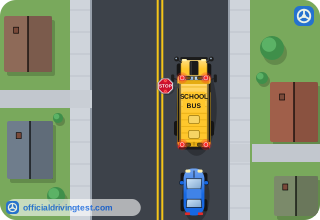
You approach a school bus from the rear and see flashing red or amber warning lights. What are you not permitted to do?
- Prepare to stop
- Pass the school bus
- Stop behind the bus
- Slow your vehicle
Show answer
Correct answer: Pass the school bus
When a school bus shows flashing red or amber warning lights, drivers approaching from the rear are not permitted to pass it.
Source: Iowa Driver’s License Manual (July 2026), page 20
-
How close to the rear of a school bus may you stop when its stop arm is extended?
- No closer than 5 feet
- No closer than 25 feet
- No closer than 30 feet
- No closer than 15 feet
Show answer
Correct answer: No closer than 15 feet
Drivers must stop no closer than 15 feet from the rear of a school bus that has stopped with its stop arm extended.
Source: Iowa Driver’s License Manual (July 2026), page 20
-
How long must you remain stopped behind a school bus whose stop arm is extended?
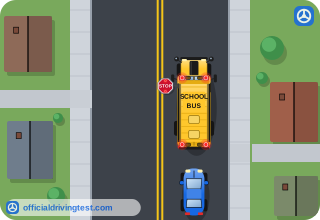
- Until the stop arm is retracted and the bus starts moving again
- Until the bus driver waves you around the stopped bus
- Until all of the children have crossed the whole road
- Until the bus has moved far enough ahead to be out of sight
Show answer
Correct answer: Until the stop arm is retracted and the bus starts moving again
You remain stopped until the stop arm is retracted and the school bus starts moving again, then proceed with caution.
Source: Iowa Driver’s License Manual (July 2026), page 20
-
You are meeting a school bus from the front on a two- or three-lane road and its amber warning lights are flashing. You must slow to no more than what speed?
- 10 mph
- 30 mph
- 20 mph
- 35 mph
Show answer
Correct answer: 20 mph
On a two- or three-lane road, you must slow to no more than 20 mph when you see amber warning lights flashing on a school bus approaching from the front.
Source: Iowa Driver’s License Manual (July 2026), page 20
-
On a two- or three-lane road, how long must you stay stopped when meeting a school bus from the front with its stop arm extended?
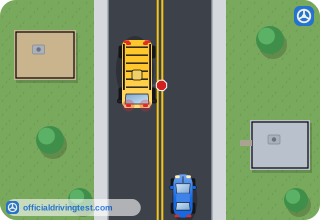
- Until the bus driver signals you to pass
- Until the stop arm is retracted
- Until the bus has driven out of sight
- Until any children have reached the sidewalk
Show answer
Correct answer: Until the stop arm is retracted
When meeting a stopped school bus with its stop arm extended, remain stopped until the stop arm is retracted, then proceed with caution.
Source: Iowa Driver’s License Manual (July 2026), page 20
-
For how long may your license be suspended for violating the school bus stopping law?
- Up to 30 days
- Up to 90 days
- Up to 120 days
- Up to 180 days
Show answer
Correct answer: Up to 180 days
Violating the school bus law may result in a license suspension of up to 180 days.
Source: Iowa Driver’s License Manual (July 2026), page 20
-
On a road with three lanes or fewer, which vehicles must stop for a school bus that has stopped with its stop arm extended?
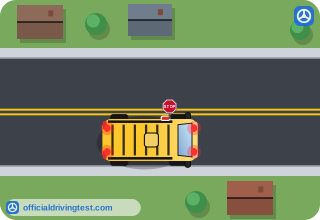
- All vehicles, from both directions
- Only vehicles approaching from the rear
- Only vehicles in the same lane as the bus
- Only large vehicles such as trucks and buses
Show answer
Correct answer: All vehicles, from both directions
On roads with three lanes or fewer, all vehicles must stop for a stopped school bus.
Source: Iowa Driver’s License Manual (July 2026), page 20
-
On a road with four or more lanes, what must you do when you approach a school bus from the rear and it stops with its stop arm extended?
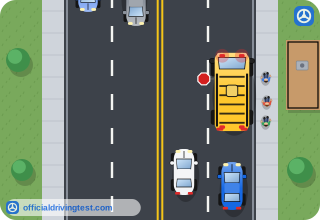
- Pass it carefully using any open lane to its left
- Slow to 20 mph and pass on the left
- Stop behind it, the same as on a two- or three-lane road
- Stop only if you are in the lane next to the bus
Show answer
Correct answer: Stop behind it, the same as on a two- or three-lane road
When approaching from the rear on a road with four or more lanes, the rules are the same as for a two- or three-lane road.
Source: Iowa Driver’s License Manual (July 2026), page 20
-
On a road with four or more lanes, when may you pass a school bus that is stopped with its stop arm extended?
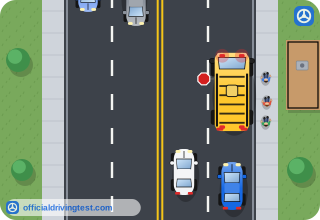
- When you approach from behind and no children are visible
- When you meet it in one of the two or more opposite lanes
- When you approach from behind in a lane to its left
- When the bus is stopped in the right-hand lane only
Show answer
Correct answer: When you meet it in one of the two or more opposite lanes
When meeting the bus in one of the opposite two (or more) lanes, you do not need to stop; this is the only time you may pass a stopped school bus with its stop arm extended.
Source: Iowa Driver’s License Manual (July 2026), page 20
-
Even when a vehicle has bicycle, pedestrian, and obstacle detection, where does the manual say to check especially often for bicyclists and pedestrians?
- In urban areas
- On interstate highways
- On empty rural roads
- In long highway tunnels
Show answer
Correct answer: In urban areas
You should not depend on detection and should check for bicyclists, pedestrians, or obstacles regularly, especially in urban areas.
Source: Iowa Driver’s License Manual (July 2026), page 29
-
What should you do instead of driving in another driver’s blind spot?
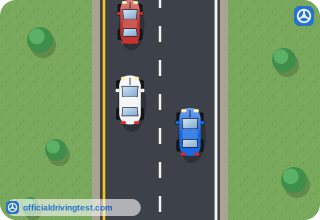
- Stay beside the vehicle and signal your intentions
- Speed up or slow down so the other driver can see your vehicle
- Drive close behind the vehicle and flash your headlights
- Keep the same speed so the other driver can predict your position
Show answer
Correct answer: Speed up or slow down so the other driver can see your vehicle
Do not drive in another driver’s blind spot: either speed up or slow down so the other driver can see your vehicle.
Source: Iowa Driver’s License Manual (July 2026), page 34
-
When passing another vehicle, what should you do about the other driver’s blind spot?
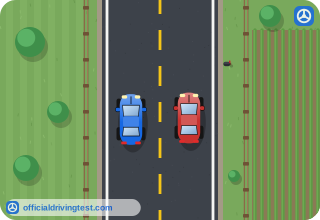
- Stay in it for a few seconds so the driver notices you
- Pass at a constant, slower speed to give the driver time to see you
- Flash your headlights before and during the pass
- Get through it as quickly as you can
Show answer
Correct answer: Get through it as quickly as you can
When passing another vehicle, you should get through the other driver’s blind spot as quickly as you can.
Source: Iowa Driver’s License Manual (July 2026), page 34
-
Why should you never stay alongside a large vehicle such as a truck or bus?
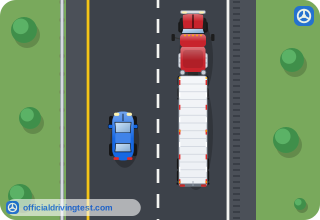
- Their tires often blow out and can throw heavy pieces of rubber at you
- Their drivers are not allowed to look at traffic beside them while moving
- These vehicles have large blind spots and it is hard for them to see you
- They always accelerate faster than cars and will run into your side
Show answer
Correct answer: These vehicles have large blind spots and it is hard for them to see you
Trucks and buses have large blind spots, so it is hard for their drivers to see you when you stay alongside.
Source: Iowa Driver’s License Manual (July 2026), page 34
-
Another driver is showing signs of aggressive driving. What should you do?
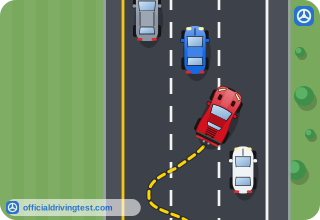
- Speed up to stay ahead of the driver
- Stay close behind the driver to watch the driving
- Slow down or pull over to avoid the driver
- Flash your headlights to warn the driver
Show answer
Correct answer: Slow down or pull over to avoid the driver
If another driver shows signs of aggressive driving, you should slow down or pull over to avoid them.
Source: Iowa Driver’s License Manual (July 2026), page 47
-
A driver is driving so dangerously that you are worried. What does the manual suggest?
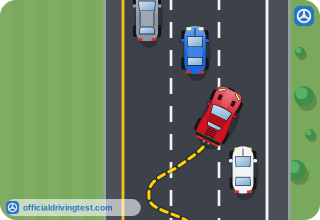
- Turn right or take the next exit to get off the roadway, if it is safe
- Pull alongside the driver and signal the driver to slow down
- Stay close behind the driver so you can report the license plate
- Speed up and pass the driver as quickly as you can
Show answer
Correct answer: Turn right or take the next exit to get off the roadway, if it is safe
If you are worried about a driver's dangerous driving, try to get off the roadway by turning right or taking the next exit if it is safe to do so.
Source: Iowa Driver’s License Manual (July 2026), page 47
-
What may farm vehicles, horse-drawn vehicles, ATVs/UTVs, and roadway maintenance vehicles have on the back?
- A white square plate with a black border and a red reflector
- A slow-moving vehicle sign (an orange triangle or flashing lights)
- A red triangle with a white center or a steady white light
- A yellow diamond-shaped sign or a green flag on a pole
Show answer
Correct answer: A slow-moving vehicle sign (an orange triangle or flashing lights)
These slower vehicles may have a slow-moving vehicle sign on the back, which is an orange triangle or flashing lights.
Source: Iowa Driver’s License Manual (July 2026), page 48