Iowa: Sharing the road — Part 3 Practice Test
Questions in this part include: “How does the manual describe rural gravel roadways?” · “When should you be especially on the lookout for animals while driving?”
Independent educational site · not affiliated with any government agency or DMV
Ready? Test yourself
- Instant feedback with an explanation
- Every answer cites its source in the manual
- Your best score is saved on this device
Questions are original and based on the official manual "Iowa Driver’s License Manual" (July 2026), Iowa Department of Transportation.
All 18 questions in this practice test
Take the test above first, then use this list to study. Tap “Show answer” to see the correct answer and explanation.
Show the questions and answersHide the questions
-
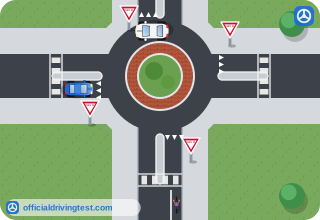
How should cyclists generally cross a roundabout crosswalk?
- Ride across the crosswalk without stopping for any traffic
- Ride on the sidewalk behind the splitter island
- Ride in the crosswalk and yield only to vehicles
- Walk their bicycles across, using the same rules as pedestrians
Show answer
Correct answer: Walk their bicycles across, using the same rules as pedestrians
Cyclists should generally walk their bicycles across the crosswalk using the same rules as pedestrians.
Source: Iowa Driver’s License Manual (July 2026), page 54
-
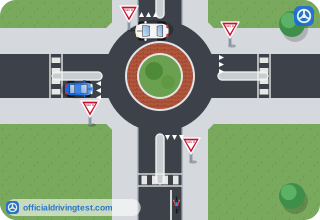
Where in the lane should an experienced cyclist ride when using a roundabout like a motorist?
- In the middle of the lane, to prevent vehicles from passing
- Next to the curb, to leave room for vehicles to pass
- In the crosswalk
- On the edge of the lane that is nearest the center island
Show answer
Correct answer: In the middle of the lane, to prevent vehicles from passing
Bicyclists using the roundabout should ride in the middle of the lane to prevent vehicles from passing and should not hug the curb.
Source: Iowa Driver’s License Manual (July 2026), page 54
-
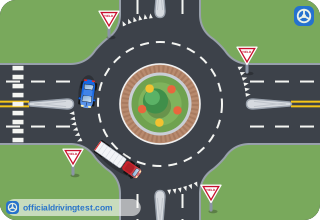
In a multi-lane roundabout, why should you not pass or drive beside trucks or buses?
- They always stop in the roundabout
- They must yield to every other vehicle
- They are not allowed in the inside lane
- They may straddle lanes or may not see you
Show answer
Correct answer: They may straddle lanes or may not see you
Trucks and buses may straddle lanes or may not see you, so do not pass or drive beside them.
Source: Iowa Driver’s License Manual (July 2026), page 54
-
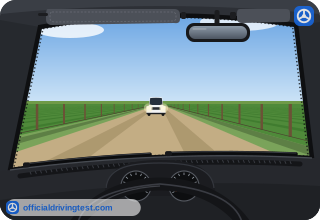
On a rural gravel roadway, what should you do when you meet oncoming vehicles?
- Slow down and move as far to the right as is safe
- Keep to the center of the road because it has no lane markings
- Speed up so that you pass the oncoming vehicles quickly
- Stop in the middle of the roadway until they have passed
Show answer
Correct answer: Slow down and move as far to the right as is safe
Rural gravel roadways are narrower and have no lane markings, so you slow down, proceed with caution and move as far to the right as is safe.
Source: Iowa Driver’s License Manual (July 2026), page 56
-
How does the manual describe rural gravel roadways?
- They are wider than paved roads and have center lines
- They have the same lane markings as major roads
- They are narrower and do not contain lane markings
- They are narrower but have painted lane markings
Show answer
Correct answer: They are narrower and do not contain lane markings
Rural gravel roadways are narrower than other roads and do not contain lane markings.
Source: Iowa Driver’s License Manual (July 2026), page 56
-
What do multiple vehicles create on rural gravel roadways?
- Standing water that hides the road edge
- Dust clouds and reduced visibility
- Ice patches that form on the gravel
- Loud noise that hides the sound of a train
Show answer
Correct answer: Dust clouds and reduced visibility
Multiple vehicles on a gravel roadway create dust clouds and reduced visibility.
Source: Iowa Driver’s License Manual (July 2026), page 56
-
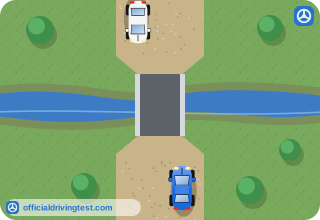
Many bridges on rural gravel roads can only accommodate one vehicle at a time. What should you be prepared to do when approaching one?
- Speed up to cross before oncoming vehicles arrive
- Drive in the center of the bridge
- Keep moving and sound your horn
- Stop for oncoming traffic
Show answer
Correct answer: Stop for oncoming traffic
Many bridges on rural gravel roads are narrower than the roadway and fit one vehicle at a time, so you must be prepared to stop for oncoming traffic.
Source: Iowa Driver’s License Manual (July 2026), page 56
-
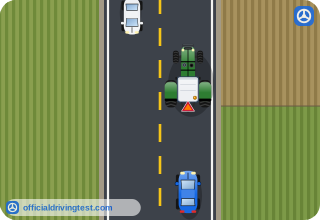
When you approach slow-moving and large vehicles on rural roads, such as farm equipment or horse drawn vehicles, what is important?
- Pass them as soon as you see them
- Follow them closely so the driver can see you
- Speed up so you can pass before an entrance
- Identify them early and slow down when approaching
Show answer
Correct answer: Identify them early and slow down when approaching
It is common to meet slow-moving and large vehicles on rural roads, so it is important to identify them early and slow down when approaching.
Source: Iowa Driver’s License Manual (July 2026), page 56
-
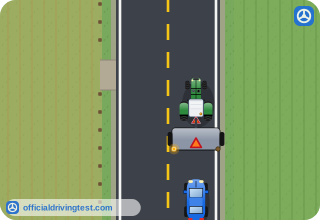
What may large farm equipment do at unmarked entrances?
- Make wide turns
- Stop and wait for all traffic to pass
- Back out onto the road without turning
- Make turns only from the left shoulder
Show answer
Correct answer: Make wide turns
The manual warns that large farm equipment may make wide turns at unmarked entrances.
Source: Iowa Driver’s License Manual (July 2026), page 56
-
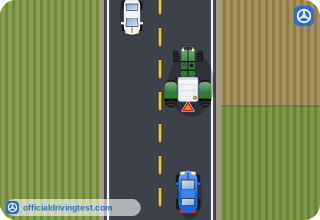
Why should you proceed with extreme caution when attempting to pass large farm equipment?
- It always speeds up whenever a vehicle tries to pass it on the road
- It is not allowed to travel on rural roads at night
- It may not see your vehicle and its turn signal may be difficult to detect
- Its driver is required to stop whenever a vehicle passes
Show answer
Correct answer: It may not see your vehicle and its turn signal may be difficult to detect
Farm equipment drivers may not see your vehicle, and a turn signal on the equipment may be difficult to detect.
Source: Iowa Driver’s License Manual (July 2026), page 56
-
When should you be especially on the lookout for animals while driving?
- At sunrise and sunset
- At midday and in the early afternoon
- Only after the middle of the night
- Only on interstate highways
Show answer
Correct answer: At sunrise and sunset
The manual says to be on the lookout for animals while driving, especially at sunrise and sunset.
Source: Iowa Driver’s License Manual (July 2026), page 57
-
Which months are the peak months for deer collisions in Iowa?
- June, July and August
- December, January and February
- October, November and May
- March, April and September
Show answer
Correct answer: October, November and May
October, November and May are the peak months for deer collisions, although they can occur at any time of the year.
Source: Iowa Driver’s License Manual (July 2026), page 57
-
Deer travel in groups. What should you do if you see one deer?
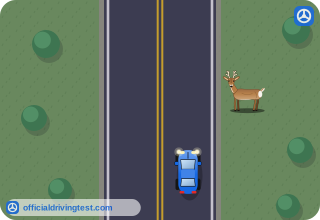
- Assume the rest have already crossed
- Always look for more animals
- Speed up to get past before others appear
- Flash your high beams and keep your speed
Show answer
Correct answer: Always look for more animals
Because deer travel in groups, you should always look for more animals if one is seen.
Source: Iowa Driver’s License Manual (July 2026), page 57
-
What are the blind spots around the front, back and sides of a large truck called?
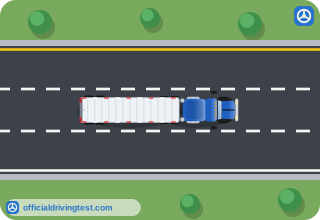
- “No-zones”
- “Dead lanes”
- “Stop zones”
- “Danger lanes”
Show answer
Correct answer: “No-zones”
Large trucks have blind spots called “no-zones” around the front, back and sides of the vehicle.
Source: Iowa Driver’s License Manual (July 2026), page 57
-
You cannot see a truck driver in the truck's mirror. What does this mean?
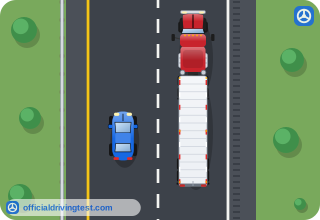
- The truck driver can see you in another mirror
- The truck is about to stop
- The truck driver cannot see you
- The truck driver is about to change lanes
Show answer
Correct answer: The truck driver cannot see you
If you cannot see the truck driver in the truck's mirror, the truck driver cannot see you.
Source: Iowa Driver’s License Manual (July 2026), page 57
-
Compared with cars, how long do trucks and buses take to stop?
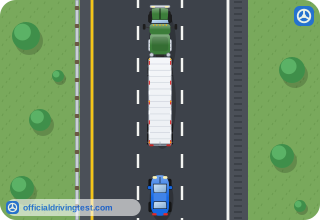
- About the same time
- Much longer
- Slightly less time
- Half as long
Show answer
Correct answer: Much longer
Trucks and buses take much longer to stop in comparison to cars.
Source: Iowa Driver’s License Manual (July 2026), page 57
-
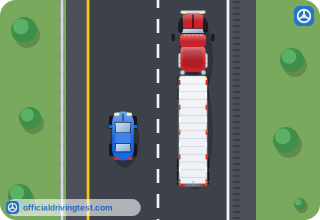
When passing a large truck, what should you look for before pulling in front of it?
- The truck driver's face in your windshield
- The truck's rear tires in your side window
- The truck's turn signal in your rearview mirror
- The front of the truck in your rearview mirror
Show answer
Correct answer: The front of the truck in your rearview mirror
Look for the front of the truck in your rearview mirror before pulling in front, and avoid pulling out in front of trucks, which creates an emergency braking situation.
Source: Iowa Driver’s License Manual (July 2026), page 57
-
To safely negotiate a right turn, in which direction do truck drivers sometimes need to swing widely?
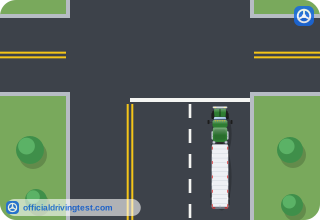
- To the left
- To the right
- Straight across the intersection
- Toward the curb
Show answer
Correct answer: To the left
Truck drivers sometimes need to swing widely to the left in order to safely negotiate a right turn.
Source: Iowa Driver’s License Manual (July 2026), page 57