Iowa: Sharing the road — Part 4 Practice Test
Questions in this part include: “Where are car/motorcycle collisions most likely to occur?” · “People riding bicycles are often prohibited from riding where?”
Independent educational site · not affiliated with any government agency or DMV
Ready? Test yourself
- Instant feedback with an explanation
- Every answer cites its source in the manual
- Your best score is saved on this device
Questions are original and based on the official manual "Iowa Driver’s License Manual" (July 2026), Iowa Department of Transportation.
All 18 questions in this practice test
Take the test above first, then use this list to study. Tap “Show answer” to see the correct answer and explanation.
Show the questions and answersHide the questions
-
What increases the possibility of a crash when a truck is making a wide right turn?
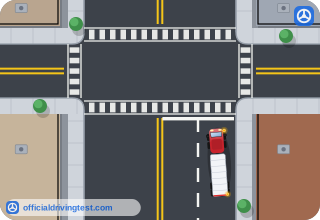
- Paying attention to the truck's signals
- Giving the truck lots of room to maneuver
- Cutting in between the truck and the curb
- Staying well behind the truck
Show answer
Correct answer: Cutting in between the truck and the curb
Cutting in between the truck and the curb increases the possibility of a crash, so pay attention to truck signals and give the truck lots of room.
Source: Iowa Driver’s License Manual (July 2026), page 57
-
Which cars can't a truck driver see when making a wide right turn?
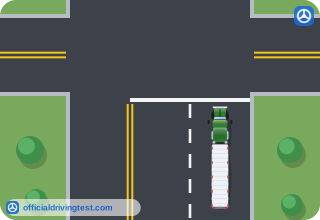
- Cars several blocks ahead of the truck
- Cars directly behind or beside the truck
- Oncoming cars in the opposite lanes
- Cars two lanes away from the truck
Show answer
Correct answer: Cars directly behind or beside the truck
Truck drivers can't see cars directly behind or beside them when they swing wide for a right turn.
Source: Iowa Driver’s License Manual (July 2026), page 57
-
Where are car/motorcycle collisions most likely to occur?
- On freeway entrance ramps
- In parking lots
- On rural gravel roads
- At intersections
Show answer
Correct answer: At intersections
Intersections are the most likely places for car/motorcycle collisions to occur.
Source: Iowa Driver’s License Manual (July 2026), page 58
-
Before you start to turn or enter an intersection, what should you make sure of regarding a motorcycle?
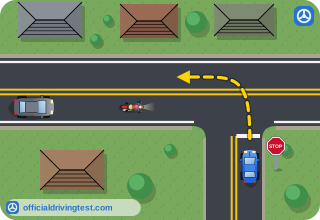
- That you see the motorcycle and know its speed
- That the rider is already slowing to a stop
- That the motorcycle's turn signal is flashing
- That the motorcycle is behind your vehicle
Show answer
Correct answer: That you see the motorcycle and know its speed
Make sure you see the motorcycle and know its speed before you start to turn or enter an intersection.
Source: Iowa Driver’s License Manual (July 2026), page 58
-
Why must you make sure you know what a motorcycle rider is going to do before you move into the motorcycle's path?
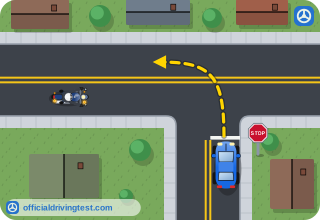
- Their turn signals flash much faster than those of cars, so they are easy to misread
- Riders turn on their signals whenever they slow down, even when not turning
- Their turn signals do not shut off by themselves, so riders may forget to cancel them
- Their turn signals are too small to be seen by drivers who are behind them
Show answer
Correct answer: Their turn signals do not shut off by themselves, so riders may forget to cancel them
Turn signals do not automatically shut off on a motorcycle and riders occasionally forget to cancel them after a turn.
Source: Iowa Driver’s License Manual (July 2026), page 58
-
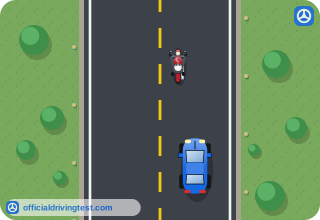
What is the minimum following distance when driving behind a motorcycle?
- At least 1 second
- At least 3-4 seconds
- At least 2 seconds
- At least 2-3 seconds
Show answer
Correct answer: At least 3-4 seconds
When driving behind a motorcycle, allow at least a 3-4 second following distance so the cyclist has enough room to maneuver or stop in an emergency.
Source: Iowa Driver’s License Manual (July 2026), page 58
-
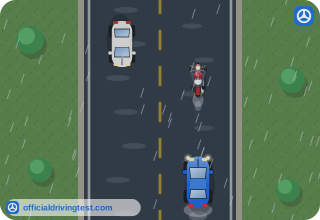
What should you do when following a motorcycle on a wet or slippery road?
- Stay closer so the rider can see you
- Keep the same following distance as on dry pavement
- Pass it as quickly as possible
- Stay further behind it
Show answer
Correct answer: Stay further behind it
When the road is wet or slippery, you should stay further behind a motorcycle.
Source: Iowa Driver’s License Manual (July 2026), page 58
-
Why may motorcycles be very unstable when trying to stop quickly?
- Only two wheels are in contact with the pavement
- They are much heavier than most cars
- Their tires have less tread than car tires
- They do not have brake lights
Show answer
Correct answer: Only two wheels are in contact with the pavement
With only two wheels in contact with the pavement, motorcycles may be very unstable when trying to stop quickly.
Source: Iowa Driver’s License Manual (July 2026), page 58
-
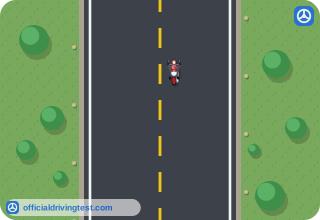
When passing a motorcycle, how much room should you allow for it?
- Half a lane
- Only the width of the motorcycle
- A full lane
- Half of the shoulder
Show answer
Correct answer: A full lane
When passing a motorcycle, allow a full lane for it and never crowd into the same lane as the cycle.
Source: Iowa Driver’s License Manual (July 2026), page 58
-
People riding bicycles are often prohibited from riding where?
- In bike lanes
- On rural roads
- On sidewalks
- On residential streets
Show answer
Correct answer: On sidewalks
People riding bicycles have the right to be on the road and are often prohibited from riding on sidewalks, so you should respect their right to be there.
Source: Iowa Driver’s License Manual (July 2026), page 58
-
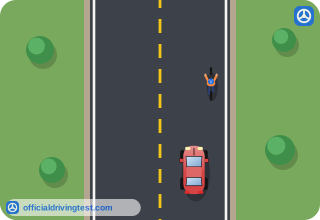
What must you do when passing bicyclists?
- Move to the edge of your lane and sound your horn to warn them
- Completely change lanes, giving the bicyclist the entire lane
- Straddle the lane line while you pass
- Stay in your lane and pass with extra speed
Show answer
Correct answer: Completely change lanes, giving the bicyclist the entire lane
When passing bicyclists, you must completely change lanes and give the bicyclist the entire lane, as you would with any other vehicle.
Source: Iowa Driver’s License Manual (July 2026), page 58
-
When may you return to the right after passing a bicyclist?
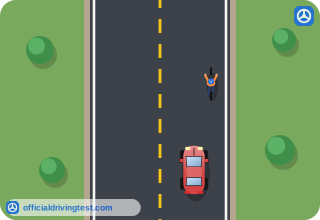
- As soon as your rear bumper passes the bicyclist's front wheel
- After you sound your horn to warn the bicyclist
- When the bicyclist has moved onto the sidewalk
- When you can see the bicyclist in your rearview mirror
Show answer
Correct answer: When you can see the bicyclist in your rearview mirror
Do not return to the right until you can see the bicyclist(s) in your rearview mirror.
Source: Iowa Driver’s License Manual (July 2026), page 58
-
How can you spot bicyclists at night?
- Watch for their reflectors or lights
- Listen for their bicycle bells
- Look for their shadows on the road ahead
- Watch for the glow of their helmets
Show answer
Correct answer: Watch for their reflectors or lights
At night, look for bicyclists and watch for their reflectors or lights.
Source: Iowa Driver’s License Manual (July 2026), page 58
-
From which direction should you especially watch for bicyclists before turning right?
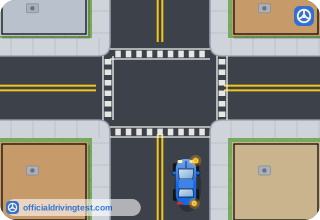
- From the left side
- From the oncoming lane
- From behind
- From straight ahead
Show answer
Correct answer: From behind
Watch for bicyclists coming from behind, especially before turning right.
Source: Iowa Driver’s License Manual (July 2026), page 58
-
At what speed do snowplows typically operate?
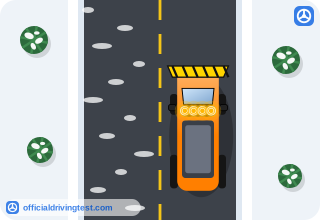
- 10-15 mph
- 25-35 mph
- 40-50 mph
- 55-65 mph
Show answer
Correct answer: 25-35 mph
Snowplows typically operate at 25-35 mph, and many drivers fail to realize this and hit them from behind.
Source: Iowa Driver’s License Manual (July 2026), page 61
-
On which side of a snowplow should you never pass?
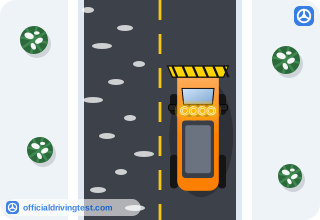
- The left side
- The side facing oncoming traffic
- The side with the blade angled out
- The shoulder side
Show answer
Correct answer: The shoulder side
Never pass on the shoulder side of a plow, because plows will move snow to the shoulders.
Source: Iowa Driver’s License Manual (July 2026), page 61
-
Why should you stay back from a snowplow and be patient until you can safely pass?
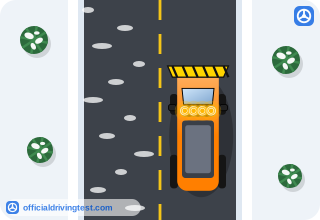
- It has large blind spots and may kick up a cloud of snow
- It must stop often to refill with salt
- It cannot drive faster than 10 mph
- It always turns without signaling or checking mirrors
Show answer
Correct answer: It has large blind spots and may kick up a cloud of snow
Snowplows have large blind spots and may kick up a cloud of snow, making it hard for you and them to see each other.
Source: Iowa Driver’s License Manual (July 2026), page 61
-
Why should you allow plenty of room when passing a snowplow?
- Its tires may throw gravel at your windshield
- It may stop suddenly to unload salt
- Its blades may stick out wider than the plow vehicle
- Its driver may swerve to the left
Show answer
Correct answer: Its blades may stick out wider than the plow vehicle
Plow blades may be sticking out further than the width of the plow vehicle.
Source: Iowa Driver’s License Manual (July 2026), page 61