Indiana: Emergency vehicles and work zones
Moving over for emergency and stopped vehicles, work zones, and what to do when you are stopped by law enforcement. Split into 3 shorter tests so you're not stuck in one long quiz.
Independent educational site · not affiliated with any government agency or DMV
Choose a part
Emergency vehicles and work zones — Part 1
Questions in this part include: “Worksite added penalty signs are an example of construction signs that convey what?”
StartEmergency vehicles and work zones — Part 2
Questions in this part include: “Approaching which emergency vehicle lights requires you to change lanes away from the vehicle?”
StartEmergency vehicles and work zones — Part 3
Questions in this part include: “Which must vehicle operators have in order to operate a vehicle?”
StartAll 49 Emergency vehicles and work zones questions with answers
Choose a part above to take a practice test, or study every question and answer here.
Show the questions and answersHide the questions
-
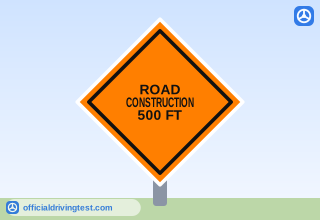
What do orange highway construction traffic signs warn drivers to do?
- Stop before passing every work crew you see
- Yield to all oncoming traffic in the work zone
- Watch for children crossing the road ahead
- Be careful when approaching construction zones
Show answer
Correct answer: Be careful when approaching construction zones
Orange highway construction signs warn drivers to be careful when approaching construction zones.
Source: Indiana Driver’s Manual (July 2026), page 30 · Open this page in the manual (Manual page 30)
-
Worksite added penalty signs are an example of construction signs that convey what?
- Regulations
- Guidance
- Distances to destinations
- Services at the next exit
Show answer
Correct answer: Regulations
The manual says construction signs convey regulations such as the worksite added penalty signs.
Source: Indiana Driver’s Manual (July 2026), page 30 · Open this page in the manual (Manual page 30)
-
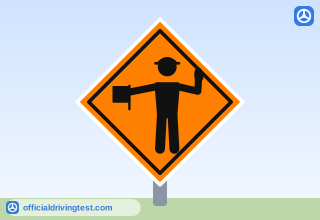
An orange diamond sign shows a person holding a flag. What does it warn drivers of?
- Work crew ahead
- Detour ahead
- Flagger ahead
- Right lane closed
Show answer
Correct answer: Flagger ahead
An orange diamond sign showing a person holding a flag is the "Flagger Ahead" sign.
Source: Indiana Driver’s Manual (July 2026), page 30 · Open this page in the manual (Manual page 30)
-
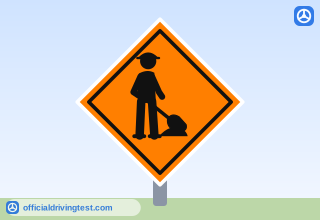
An orange diamond sign shows a person with a shovel. What does it warn drivers of?
- Flagger ahead
- Work crew ahead
- Detour ahead
- Worksite speed limit
Show answer
Correct answer: Work crew ahead
An orange diamond sign showing a person with a shovel is the "Work Crew Ahead" sign.
Source: Indiana Driver’s Manual (July 2026), page 30 · Open this page in the manual (Manual page 30)
-
What do lane markings, traffic cones, barrels or barricades do in a work zone with a lane closure or crossover?
- Mark where drivers must stop for workers
- Show the end of the work zone
- Outline the path the vehicle must follow
- Show where flaggers may stand
Show answer
Correct answer: Outline the path the vehicle must follow
Lane markings, traffic cones, barrels or barricades outline the path the vehicle must follow.
Source: Indiana Driver’s Manual (July 2026), page 47 · Open this page in the manual (Manual page 47)
-
What does a flashing arrow board that does not indicate a direction either way tell a driver?
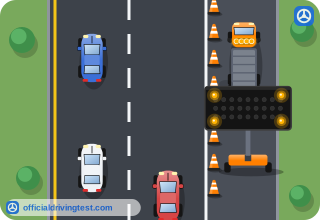
- Use caution; no lane change needed
- Move to the left lane immediately
- Stop and wait for the flagger
- The road ahead is completely closed
Show answer
Correct answer: Use caution; no lane change needed
An arrow board showing no direction is a signal to use caution, not a requirement to change lanes.
Source: Indiana Driver’s Manual (July 2026), page 47 · Open this page in the manual (Manual page 47)
-
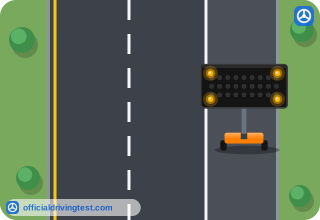
What are flashing arrow boards often used to indicate?
- A school zone
- An upcoming railroad crossing
- A change in the speed limit
- A lane closure or “crossover”
Show answer
Correct answer: A lane closure or “crossover”
The manual says flashing arrow boards are often used to indicate a lane closure or “crossover.”
Source: Indiana Driver’s Manual (July 2026), page 47 · Open this page in the manual (Manual page 47)
-
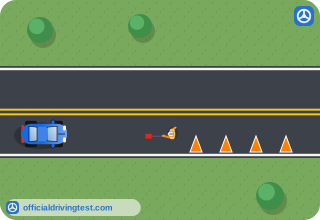
What must you do when a flagger extends a fluorescent orange/red flag in a horizontal position into the line of traffic?
- Slow down and keep moving
- Stop
- Change lanes
- Yield only to oncoming vehicles
Show answer
Correct answer: Stop
The manual says you must stop when a flagger extends a fluorescent orange/red flag horizontally into the line of traffic.
Source: Indiana Driver’s Manual (July 2026), page 47 · Open this page in the manual (Manual page 47)
-
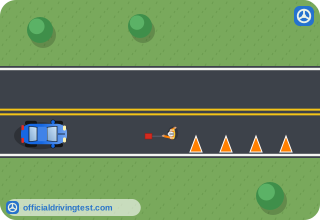
After stopping for a flagger’s horizontal flag, when may you proceed?
- As soon as no workers are in sight
- Only when the flagger directs you
- After waiting five seconds
- Whenever the vehicle ahead moves
Show answer
Correct answer: Only when the flagger directs you
You may proceed at a reduced speed only when the flagger directs you to.
Source: Indiana Driver’s Manual (July 2026), page 47 · Open this page in the manual (Manual page 47)
-
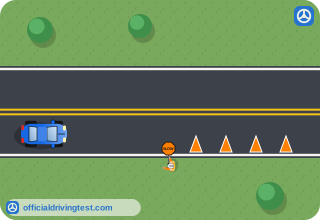
What must you do when a flagger holds a signal paddle that displays “SLOW”?
- Stop and wait
- Pull onto the shoulder
- Speed up to clear the work zone
- Proceed slowly
Show answer
Correct answer: Proceed slowly
If a flagger uses a signal paddle, you must stop or proceed slowly according to the “STOP” or “SLOW” message on the sign.
Source: Indiana Driver’s Manual (July 2026), page 47 · Open this page in the manual (Manual page 47)
-
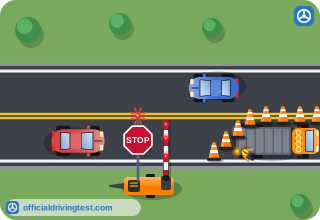
Why are Automated Flagger Assistance Devices used?
- To keep flaggers out of the lane of traffic
- To count the vehicles passing the work zone
- To replace the posted speed limit
- To warn drivers of railroad crossings
Show answer
Correct answer: To keep flaggers out of the lane of traffic
Automated Flagger Assistance Devices are used to enable flaggers to be positioned out of the lane of traffic.
Source: Indiana Driver’s Manual (July 2026), page 47 · Open this page in the manual (Manual page 47)
-
What does an Automated Flagger Assistance Device display?
- Only a flashing green arrow and a siren
- A railroad crossbuck with a yield sign
- A “STOP” or “SLOW” sign, or red and yellow lights
- The posted speed limit and a work zone map
Show answer
Correct answer: A “STOP” or “SLOW” sign, or red and yellow lights
These devices display a “STOP” or a “SLOW” sign like a flagger-held paddle, or use red and yellow lights.
Source: Indiana Driver’s Manual (July 2026), page 47 · Open this page in the manual (Manual page 47)
-
What does the manual say work zone signs will state?
- Exactly what to expect ahead
- Only the speed limit
- Where the workers are standing
- How long the delay will last
Show answer
Correct answer: Exactly what to expect ahead
The manual says work zone signs will state exactly what to expect ahead.
Source: Indiana Driver’s Manual (July 2026), page 47 · Open this page in the manual (Manual page 47)
-
Which of these should you look for when you stay alert in a work zone?
- Wider lanes and higher posted speed limits
- Free parking spaces beside the work area
- Reduced speed limits, narrow lanes and workers
- Shortcuts around the work zone on side roads
Show answer
Correct answer: Reduced speed limits, narrow lanes and workers
Staying alert means looking for reduced speed limits, narrow driving lanes and highway workers.
Source: Indiana Driver’s Manual (July 2026), page 47 · Open this page in the manual (Manual page 47)
-
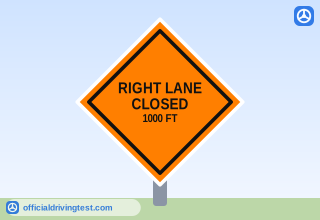
Which work zone safety tip says that traffic will generally flow more smoothly if you act at first sight of the signs?
- Slow down
- Merge early
- Don’t tailgate
- Plan ahead
Show answer
Correct answer: Merge early
The manual says that merging early, at first sight of the signs, lets traffic generally flow more smoothly.
Source: Indiana Driver’s Manual (July 2026), page 47 · Open this page in the manual (Manual page 47)
-
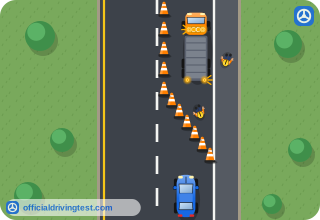
What is late or zipper merging used for?
- To let trucks pass on the shoulder
- To mark the end of a work zone
- To warn of a flagger ahead
- To shorten a traffic back-up
Show answer
Correct answer: To shorten a traffic back-up
At some locations traffic is encouraged to merge toward the lane closure, called late or zipper merging, which may reduce the length of a traffic back-up.
Source: Indiana Driver’s Manual (July 2026), page 48 · Open this page in the manual (Manual page 48)
-
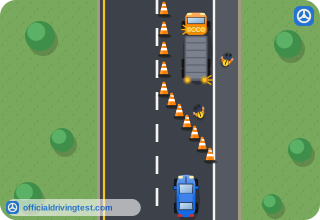
What will you encounter within seconds if you are speeding when you approach a work zone?
- A flagger waving you through
- A wider driving lane
- Slowed or stopped traffic
- A lower speed limit sign only
Show answer
Correct answer: Slowed or stopped traffic
If you are speeding when you approach a work zone you will encounter slowed or stopped traffic within seconds.
Source: Indiana Driver’s Manual (July 2026), page 48 · Open this page in the manual (Manual page 48)
-
How much distance does the manual say to maintain when you are in a work zone?
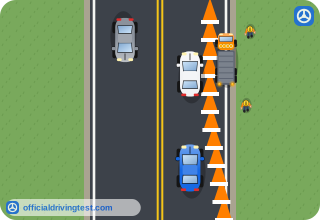
- A safe distance on all sides of your vehicle
- A safe distance behind the vehicle ahead only
- A safe distance from the workers only
- A safe distance from the right shoulder only
Show answer
Correct answer: A safe distance on all sides of your vehicle
The manual says not to tailgate and to maintain a safe distance on all sides of your vehicle.
Source: Indiana Driver’s Manual (July 2026), page 48 · Open this page in the manual (Manual page 48)
-
What does Indiana's Move Over law require motorists to do when approaching an emergency vehicle with its lights flashing?
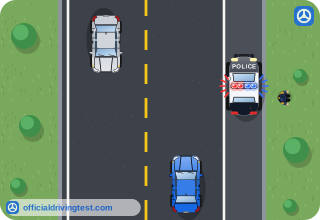
- Speed up and pass it before reaching the next intersection or exit ahead
- Slow down and stay in the same lane at a steady pace until it passes
- Pull onto the left shoulder and wait there for it to go by safely
- Yield the right of way, move over to the right and stop, or change lanes
Show answer
Correct answer: Yield the right of way, move over to the right and stop, or change lanes
The Move Over law requires motorists to yield, move over to the right and stop, or change lanes.
Source: Indiana Driver’s Manual (July 2026), page 51 · Open this page in the manual (Manual page 51)
-
Approaching which emergency vehicle lights requires you to change lanes away from the vehicle?
- Alternately flashing red, red and white, or red and blue lights
- Alternately flashing green and white lights shown on the vehicle
- Steady blue lights that are not flashing in any pattern
- Flashing white lights with no red lights shown on the vehicle
Show answer
Correct answer: Alternately flashing red, red and white, or red and blue lights
Motorists approaching an emergency vehicle with alternately flashing red, red and white, or red and blue lights must change lanes away.
Source: Indiana Driver’s Manual (July 2026), page 51 · Open this page in the manual (Manual page 51)
-
If you cannot move over for an emergency vehicle with flashing lights, how must you drive?
- Reduce your speed to 5 mph under the posted limit and proceed with caution
- Reduce your speed to 20 mph under the posted limit and proceed with caution
- Reduce your speed to 10 mph under the posted limit and proceed with caution
- Reduce your speed to 15 mph under the posted limit and proceed with caution
Show answer
Correct answer: Reduce your speed to 10 mph under the posted limit and proceed with caution
If you cannot move over, you must reduce your speed to 10 mph under the posted limit and proceed with caution.
Source: Indiana Driver’s Manual (July 2026), page 51 · Open this page in the manual (Manual page 51)
-
What is the penalty for failing to change lanes or slow down for an emergency vehicle with flashing lights?
- A Class B infraction
- A Class A infraction
- A Class A misdemeanor
- A Level 6 felony
Show answer
Correct answer: A Class A infraction
The manual states that failure to comply is a Class A infraction.
Source: Indiana Driver’s Manual (July 2026), page 51 · Open this page in the manual (Manual page 51)
-
Which of these is an authorized emergency vehicle under the manual?
- Taxi cabs
- Mail delivery trucks
- Commercial passenger buses
- Police department vehicles
Show answer
Correct answer: Police department vehicles
The manual lists police department vehicles among the authorized emergency vehicles.
Source: Indiana Driver’s Manual (July 2026), page 51 · Open this page in the manual (Manual page 51)
-
What are motorists required to do when approaching an authorized parked vehicle with amber flashing lights?
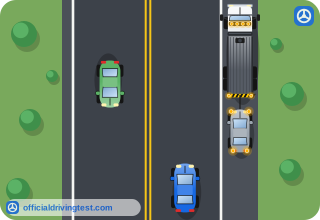
- Change lanes away from the vehicle
- Stop completely until it leaves
- Speed up and pass on the left
- Sound the horn and pass closely
Show answer
Correct answer: Change lanes away from the vehicle
Motorists must change lanes away from an authorized parked vehicle with amber flashing lights.
Source: Indiana Driver’s Manual (July 2026), page 51 · Open this page in the manual (Manual page 51)
-
What is the penalty for failing to change lanes or slow down for an authorized parked vehicle with amber flashing lights?
- A Class A infraction
- A Level 6 felony
- A Class B infraction
- A Class A misdemeanor
Show answer
Correct answer: A Class B infraction
The manual states that failure to do so is a Class B infraction.
Source: Indiana Driver’s Manual (July 2026), page 51 · Open this page in the manual (Manual page 51)
-
Which of these is listed as an authorized vehicle with amber flashing lights?
- Postal delivery vehicles
- Utility service vehicles
- Taxi and shuttle vehicles
- Private passenger buses
Show answer
Correct answer: Utility service vehicles
Utility service vehicles are among the authorized vehicles with amber flashing lights.
Source: Indiana Driver’s Manual (July 2026), page 51 · Open this page in the manual (Manual page 51)
-
What are you required to do when approaching a disabled stationary vehicle with flashing hazard warning signals?
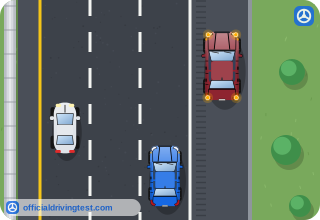
- Stop behind it and offer help
- Stay in your lane at the same speed
- Honk to warn the driver and pass closely
- Change lanes away from the disabled vehicle
Show answer
Correct answer: Change lanes away from the disabled vehicle
Motorists must change lanes away from a disabled stationary vehicle with flashing hazard warning signals.
Source: Indiana Driver’s Manual (July 2026), page 51 · Open this page in the manual (Manual page 51)
-
What is the penalty for failing to change lanes or slow down for a disabled stationary vehicle with flashing hazard warning signals?
- A Class B infraction
- A Class A infraction
- A Level 6 felony
- A Class A misdemeanor
Show answer
Correct answer: A Class B infraction
The manual states that failure to do so is a Class B infraction.
Source: Indiana Driver’s Manual (July 2026), page 51 · Open this page in the manual (Manual page 51)
-
According to the manual, what is the purpose of a traffic stop?
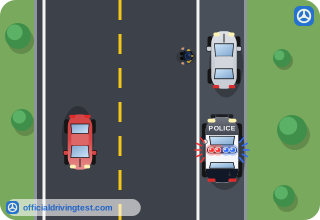
- To collect fines from the driver on the spot where the stop happens
- To ensure that a vehicle operator is safe and in compliance with the law
- To inspect the vehicle for equipment defects and worn tires
- To test the driver's knowledge of the rules of the road
Show answer
Correct answer: To ensure that a vehicle operator is safe and in compliance with the law
The purpose of the traffic stop is to ensure the vehicle operator is safe and in compliance with the law.
Source: Indiana Driver’s Manual (July 2026), page 60 · Open this page in the manual (Manual page 60)
-
When stopped by law enforcement, how should you acknowledge the officer's presence?
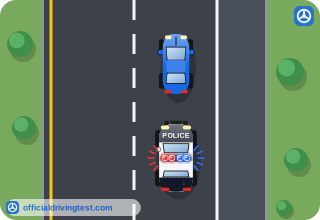
- By flashing your headlights
- By turning on your left turn signal
- By sounding your horn briefly
- By turning on your right turn signal
Show answer
Correct answer: By turning on your right turn signal
The manual says to acknowledge the officer's presence by turning on your right turn signal.
Source: Indiana Driver’s Manual (July 2026), page 60 · Open this page in the manual (Manual page 60)
-
Why should you acknowledge an officer's presence with your turn signal during a traffic stop?
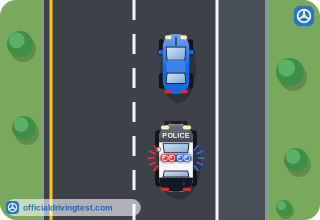
- Without it, an officer might think you are avoiding yielding or are impaired
- Without it, the officer cannot tell which lane your vehicle is in at night
- Without it, the stop is automatically treated as a ticket and an arrest
- Without it, the officer cannot look up your registration from the car
Show answer
Correct answer: Without it, an officer might think you are avoiding yielding or are impaired
If you fail to acknowledge the officer, the officer might perceive that you have a reason to avoid yielding or that you might be impaired.
Source: Indiana Driver’s Manual (July 2026), page 60 · Open this page in the manual (Manual page 60)
-
When stopped by law enforcement, where should you move your vehicle?
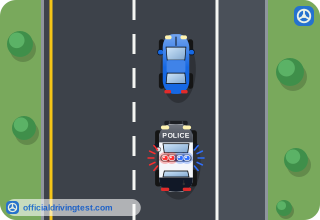
- Onto the center median
- To the opposite side of a two-lane roadway
- To the right-side shoulder of the road
- To the left shoulder of a freeway
Show answer
Correct answer: To the right-side shoulder of the road
The manual says to move your vehicle to the right-side shoulder and not onto the center median.
Source: Indiana Driver’s Manual (July 2026), page 61 · Open this page in the manual (Manual page 61)
-
If there is no shoulder, or it is too narrow to pull over for a traffic stop, what should you do?
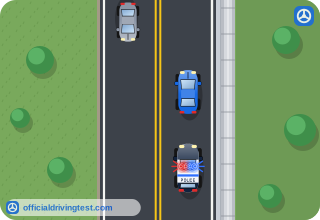
- Stop in the center median
- Find the next safest location and pull over
- Stop in the lane where you are
- Keep driving until the officer passes you
Show answer
Correct answer: Find the next safest location and pull over
If there is no shoulder or it is too narrow, you should find the next safest location and pull over.
Source: Indiana Driver’s Manual (July 2026), page 61 · Open this page in the manual (Manual page 61)
-
When you are stopped by law enforcement in the dark, where should you look to stop if possible?
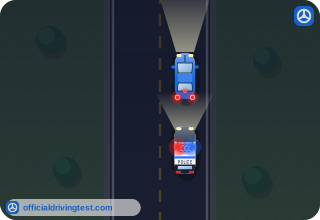
- Quiet side roads away from other traffic, where it is easy to talk
- Open fields beside the road with plenty of space for the vehicles
- Dark spots where the officer can use a spotlight to see you well
- Places with more light, such as street lights, restaurants, or service stations
Show answer
Correct answer: Places with more light, such as street lights, restaurants, or service stations
When it is dark, look for locations with more light, such as street or freeway lights, restaurants, or service stations.
Source: Indiana Driver’s Manual (July 2026), page 61 · Open this page in the manual (Manual page 61)
-
If you are stopped by law enforcement at night, what are you encouraged to do?
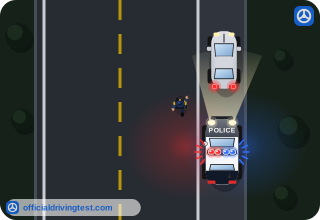
- Turn on the interior light of the vehicle
- Turn off your headlights
- Turn on your high beams
- Step out of the vehicle to show your face
Show answer
Correct answer: Turn on the interior light of the vehicle
The manual encourages turning on the interior light of the vehicle when stopped at night.
Source: Indiana Driver’s Manual (July 2026), page 61 · Open this page in the manual (Manual page 61)
-
You cannot find a safe place to stop right away for a police officer. What should you do?
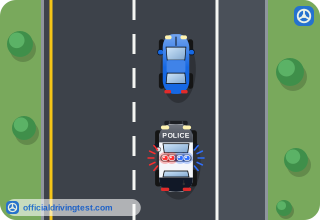
- Speed up to reach a better place quickly
- Stop immediately in your lane
- Slow down and turn on your hazard lights
- Turn off your headlights
Show answer
Correct answer: Slow down and turn on your hazard lights
Slowing down and turning on hazard lights shows the officer you acknowledge them and are actively trying to find a safe place to stop.
Source: Indiana Driver’s Manual (July 2026), page 61 · Open this page in the manual (Manual page 61)
-
What should you do with your phone and radio when stopped by law enforcement?
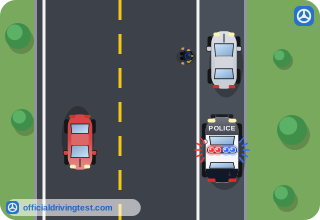
- Lower the radio volume but keep your call going
- End cell phone conversations and turn off the radio
- Keep your phone in your hand to show it is off
- Use your phone to record the officer
Show answer
Correct answer: End cell phone conversations and turn off the radio
The officer needs your full attention, so you should end cell phone conversations and turn off your radio.
Source: Indiana Driver’s Manual (July 2026), page 61 · Open this page in the manual (Manual page 61)
-
During a traffic stop, what should you do unless the officer tells you otherwise?
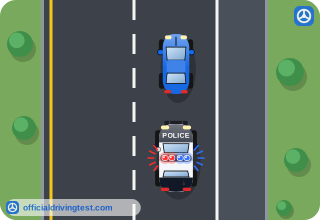
- Step out and wait beside your vehicle
- Walk back to the patrol car
- Stand near the rear of your vehicle with your hands up
- Remain inside your vehicle
Show answer
Correct answer: Remain inside your vehicle
The manual says to remain inside your vehicle unless otherwise directed by the officer.
Source: Indiana Driver’s Manual (July 2026), page 61 · Open this page in the manual (Manual page 61)
-
During a traffic stop, where should the driver keep their hands?
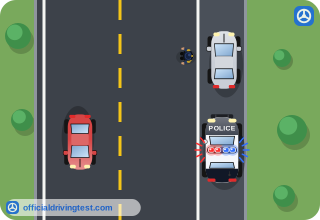
- On the steering wheel
- On top of the dashboard
- Out of the window
- Behind the head
Show answer
Correct answer: On the steering wheel
The driver should keep their hands on the steering wheel so the officer can see them.
Source: Indiana Driver’s Manual (July 2026), page 61 · Open this page in the manual (Manual page 61)
-
During a traffic stop, where should passengers' hands be?
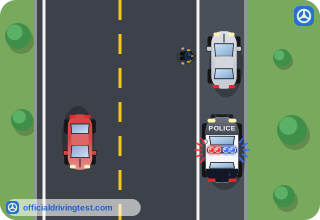
- On the back of the front seats
- Out of the window
- Kept visible on their own laps
- Under the seat
Show answer
Correct answer: Kept visible on their own laps
Passenger hands should be visible on their laps.
Source: Indiana Driver’s Manual (July 2026), page 61 · Open this page in the manual (Manual page 61)
-
If your windows are tinted, what does the manual recommend during a traffic stop?
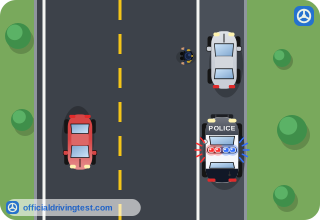
- Roll down only the driver window after the officer has walked up to it
- Roll down all windows after stopping and before the officer makes contact
- Keep all windows closed until the officer asks you to open them
- Turn off the engine and open all the doors before the officer arrives
Show answer
Correct answer: Roll down all windows after stopping and before the officer makes contact
It is recommended to roll down all windows after stopping on the right shoulder and before the officer makes contact.
Source: Indiana Driver’s Manual (July 2026), page 61 · Open this page in the manual (Manual page 61)
-
Which must vehicle operators have in order to operate a vehicle?
- A valid license, registration, and a vehicle inspection certificate
- A valid license, insurance, and a vehicle title
- A valid license, registration, and a safety-check sticker
- A valid driver's license, registration, and insurance
Show answer
Correct answer: A valid driver's license, registration, and insurance
Vehicle operators are required to have a valid driver's license, registration, and insurance.
Source: Indiana Driver’s Manual (July 2026), page 61 · Open this page in the manual (Manual page 61)
-
If your documents are in the glove box or under the seat, what should you do when an officer asks to see them?
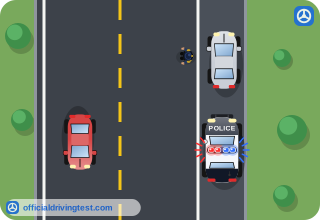
- First tell the officer, then follow the officer's directions before reaching
- Reach for them right away to save the officer's time and your own
- Step out of the vehicle and get them yourself from the glove box
- Wait for the officer to reach inside the vehicle and find them
Show answer
Correct answer: First tell the officer, then follow the officer's directions before reaching
You should first inform the officer where the items are and then follow the officer's directions before reaching.
Source: Indiana Driver’s Manual (July 2026), page 61 · Open this page in the manual (Manual page 61)
-
What does signing a traffic ticket mean?
- An admission of the driver's guilt
- A promise to pay the fine within a month
- Only an acknowledgment of receiving the ticket
- A waiver of the right to go to court
Show answer
Correct answer: Only an acknowledgment of receiving the ticket
Signing a ticket is not an admission of guilt, but only an acknowledgment of receiving the ticket.
Source: Indiana Driver’s Manual (July 2026), page 61 · Open this page in the manual (Manual page 61)
-
If you believe a ticket was issued unfairly, what does the manual say you will have the opportunity to do?
- Argue the case with the officer at the scene
- Refuse to sign the ticket
- Have the officer cancel the ticket on the spot
- Present the case in traffic court
Show answer
Correct answer: Present the case in traffic court
A driver who believes an offense was not committed or the ticket was unfair can present the case in traffic court.
Source: Indiana Driver’s Manual (July 2026), page 61 · Open this page in the manual (Manual page 61)
-
What does the manual say to do if you are taken into custody by the police?
- Do not resist arrest
- Argue about the reason for the stop
- Refuse to answer any request
- Drive yourself to the station
Show answer
Correct answer: Do not resist arrest
Drivers should not resist arrest if taken into custody by the police.
Source: Indiana Driver’s Manual (July 2026), page 61 · Open this page in the manual (Manual page 61)
-
What are police officers required to provide upon request during a traffic stop?
- Their home addresses
- A copy of the traffic stop report
- Their names and badge numbers
- The name of their supervisor only
Show answer
Correct answer: Their names and badge numbers
Officers are required to provide their names and badge numbers upon request.
Source: Indiana Driver’s Manual (July 2026), page 61 · Open this page in the manual (Manual page 61)
-
Where can written complaints about an officer's conduct be filed?
- With the nearest BMV branch in your own county
- With the agency's internal affairs division or civilian complaint board
- With the clerk of the traffic court in your area only
- With the insurance company of the driver who was stopped by the officer
Show answer
Correct answer: With the agency's internal affairs division or civilian complaint board
Written complaints can be filed with the agency's internal affairs division or civilian complaint board.
Source: Indiana Driver’s Manual (July 2026), page 61 · Open this page in the manual (Manual page 61)
-
What are police officers legally required to do for every traffic stop?
- Issue every driver either a written warning or a traffic ticket
- Record the whole stop on video and keep the video on file
- Search the vehicle for the driver's documents before leaving
- Document it, including the driver's name and address for data collection
Show answer
Correct answer: Document it, including the driver's name and address for data collection
Police officers are legally required to document all traffic stops, including obtaining the driver's name and address.
Source: Indiana Driver’s Manual (July 2026), page 61 · Open this page in the manual (Manual page 61)