Indiana: Emergency vehicles and work zones — Part 1 Practice Test
Questions in this part include: “Worksite added penalty signs are an example of construction signs that convey what?” · “What does an Automated Flagger Assistance Device display?”
Independent educational site · not affiliated with any government agency or DMV
Ready? Test yourself
- Instant feedback with an explanation
- Every answer cites its source in the manual
- Your best score is saved on this device
Questions are original and based on the official manual "Indiana Driver’s Manual" (July 2026), Indiana Bureau of Motor Vehicles.
All 17 questions in this practice test
Take the test above first, then use this list to study. Tap “Show answer” to see the correct answer and explanation.
Show the questions and answersHide the questions
-
What do orange highway construction traffic signs warn drivers to do?
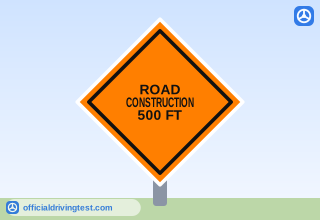
- Stop before passing every work crew you see
- Yield to all oncoming traffic in the work zone
- Watch for children crossing the road ahead
- Be careful when approaching construction zones
Show answer
Correct answer: Be careful when approaching construction zones
Orange highway construction signs warn drivers to be careful when approaching construction zones.
Source: Indiana Driver’s Manual (July 2026), page 30 · Open this page in the manual (Manual page 30)
-
Worksite added penalty signs are an example of construction signs that convey what?
- Regulations
- Guidance
- Distances to destinations
- Services at the next exit
Show answer
Correct answer: Regulations
The manual says construction signs convey regulations such as the worksite added penalty signs.
Source: Indiana Driver’s Manual (July 2026), page 30 · Open this page in the manual (Manual page 30)
-
An orange diamond sign shows a person holding a flag. What does it warn drivers of?
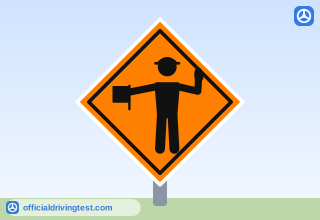
- Work crew ahead
- Detour ahead
- Flagger ahead
- Right lane closed
Show answer
Correct answer: Flagger ahead
An orange diamond sign showing a person holding a flag is the "Flagger Ahead" sign.
Source: Indiana Driver’s Manual (July 2026), page 30 · Open this page in the manual (Manual page 30)
-
An orange diamond sign shows a person with a shovel. What does it warn drivers of?
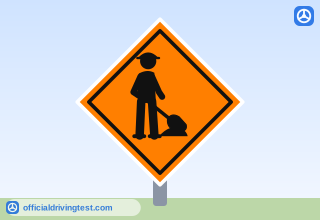
- Flagger ahead
- Work crew ahead
- Detour ahead
- Worksite speed limit
Show answer
Correct answer: Work crew ahead
An orange diamond sign showing a person with a shovel is the "Work Crew Ahead" sign.
Source: Indiana Driver’s Manual (July 2026), page 30 · Open this page in the manual (Manual page 30)
-
What do lane markings, traffic cones, barrels or barricades do in a work zone with a lane closure or crossover?
- Mark where drivers must stop for workers
- Show the end of the work zone
- Outline the path the vehicle must follow
- Show where flaggers may stand
Show answer
Correct answer: Outline the path the vehicle must follow
Lane markings, traffic cones, barrels or barricades outline the path the vehicle must follow.
Source: Indiana Driver’s Manual (July 2026), page 47 · Open this page in the manual (Manual page 47)
-
What does a flashing arrow board that does not indicate a direction either way tell a driver?
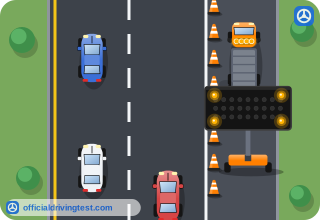
- Use caution; no lane change needed
- Move to the left lane immediately
- Stop and wait for the flagger
- The road ahead is completely closed
Show answer
Correct answer: Use caution; no lane change needed
An arrow board showing no direction is a signal to use caution, not a requirement to change lanes.
Source: Indiana Driver’s Manual (July 2026), page 47 · Open this page in the manual (Manual page 47)
-
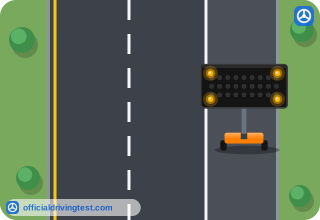
What are flashing arrow boards often used to indicate?
- A school zone
- An upcoming railroad crossing
- A change in the speed limit
- A lane closure or “crossover”
Show answer
Correct answer: A lane closure or “crossover”
The manual says flashing arrow boards are often used to indicate a lane closure or “crossover.”
Source: Indiana Driver’s Manual (July 2026), page 47 · Open this page in the manual (Manual page 47)
-
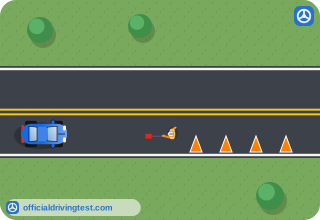
What must you do when a flagger extends a fluorescent orange/red flag in a horizontal position into the line of traffic?
- Slow down and keep moving
- Stop
- Change lanes
- Yield only to oncoming vehicles
Show answer
Correct answer: Stop
The manual says you must stop when a flagger extends a fluorescent orange/red flag horizontally into the line of traffic.
Source: Indiana Driver’s Manual (July 2026), page 47 · Open this page in the manual (Manual page 47)
-
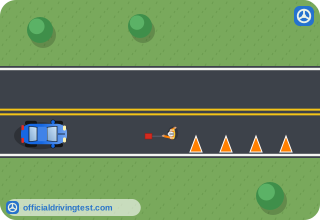
After stopping for a flagger’s horizontal flag, when may you proceed?
- As soon as no workers are in sight
- Only when the flagger directs you
- After waiting five seconds
- Whenever the vehicle ahead moves
Show answer
Correct answer: Only when the flagger directs you
You may proceed at a reduced speed only when the flagger directs you to.
Source: Indiana Driver’s Manual (July 2026), page 47 · Open this page in the manual (Manual page 47)
-
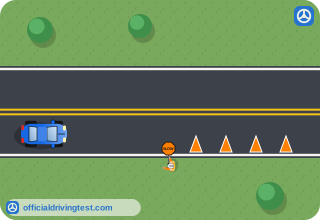
What must you do when a flagger holds a signal paddle that displays “SLOW”?
- Stop and wait
- Pull onto the shoulder
- Speed up to clear the work zone
- Proceed slowly
Show answer
Correct answer: Proceed slowly
If a flagger uses a signal paddle, you must stop or proceed slowly according to the “STOP” or “SLOW” message on the sign.
Source: Indiana Driver’s Manual (July 2026), page 47 · Open this page in the manual (Manual page 47)
-
Why are Automated Flagger Assistance Devices used?
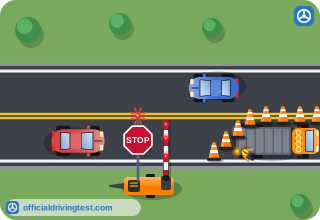
- To keep flaggers out of the lane of traffic
- To count the vehicles passing the work zone
- To replace the posted speed limit
- To warn drivers of railroad crossings
Show answer
Correct answer: To keep flaggers out of the lane of traffic
Automated Flagger Assistance Devices are used to enable flaggers to be positioned out of the lane of traffic.
Source: Indiana Driver’s Manual (July 2026), page 47 · Open this page in the manual (Manual page 47)
-
What does an Automated Flagger Assistance Device display?
- Only a flashing green arrow and a siren
- A railroad crossbuck with a yield sign
- A “STOP” or “SLOW” sign, or red and yellow lights
- The posted speed limit and a work zone map
Show answer
Correct answer: A “STOP” or “SLOW” sign, or red and yellow lights
These devices display a “STOP” or a “SLOW” sign like a flagger-held paddle, or use red and yellow lights.
Source: Indiana Driver’s Manual (July 2026), page 47 · Open this page in the manual (Manual page 47)
-
What does the manual say work zone signs will state?
- Exactly what to expect ahead
- Only the speed limit
- Where the workers are standing
- How long the delay will last
Show answer
Correct answer: Exactly what to expect ahead
The manual says work zone signs will state exactly what to expect ahead.
Source: Indiana Driver’s Manual (July 2026), page 47 · Open this page in the manual (Manual page 47)
-
Which of these should you look for when you stay alert in a work zone?
- Wider lanes and higher posted speed limits
- Free parking spaces beside the work area
- Reduced speed limits, narrow lanes and workers
- Shortcuts around the work zone on side roads
Show answer
Correct answer: Reduced speed limits, narrow lanes and workers
Staying alert means looking for reduced speed limits, narrow driving lanes and highway workers.
Source: Indiana Driver’s Manual (July 2026), page 47 · Open this page in the manual (Manual page 47)
-
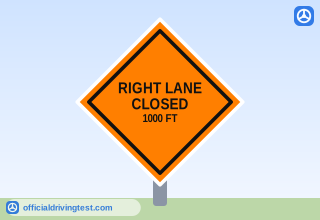
Which work zone safety tip says that traffic will generally flow more smoothly if you act at first sight of the signs?
- Slow down
- Merge early
- Don’t tailgate
- Plan ahead
Show answer
Correct answer: Merge early
The manual says that merging early, at first sight of the signs, lets traffic generally flow more smoothly.
Source: Indiana Driver’s Manual (July 2026), page 47 · Open this page in the manual (Manual page 47)
-
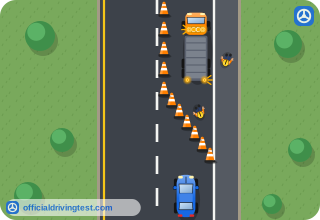
What is late or zipper merging used for?
- To let trucks pass on the shoulder
- To mark the end of a work zone
- To warn of a flagger ahead
- To shorten a traffic back-up
Show answer
Correct answer: To shorten a traffic back-up
At some locations traffic is encouraged to merge toward the lane closure, called late or zipper merging, which may reduce the length of a traffic back-up.
Source: Indiana Driver’s Manual (July 2026), page 48 · Open this page in the manual (Manual page 48)
-
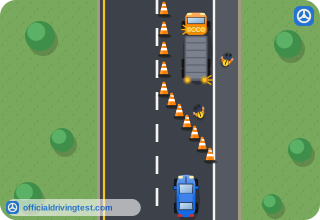
What will you encounter within seconds if you are speeding when you approach a work zone?
- A flagger waving you through
- A wider driving lane
- Slowed or stopped traffic
- A lower speed limit sign only
Show answer
Correct answer: Slowed or stopped traffic
If you are speeding when you approach a work zone you will encounter slowed or stopped traffic within seconds.
Source: Indiana Driver’s Manual (July 2026), page 48 · Open this page in the manual (Manual page 48)