Indiana: Emergency vehicles and work zones — Part 2 Practice Test
Questions in this part include: “Approaching which emergency vehicle lights requires you to change lanes away from the vehicle?” · “What is the penalty for failing to change lanes or slow down for an emergency vehicle with flashing lights?”
Independent educational site · not affiliated with any government agency or DMV
Ready? Test yourself
- Instant feedback with an explanation
- Every answer cites its source in the manual
- Your best score is saved on this device
Questions are original and based on the official manual "Indiana Driver’s Manual" (July 2026), Indiana Bureau of Motor Vehicles.
All 16 questions in this practice test
Take the test above first, then use this list to study. Tap “Show answer” to see the correct answer and explanation.
Show the questions and answersHide the questions
-
How much distance does the manual say to maintain when you are in a work zone?
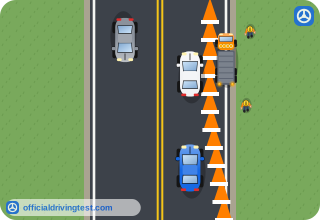
- A safe distance on all sides of your vehicle
- A safe distance behind the vehicle ahead only
- A safe distance from the workers only
- A safe distance from the right shoulder only
Show answer
Correct answer: A safe distance on all sides of your vehicle
The manual says not to tailgate and to maintain a safe distance on all sides of your vehicle.
Source: Indiana Driver’s Manual (July 2026), page 48 · Open this page in the manual (Manual page 48)
-
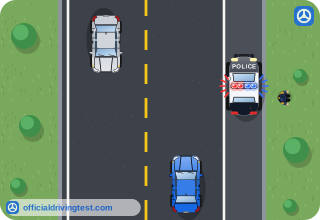
What does Indiana's Move Over law require motorists to do when approaching an emergency vehicle with its lights flashing?
- Speed up and pass it before reaching the next intersection or exit ahead
- Slow down and stay in the same lane at a steady pace until it passes
- Pull onto the left shoulder and wait there for it to go by safely
- Yield the right of way, move over to the right and stop, or change lanes
Show answer
Correct answer: Yield the right of way, move over to the right and stop, or change lanes
The Move Over law requires motorists to yield, move over to the right and stop, or change lanes.
Source: Indiana Driver’s Manual (July 2026), page 51 · Open this page in the manual (Manual page 51)
-
Approaching which emergency vehicle lights requires you to change lanes away from the vehicle?
- Alternately flashing red, red and white, or red and blue lights
- Alternately flashing green and white lights shown on the vehicle
- Steady blue lights that are not flashing in any pattern
- Flashing white lights with no red lights shown on the vehicle
Show answer
Correct answer: Alternately flashing red, red and white, or red and blue lights
Motorists approaching an emergency vehicle with alternately flashing red, red and white, or red and blue lights must change lanes away.
Source: Indiana Driver’s Manual (July 2026), page 51 · Open this page in the manual (Manual page 51)
-
If you cannot move over for an emergency vehicle with flashing lights, how must you drive?
- Reduce your speed to 5 mph under the posted limit and proceed with caution
- Reduce your speed to 20 mph under the posted limit and proceed with caution
- Reduce your speed to 10 mph under the posted limit and proceed with caution
- Reduce your speed to 15 mph under the posted limit and proceed with caution
Show answer
Correct answer: Reduce your speed to 10 mph under the posted limit and proceed with caution
If you cannot move over, you must reduce your speed to 10 mph under the posted limit and proceed with caution.
Source: Indiana Driver’s Manual (July 2026), page 51 · Open this page in the manual (Manual page 51)
-
What is the penalty for failing to change lanes or slow down for an emergency vehicle with flashing lights?
- A Class B infraction
- A Class A infraction
- A Class A misdemeanor
- A Level 6 felony
Show answer
Correct answer: A Class A infraction
The manual states that failure to comply is a Class A infraction.
Source: Indiana Driver’s Manual (July 2026), page 51 · Open this page in the manual (Manual page 51)
-
Which of these is an authorized emergency vehicle under the manual?
- Taxi cabs
- Mail delivery trucks
- Commercial passenger buses
- Police department vehicles
Show answer
Correct answer: Police department vehicles
The manual lists police department vehicles among the authorized emergency vehicles.
Source: Indiana Driver’s Manual (July 2026), page 51 · Open this page in the manual (Manual page 51)
-
What are motorists required to do when approaching an authorized parked vehicle with amber flashing lights?
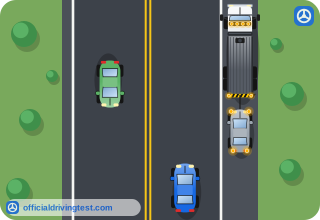
- Change lanes away from the vehicle
- Stop completely until it leaves
- Speed up and pass on the left
- Sound the horn and pass closely
Show answer
Correct answer: Change lanes away from the vehicle
Motorists must change lanes away from an authorized parked vehicle with amber flashing lights.
Source: Indiana Driver’s Manual (July 2026), page 51 · Open this page in the manual (Manual page 51)
-
What is the penalty for failing to change lanes or slow down for an authorized parked vehicle with amber flashing lights?
- A Class A infraction
- A Level 6 felony
- A Class B infraction
- A Class A misdemeanor
Show answer
Correct answer: A Class B infraction
The manual states that failure to do so is a Class B infraction.
Source: Indiana Driver’s Manual (July 2026), page 51 · Open this page in the manual (Manual page 51)
-
Which of these is listed as an authorized vehicle with amber flashing lights?
- Postal delivery vehicles
- Utility service vehicles
- Taxi and shuttle vehicles
- Private passenger buses
Show answer
Correct answer: Utility service vehicles
Utility service vehicles are among the authorized vehicles with amber flashing lights.
Source: Indiana Driver’s Manual (July 2026), page 51 · Open this page in the manual (Manual page 51)
-
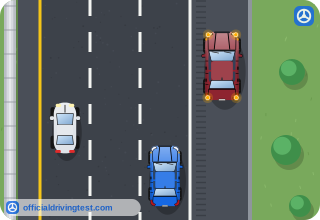
What are you required to do when approaching a disabled stationary vehicle with flashing hazard warning signals?
- Stop behind it and offer help
- Stay in your lane at the same speed
- Honk to warn the driver and pass closely
- Change lanes away from the disabled vehicle
Show answer
Correct answer: Change lanes away from the disabled vehicle
Motorists must change lanes away from a disabled stationary vehicle with flashing hazard warning signals.
Source: Indiana Driver’s Manual (July 2026), page 51 · Open this page in the manual (Manual page 51)
-
What is the penalty for failing to change lanes or slow down for a disabled stationary vehicle with flashing hazard warning signals?
- A Class B infraction
- A Class A infraction
- A Level 6 felony
- A Class A misdemeanor
Show answer
Correct answer: A Class B infraction
The manual states that failure to do so is a Class B infraction.
Source: Indiana Driver’s Manual (July 2026), page 51 · Open this page in the manual (Manual page 51)
-
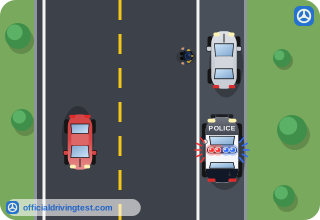
According to the manual, what is the purpose of a traffic stop?
- To collect fines from the driver on the spot where the stop happens
- To ensure that a vehicle operator is safe and in compliance with the law
- To inspect the vehicle for equipment defects and worn tires
- To test the driver's knowledge of the rules of the road
Show answer
Correct answer: To ensure that a vehicle operator is safe and in compliance with the law
The purpose of the traffic stop is to ensure the vehicle operator is safe and in compliance with the law.
Source: Indiana Driver’s Manual (July 2026), page 60 · Open this page in the manual (Manual page 60)
-
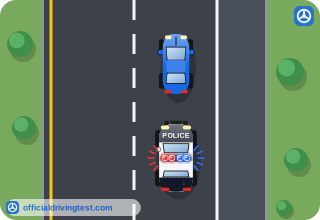
When stopped by law enforcement, how should you acknowledge the officer's presence?
- By flashing your headlights
- By turning on your left turn signal
- By sounding your horn briefly
- By turning on your right turn signal
Show answer
Correct answer: By turning on your right turn signal
The manual says to acknowledge the officer's presence by turning on your right turn signal.
Source: Indiana Driver’s Manual (July 2026), page 60 · Open this page in the manual (Manual page 60)
-
Why should you acknowledge an officer's presence with your turn signal during a traffic stop?
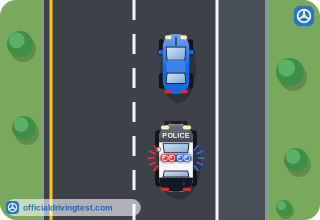
- Without it, an officer might think you are avoiding yielding or are impaired
- Without it, the officer cannot tell which lane your vehicle is in at night
- Without it, the stop is automatically treated as a ticket and an arrest
- Without it, the officer cannot look up your registration from the car
Show answer
Correct answer: Without it, an officer might think you are avoiding yielding or are impaired
If you fail to acknowledge the officer, the officer might perceive that you have a reason to avoid yielding or that you might be impaired.
Source: Indiana Driver’s Manual (July 2026), page 60 · Open this page in the manual (Manual page 60)
-
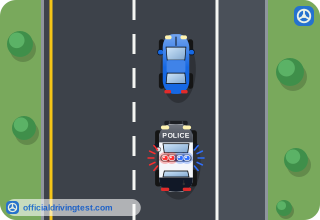
When stopped by law enforcement, where should you move your vehicle?
- Onto the center median
- To the opposite side of a two-lane roadway
- To the right-side shoulder of the road
- To the left shoulder of a freeway
Show answer
Correct answer: To the right-side shoulder of the road
The manual says to move your vehicle to the right-side shoulder and not onto the center median.
Source: Indiana Driver’s Manual (July 2026), page 61 · Open this page in the manual (Manual page 61)
-
If there is no shoulder, or it is too narrow to pull over for a traffic stop, what should you do?
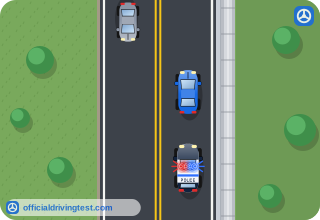
- Stop in the center median
- Find the next safest location and pull over
- Stop in the lane where you are
- Keep driving until the officer passes you
Show answer
Correct answer: Find the next safest location and pull over
If there is no shoulder or it is too narrow, you should find the next safest location and pull over.
Source: Indiana Driver’s Manual (July 2026), page 61 · Open this page in the manual (Manual page 61)