Indiana: Emergency vehicles and work zones — Part 3 Practice Test
Questions in this part include: “Which must vehicle operators have in order to operate a vehicle?” · “What does the manual say to do if you are taken into custody by the police?”
Independent educational site · not affiliated with any government agency or DMV
Ready? Test yourself
- Instant feedback with an explanation
- Every answer cites its source in the manual
- Your best score is saved on this device
Questions are original and based on the official manual "Indiana Driver’s Manual" (July 2026), Indiana Bureau of Motor Vehicles.
All 16 questions in this practice test
Take the test above first, then use this list to study. Tap “Show answer” to see the correct answer and explanation.
Show the questions and answersHide the questions
-
When you are stopped by law enforcement in the dark, where should you look to stop if possible?
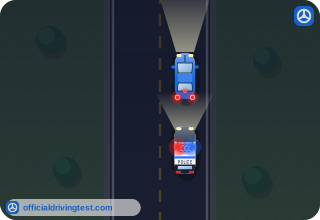
- Quiet side roads away from other traffic, where it is easy to talk
- Open fields beside the road with plenty of space for the vehicles
- Dark spots where the officer can use a spotlight to see you well
- Places with more light, such as street lights, restaurants, or service stations
Show answer
Correct answer: Places with more light, such as street lights, restaurants, or service stations
When it is dark, look for locations with more light, such as street or freeway lights, restaurants, or service stations.
Source: Indiana Driver’s Manual (July 2026), page 61 · Open this page in the manual (Manual page 61)
-
If you are stopped by law enforcement at night, what are you encouraged to do?
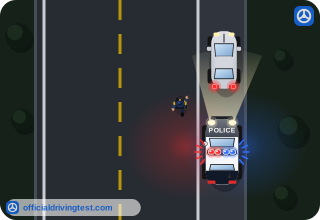
- Turn on the interior light of the vehicle
- Turn off your headlights
- Turn on your high beams
- Step out of the vehicle to show your face
Show answer
Correct answer: Turn on the interior light of the vehicle
The manual encourages turning on the interior light of the vehicle when stopped at night.
Source: Indiana Driver’s Manual (July 2026), page 61 · Open this page in the manual (Manual page 61)
-
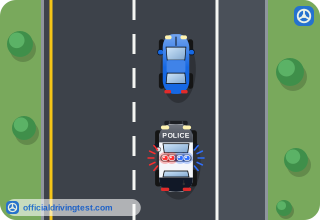
You cannot find a safe place to stop right away for a police officer. What should you do?
- Speed up to reach a better place quickly
- Stop immediately in your lane
- Slow down and turn on your hazard lights
- Turn off your headlights
Show answer
Correct answer: Slow down and turn on your hazard lights
Slowing down and turning on hazard lights shows the officer you acknowledge them and are actively trying to find a safe place to stop.
Source: Indiana Driver’s Manual (July 2026), page 61 · Open this page in the manual (Manual page 61)
-
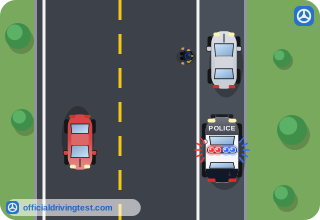
What should you do with your phone and radio when stopped by law enforcement?
- Lower the radio volume but keep your call going
- End cell phone conversations and turn off the radio
- Keep your phone in your hand to show it is off
- Use your phone to record the officer
Show answer
Correct answer: End cell phone conversations and turn off the radio
The officer needs your full attention, so you should end cell phone conversations and turn off your radio.
Source: Indiana Driver’s Manual (July 2026), page 61 · Open this page in the manual (Manual page 61)
-
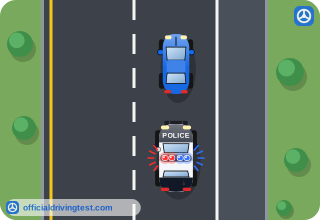
During a traffic stop, what should you do unless the officer tells you otherwise?
- Step out and wait beside your vehicle
- Walk back to the patrol car
- Stand near the rear of your vehicle with your hands up
- Remain inside your vehicle
Show answer
Correct answer: Remain inside your vehicle
The manual says to remain inside your vehicle unless otherwise directed by the officer.
Source: Indiana Driver’s Manual (July 2026), page 61 · Open this page in the manual (Manual page 61)
-
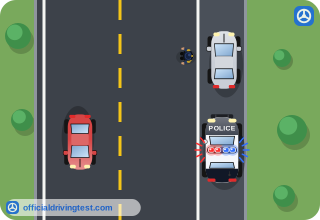
During a traffic stop, where should the driver keep their hands?
- On the steering wheel
- On top of the dashboard
- Out of the window
- Behind the head
Show answer
Correct answer: On the steering wheel
The driver should keep their hands on the steering wheel so the officer can see them.
Source: Indiana Driver’s Manual (July 2026), page 61 · Open this page in the manual (Manual page 61)
-
During a traffic stop, where should passengers' hands be?
- On the back of the front seats
- Out of the window
- Kept visible on their own laps
- Under the seat
Show answer
Correct answer: Kept visible on their own laps
Passenger hands should be visible on their laps.
Source: Indiana Driver’s Manual (July 2026), page 61 · Open this page in the manual (Manual page 61)
-
If your windows are tinted, what does the manual recommend during a traffic stop?
- Roll down only the driver window after the officer has walked up to it
- Roll down all windows after stopping and before the officer makes contact
- Keep all windows closed until the officer asks you to open them
- Turn off the engine and open all the doors before the officer arrives
Show answer
Correct answer: Roll down all windows after stopping and before the officer makes contact
It is recommended to roll down all windows after stopping on the right shoulder and before the officer makes contact.
Source: Indiana Driver’s Manual (July 2026), page 61 · Open this page in the manual (Manual page 61)
-
Which must vehicle operators have in order to operate a vehicle?
- A valid license, registration, and a vehicle inspection certificate
- A valid license, insurance, and a vehicle title
- A valid license, registration, and a safety-check sticker
- A valid driver's license, registration, and insurance
Show answer
Correct answer: A valid driver's license, registration, and insurance
Vehicle operators are required to have a valid driver's license, registration, and insurance.
Source: Indiana Driver’s Manual (July 2026), page 61 · Open this page in the manual (Manual page 61)
-
If your documents are in the glove box or under the seat, what should you do when an officer asks to see them?
- First tell the officer, then follow the officer's directions before reaching
- Reach for them right away to save the officer's time and your own
- Step out of the vehicle and get them yourself from the glove box
- Wait for the officer to reach inside the vehicle and find them
Show answer
Correct answer: First tell the officer, then follow the officer's directions before reaching
You should first inform the officer where the items are and then follow the officer's directions before reaching.
Source: Indiana Driver’s Manual (July 2026), page 61 · Open this page in the manual (Manual page 61)
-
What does signing a traffic ticket mean?
- An admission of the driver's guilt
- A promise to pay the fine within a month
- Only an acknowledgment of receiving the ticket
- A waiver of the right to go to court
Show answer
Correct answer: Only an acknowledgment of receiving the ticket
Signing a ticket is not an admission of guilt, but only an acknowledgment of receiving the ticket.
Source: Indiana Driver’s Manual (July 2026), page 61 · Open this page in the manual (Manual page 61)
-
If you believe a ticket was issued unfairly, what does the manual say you will have the opportunity to do?
- Argue the case with the officer at the scene
- Refuse to sign the ticket
- Have the officer cancel the ticket on the spot
- Present the case in traffic court
Show answer
Correct answer: Present the case in traffic court
A driver who believes an offense was not committed or the ticket was unfair can present the case in traffic court.
Source: Indiana Driver’s Manual (July 2026), page 61 · Open this page in the manual (Manual page 61)
-
What does the manual say to do if you are taken into custody by the police?
- Do not resist arrest
- Argue about the reason for the stop
- Refuse to answer any request
- Drive yourself to the station
Show answer
Correct answer: Do not resist arrest
Drivers should not resist arrest if taken into custody by the police.
Source: Indiana Driver’s Manual (July 2026), page 61 · Open this page in the manual (Manual page 61)
-
What are police officers required to provide upon request during a traffic stop?
- Their home addresses
- A copy of the traffic stop report
- Their names and badge numbers
- The name of their supervisor only
Show answer
Correct answer: Their names and badge numbers
Officers are required to provide their names and badge numbers upon request.
Source: Indiana Driver’s Manual (July 2026), page 61 · Open this page in the manual (Manual page 61)
-
Where can written complaints about an officer's conduct be filed?
- With the nearest BMV branch in your own county
- With the agency's internal affairs division or civilian complaint board
- With the clerk of the traffic court in your area only
- With the insurance company of the driver who was stopped by the officer
Show answer
Correct answer: With the agency's internal affairs division or civilian complaint board
Written complaints can be filed with the agency's internal affairs division or civilian complaint board.
Source: Indiana Driver’s Manual (July 2026), page 61 · Open this page in the manual (Manual page 61)
-
What are police officers legally required to do for every traffic stop?
- Issue every driver either a written warning or a traffic ticket
- Record the whole stop on video and keep the video on file
- Search the vehicle for the driver's documents before leaving
- Document it, including the driver's name and address for data collection
Show answer
Correct answer: Document it, including the driver's name and address for data collection
Police officers are legally required to document all traffic stops, including obtaining the driver's name and address.
Source: Indiana Driver’s Manual (July 2026), page 61 · Open this page in the manual (Manual page 61)