Indiana: Emergencies — Part 4 Practice Test
Questions in this part include: “If you use the parking brake after your brakes fail, what should you do?” · “Carbon monoxide is most likely to leak into a vehicle in which situation?”
Independent educational site · not affiliated with any government agency or DMV
Ready? Test yourself
- Instant feedback with an explanation
- Every answer cites its source in the manual
- Your best score is saved on this device
Questions are original and based on the official manual "Indiana Driver’s Manual" (July 2026), Indiana Bureau of Motor Vehicles.
All 19 questions in this practice test
Take the test above first, then use this list to study. Tap “Show answer” to see the correct answer and explanation.
Show the questions and answersHide the questions
-
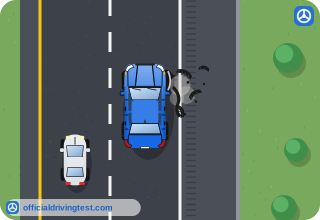
What should you do first if you have a flat tire or blowout?
- Brake hard right away so that the car stops as soon as possible
- Steer sharply toward the shoulder to leave the traffic lane quickly
- Shift into neutral and turn off the engine to slow down quickly
- Hold the steering wheel firmly and keep the car going straight
Show answer
Correct answer: Hold the steering wheel firmly and keep the car going straight
In a flat tire or blowout, hold the steering wheel firmly and keep the car going straight.
Source: Indiana Driver’s Manual (July 2026), page 60 · Open this page in the manual (Manual page 60)
-
During a tire blowout, when should you apply the brakes?
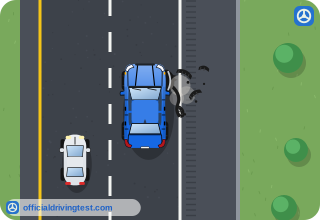
- When the car is almost stopped, after it has slowed and you have pulled off the road
- Immediately, as hard as you can, to stop the car in the shortest distance
- Never, because the brakes must stay off until the engine is turned off
- As soon as you begin steering toward the shoulder of the road
Show answer
Correct answer: When the car is almost stopped, after it has slowed and you have pulled off the road
The manual says to take your foot off the gas, not brake, let the car slow, pull off the road, and apply the brakes when the car is almost stopped.
Source: Indiana Driver’s Manual (July 2026), page 60 · Open this page in the manual (Manual page 60)
-
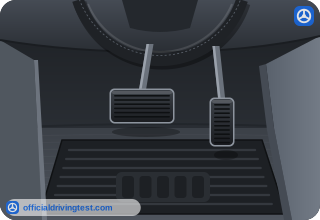
If a vehicle's conventional disc or drum brakes suddenly fail, what should you do?
- Shift into neutral and let the vehicle coast to a stop on its own
- Turn the ignition to the lock position to switch the engine off
- Shift to a lower gear if possible and pump the brake pedal fast and hard
- Press the brake pedal slowly and hold it down firmly to the floor
Show answer
Correct answer: Shift to a lower gear if possible and pump the brake pedal fast and hard
The manual says to shift to a lower gear if possible and pump the brake pedal fast and hard several times.
Source: Indiana Driver’s Manual (July 2026), page 60 · Open this page in the manual (Manual page 60)
-
If you use the parking brake after your brakes fail, what should you do?
- Pull the parking brake all the way up and keep it there until you stop
- Hold the brake release so it can be released if the rear wheels lock
- Use it only after you have turned off the engine of the vehicle
- Apply it at the same time as the foot brake, as hard as you can
Show answer
Correct answer: Hold the brake release so it can be released if the rear wheels lock
The manual says to hold the brake release so it can be released to avoid skidding if the rear wheels lock.
Source: Indiana Driver’s Manual (July 2026), page 60 · Open this page in the manual (Manual page 60)
-
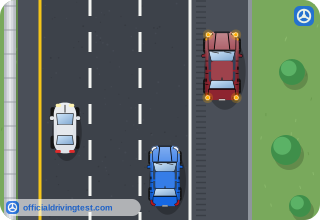
After a vehicle with failed brakes has come to a stop, what should the driver do?
- Drive slowly to the nearest repair shop
- Test the brakes again, then continue
- Drive to the nearest BMV branch
- Call for help and not try to drive anywhere
Show answer
Correct answer: Call for help and not try to drive anywhere
After the vehicle has stopped, the driver should call for help but not try to drive anywhere.
Source: Indiana Driver’s Manual (July 2026), page 60 · Open this page in the manual (Manual page 60)
-
Why should you never turn the ignition to the lock position while the vehicle is in motion, in a vehicle with a steering wheel interlock system?
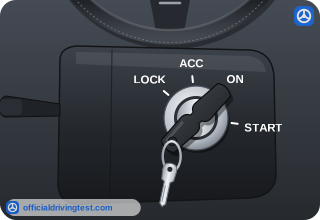
- The steering will lock when the wheel is turned, causing a loss of control
- The brakes will lock and the vehicle will begin to skid at once
- The headlights will turn off and the engine will restart by itself
- The doors will lock and trap the occupants inside the vehicle
Show answer
Correct answer: The steering will lock when the wheel is turned, causing a loss of control
With a steering wheel interlock system, the steering locks as the wheel is turned, causing a loss of control.
Source: Indiana Driver’s Manual (July 2026), page 60 · Open this page in the manual (Manual page 60)
-
In an emergency on the highway, what should a driver not try to do?
- Slow down gradually
- Look for a place to stop off the roadway
- Turn off the vehicle while it is still moving
- Turn on the hazard lights
Show answer
Correct answer: Turn off the vehicle while it is still moving
Drivers in an emergency situation on the highway should not try to turn off the vehicle while it is still moving.
Source: Indiana Driver’s Manual (July 2026), page 60 · Open this page in the manual (Manual page 60)
-
Which action may reduce the chance of having your vehicle stolen?
- Hiding a second set of keys somewhere in or on the vehicle
- Never leaving the vehicle unattended with the engine running
- Leaving the doors unlocked when you stop for a short time
- Parking in dark, quiet areas where fewer people walk by
Show answer
Correct answer: Never leaving the vehicle unattended with the engine running
The manual lists never leaving a vehicle unattended with the engine running as a precaution against theft.
Source: Indiana Driver’s Manual (July 2026), page 60 · Open this page in the manual (Manual page 60)
-
What does the manual say about a second set of keys?
- Hide it under the bumper where only you know
- Keep it in the glove box of the vehicle
- Leave it under the driver's seat for emergencies
- Do not hide it in or around the vehicle
Show answer
Correct answer: Do not hide it in or around the vehicle
To reduce the chance of theft, the manual says not to hide a second set of keys in or around the vehicle.
Source: Indiana Driver’s Manual (July 2026), page 60 · Open this page in the manual (Manual page 60)
-
Where should you park, whenever possible, to reduce the chance of having your vehicle stolen?
- In well-lit, well-patrolled areas
- Near the entrance of a shopping area
- In quiet side streets
- Behind a building, out of sight
Show answer
Correct answer: In well-lit, well-patrolled areas
The manual lists parking in well-lit, well-patrolled areas whenever possible.
Source: Indiana Driver’s Manual (July 2026), page 60 · Open this page in the manual (Manual page 60)
-
To reduce the chance of vehicle theft, what should you always do?
- Leave the windows slightly open
- Leave the headlights on
- Lock the vehicle's doors
- Leave the keys under the floor mat
Show answer
Correct answer: Lock the vehicle's doors
Always locking a vehicle's doors is one of the manual's anti-theft precautions.
Source: Indiana Driver’s Manual (July 2026), page 60 · Open this page in the manual (Manual page 60)
-
Carbon monoxide is most likely to leak into a vehicle in which situation?
- When the heater is running, the exhaust is faulty, or in heavy traffic
- When the vehicle is parked beside the road with all the windows open
- When the vehicle is parked outdoors with the engine switched off
- When driving at highway speed with the fresh-air vent fully open
Show answer
Correct answer: When the heater is running, the exhaust is faulty, or in heavy traffic
Carbon monoxide is most likely to leak in when the heater is running, the exhaust system is faulty, or in heavy traffic.
Source: Indiana Driver’s Manual (July 2026), page 62 · Open this page in the manual (Manual page 62)
-
Which statement about carbon monoxide gas is correct?
- It has a strong smell you notice quickly
- It is visible as a gray haze near the exhaust
- It cannot be seen, smelled, or tasted
- It leaves a sour taste in your mouth
Show answer
Correct answer: It cannot be seen, smelled, or tasted
The manual states that you cannot see, smell, or taste carbon monoxide.
Source: Indiana Driver’s Manual (July 2026), page 62 · Open this page in the manual (Manual page 62)
-
Which is a symptom of carbon monoxide poisoning?
- Ringing in the ears that comes and goes
- A bluish tinge to your skin or lips
- A sudden, dry cough that lasts for days
- Blurred hearing in one ear at a time
Show answer
Correct answer: A bluish tinge to your skin or lips
Symptoms can include drowsiness or dizziness, a bluish tinge to your skin or lips, a headache, and increased sensitivity to light.
Source: Indiana Driver’s Manual (July 2026), page 62 · Open this page in the manual (Manual page 62)
-
What should you do with the fresh-air vent in congested traffic to avoid carbon monoxide poisoning?
- Open it
- Leave it half open
- Switch it off and open the windows
- Close it
Show answer
Correct answer: Close it
In congested traffic, close the fresh-air vent.
Source: Indiana Driver’s Manual (July 2026), page 62 · Open this page in the manual (Manual page 62)
-
What should you do with the fresh-air vent on highways in cold weather to avoid carbon monoxide poisoning?
- Open it
- Close it
- Close it and turn the heater up
- Switch it off and recirculate the air
Show answer
Correct answer: Open it
On highways in cold weather, open the fresh-air vent.
Source: Indiana Driver’s Manual (July 2026), page 62 · Open this page in the manual (Manual page 62)
-
To avoid carbon monoxide poisoning, what should you never let your vehicle's engine do?
- Idle for more than a minute
- Run with the windows closed
- Run in a closed garage
- Run while parked in the sun
Show answer
Correct answer: Run in a closed garage
The manual says never to let your vehicle's engine run in a closed garage.
Source: Indiana Driver’s Manual (July 2026), page 62 · Open this page in the manual (Manual page 62)
-
To avoid carbon monoxide poisoning, what should you be alert for?
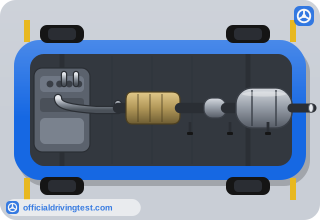
- A sweet smell from the heater
- Any unusual roar from under the car
- A loud noise from the engine only when parked
- Any change in the color of the exhaust
Show answer
Correct answer: Any unusual roar from under the car
The manual says to be alert for any unusual roar from under the car.
Source: Indiana Driver’s Manual (July 2026), page 62 · Open this page in the manual (Manual page 62)
-
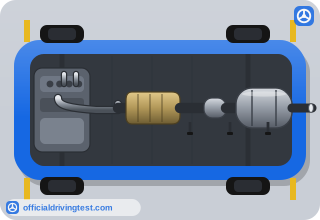
To avoid carbon monoxide poisoning, how often should your vehicle's exhaust system be checked?
- Only after an accident
- Only when it makes noise
- Once a year at a BMV branch
- Regularly
Show answer
Correct answer: Regularly
The manual says to have your vehicle's exhaust system checked regularly.
Source: Indiana Driver’s Manual (July 2026), page 62 · Open this page in the manual (Manual page 62)