Hawaii: Sharing the road
Bicycles, motorcycles, trucks, trailers and buses, school buses, and passing and being passed. Split into 5 shorter tests so you're not stuck in one long quiz.
Independent educational site · not affiliated with any government agency or DMV
Choose a part
Sharing the road — Part 1
Questions in this part include: “In the definitions, a bicycle is a human-powered device with two or three wheels of what minimum diameter?”
StartSharing the road — Part 2
Questions in this part include: “To whom must drivers of large vehicles give proper consideration?”
StartSharing the road — Part 3
Questions in this part include: “Where are car/motorcycle collisions most likely to occur?”
StartSharing the road — Part 4
Questions in this part include: “How does the manual define a divided highway?”
StartSharing the road — Part 5
Questions in this part include: “Where may bicyclists ride two abreast, if it is wide enough not to impede traffic?”
StartAll 87 Sharing the road questions with answers
Choose a part above to take a practice test, or study every question and answer here.
Show the questions and answersHide the questions
-
In the definitions, a bicycle is a human-powered device with two or three wheels of what minimum diameter?
- 16 inches
- 12 inches
- 20 inches
- 24 inches
Show answer
Correct answer: 16 inches
A bicycle is defined as a device with two or three wheels having a diameter of 16 inches or greater propelled by human power.
Source: Hawaii Driver's Manual (2023), page 8 · Open this page in the manual (Manual page 8)
-
According to the definitions, a bus is a motor vehicle designed for carrying more than how many passengers and used for the transportation of persons?
- 6 passengers
- 12 passengers
- 20 passengers
- 10 passengers
Show answer
Correct answer: 10 passengers
A bus is defined as every motor vehicle designed for carrying more than ten passengers and used for the transportation of persons.
Source: Hawaii Driver's Manual (2023), page 8 · Open this page in the manual (Manual page 8)
-
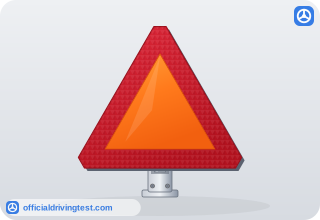
A highly reflective triangular emblem on the rear of a vehicle is required to be how many inches (cm) in size?
- 12 inches (30cm)
- 18 inches (46cm)
- 24 inches (61cm)
- 36 inches (91cm)
Show answer
Correct answer: 18 inches (46cm)
The slow moving vehicle emblem is a highly reflective 18 inch (46cm) triangular emblem.
Source: Hawaii Driver's Manual (2023), page 30 · Open this page in the manual (Manual page 30)
-
The slow moving vehicle emblem must be displayed on the rear of vehicles designed to operate at what speed?
- 15 mph (24 km/h) or less
- 35 mph (56 km/h) or less
- 45 mph (72 km/h) or less
- 25 mph (40 km/h) or less
Show answer
Correct answer: 25 mph (40 km/h) or less
The emblem is required on the rear of vehicles designed to operate at speeds of 25 mph (40 km/h) or less.
Source: Hawaii Driver's Manual (2023), page 30 · Open this page in the manual (Manual page 30)
-
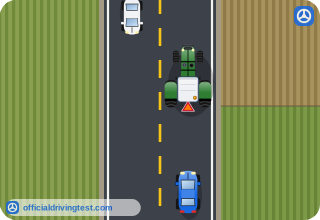
What should you do when you see a highly reflective triangular emblem on the rear of the vehicle ahead?
- Reduce speed and approach cautiously
- Pass as quickly as possible
- Follow closely and flash your headlights
- Move to the left lane at once
Show answer
Correct answer: Reduce speed and approach cautiously
When you see the slow moving vehicle emblem, reduce speed and approach cautiously.
Source: Hawaii Driver's Manual (2023), page 30 · Open this page in the manual (Manual page 30)
-
How does the manual say you should respond to competition from an arrogant driver?
- Never get involved in competition with him
- Race him briefly to show you are not afraid
- Speed up so that he cannot pass you
- Follow him closely until he leaves the road
Show answer
Correct answer: Never get involved in competition with him
The manual says never allow yourself to become involved in competition with an arrogant driver, or become one, because there is nothing to gain and too much to lose.
Source: Hawaii Driver's Manual (2023), page 58 · Open this page in the manual (Manual page 58)
-
Compared with the impatient driver, who is simply in a hurry, how is the arrogant driver described?
- He drives too slowly because he is unsure
- He is careless but not in a hurry
- He is easily distracted by passengers
- He is purposely in a hurry
Show answer
Correct answer: He is purposely in a hurry
The manual describes the arrogant driver as purposely in a hurry, competing with his vehicle.
Source: Hawaii Driver's Manual (2023), page 58 · Open this page in the manual (Manual page 58)
-
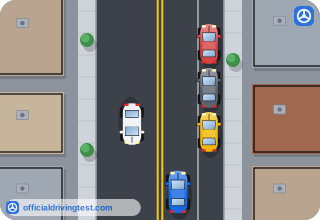
Why must you use care when passing cars parked by the roadside?
- They are always about to move into your traffic lane
- They hide other traffic, and a door may open into your path
- They cannot be seen clearly by drivers at night
- They make the traffic lane wider than it normally is
Show answer
Correct answer: They hide other traffic, and a door may open into your path
Parked cars obstruct your view of possible conflicts, and a parked car may suddenly move into your lane or a door may be opened into your path.
Source: Hawaii Driver's Manual (2023), page 69 · Open this page in the manual (Manual page 69)
-
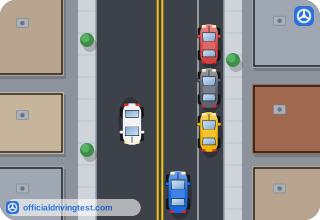
Which is a clue that a parked car may move into your lane?
- Its back-up lamps are illuminated
- Its windows are fully closed
- Its hazard sign is missing
- Its engine is cool to the touch
Show answer
Correct answer: Its back-up lamps are illuminated
Illuminated stop lamps, back-up lamps or signal lamps are one of the clues that a parked car may move.
Source: Hawaii Driver's Manual (2023), page 69 · Open this page in the manual (Manual page 69)
-
What should you assume when you approach a vehicle that has just stopped in a parked position?
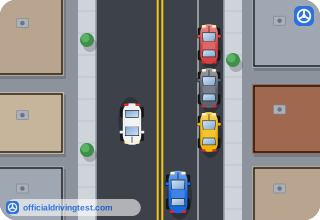
- That the driver will stay inside
- That the vehicle will not move again
- That the driver will open the door as you approach
- That the driver will signal before exiting
Show answer
Correct answer: That the driver will open the door as you approach
When you approach a vehicle that has just stopped in a parked position, you should assume that the driver will open the door as you approach.
Source: Hawaii Driver's Manual (2023), page 69 · Open this page in the manual (Manual page 69)
-
Compared with small vehicles, what are larger vehicles?
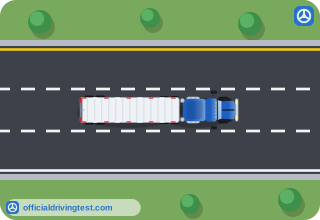
- Harder to see but easier for the driver to operate
- Easier to see but more difficult for the driver to operate
- Less protective of occupants and more agile
- More agile and easier to operate
Show answer
Correct answer: Easier to see but more difficult for the driver to operate
Larger vehicles afford more protection and are easier to see but are more difficult for the driver to operate.
Source: Hawaii Driver's Manual (2023), page 74 · Open this page in the manual (Manual page 74)
-
How much of its traffic lane is a motorcyclist entitled to?
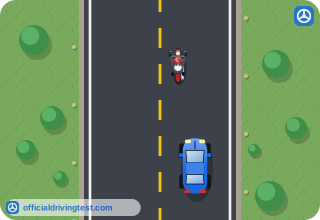
- The left half
- The right half
- The entire width
- Only the center of the lane
Show answer
Correct answer: The entire width
The manual says a motorcyclist is entitled to the entire width of his traffic lane.
Source: Hawaii Driver's Manual (2023), page 75 · Open this page in the manual (Manual page 75)
-
When should you use extra caution to look for motorcyclists, bicyclists and pedestrians?
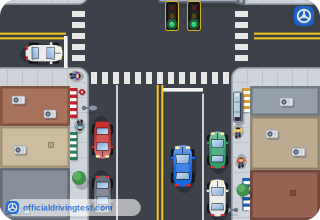
- When making turns or changing lanes
- Only when driving on a freeway
- Only when driving at night
- Only when parking
Show answer
Correct answer: When making turns or changing lanes
The manual says to give them plenty of room and use extra caution to look for them when making turns or changing lanes.
Source: Hawaii Driver's Manual (2023), page 75 · Open this page in the manual (Manual page 75)
-
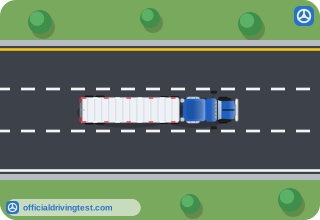
Why do larger vehicles generally give their drivers better forward visibility than other vehicles?
- Their windshields are always larger than car windshields
- Their hoods are shorter than the hoods of cars
- The driver’s position is above most other vehicles
- They are fitted with extra headlights on the roof
Show answer
Correct answer: The driver’s position is above most other vehicles
The manual says the driver’s position is above most other vehicles, which gives better forward visibility.
Source: Hawaii Driver's Manual (2023), page 85 · Open this page in the manual (Manual page 85)
-
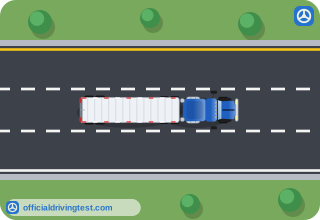
How can the driver of a large vehicle see other traffic to the sides and rear?
- By looking through large side and rear windows
- Only by the use of mirrors
- By turning around in the seat to look behind
- Through a camera mounted on the rear bumper
Show answer
Correct answer: Only by the use of mirrors
Visibility to the sides and rear is severely limited, so other traffic can only be seen by the use of mirrors.
Source: Hawaii Driver's Manual (2023), page 85 · Open this page in the manual (Manual page 85)
-
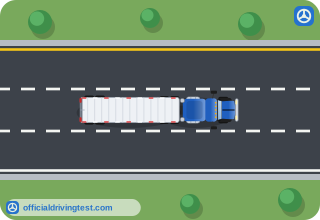
What is true of the area to the immediate rear of a large vehicle?
- It is fully visible in the driver’s mirrors
- It is visible only when the vehicle is backing
- It is visible only when headlights are on
- It is not visible to the driver
Show answer
Correct answer: It is not visible to the driver
The manual states that the area to the immediate rear of the vehicle is not visible to the driver.
Source: Hawaii Driver's Manual (2023), page 85 · Open this page in the manual (Manual page 85)
-
When must drivers of large vehicles allow for the greater width and length of their vehicles?
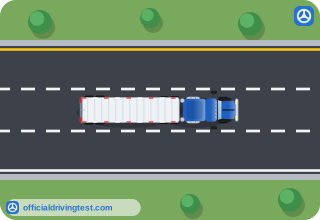
- When turning, changing lanes or backing
- Only when carrying hazardous materials
- Only when travelling above the speed limit
- Only when towing a trailer
Show answer
Correct answer: When turning, changing lanes or backing
Drivers of large vehicles must make allowances for their greater width and length when turning, changing lanes or backing.
Source: Hawaii Driver's Manual (2023), page 85 · Open this page in the manual (Manual page 85)
-
Because they spend much more time driving, what should professional drivers of large vehicles be?
- The fastest and most aggressive drivers on the highways
- The only drivers allowed to use the left lane
- The most skilled, knowledgeable and experienced drivers
- Drivers who are exempt from some traffic laws
Show answer
Correct answer: The most skilled, knowledgeable and experienced drivers
The manual says they should be the most skilled, knowledgeable and experienced drivers on the highways.
Source: Hawaii Driver's Manual (2023), page 85 · Open this page in the manual (Manual page 85)
-
To whom must drivers of large vehicles give proper consideration?
- Only the passengers and cargo that they carry
- Other highway users, their passengers and their cargo
- Only other drivers of large vehicles on the highway
- Only pedestrians and bicyclists using the road
Show answer
Correct answer: Other highway users, their passengers and their cargo
Drivers must recognize their responsibility to give proper consideration to other highway users as well as to their passengers and cargo.
Source: Hawaii Driver's Manual (2023), page 85 · Open this page in the manual (Manual page 85)
-
What should other drivers and highway users do to help a large vehicle driver make maneuvers safely?
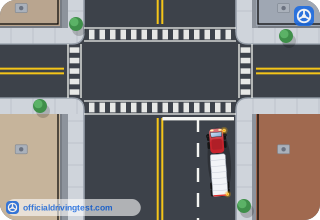
- Stay close alongside the vehicle
- Follow as closely as possible behind it
- Speed up to pass it during the turn
- Allow the driver additional space
Show answer
Correct answer: Allow the driver additional space
Other drivers and highway users should allow the large vehicle driver additional space to make the maneuvers safely.
Source: Hawaii Driver's Manual (2023), page 86 · Open this page in the manual (Manual page 86)
-
How much space do large vehicles require for turning movements?
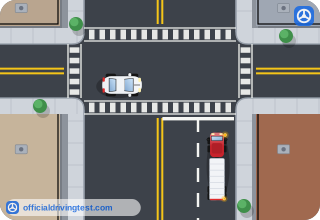
- More space
- Less space
- The same space
- No extra space
Show answer
Correct answer: More space
The manual states that large vehicles require more space for turning movements.
Source: Hawaii Driver's Manual (2023), page 86 · Open this page in the manual (Manual page 86)
-
Where should other drivers stay when they are near a large vehicle?
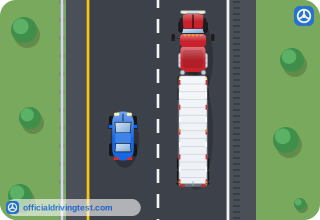
- Close behind it, where it shields them from other traffic
- Beside its rear wheels, where it cannot hit them
- In a location where its driver can see them
- Wherever they can pass it the fastest
Show answer
Correct answer: In a location where its driver can see them
Drivers of other vehicles should remain where they can be seen by the driver of the large vehicle and where their view of other traffic is not blocked.
Source: Hawaii Driver's Manual (2023), page 86 · Open this page in the manual (Manual page 86)
-
How do the stopping distances of large vehicles compare with those of other vehicles?
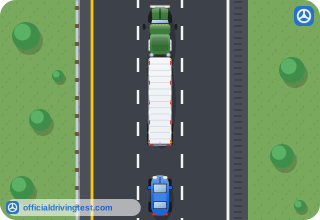
- Shorter
- Greater
- The same
- Half as long
Show answer
Correct answer: Greater
Large vehicles require greater stopping distances than other vehicles.
Source: Hawaii Driver's Manual (2023), page 86 · Open this page in the manual (Manual page 86)
-
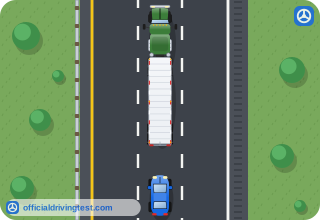
When must other drivers allow for the increased stopping distance of large vehicles?
- Only when driving downhill
- Only when it is raining
- Only when the large vehicle is loaded
- When changing lanes or at intersections
Show answer
Correct answer: When changing lanes or at intersections
When changing lanes or at intersections, other drivers and highway users must make allowances for the increased stopping distance required by large vehicles.
Source: Hawaii Driver's Manual (2023), page 86 · Open this page in the manual (Manual page 86)
-
How do large vehicles accelerate compared with other vehicles?
- Very slowly
- Very quickly
- At the same rate
- Slowly only uphill
Show answer
Correct answer: Very slowly
Large vehicles accelerate very slowly and cannot make maneuvers as quickly as other vehicles.
Source: Hawaii Driver's Manual (2023), page 86 · Open this page in the manual (Manual page 86)
-
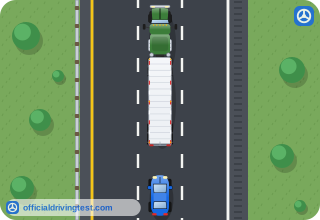
What should drivers be aware of about the speed of large vehicles?
- They always travel at the posted speed limit
- They travel faster than the posted limit on hills
- They are required to match the speed of traffic
- They may be travelling slower than the posted speed limit
Show answer
Correct answer: They may be travelling slower than the posted speed limit
Large vehicles may be travelling at a speed less than the posted speed limit, so drivers should use caution when approaching or passing.
Source: Hawaii Driver's Manual (2023), page 86 · Open this page in the manual (Manual page 86)
-
What should drivers of other vehicles do when a large vehicle is overtaking them?
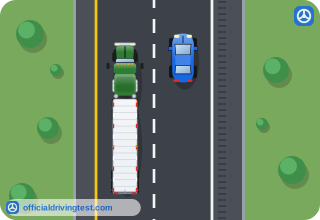
- Be alert and move out of its way
- Speed up to keep it behind them
- Brake sharply to let it pass
- Hold their position beside it
Show answer
Correct answer: Be alert and move out of its way
The drivers of other vehicles should be alert to overtaking large vehicles and move out of their way.
Source: Hawaii Driver's Manual (2023), page 86 · Open this page in the manual (Manual page 86)
-
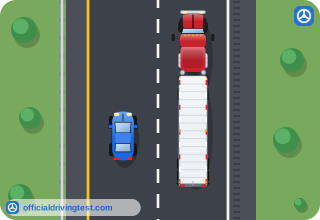
What should drivers of smaller vehicles be prepared to do when approaching or passing large vehicles moving at or near maximum speeds?
- Brake hard to avoid the wind gusts
- Sound the horn to warn the driver
- Take proper corrective steering action
- Speed up to leave the wind gusts behind
Show answer
Correct answer: Take proper corrective steering action
Large fast-moving vehicles cause wind gusts that can change the direction of smaller vehicles, so drivers should be ready to correct their steering.
Source: Hawaii Driver's Manual (2023), page 86 · Open this page in the manual (Manual page 86)
-
Who is responsible for making sure that hazardous materials are properly packaged and marked?
- Other drivers who share the road with it
- The drivers of the vehicles carrying them
- The emergency crews who respond to a crash
- The county examiner of drivers who licenses them
Show answer
Correct answer: The drivers of the vehicles carrying them
The manual says drivers of vehicles carrying dangerous materials are responsible for proper packaging and marking.
Source: Hawaii Driver's Manual (2023), page 86 · Open this page in the manual (Manual page 86)
-
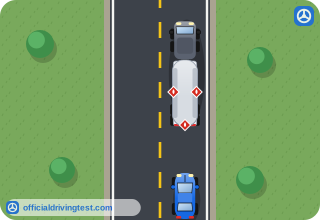
Why must a vehicle carrying hazardous materials be marked to indicate the type of material carried?
- So other drivers know it may travel below the speed limit
- So it can be identified at a safety inspection
- So it is allowed to use the left lane
- So proper protective action can be taken in case of a crash
Show answer
Correct answer: So proper protective action can be taken in case of a crash
The vehicle is marked so that proper protective action can be taken in case of a crash.
Source: Hawaii Driver's Manual (2023), page 86 · Open this page in the manual (Manual page 86)
-
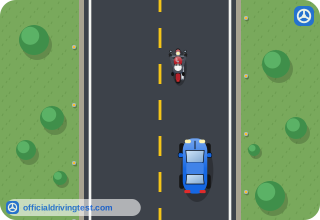
Compared with a car driver, how vulnerable to injury is a motorcyclist in a crash?
- Less vulnerable
- More vulnerable
- Equally vulnerable
- Not at risk of injury
Show answer
Correct answer: More vulnerable
Motorcyclists are more vulnerable to injury than a car driver if involved in a crash.
Source: Hawaii Driver's Manual (2023), page 89 · Open this page in the manual (Manual page 89)
-
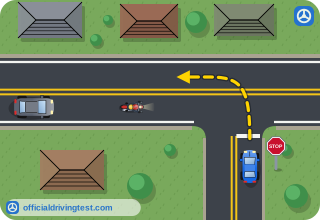
How may the small profile of a motorcycle make it appear?
- Closer and faster than it actually is
- Larger and louder than it actually is
- Wider and more stable than it actually is
- Farther away and slower than it actually is
Show answer
Correct answer: Farther away and slower than it actually is
The small profile may make a motorcycle appear farther away and travelling slower than it actually is.
Source: Hawaii Driver's Manual (2023), page 90 · Open this page in the manual (Manual page 90)
-
Because a motorcycle’s distance and speed are hard to judge, what do car drivers need to do?
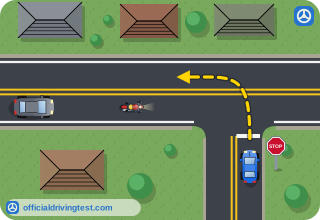
- Take a second look, and then a third
- Follow it closely to measure its speed
- Assume it is travelling at the speed limit
- Use the horn to make it slow down
Show answer
Correct answer: Take a second look, and then a third
The manual says car drivers need to take a second look, and then a third.
Source: Hawaii Driver's Manual (2023), page 90 · Open this page in the manual (Manual page 90)
-
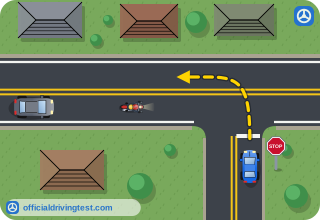
Compared with another car, how easy is a motorcycle to spot in traffic?
- Easier
- No different
- More difficult
- Easier at night
Show answer
Correct answer: More difficult
Its small size makes a motorcycle more difficult to spot in traffic than another car.
Source: Hawaii Driver's Manual (2023), page 90 · Open this page in the manual (Manual page 90)
-
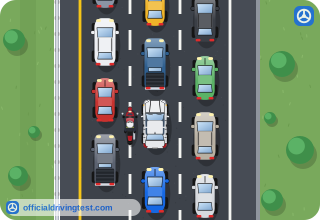
Some motorcycles use their small size to cut between cars. What should drivers be alert for?
- A motorcycle stopping at every intersection
- A motorcycle appearing unexpectedly
- A motorcycle staying far behind other traffic
- A motorcycle waiting for cars to turn first
Show answer
Correct answer: A motorcycle appearing unexpectedly
Motorcycles may cut between cars and be where drivers cannot see them, so be alert for one to appear unexpectedly.
Source: Hawaii Driver's Manual (2023), page 90 · Open this page in the manual (Manual page 90)
-
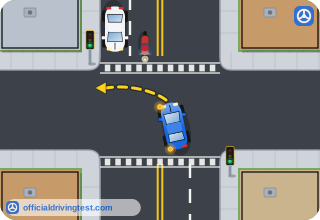
What should you make sure of before you start to turn or enter an intersection?
- That the motorcycle’s turn signal is not flashing
- That the motorcycle is behind a larger vehicle
- That the motorcycle’s rider is wearing a helmet
- That you see the motorcycle and know its speed
Show answer
Correct answer: That you see the motorcycle and know its speed
The manual says to make sure you see the motorcycle and know its speed before you start to turn or enter an intersection.
Source: Hawaii Driver's Manual (2023), page 90 · Open this page in the manual (Manual page 90)
-
Why does a motorcyclist often ride in the left portion of the traffic lane?
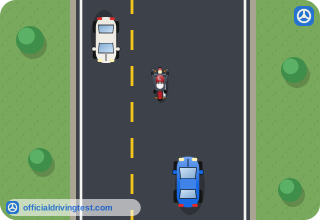
- To get a better view and be more visible to other traffic
- To leave room for cars to share the lane
- To keep away from vehicles entering from the right
- To make passing by cars easier on the left
Show answer
Correct answer: To get a better view and be more visible to other traffic
Riding in the left portion allows a better view of some traffic and road situations and makes the motorcycle more visible to other traffic.
Source: Hawaii Driver's Manual (2023), page 91 · Open this page in the manual (Manual page 91)
-
Why does a motorcyclist change position within the lane?
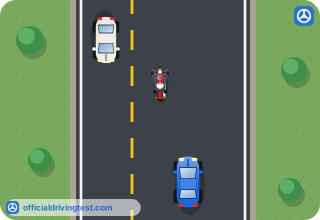
- To make room for another vehicle to share the lane
- To warn drivers behind to slow down
- To increase the distance from potential hazards
- To keep the same distance from the center line
Show answer
Correct answer: To increase the distance from potential hazards
The manual says the motorcyclist will change position within the lane to increase the distance from potential hazards.
Source: Hawaii Driver's Manual (2023), page 91 · Open this page in the manual (Manual page 91)
-
What should motorists be alert for when driving near motorcycles?
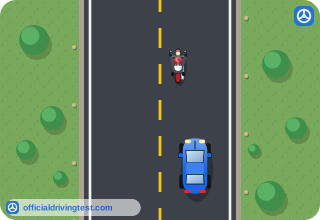
- Motorcycles that never leave one lane position
- Sudden changes in the motorcycle’s position and direction
- Riders who always ride in the center of the lane
- Riders who stay behind all other traffic
Show answer
Correct answer: Sudden changes in the motorcycle’s position and direction
Lateral movements sometimes occur suddenly, so motorists must be alert for sudden changes in position and direction.
Source: Hawaii Driver's Manual (2023), page 91 · Open this page in the manual (Manual page 91)
-
How much of a lane is a motorcycle allowed in which to maneuver?
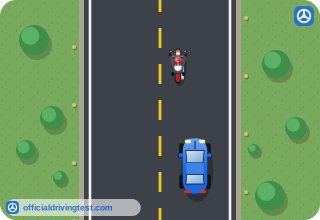
- Half the width of the lane
- Only the left portion of it
- Two-thirds of the width
- The full width of the lane
Show answer
Correct answer: The full width of the lane
Motorcycles are allowed the full width of a lane in which to maneuver.
Source: Hawaii Driver's Manual (2023), page 91 · Open this page in the manual (Manual page 91)
-
What is the effect of sharing a lane with a motorcyclist?
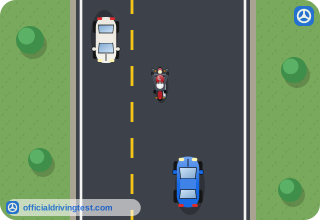
- It restricts the rider’s ability to avoid hazardous situations
- It helps the rider stay visible to other drivers on the road
- It gives the rider more room to avoid road hazards ahead
- It lets the rider save fuel by riding in the car’s draft
Show answer
Correct answer: It restricts the rider’s ability to avoid hazardous situations
The manual says to refrain from sharing a lane because it restricts the rider’s ability to avoid hazardous situations.
Source: Hawaii Driver's Manual (2023), page 91 · Open this page in the manual (Manual page 91)
-
Where are car/motorcycle collisions most likely to occur?
- On freeway on-ramps
- In parking lots
- At intersections
- On long straight roads
Show answer
Correct answer: At intersections
Intersections are the most likely places for car/motorcycle collisions to occur.
Source: Hawaii Driver's Manual (2023), page 92 · Open this page in the manual (Manual page 92)
-
What usually causes car/motorcycle collisions at intersections?
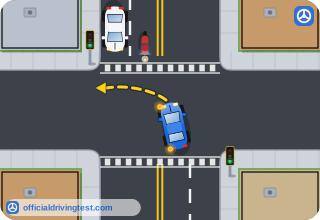
- A motorcyclist riding faster than the posted speed limit
- A car driver not seeing the motorcycle and turning into its path
- A motorcycle’s turn signal failing to flash
- A motorcyclist ignoring a stop sign
Show answer
Correct answer: A car driver not seeing the motorcycle and turning into its path
This usually is the result of a car driver not seeing the motorcycle and turning into the motorcycle’s path.
Source: Hawaii Driver's Manual (2023), page 92 · Open this page in the manual (Manual page 92)
-
How long should you wait before assuming a motorcycle rider’s intention?
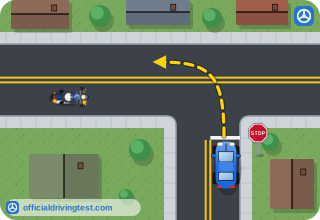
- Until the rider moves to one side of the lane
- Until the rider’s turn signal starts flashing
- Until the rider looks toward your vehicle
- Until the maneuver is unmistakably started
Show answer
Correct answer: Until the maneuver is unmistakably started
Do not assume the rider’s intention until the maneuver is unmistakably started, such as a turn into an intersection or driveway.
Source: Hawaii Driver's Manual (2023), page 92 · Open this page in the manual (Manual page 92)
-
What is true of turn signals on a motorcycle?
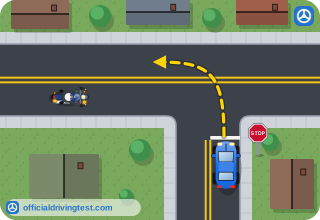
- They do not shut off automatically after a turn
- They shut off automatically after a turn
- They flash only when the brake is applied
- They cannot be used while changing lanes
Show answer
Correct answer: They do not shut off automatically after a turn
Turn signals do not automatically shut off on a motorcycle, and riders occasionally forget to cancel them after a turn.
Source: Hawaii Driver's Manual (2023), page 92 · Open this page in the manual (Manual page 92)
-
What may it mean when a motorcycle rider moves to one side of the lane?
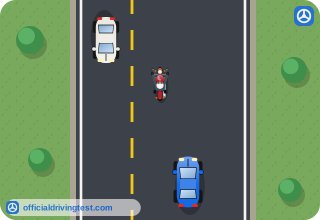
- The rider is inviting another vehicle to share the lane with him
- The rider is about to stop and park at the roadside
- The rider may be preparing for a turn or moving away from a hazard
- The rider is signaling that a faster vehicle may pass
Show answer
Correct answer: The rider may be preparing for a turn or moving away from a hazard
A rider moves to one side of the lane in preparation for a turn or possibly to move away from a hazard unseen by other motorists.
Source: Hawaii Driver's Manual (2023), page 92 · Open this page in the manual (Manual page 92)
-
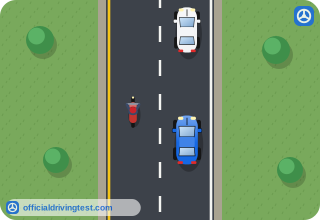
What should a motorist being overtaken by a motorcycle do?
- Maintain lane position and speed
- Move to the right edge of the lane
- Slow down and move to one side
- Speed up so the cyclist cannot pass
Show answer
Correct answer: Maintain lane position and speed
The motorist being overtaken by a motorcycle should maintain lane position and speed.
Source: Hawaii Driver's Manual (2023), page 94 · Open this page in the manual (Manual page 94)
-
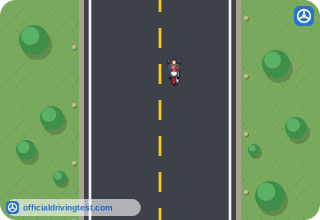
How much of a lane should you allow when passing a motorcycle?
- Half a lane
- Half a car width
- A full lane
- Only the shoulder
Show answer
Correct answer: A full lane
When passing a motorcycle, allow a full lane to the motorcycle and never crowd into the same lane.
Source: Hawaii Driver's Manual (2023), page 94 · Open this page in the manual (Manual page 94)
-
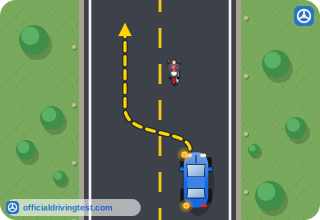
What can happen if you return to your original lane too soon after passing a motorcycle?
- The rider may be blinded by your brake lights and stop suddenly
- The rider may swerve to the right into traffic or off the road
- The rider may be forced to pass you on the right shoulder
- The rider may be forced to stop and wait in the middle of the road
Show answer
Correct answer: The rider may swerve to the right into traffic or off the road
Returning to the original lane too soon can force a rider to swerve to the right into traffic or off the road.
Source: Hawaii Driver's Manual (2023), page 94 · Open this page in the manual (Manual page 94)
-
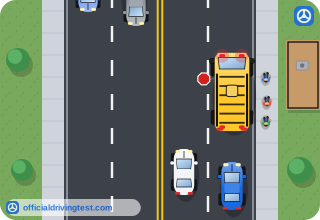
A school bus is stopped on a highway with its alternating red signal lamps flashing. Which drivers on the same highway must stop?
- Drivers in the lane occupied by the school bus and in all lanes adjacent to it
- Only drivers traveling behind the school bus, in any lane of the highway
- Only drivers in the lanes next to the school bus, not in its own lane
- Only drivers in the same lane as the school bus and no other lane
Show answer
Correct answer: Drivers in the lane occupied by the school bus and in all lanes adjacent to it
The law requires drivers in the bus's lane and all adjacent lanes to stop before reaching the school bus.
Source: Hawaii Driver's Manual (2023), page 96 · Open this page in the manual (Manual page 96)
-
After stopping for a school bus with flashing red signal lamps, when may you proceed?
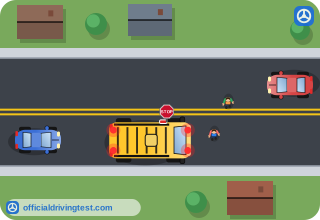
- As soon as the school children are out of sight
- When the bus driver signals for you to go ahead
- When no children are visible anywhere near the road
- When the bus moves again or the red lamps stop flashing
Show answer
Correct answer: When the bus moves again or the red lamps stop flashing
Drivers shall not proceed until the school bus resumes motion or the flashing red signal lamps are turned off.
Source: Hawaii Driver's Manual (2023), page 96 · Open this page in the manual (Manual page 96)
-
According to the manual, how much can failing to stop for a school bus with flashing red signal lamps cost you?
- $100
- $1,000
- $250
- $500
Show answer
Correct answer: $1,000
The manual states that failing to comply with the school bus law can cost you $1,000.
Source: Hawaii Driver's Manual (2023), page 96 · Open this page in the manual (Manual page 96)
-
A school bus has its red signal lamps flashing on a divided highway. What must drivers proceeding in the opposite direction do?
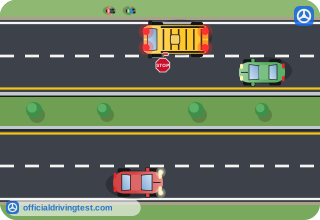
- They must stop before reaching the school bus
- They are not required to stop
- They must stop only if children are visible
- They must slow to 10 MPH and pass
Show answer
Correct answer: They are not required to stop
Vehicles proceeding in the opposite direction on a divided highway are not required to stop.
Source: Hawaii Driver's Manual (2023), page 96 · Open this page in the manual (Manual page 96)
-
How does the manual define a divided highway?
- A highway with a painted double yellow line in the center of it
- A highway that has a turn lane in the middle for left turns
- Any highway that has four or more traffic lanes in total
- Two roadways separated by land or other space not meant for vehicles
Show answer
Correct answer: Two roadways separated by land or other space not meant for vehicles
The manual defines a divided highway as two roadways separated by a strip of land or other space not intended for vehicular travel.
Source: Hawaii Driver's Manual (2023), page 96 · Open this page in the manual (Manual page 96)
-
In the morning, what does the presence of school children waiting along the roadway indicate?
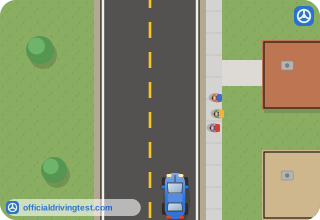
- A school bus is in the area
- A school crossing guard is on duty
- The road is a school zone with a lower speed limit
- The schools in the area are closed
Show answer
Correct answer: A school bus is in the area
The manual says school children waiting along the roadway in the morning indicate a school bus is in the area.
Source: Hawaii Driver's Manual (2023), page 96 · Open this page in the manual (Manual page 96)
-
How does the manual say bicycles are legally considered?
- As pedestrians, with all of the rights of persons walking on the road
- As vehicles, but with no responsibilities under the traffic laws
- As vehicles, with the same rights and responsibilities as other vehicles
- As a separate class that may ignore traffic signals and signs
Show answer
Correct answer: As vehicles, with the same rights and responsibilities as other vehicles
Bicycles are legally considered vehicles and have all of the rights and responsibilities that other vehicles have.
Source: Hawaii Driver's Manual (2023), page 97 · Open this page in the manual (Manual page 97)
-
Why does the manual say motorists should be extra alert for bicyclists?
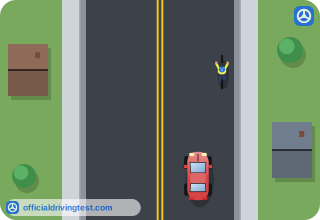
- Bicyclists are not permitted to use the roadway at all
- Bicyclists always ride faster than the traffic around them
- Bicyclists are exempt from obeying traffic signs and signals
- Bicyclists are often not as easy to see as other vehicles
Show answer
Correct answer: Bicyclists are often not as easy to see as other vehicles
Motorists should be extra alert because bicyclists are often not as easy to see as other vehicles.
Source: Hawaii Driver's Manual (2023), page 97 · Open this page in the manual (Manual page 97)
-
Which of these is a time when a bicyclist may legally move into the travel lane, according to the motorists' section?
- When riding in a group of bicyclists
- When preparing to make a left turn
- When riding downhill on a steep road
- When riding in the early evening hours
Show answer
Correct answer: When preparing to make a left turn
Bicyclists may move into the lane when preparing to make a left turn, passing another bicycle or avoiding an obstacle in the edge of the road.
Source: Hawaii Driver's Manual (2023), page 97 · Open this page in the manual (Manual page 97)
-
On what kind of road may bicyclists legally ride on the left-hand edge?
- A road with no bike lane
- A road with a speed limit under 25 MPH
- A one-way road
- A two-way road with a wide shoulder
Show answer
Correct answer: A one-way road
Bicyclists may legally ride on the left-hand edge of a one-way road.
Source: Hawaii Driver's Manual (2023), page 97 · Open this page in the manual (Manual page 97)
-
What does the manual say about bicyclists riding against traffic?
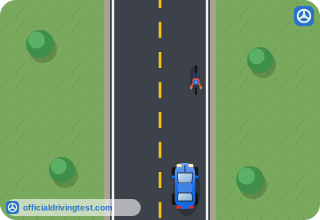
- It is illegal
- It is legal on short trips
- It is legal on roads with no sidewalk
- It is legal in a bike lane
Show answer
Correct answer: It is illegal
The manual states that it is illegal to ride against traffic, which is why drivers should look out for it, especially when turning.
Source: Hawaii Driver's Manual (2023), page 97 · Open this page in the manual (Manual page 97)
-
How much space should motorists maintain between the bicyclist and their vehicle until they have safely passed?
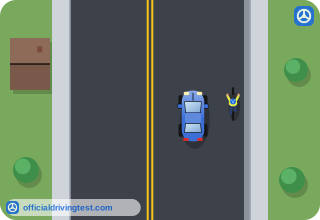
- At least 3 feet
- At least 1 foot
- At least 2 feet
- At least 4 feet
Show answer
Correct answer: At least 3 feet
Motorists should maintain at least 3 feet of space between the bicyclist and their vehicle until they have safely passed.
Source: Hawaii Driver's Manual (2023), page 97 · Open this page in the manual (Manual page 97)
-
According to the manual, what causes a significant number of crashes when a motorist passes a bicyclist?
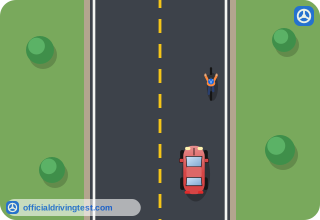
- Passing the bicyclist on the left side at a very high speed
- Sounding the horn while passing and startling the bicyclist into swerving
- Slowing and turning right immediately after passing, leaving too little space
- Staying behind the bicyclist for too long before passing them
Show answer
Correct answer: Slowing and turning right immediately after passing, leaving too little space
A significant number of crashes occur when a motorist passes a bicyclist and immediately slows down and turns right without leaving enough space.
Source: Hawaii Driver's Manual (2023), page 97 · Open this page in the manual (Manual page 97)
-
If you plan to make an immediate right turn and a bicyclist is ahead of you, what does the manual say is better?
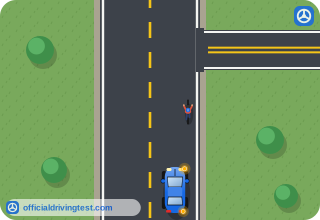
- To pass the bicyclist quickly before turning
- Not to pass the bicyclist
- To sound your horn and turn ahead of the bicyclist
- To drive in the bike lane until you turn
Show answer
Correct answer: Not to pass the bicyclist
The manual says that if you plan to make an immediate right turn, it is better not to pass the bicyclist.
Source: Hawaii Driver's Manual (2023), page 97 · Open this page in the manual (Manual page 97)
-
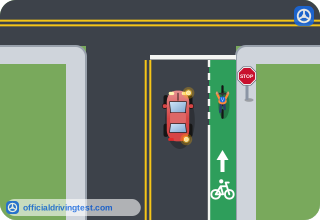
What should a driver do when crossing a bike lane while making a right turn at an intersection?
- Speed up to turn ahead of the bicyclists
- Sound the horn and then turn
- Move into the bike lane well before the intersection
- Look for and yield to bicyclists
Show answer
Correct answer: Look for and yield to bicyclists
The manual says to remain clear of bike lanes and to look for and yield to bicyclists when crossing them.
Source: Hawaii Driver's Manual (2023), page 97 · Open this page in the manual (Manual page 97)
-
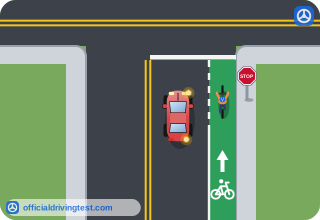
When should a driver look for overtaking bicyclists when making a right turn?
- Only when a bike lane is marked on the road ahead
- Only when a bicyclist is visible near your vehicle
- Every time, even when no bicyclist seems to be around
- Only when it is dark or when visibility is poor
Show answer
Correct answer: Every time, even when no bicyclist seems to be around
The manual says to train yourself to look for overtaking bicyclists every time you make a right turn, even when you think there is no bicyclist around.
Source: Hawaii Driver's Manual (2023), page 97 · Open this page in the manual (Manual page 97)
-
What does the manual say about opening a car door into moving traffic, including bicyclists?
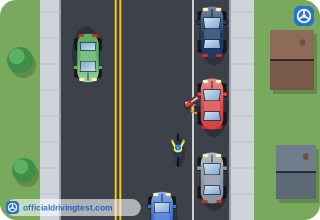
- It is a violation to open it unexpectedly and create a hazard
- It is allowed if the driver signals before opening it
- It is allowed if no vehicle is within 3 feet of the door
- It is a violation only when a bicyclist is actually hit
Show answer
Correct answer: It is a violation to open it unexpectedly and create a hazard
Opening a car door unexpectedly so as to create a hazard for moving traffic, including bicyclists, is a traffic violation.
Source: Hawaii Driver's Manual (2023), page 97 · Open this page in the manual (Manual page 97)
-
What does the manual say about bicyclists and traffic signs, signals and other traffic regulations?
- They are required to obey only the signals
- They are exempt when no vehicles are nearby
- They must obey them only on roads with bike lanes
- Like motorists, they are required to obey all of them
Show answer
Correct answer: Like motorists, they are required to obey all of them
Like motorists, bicyclists are required to obey all traffic signs, signals and other traffic regulations.
Source: Hawaii Driver's Manual (2023), page 97 · Open this page in the manual (Manual page 97)
-
When making a right turn, what do both motorists and bicyclists often forget to check, because they are searching for traffic coming from the left?
- Vehicles stopped directly behind them
- Pedestrians coming from their right
- Signs posted along the left side
- Bicyclists riding on the sidewalk
Show answer
Correct answer: Pedestrians coming from their right
Both are often so preoccupied with traffic from the left that they forget to check for pedestrians coming from their right.
Source: Hawaii Driver's Manual (2023), page 97 · Open this page in the manual (Manual page 97)
-
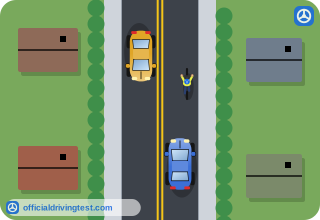
Under which condition may a bicyclist move into the travelway, according to the bicyclists' rules?
- When the bicyclist is carrying a passenger on the bicycle
- When the lane is too narrow for a bicycle and a car to safely share
- When there are no vehicles following behind the bicyclist
- When the bicyclist is riding downhill on a long steep road
Show answer
Correct answer: When the lane is too narrow for a bicycle and a car to safely share
Bicyclists may move into the travelway when making a left turn, avoiding hazards, moving the same speed as traffic or if the lane is too narrow to share safely.
Source: Hawaii Driver's Manual (2023), page 98 · Open this page in the manual (Manual page 98)
-
How must bicyclists ride on the roadway?
- Two abreast at all times
- Two abreast when no vehicle is behind them
- Three abreast if the road is wide
- Single file
Show answer
Correct answer: Single file
On the roadway, bicyclists must ride single file.
Source: Hawaii Driver's Manual (2023), page 98 · Open this page in the manual (Manual page 98)
-
Where may bicyclists ride two abreast, if it is wide enough not to impede traffic?
- On a bicycle lane or path
- On any roadway with a shoulder
- On a sidewalk in a business district
- On a one-way road
Show answer
Correct answer: On a bicycle lane or path
Bicyclists may ride two abreast on a bicycle lane or path if it is wide enough not to impede traffic.
Source: Hawaii Driver's Manual (2023), page 98 · Open this page in the manual (Manual page 98)
-
What penalties apply to bicyclists caught violating traffic laws?
- Lighter penalties than drivers
- No penalties, only warnings
- The same penalties as drivers
- Penalties only if a crash occurs
Show answer
Correct answer: The same penalties as drivers
Bicyclists caught violating traffic laws are subject to the same penalties as drivers.
Source: Hawaii Driver's Manual (2023), page 98 · Open this page in the manual (Manual page 98)
-
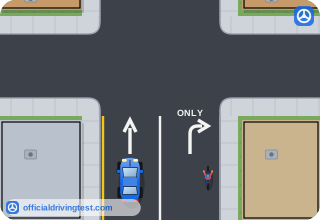
A bicyclist who is going straight through should do what with a right-turn-only lane?
- Stay in it and signal
- Use it to pass vehicles on the right
- Ride in it only at night
- Move out of it
Show answer
Correct answer: Move out of it
The manual says to follow lane markings and to move out of a right-turn-only lane if you are going straight through.
Source: Hawaii Driver's Manual (2023), page 98 · Open this page in the manual (Manual page 98)
-
What must a bicycle have if it is ridden at night?
- A rear light and pedal reflectors
- A headlight and a rear reflector
- A headlight and a horn
- A rear reflector and a bell
Show answer
Correct answer: A headlight and a rear reflector
A bicyclist riding at night must have a headlight and rear reflector; a rear light and pedal reflectors are only recommended.
Source: Hawaii Driver's Manual (2023), page 98 · Open this page in the manual (Manual page 98)
-
When may a bicyclist carry passengers?
- Whenever the passenger sits behind the rider
- Whenever the passenger wears a helmet
- Only when the bicycle is equipped to do so
- Only on roads with a bike lane
Show answer
Correct answer: Only when the bicycle is equipped to do so
The manual says not to carry passengers unless the bicycle is equipped to do so.
Source: Hawaii Driver's Manual (2023), page 98 · Open this page in the manual (Manual page 98)
-
Where are bicycles not allowed to ride on the sidewalk?
- In business districts
- In residential areas
- Near schools
- Along parks
Show answer
Correct answer: In business districts
Bicycles are not allowed to ride on the sidewalk in business districts; in other areas they may if they stay at 10 MPH or less and yield to pedestrians.
Source: Hawaii Driver's Manual (2023), page 98 · Open this page in the manual (Manual page 98)
-
Where sidewalk riding is permitted, what is the maximum speed for a bicyclist?
- 10 MPH
- 5 MPH
- 15 MPH
- 20 MPH
Show answer
Correct answer: 10 MPH
In areas where sidewalk riding is allowed, bicyclists must stay at 10 MPH or less.
Source: Hawaii Driver's Manual (2023), page 98 · Open this page in the manual (Manual page 98)
-
What does the manual advise about wearing a bicycle helmet?
- Wear one only when you are riding fast or a long way from home
- Wear one every time you ride, even if the law does not require it
- Wear one only when you are riding at night or in the rain
- Wear one only in places where the law requires it of you
Show answer
Correct answer: Wear one every time you ride, even if the law does not require it
The manual says to wear a bicycle helmet every time you ride; although it may not be required by law, it is a good idea.
Source: Hawaii Driver's Manual (2023), page 98 · Open this page in the manual (Manual page 98)
-
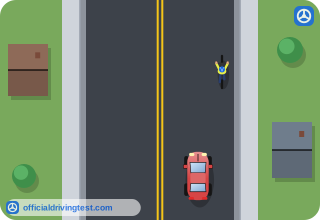
What does the manual mean when it tells bicyclists to be predictable?
- Ride only at the same time and place every day so drivers expect you
- Ride in the center of the travel lane at all times, on every road
- Always ride closely behind another bicyclist to be more visible
- Do nothing that would surprise drivers, such as swerving in and out of traffic
Show answer
Correct answer: Do nothing that would surprise drivers, such as swerving in and out of traffic
Bicyclists should not do anything that would surprise drivers, such as swerving in and out of parked cars or traffic.
Source: Hawaii Driver's Manual (2023), page 98 · Open this page in the manual (Manual page 98)
-
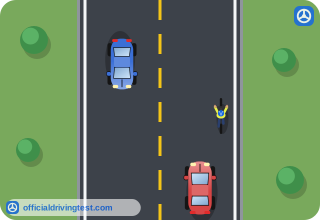
Before making a left turn or moving into the travelway, what should a bicyclist do?
- Speed up to cross ahead of traffic
- Ride onto the sidewalk first
- Look behind to make sure it is clear
- Watch only the vehicles ahead
Show answer
Correct answer: Look behind to make sure it is clear
Bicyclists should look behind them and make sure it is clear before making a left turn or moving into the travelway.
Source: Hawaii Driver's Manual (2023), page 98 · Open this page in the manual (Manual page 98)
-
How close to parked cars should a bicyclist ride, according to the manual?
- Leave at least 3 feet, in case a driver suddenly opens a door
- Leave at least 1 foot so that cars can still pass you
- Ride close enough to touch the parked cars on your right
- Leave at least 6 feet from parked cars at all times
Show answer
Correct answer: Leave at least 3 feet, in case a driver suddenly opens a door
Bicyclists should leave at least 3 feet from parked cars so they won't be hit if a driver suddenly opens the door.
Source: Hawaii Driver's Manual (2023), page 98 · Open this page in the manual (Manual page 98)
-
Why does the manual tell bicyclists not to wear headphones?
- Headphones are illegal for all bicyclists on public roads
- Headphones can slip off and tangle in the wheels or chain
- Headphones make bicycle helmets fit poorly on the head
- They need to hear the traffic around them and stay alert
Show answer
Correct answer: They need to hear the traffic around them and stay alert
Bicyclists need to hear the traffic around them and be alert to what is going on.
Source: Hawaii Driver's Manual (2023), page 98 · Open this page in the manual (Manual page 98)
-
Before riding, what should a bicyclist make sure about the seat and handlebars?
- That they are loose enough to adjust while riding
- That they are tight
- That they are set as high as possible
- That they are covered with padding
Show answer
Correct answer: That they are tight
The manual says to make sure the brakes work, the seat and handlebars are tight and the tires are properly inflated.
Source: Hawaii Driver's Manual (2023), page 98 · Open this page in the manual (Manual page 98)
-
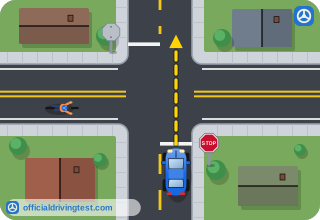
What should a bicyclist not assume about drivers, even after making eye contact?
- That the drivers will use turn signals
- That the drivers see the bicyclist
- That the drivers are driving slowly
- That the drivers know the traffic laws
Show answer
Correct answer: That the drivers see the bicyclist
The manual says not to assume that drivers see you, even if you make eye contact, and to elicit a response from the driver.
Source: Hawaii Driver's Manual (2023), page 98 · Open this page in the manual (Manual page 98)
-
What color of clothes does the manual say a bicyclist should wear to be visible?
- Dark-colored clothes
- Gray clothes
- Clothes of any color
- Bright-colored clothes
Show answer
Correct answer: Bright-colored clothes
To be visible, bicyclists should wear bright-colored clothes when they ride.
Source: Hawaii Driver's Manual (2023), page 98 · Open this page in the manual (Manual page 98)
-
Besides turning like a motor vehicle, how else may a bicyclist choose to turn left, according to the manual?
- Ride to the crosswalk, walk the bicycle across and continue riding
- Ride across the intersection on the sidewalk without slowing down
- Turn from the right edge of the road without signaling
- Wait in the right lane until traffic clears and turn from there
Show answer
Correct answer: Ride to the crosswalk, walk the bicycle across and continue riding
Others may cross like a pedestrian: ride to the crosswalk, walk their bicycle across the intersection, then continue riding.
Source: Hawaii Driver's Manual (2023), page 98 · Open this page in the manual (Manual page 98)
-
What does the manual say about passing vehicles on the right when riding a bicycle?
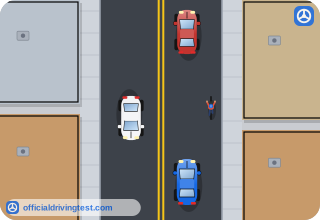
- Do it only when the vehicles are stopped at a red light
- Do it only on one-way roads
- Don't do it, because drivers may not expect or see you
- Do it when the lane is wide enough
Show answer
Correct answer: Don't do it, because drivers may not expect or see you
Bicyclists should not pass vehicles on the right because drivers may not expect or see them; when stopped in traffic it is safer to take your place in line.
Source: Hawaii Driver's Manual (2023), page 98 · Open this page in the manual (Manual page 98)