Hawaii: Sharing the road — Part 2 Practice Test
Questions in this part include: “To whom must drivers of large vehicles give proper consideration?” · “How do large vehicles accelerate compared with other vehicles?”
Independent educational site · not affiliated with any government agency or DMV
Ready? Test yourself
- Instant feedback with an explanation
- Every answer cites its source in the manual
- Your best score is saved on this device
Questions are original and based on the official manual "Hawaii Driver's Manual" (2023), Hawaii Department of Transportation.
All 18 questions in this practice test
Take the test above first, then use this list to study. Tap “Show answer” to see the correct answer and explanation.
Show the questions and answersHide the questions
-
To whom must drivers of large vehicles give proper consideration?
- Only the passengers and cargo that they carry
- Other highway users, their passengers and their cargo
- Only other drivers of large vehicles on the highway
- Only pedestrians and bicyclists using the road
Show answer
Correct answer: Other highway users, their passengers and their cargo
Drivers must recognize their responsibility to give proper consideration to other highway users as well as to their passengers and cargo.
Source: Hawaii Driver's Manual (2023), page 85 · Open this page in the manual (Manual page 85)
-
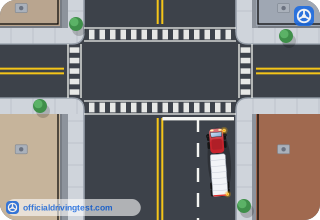
What should other drivers and highway users do to help a large vehicle driver make maneuvers safely?
- Stay close alongside the vehicle
- Follow as closely as possible behind it
- Speed up to pass it during the turn
- Allow the driver additional space
Show answer
Correct answer: Allow the driver additional space
Other drivers and highway users should allow the large vehicle driver additional space to make the maneuvers safely.
Source: Hawaii Driver's Manual (2023), page 86 · Open this page in the manual (Manual page 86)
-
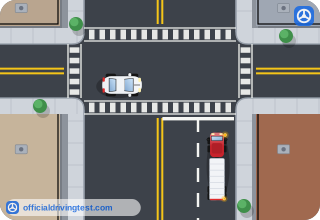
How much space do large vehicles require for turning movements?
- More space
- Less space
- The same space
- No extra space
Show answer
Correct answer: More space
The manual states that large vehicles require more space for turning movements.
Source: Hawaii Driver's Manual (2023), page 86 · Open this page in the manual (Manual page 86)
-
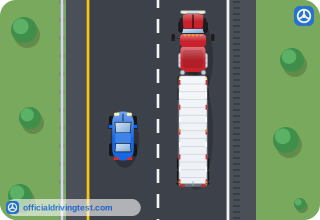
Where should other drivers stay when they are near a large vehicle?
- Close behind it, where it shields them from other traffic
- Beside its rear wheels, where it cannot hit them
- In a location where its driver can see them
- Wherever they can pass it the fastest
Show answer
Correct answer: In a location where its driver can see them
Drivers of other vehicles should remain where they can be seen by the driver of the large vehicle and where their view of other traffic is not blocked.
Source: Hawaii Driver's Manual (2023), page 86 · Open this page in the manual (Manual page 86)
-
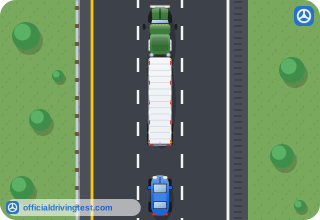
How do the stopping distances of large vehicles compare with those of other vehicles?
- Shorter
- Greater
- The same
- Half as long
Show answer
Correct answer: Greater
Large vehicles require greater stopping distances than other vehicles.
Source: Hawaii Driver's Manual (2023), page 86 · Open this page in the manual (Manual page 86)
-
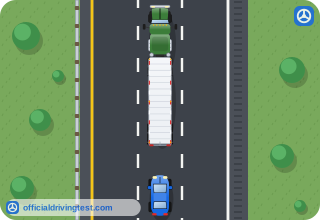
When must other drivers allow for the increased stopping distance of large vehicles?
- Only when driving downhill
- Only when it is raining
- Only when the large vehicle is loaded
- When changing lanes or at intersections
Show answer
Correct answer: When changing lanes or at intersections
When changing lanes or at intersections, other drivers and highway users must make allowances for the increased stopping distance required by large vehicles.
Source: Hawaii Driver's Manual (2023), page 86 · Open this page in the manual (Manual page 86)
-
How do large vehicles accelerate compared with other vehicles?
- Very slowly
- Very quickly
- At the same rate
- Slowly only uphill
Show answer
Correct answer: Very slowly
Large vehicles accelerate very slowly and cannot make maneuvers as quickly as other vehicles.
Source: Hawaii Driver's Manual (2023), page 86 · Open this page in the manual (Manual page 86)
-
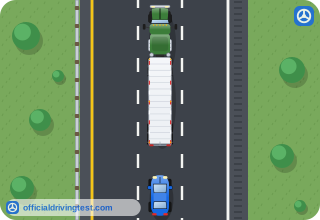
What should drivers be aware of about the speed of large vehicles?
- They always travel at the posted speed limit
- They travel faster than the posted limit on hills
- They are required to match the speed of traffic
- They may be travelling slower than the posted speed limit
Show answer
Correct answer: They may be travelling slower than the posted speed limit
Large vehicles may be travelling at a speed less than the posted speed limit, so drivers should use caution when approaching or passing.
Source: Hawaii Driver's Manual (2023), page 86 · Open this page in the manual (Manual page 86)
-
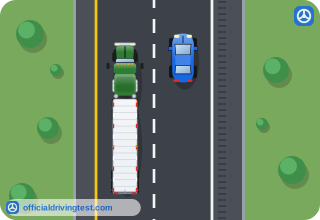
What should drivers of other vehicles do when a large vehicle is overtaking them?
- Be alert and move out of its way
- Speed up to keep it behind them
- Brake sharply to let it pass
- Hold their position beside it
Show answer
Correct answer: Be alert and move out of its way
The drivers of other vehicles should be alert to overtaking large vehicles and move out of their way.
Source: Hawaii Driver's Manual (2023), page 86 · Open this page in the manual (Manual page 86)
-
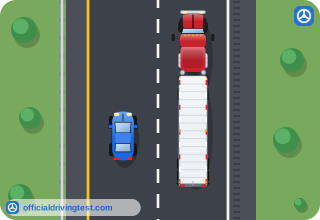
What should drivers of smaller vehicles be prepared to do when approaching or passing large vehicles moving at or near maximum speeds?
- Brake hard to avoid the wind gusts
- Sound the horn to warn the driver
- Take proper corrective steering action
- Speed up to leave the wind gusts behind
Show answer
Correct answer: Take proper corrective steering action
Large fast-moving vehicles cause wind gusts that can change the direction of smaller vehicles, so drivers should be ready to correct their steering.
Source: Hawaii Driver's Manual (2023), page 86 · Open this page in the manual (Manual page 86)
-
Who is responsible for making sure that hazardous materials are properly packaged and marked?
- Other drivers who share the road with it
- The drivers of the vehicles carrying them
- The emergency crews who respond to a crash
- The county examiner of drivers who licenses them
Show answer
Correct answer: The drivers of the vehicles carrying them
The manual says drivers of vehicles carrying dangerous materials are responsible for proper packaging and marking.
Source: Hawaii Driver's Manual (2023), page 86 · Open this page in the manual (Manual page 86)
-
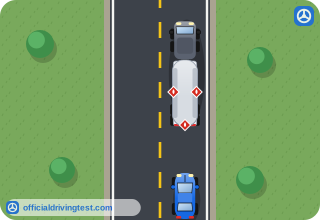
Why must a vehicle carrying hazardous materials be marked to indicate the type of material carried?
- So other drivers know it may travel below the speed limit
- So it can be identified at a safety inspection
- So it is allowed to use the left lane
- So proper protective action can be taken in case of a crash
Show answer
Correct answer: So proper protective action can be taken in case of a crash
The vehicle is marked so that proper protective action can be taken in case of a crash.
Source: Hawaii Driver's Manual (2023), page 86 · Open this page in the manual (Manual page 86)
-
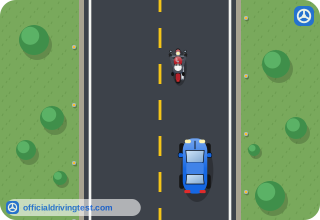
Compared with a car driver, how vulnerable to injury is a motorcyclist in a crash?
- Less vulnerable
- More vulnerable
- Equally vulnerable
- Not at risk of injury
Show answer
Correct answer: More vulnerable
Motorcyclists are more vulnerable to injury than a car driver if involved in a crash.
Source: Hawaii Driver's Manual (2023), page 89 · Open this page in the manual (Manual page 89)
-
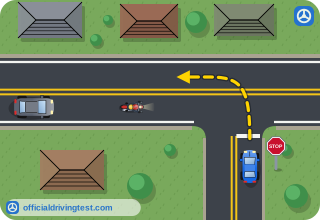
How may the small profile of a motorcycle make it appear?
- Closer and faster than it actually is
- Larger and louder than it actually is
- Wider and more stable than it actually is
- Farther away and slower than it actually is
Show answer
Correct answer: Farther away and slower than it actually is
The small profile may make a motorcycle appear farther away and travelling slower than it actually is.
Source: Hawaii Driver's Manual (2023), page 90 · Open this page in the manual (Manual page 90)
-
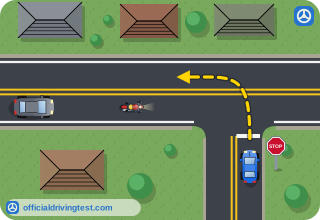
Because a motorcycle’s distance and speed are hard to judge, what do car drivers need to do?
- Take a second look, and then a third
- Follow it closely to measure its speed
- Assume it is travelling at the speed limit
- Use the horn to make it slow down
Show answer
Correct answer: Take a second look, and then a third
The manual says car drivers need to take a second look, and then a third.
Source: Hawaii Driver's Manual (2023), page 90 · Open this page in the manual (Manual page 90)
-
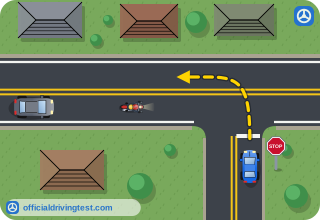
Compared with another car, how easy is a motorcycle to spot in traffic?
- Easier
- No different
- More difficult
- Easier at night
Show answer
Correct answer: More difficult
Its small size makes a motorcycle more difficult to spot in traffic than another car.
Source: Hawaii Driver's Manual (2023), page 90 · Open this page in the manual (Manual page 90)
-
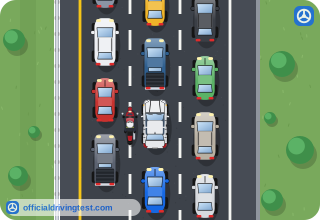
Some motorcycles use their small size to cut between cars. What should drivers be alert for?
- A motorcycle stopping at every intersection
- A motorcycle appearing unexpectedly
- A motorcycle staying far behind other traffic
- A motorcycle waiting for cars to turn first
Show answer
Correct answer: A motorcycle appearing unexpectedly
Motorcycles may cut between cars and be where drivers cannot see them, so be alert for one to appear unexpectedly.
Source: Hawaii Driver's Manual (2023), page 90 · Open this page in the manual (Manual page 90)
-
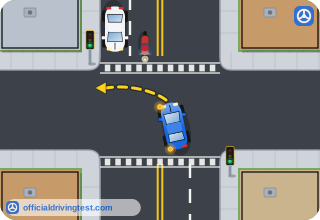
What should you make sure of before you start to turn or enter an intersection?
- That the motorcycle’s turn signal is not flashing
- That the motorcycle is behind a larger vehicle
- That the motorcycle’s rider is wearing a helmet
- That you see the motorcycle and know its speed
Show answer
Correct answer: That you see the motorcycle and know its speed
The manual says to make sure you see the motorcycle and know its speed before you start to turn or enter an intersection.
Source: Hawaii Driver's Manual (2023), page 90 · Open this page in the manual (Manual page 90)